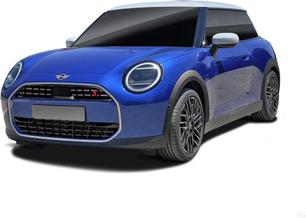
What's the difference?
Can it be possible that, between 1959 and 2023, there have only been four distinct generations of Mini?
Besides the 1959 British Motor Corporation (BMC) original, it’s just been a trio of hatchback versions under BMW stewardship – the R50 of 2001, 2006’s R56 and the 2014 F56.
Now, in 2024, that number has suddenly jumped to six.
The F56 has morphed into the lightly restyled and solely petrol-powered F66 Cooper range in F66 three-door (3DR) and coming F65 five-door (5DR) hatchback guises like before.
Meanwhile, the completely new and electric-only J01 Cooper 3DR joins the fold, along with its J05 Aceman 5DR crossover spin-off.
Despite their shared name and similar styling inside and out, the British-built Cooper and electric Cooper from China are two different cars. You can read all about the latter in another review, as this is about the petrol-powered Cooper range.
More of a thorough makeover and less of a total redesign, has it changed enough? Let’s find out.
Cub Campers is Australia’s oldest camper-trailer manufacturer and one of the oldest businesses in the caravan and camping industry, having just celebrated 50 years of operation in 2018.
The company can lay claim to inventing the soft-floor camper trailer, pioneering the rear-fold and championing off-road campers when everyone else was concerned with the on-road market. Amongst all that, though, it was late to the game when it comes to forward-fold campers, not releasing the Frontier until early in 2016, well after the flood of Chinese manufactured versions became immensely popular. So why did Cub wait so long and was it worth it?
The new petrol Cooper range very gently evolves the upmarket Cool Britannia cliché BMW invented with the R50 back in 2001 and fostered with every iteration since.
More of the same, only slightly updated and just improved enough to justify trading the old one in. If this appeals to you, then go for it. This is the best petrol version yet. Probably.
But the Cooper’s real spark literally and metaphorically lies within the EV version.
Two very different Minis indeed.
Note: CarsGuide attended this event as a guest of the manufacturer, with meals provided.
All in all, the Frontier is the best forward-fold camper on the market, although it is also the most expensive. If you were making a buying decision purely based on features, you’d probably look elsewhere, but if you are prepared to pay a little more because this camper-trailer is Australian made, you get a very functional camper that’s easy to set up, reliable, strong and light.
The previous Mini 3DR featured a messy and quite overbearing dashboard design from 2013 that’s aged about as well as Robin Thicke’s videos from that year.
In contrast, the new model's is far simpler and less protruding, dramatically boosting the sense of space and light.
That said, all four occupants still sit low, with an upright windscreen ahead and beside high window sills. There’s an oversized, circular screen in the middle of a pared-back dash and a neat row of toggle switches below. It’s still pure Mini in theme.
As before, there’s enough space for even the tallest people up front, reflecting the British icon’s German packaging, with plenty of head and legroom, as well as ample width. It’s only when you jump from the EV to the petrol Cooper that you realise this feels noticeably narrower.
All Coopers regardless of fuel share the 240mm (9.4-inch) central OLED display. It might seem like visual overload at first glance, with so much going on, but after a brief period of familiarisation, the touchscreen becomes a cinch to decipher and navigate. The colour-coded driving modes, pleasingly slick screen swipe action and ultra-crisp graphics are especially noteworthy.
Revel, too, in the twist engine starter and toggle gear selector actions, that also save space and are super natural to operate. This is button-lite dashboard de-cluttering done right.
As with the previous model, the Mini’s driving position has you sitting upright, but it’s comfortable enough on the S’ sports seats we sampled this on, and everything is within reach. There’s sufficient storage. The ambient mood lighting is fun. And kudos for the deployment of animal-free materials. In fact, the Cooper’s fresh textures are quite remarkable.
We’re less fond of the glass roof with no sunlight block; there are blind spots due to the thick side pillars; and some of the lower-placed plastics do not seem $60K’s worth in a supermini this expensive.
Rear-seat access isn’t graceful, with a narrow aperture to squeeze past and a slow-moving electric seat to wait for, but that should surprise nobody given this car’s size. There’s enough space for two adults and not much else really. It’s pretty basic back there.
And even further back, Mini quotes just 210 litres VDA of luggage capacity, rising to 725L with the twin backrests dropped.
Don’t forget, though, that no spare wheel exists. Just an ever-fiddly tyre repair kit.
Meanwhile, at the other end of the Cooper…
The real appeal of a forward-fold camper-trailer is the internal configuration. Because the bed folds out over the front of the camper, the trailer body is configured with a wrap-around lounge and dinette area, that also converts into a bed. It brings a certain level of caravan comfort to a camper-trailer-sized package. Cub’s execution is quite good. The lounge is comfortable and the dinette table is highly adjustable up and down or around and around. It converts into a bed more simply than any other on the market I’ve seen.
The downside of the forward-fold concept is the quantity and access of storage. Very little of the internal storage is easy to get to, and in truth there’s very little of it. That’s what happens when you put a couch in a trailer, sorry. There are hatches under the seats, but even they are limited by the slide-out kitchen and battery box across the back, plus, they’re not as easy to get to as a drawer. It’s the same in every manufacturers version, though. However, the Frontier has one unique features that makes it stand out – a series of pigeon holes under the foot of the bed which provide the only easy-to-access internal storage in any forward-fold I’ve come across so far.
So far, similarities in design, packaging, dashboard presentation and suspension layout suggest that the electric Cooper and petrol Cooper would be like fraternal twins from behind the wheel.
But in reality, the petrol-powered Mini feels much the same as the previous model, whilst the EV is more akin to what we secretly wish the fantasy Tesla Model 1 would be like. From the future.
Now, we never had a chance to drive the Cooper C, but the closely-related (though larger and heavier) Countryman C sibling – complete with the same powertrain – proved to be a willing and feisty performer once on the go, after what seemed like protracted turbo and DCT lag.
Why the hell can’t Mini just offer manuals again?
The Cooper S, meanwhile, completely lived up to brand expectations, with the familiar, revvy snarl of BMW’s sophisticated 2.0-litre four-pot turbo providing punchy of throttle response and effortless cruising capability, though there’s still some initial acceleration hesitation.
Thankfully, the Mini’s steering is always alert, offering precision and agility by the bucketful, backed up a chassis that seems permanently glued to the road – even in the wet and wintry conditions we had to endure.
Yet, other than a ride quality that seemed better than any previous-gen Mini we’ve ever encountered and so genuinely surprised us, the Cooper S seemed a little… stale compared to the glorious SE EV we had just (reluctantly) surrendered.
A bit like having a favourite dish as leftovers for two nights in a row, it felt a bit passé in 2024, even when surrounded by that dazzling OLED dash and glitzy ambient lighting.
In every important metric – performance, handling, roadholding, ride quality, packaging and (particularly) refinement – the battery-powered Cooper is the more vibrant and alive option. And truer to the vision of the original’s creator, Alec Issigonis, as a result.
The Frontier is quite good under tow. Cub designed and manufactures its own coil-spring independent suspension and has paid quite close attention to the balance and dynamics of the trailer.
As it’s not overly heavy, it’s not a handful, even on the beach, and behind the Mitsubishi Triton I tested it with, it was barely a struggle. On the road, the camper is well behaved, easy to see over and around and because it’s not very long, it’s not very daunting.