What's the difference?
There’s nothing quite like the Mercedes-Benz GLB. It’s a smallish mid-size SUV with a third seating row (strictly for small children… ), it has a distinctive boxy shape, and for the second generation, you can have a mild-hybrid or fully-electric powertrain. It is the definition of versatile.
The previous GLB was petrol only and Mercedes also offered the similar looking EQB as part of its EQ electric sub-brand. The separate EV model strategy wasn’t working so the German carmaker followed rival BMW’s plan of simply offering electric versions of popular models. Hence the two powertrain options for the new GLB.
This time around Benz has sharpened up pricing, added a bunch of new tech, and developed a new vehicle architecture, while retaining what buyers loved about the original.
Is the new-gen GLB a success?
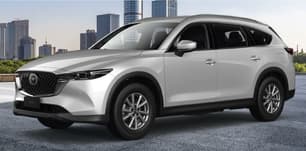
Mazda has a tendency to have a lot of similar looking horses in the stable; blink and you'll miss the (very) subtle differences between the CX-8 and the CX-9 but if you're not super keen on the bulk of the CX-9 and you've outgrown the space of the CX-5... this one's for you.
Especially, if you've been considering its competition - the Hyundai Santa Fe Elite CRDi AWD and Toyota Kluger GXL AWD. Both of which have become known for their features and space.
So, how does it compare? The CX-8 GT SP diesel all-wheel drive seats seven, has a decent boot space (albeit, when the third row isn't in use) and handles like a dream.
Perfect combination? Maybe. I've been driving it for the last week with my family to find out for you.
The new GLB is a worthy successor to the original. It has retained everything that made it such a unique proposition but improves where it counts - interior space and comfort, in-car and safety tech, standard features, powertrain, ride quality and, importantly, value-for-money.
The EV is the pick of the powertrains and while I didn’t get to drive it, the GLB250+ is the best value.
Servicing is expensive and the standard glass roof is a bugbear but if you can cope with those things, the boxy GLB is a terrific smallish family SUV.
So, what did my family think about the Mazda CX-8 GT SP diesel all-wheel drive? I love how it performs on the road - it's super easy to drive and you don't notice how large it is in a car park.
There are some great family-friendly features scattered throughout and I like how practical this is too with the extra seats and top-tether points. The multimedia system isn’t my favourite and I would have preferred to have seen a few extra airbags and a 360-degree view camera, but overall, it’s a good family car and gets an 8.0/10 from me.
My son loved the sun blinds and the cool colour of the seats. He also gives it an 8.0/10.
The original first-generation GLB was a standout when it comes to exterior design. It was boxy, upright and unlike anything else in the premium SUV segment. If you wanted a conventional Mercedes SUV you could opt for the smaller, bubble-shaped GLA or the larger, more sophisticated GLC.
But the GLB occupied its own space. Thankfully Benz has largely stuck with the script for the second-gen GLB, but they’ve modernised it.
Built on the new Mercedes Modular Architecture (MMA), the GLB is a full 98mm longer, has a 50mm longer wheelbase, is 27mm wider and 14mm shorter. And it does look noticeably lower to the ground compared to the old model.
While the square silhouette remains, Benz’s latest design direction is seen everywhere. The front end is more rounded now and has a large gaping low-set grille with an LED light bar running the width of the bonnet. It’s an acquired taste but I prefer the previous GLB face.
The rear is a much better angle for the GLB. Looking at it directly from the rear, it has pronounced shoulders that give it a lovely muscular look, and the curved tail-lights are a highlight.
Benz is leaning into its brand in a bid to stand out in an increasingly competitive global market. It’s doing this by using the iconic three-pointed star as a motif in the head and tail-light cluster, as well as the grille which is illuminated for some grades. I’m not sold on that element as it feels a bit over the top, but at least you won’t get confused about what brand of car it is.
Another design element I’m not sold on is the pop-out door handles. With car companies finding better solutions for handles, this seems out of touch.
Inside, everything feels upright. The integrated glass dash panel spans the width of the cabin, while brushed aluminium panels also feature. The signature Benz seat adjuster switches on the doors and the gorgeous air vent design have been upgraded successfully.
The three-spoke leather steering wheel in the GLB350 is a highlight - it’s the perfect width and well executed.
Overall the design is modern, tech focussed and very Benz.
To be honest, I can't really tell the CX-8 and CX-9 apart on the road. They're both large SUVs that sport the classic Mazda bonnet - sharp and long. Up close, the CX-9 has a bulkier shape but otherwise they are remarkably similar.
The CX-8's darkened grille generates some interest with its lattice-work and there are enough shiny chrome accents scattered about the car that it looks pretty.
Yet, the sporty sharpness that Mazda is known for is still hinted at with its shaping and the 19-inch black alloy wheels.
Our model is finished in 'Platinum Quartz Metallic' and it is the highlight for the exterior styling for me. I think because it's such an interesting colour to look at - it varies a lot depending on lighting conditions. Sometimes, it almost has a sheen of pink to it and at others, it looks like pearly sand.
The interior looks polished and refined with its burgundy leather trim and soft-touchpoints. Again, there is a lot of chrome inside to make otherwise dull features, like air vents, pop out.
The extra length and width means more cabin space which is more apparent in the rear. But there is ample space up front, especially headroom.
The centre console sits up a little too high for my liking but it means you have under console storage with two USB-C ports, and a rubber mat so your phone doesn’t slide around.
It’s got a really deep central bin, while door cavities will only hold smaller bottles. You also get a wireless charger and two cupholders.
There is only a handful of buttons - hazard lights, volume, voice command and drive mode selection - under the central air vents. All other functions are found in the multimedia screen.
Benz has been a standout in the past decade with its MBUX multimedia system and the latest version is responsive, relatively easy to navigate (once you’ve located the key controls), and the graphics look super sharp and cool. The digital instrument cluster is similarly excellent.
Hopping into the second row, the seat base is set higher than the front seats for stadium seating. The seats have some bolstering but quite a lot of lumbar support.
There’s ample space in the second row, thanks to 68mm more space from the back of the seat to the front seat and an extra 34mm of headroom compared to the old car. I have ample knee, head and legroom behind my 183cm (six-foot) tall driving position, although my head is about the same height as the top of the window frame which impedes a little.
Amenities include smallish map pockets, two USB-C ports and knee-level air vents, which is always good to see. There’s a deep but skinny bottle holder on either side and a fold-down centre armrest that sits up a bit too high but it’s wide and has two shallow cupholders and a neat little phone holder.
Each of the 40/20/40 split seats folds via a pull strap at the seat base and the good news is you can adjust the second row backrest a little. The base is also on rails so it can slide fore and aft.
That is how you lower the seats to get into the third row, which is strictly for children. Benz has made it slightly easier for littlies to get back there but it is not a space for taller humans. In fact, Benz recommends up to 171cm tall at most.
One gripe is that there is no sunshade or blind for the massive standard panoramic fixed glass roof. Benz says it is tinted and has a film to reduce UV light and heat, but I’d say a few hours driving in Australian summer will challenge that. Benz isn’t the only brand doing this, but at least you can buy an accessory blind for your Polestar or Tesla. The fact is, not everyone wants a glass roof, especially in Australia, so this feature should be an option.
The boot can swallow 145 litres with all three rows up, increasing to 480L with the third row stowed and 1605L will all seats lowered. This is all decent for a smallish seven seater but if boot space is a priority then maybe have a look at a GLC.
There’s a floor mat and cargo blind but sadly no spare wheel of any kind, just a tyre repair kit, which isn’t great.
The CX-8 is a very practical family hauler because there's ample room in all three rows. Yes, even adults will be able to squeeze into that third row without too many complaints!
All rows enjoy well-cushioned seats and up front they are electrically adjustable, but unfortunately, only the driver's side has lumbar support.
The middle row can slide forward manually or by using the electric button found on the side of the seats... but doing it yourself is way faster.
They do slide far enough forward that you won't embarrass yourself too much when you have to clamber into the third row. Where the seats have a 50/50 split-fold and manual adjustments (accessed via the boot).
In the first two rows there are lots of individual storage options but the front enjoys the most. The middle console is deep enough to be useful and I like the dual opening lid. Each row gets a couple of cupholders and drink bottle holders, too.
The charging options are great, with each row getting two USB-C ports and the front getting a wireless charging pad and 12-volt socket.
All of the controls and dials feel within easy reach and the 10.25-inch touchscreen multimedia system graphics are clear.
You can use it as a touchscreen or opt for the rotary dial but switching between the two was awkward for me. Especially, since the touchscreen function is disabled when you are using the wireless Apple CarPlay. This also has wired Android Auto, for those users.
The amenities are practical throughout with a dark headliner, three-zone climate control and heated outboard seats and retractable sun-blinds in the middle row.
Good news for families because there are five top-tether points across the back rows and ISOFIX child seat mounts on the outboard seats in middle row, in case you need them.
You can fit a 0-4 rearward facing child seat and it shouldn’t impact on front passenger comfort.
My six-year old found it super easy to get in and out of this car because of the 205mm ground clearance and wide door apertures. He enjoyed the high seating position, too, but was disappointed he couldn’t see out of the sunroof!
The boot space is a bit cramped with all three rows are in use at 209L but folding the third row opens up a more respectable 775L - perfect for the average family and its stuff!
The loading space is level, with the temporary spare tyre and clever storage compartments housed underneath. There is a retractable cargo blind and net, luggage anchor points and a 12-volt port, too.
And, as always, I love a powered tailgate, which this has!
The 2026 GLB line-up includes two mild-hybrid and two EV model grades, for now. We can probably expect a spicier AMG version down the track.
Things kick off with the GLB200 front-wheel drive mild-hybrid at $65,400, before on-road costs. This is $2200 cheaper than the previous 200.
Next up is the GLB220 4Matic, which is Benz speak for all-wheel drive. That costs $76,100.
The most affordable EV is the rear-wheel drive GLB250+ at $74,990 which is about $10,000 more than the base hybrid. It’s also about $14,000 more affordable than the previous equivalent EQB grade. Clearly Mercedes has seen the shift in the market and adjusted its prices accordingly.
The range tops out with the GLB350 4Matic at $86,200.
It’s tricky to compare the GLB to other mid-size SUVs as it occupies a fairly rare space given its boxy shape, two powertrain options and seven-seat layout.
A base BMW X3 mild-hybrid is $20,000 pricier than the entry GLB, while Volvo’s EX60 EV will start from $87,000. But they only have five seats each.
Interestingly, a Tesla Model Y L with six seats is $74,900 - just $90 cheaper than the GLB250+. You could argue, however, that Tesla is not a premium brand.
Standard gear in the GLB200 includes:
Step up to the GLB220 4Matic and you’ll also get:
The GLB250+ EV comes with everything you get in the two mild-hybrid grades but also gets a seven-metre home/public charging cable.
The flagship GLB350 4Matic gains the Terrain mode and transparent bonnet of the other 4Matic grade, as well as a second motor and a bump in power and torque.
The tech offering is very impressive and makes up the majority of the standard features list. It’s an extensive list and there’s a lot more when it comes to safety features (see the Safety section). Thankfully Benz no longer offers stripped-out, bare-bones base grades. You could even suggest the GLB offers decent value-for-money. Who would’ve thought?
Being a Benz there are a few options packs including AMG Line for the base grade and a $4000 Premium Plus Package with Digital extras.
The GT SP diesel AWD is one of the premium models, sitting third from the top and will cost you $65,560, before on road costs.
However, its price tag positions it as the most expensive compared to its rivals. With the closest rival being the Kluger at $65,310 and the most affordable being the Santa Fe at $60,000.
You do get a stylish-looking package with lots of features for your cash, like heated front seats, heated rear outboard seats, a tilt and slide sunroof, and premium leather interior trim.
There's some great tech scattered throughout, too, like the 10.25-inch touchscreen multimedia system, wireless charging pad, USB-A ports in the third row, Bose Premium sound system with 10 speakers, wireless Apple CarPlay and wired Android Auto.