What's the difference?
Buuuuuuuur, parp, buuuuuuuuuuuur, parp. Anyone who knows anything about cars immediately recognises the sound of a 45-engined A-class derivative. It's the sound you hear in a tunnel as old mate blasts past with a giant carbon-fibre wing atop his hatchback. It's the sound you hear at 3:00am on a summer morning (if your suburb has no speed bumps, of course).
In short, that sound means big power from a 2.0-litre turbocharged engine, a seven-speed transmission, and a bunch of Germans who clearly had a sense of humour in charge of tuning the exhaust note.
Sure, the GLA compact SUV is probably a slightly unexpected source of all that noise. But then, Merc's Ingolstadt rivals stuffed Audi's stupendous five-cylinder engine into a Q3 to make the hugely improbable RSQ3, so why not do the same with their skirts-lifted A-Class?
To be honest, my expectations for this car were low. So do I owe Mercedes a grovelling apology? Or can I still claim the moral high ground after a week of GLA 45 "ownership"?
Mazda calls the new CX-70 its "flagship" five-seat SUV, which also makes it yet another flag-bearer for the brands relentless push up market as part of its 'Mazda Premium' strategy.
It might have a different badge, but it's really a five-seat version of the brand's biggest and most expensive offering, the seven-seat CX-90.
And, for reasons that will become clear in a moment, it's something of a bargain, at least in the context of Mazda's plush large SUV range.
How so, you ask? Read on.
My wonderful wife, who is not really into this kind of car, admitted to me in a quiet voice that she really liked the GLA45 as long as it was in Sport + mode. And I have to agree. While I'm very fond of the ridiculous Audi RSQ3 (that turbo five-cylinder sounds amazing), I think I'd stump up the extra for the GLA.
Importantly, it can be comfortable, it can be quiet and it's a better fit for most humans than the A or CLA. It is getting on a bit and could do with a further clean-out of the poor ergonomics, but in what is likely its final year on sale, it's still a belter.
For mine, the CX-70 is the pick of Mazda's premium SUV range, and if you can survive without a third row of seats, it's significantly cheaper than its CX-90 twin, too.
Note: CarsGuide attended this event as a guest of the manufacturer, with travel, accommodation and meals provided.
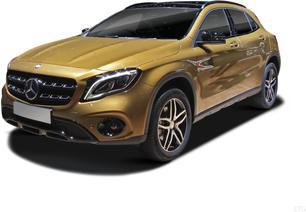
The GLA45 isn't a looker, but then, none of the GLAs are. There's a certain blobbiness to it. A bit of Teletubby mixed with...um, another Teletubby. It's not ugly, it's just not particularly attractive. The 20-inch wheels do much to lift the appearance and negate the effect of the raised ride height compared to the A45/CLA45.
The body kit stops just short of lairy, which is heartening. So if you want to stand out, venture out into the aftermarket world.
Inside was a mild surprise. The last time I drove a CLA 45 I used the word "gaudy". While the GLA isn't amazingly better, the texture of the Alcantara replacing the brushed metal-look plastic, or the carbon of the option pack, was much more pleasant. The brightwork in the cabin is still a bit odd looking, and it's still overcooked with its red detailing, but it is an otherwise beautifully built and well-detailed interior.
Yes, the Mazda premium SUV range can look a little same-same, but Mazda insists there are critical differences.
That said, if you can immediately spot the difference between the CX-70 and CX-90 without taking a peek inside, you're doing better than me, given it is the same exact dimensions as Mazda's three-row flagship.
Sure, Mazda talks about things like this design being a “passion pursuer” that serves up "dignified performance” – all of which sounds utterly ridiculous – but the less marketing-speak version is that it looks like a shapely large SUV that ditches the boxy dimensions of a proper 4WD for a more sleek and swooping profile.
Inside, it's a plush and premium-feeling space, with lovely cabin materials, plenty of tech, and plenty of space.
The front seats are utterly brilliant and feel as good as they look. On first acquaintance they may feel under-padded, but once you've adjusted them to your liking, you never want to leave. The AMG cars also feature one vast improvement over a normal GLA - the ergonomic disaster of a column-mounted shifter is removed, with a console-mounted shifter added where a small cubby once lived. It's so much better, although the Park button is oddly difficult to press.
When luxuriating in those snug front seats, you'll have access to two cupholders and door-mounted bottle holders, as well as a console bin (where the USB ports are) and a tray under the climate controls. Rear seat passengers will find legroom tight but headroom good, even with the huge sunroof.
The GLA's boot holds an entirely reasonable 421 litres, rising to 1235 when you drop both rear seats.
The CX-70 measures a substantial 5120mm long, 1994mm wide, and 1745mm tall, and it rides on a 3120mm wheelbase.
It will tow 2.5 tonnes no matter which engine you choose, and the expansive boot will swallow between 589 litres and 2015 litres, depending on how you configure the backseat.
All of that space translates to a hugely airy backseat experience, with the second row able to be fixed in a position that either prioritises leg room or boot space.
With the former, you've got tons of space in the second row. I'm 175cm, and my knee and leg room was ample, with only the intrusive tunnel that runs down the middle-centre of the cabin eating into leg room for the middle passenger.
There are also air vents and temp controls, twin USB charge ports, seat heating in the window seats and swathes of very nice materials.
The boot is massive, too. I can't even reach the back of the rear seats when I lean into it, and Mazda says it will swallow smaller surfboard or SUPs without needing to resort to roof racks.
Under-floor storage adds a bit more security for precious items, too.
The GLA 45 lightens your wallet by no less than $89,211 - more than double the GLA 180 front-wheel drive, and about $5000 more than the bonkers (and ancient) RS Q3.
Packed into the GLA's kit bag are 20-inch alloy wheels, a 12-speaker stereo, dual-zone climate control, comprehensive safety gear, reversing camera, keyless entry and start, front and rear parking sensors, electric and heated front seats, sat nav, auto LED headlights, auto wipers, leather trim (some real, some not), auto parking, powered and heated folding mirrors, a massive sunroof and dynamic dampers. There's no spare tyre, just a tyre-repair kit.
The multimedia system is Mercedes' COMAND unit and it is as user-unfriendly as ever. It does, however, power a very decent stereo, and also offers Apple CarPlay and Android Auto.
Thankfully our car was bereft of both the carbon-fibre package ($990) and the aerodynamics package ($1990).
We'll drill down on this a little more in the practicality section, but it's important to note here that the CX-70 is the same size as the CX-90 – both are 5120mm long, 1994mm wide and 1745mm high — which means the only real difference between the two models is the third row of seats in the CX-90.
And, as it turns out, that's a very expensive pair of chairs. The CX-70 starts with the GT trim at $75,970 before on-road costs for the petrol or $77,970 for the diesel, and then climbs to the Azami trim, which is $82,970 or $84,970.
The CX-90, though, is $82,577 or $85,785 for the GT, or $91,461 or $93,030 for the Azami.
That makes the CX-90's third row at least a $6600 option, but as much as an $8000 upgrade. Mazda has made moves to address this, with a drive-away "plate clearance" that closes that gap, but we suspect those offers will become permanent fixtures to make the jump from 70 to 90 less ferocious.
Anyway, Mazda has thrown just about everything they've got at the CX-70. The GT kicks off with plenty of high-end gear, including 21-inch black alloy wheels, adaptive LED headlights, a panoramic sunroof and a handsfree powered tailgate.
Inside, there are twin 12.3-inch screens with Apple CarPlay and Android Auto, a 12-speaker Bose stereo, leather seats that are heated front and rear, three-zone climate control and a heated steering wheel.
The Azami then adds things like ambient lighting, black Nappa leather seats, which are now ventilated in the front, footwell lighting, body-coloured wheel arches and lower cladding and body-coloured door handles.
AMG's fabled 2.0-litre turbo four lurks under that higher bonnet, still kicking out an improbable 280kW and 475Nm. Drive reaches the road via Merc's own seven-speed twin-clutch transmission and all four of its wheels.
All that power and grip translates to a 4.4-second dash to 100km/h for the slightly tubby (over 1600kg) GLA, but just between you and me, anything under five seconds feels scorchingly quick.
You can have one of two engines in the CX-70, with the cheapest being a 3.3-litre, six-cylinder turbo-petrol, producing 254kW and 500Nm. There's also a 3.3-litre, six-cylinder turbo-diesel, making 187kW and 550Nm. Both are equipped with a 48-volt mild hybrid system to marginally reduce fuel use.
All models are AWD, and pair with an eight-speed automatic transmission.
The official combined-cycle figure suggests the GLA45 will consume 7.5L/100km. Obviously that figure is largely irrelevant, and not just for the usual reasons, but because you don't buy a GLA45 to potter about in. I got, uh, 12.5L/100km, so you can imagine how much I was enjoying it.
As you might expect, you'll need to feed it 98RON.
Petrol-powered cars will sip 8.1L/100km on the combined cycle, while the diesel drops that to 5.4 litres.
Both models get a 74-litre tank, meaning a theoretical driving range of around 900kms in the petrol, and almost 1400kms in the diesel.
When the 45-badged cars first launched, they were something of a revelation. BMW's turbo six-cylinder fans sniffed at the 2.0-litre's staggering outputs and all-wheel-drive chassis, but this car really captured the imagination. The GLA45 might be slightly unexpected, but it's better in almost every way as a daily driver than the A or CLA.
For a start, its higher ride height seems to translate to a much better ride quality. Anything on 20-inch wheels should have an appalling ride, but the GLA45 manages to be firm yet comfortable. Put the other two in Race mode and you'll need to up your private health insurance extras to include osteo, physio and whatever "o"-ending specialist fixes your back.
The improved ride quality meant I was far happier to chuck this car around. While it doesn't have the same ultimate overall performance of the lower cars, it's far more comfortable whether you're on it or just driving around. The front seats are supportive and comfortable, and the steering is excellent.
As for the engine...well, it still farts like toddler during a moment of silence at a funeral, but you can't deny its technical brilliance and huge power outputs. I remember the CLA45's engine as being a bit highly strung. Perhaps I couldn't separate the overall high-strung nature of the car from the engine, but I felt the same engine in this car wasn't as jumpy.
The way it propels this car into triple figures is tremendous fun. It's not as charismatic as the Audi five-cylinder, perhaps, but that doesn't matter in the end - it's properly fast, attached to a better chassis and offers a cabin with a driving position fit for humans.
Interestingly, the CX-70 has been tagged as the expected smallest seller of Mazda's premium SUV range, but I reckon it just might be the pick of the bunch.
Every one of the CX-0 models (60, 70, 80 and 90) all get slightly different suspension tunes, and while you can find harsh edges in the other models, the CX-70 feels utterly composed and refined, at least on the smooth-ish roads of our launch test route.
Perhaps most surprising, though, is the CX-70's ability to hold its own on a properly twisting road. We expected lots of weight transfer and the high-pitched sounds of tyres screaming out in pain, but instead found Mazda's massive SUV served up grip, composure, and very little in the way of sea-swell-style body roll.
The two big six-cylinder engines also feel perfectly suited to a vehicle in this space. There's tons of power whenever you need it, and solid levels of refinement in terms of engine noise or diesel rattles.
For mine, the petrol engine is the pick though, feeing just a little smoother than the diesel option. The latter can feel a bit jerky at slower speeds, whether that's the power delivery or the gearbox, and it doesn't seem to happen with the petrol engine.
The biggest caveat, though, is that we haven't driven the CX-70 in its natural environment, the city and suburbs, so while it largely shone on flowing country roads, how it performs on roads like the ones near your place remains a bit of a mystery.
The GLA comes with nine airbags (including driver's knee), blind-spot sensors, lane-departure warning, lane-keep assist, forward-collision warning and mitigation and driver-attention detection.
The GLA does not have its own ANCAP rating, but the A-Class on which it is so heavily-based scored five stars in 2013.
The CX-70 hasn’t been ANCAP tested, but it does arrive with a pretty stacked safety offering, including a 360-degree-view camera, blind-spot monitoring, front and rear cross-traffic alert, and a total of eight airbags, including a knee airbag for the driver.
The Mercedes standard warranty is three years/unlimited kilometres with roadside assist to match. Service intervals are a very reasonable 12 months/20,000km.
The company also offers capped-price servicing - first service is $576 but the second and third are a whopping $1152 each. Three years will set you back $2880.
Servicing is not particularly cheap in the CX-70, and the service intervals, at least in the diesel, feel a little short, too.
Buy that one, and you’ll be visiting the dealership every 12 months or 10,000kms, and the first five years of ownership will cost you $3298.
Petrol cars require servicing every 12 months or 15,000kms, and five years will set you back $3436.
The CX-70 is also covered by Mazda's five-year, unlimited-kilometre warranty.