What's the difference?
Mercedes has long been the leader in niche filling, and we’d argue that no other model encapsulates that more than the CLA four-door coupe.
Now in its second-generation form, the CLA is based on Mercedes’ MFA2 small car platform that also underpins the A-Class small car range, B-Class tallboy hatchback and GLA crossover, but is actually dimensionally longer than the one-size up C-Class.
However, while the C-Class might offer more conventional styling, Mercedes says the CLA is targeted towards a younger demographic that puts more weight on design and aesthetics.
The previous generation CLA was topped by a hardcore 45 version, which makes a return here, but new this time around is the less-potent, but still AMG-badged, 35 variant to plug the gap between mainstream grades and the range-topper.
After living with the car for a week, here are our thoughts on the new baby AMG CLA.
Chery’s explosive growth in Australia has been thanks to its range of affordable SUVs in some of Australia’s most in-demand categories.
Lately the brand has been expanding into the most in-demand segment of them all - hybrids. To that end, the Tiggo 4 Hybrid seems to tick a lot of boxes.
It’s relatively affordable, looks modern and offers plenty of features. Plus, unlike other Chery hybrids, it’s not a plug-in.
However, to see why I found the Tiggo 4 Hybrid a little disappointing - read on.
Is the Mercedes-AMG CLA 35 the perfect choice in the sleek sedan’s line-up?
Well, if you are after outright performance, then the answer still clearly lies with the CLA 45. But for those that just want a little more pep compared to the standard CLA range, the 35 is undoubtedly the one to get.
It’s not without its flaws, though, commanding a $15,000 price premium over the CLA 250 and a tougher-than-we’d-like ride, but if you value a more engaging drive and a brisk 0-100km/h time, the CLA 35 should definitely be on your shopping list.
If you’re just looking for an affordable hybrid which will save you money at the pump, the Tiggo 4 will do the trick, but there are so many little things which could be better here, it’s evident you’re getting what you’re paying for.
This makes the Tiggo 4 hybrid a bit of a let down, because the other Cherys I’ve driven recently have been pleasantly surprising given their price-points, not to mention the price-gap between the Tiggo 4 and many of its rivals is nowhere near as large.
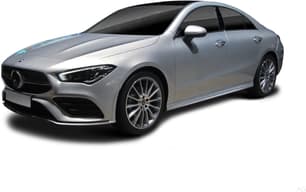
From the front, the CLA 35 exterior oozes style and luxury.
Up front, the sleek and slender headlights emphasise the width of the fascia, while the large Mercedes logo sits proudly front and centre of the CLA’s nose.
There are subtle hints to the CLA 35’s sportiness too, with a slightly bulging bonnet and chiselled lower chin.
The grille is also unique on the 35, with a dual-horizontal slat design instead of the non-AMG CLA’s diamond pattern or the CLA 45’s Panamericana grille.
To my eye, the front of the CLA 35 is actually a bit too tame in styling for an AMG model. I prefer the in-your-face aggression of the CLA 45’s widened track and front grille, while the CLA 35 opts for more subtle styling cues. To each their own, though.
The silver paintwork of our test car probably doesn’t help, and if it was my choice I'd pick 'Sun Yellow' or 'Denim Blue' to stand out a bit more from the sea of black, grey and white German cars out there.
Move to the rear of the car though, and a large rear diffuser, big dual-exhaust outlets and a bootlid spoiler are much more befitting an AMG model.
Step inside the CLA and you will see it adopts the same dashboard design as all new-generation Mercedes vehicles built on the MFA2 platform, with the 'MBUX' dual-screen layout, large air-vents and central touchpad.
Our car was specced out with red-leather interior, which is a bit too loud for my tastes, but a two-tone black leather/titanium grey combo can also be had at no extra cost.
Sitting inside the CLA 35, you can tell it’s a modern car thanks to the clean layout of all the controls, while the screen-heavy dashboard definitely makes it feel tech-focused.
On the outside, I think the Tiggo 4 Hybrid is pretty generic and inoffensive. It shares its 'box-on-wheels' aesthetic with cars like the outgoing Mitsubishi ASX and Hyundai Venue, which, to be fair, have been strong sellers.
It might not be an eye catcher, then, but there’s something to be said for not trying anything controversial, and this is pretty consistent across Chery’s range. In fact, compared to some brands in the market, Chery is doing a solid job of design consistency for its mainline SUVs.
Highlights on the outside include the enormous grille and contemporary LED light strip across the rear.
On the inside things also look pretty swish for this compact SUV category. The seats immediately jump out as a highlight, big and lavishly trimmed in comparatively soft synthetic stuff. The glitzy steering wheel and dual-screen layout continues from other Chery products and the dash design is tidy, if a little generic.
Measuring 4695mm long, 1834mm wide, 1399mm tall and with a 2729mm wheelbase, the CLA 35 is definitely a sizeable sedan in the metal.
This actually makes the CLA 35 slightly longer and wider than a non-AMG C-Class sedan that measures 4686 and 1810mm respectively, but don’t expect the same level of practical interior space.
With a heavily sloped roofline, rear-seat comfort takes a hit. My 183cm (6.0ft) frame could not sit upright behind my driving position without tilting my head, while legroom was also slightly lacking.
With such large C-pillars and a small rear window, the second-row can actually feel a little claustrophobic for full-sized adults, but will seat children quite comfortably.
Second-row amenities include air-vents, two USB-C ports, back-of-seat storage nets, bottle holders in the doors, and two cupholders in the fold-down arm rest.
Just like at a music concert though, the best seats in the CLA 35 are up front, with plenty of room for heads, shoulders and legs.
The cabin is also much more light-filled up front, making for a more pleasant experience.
The front seats are electronically adjustable, as is the steering column, but the headrests are fixed.
Storage options include sizeable door bins, a centre console cubby, glove box, two cupholders and a wireless smartphone charger.
Boot space is 460 litres, but can expand with the rear split-fold 40/20/40 rear seats stowed.
Though the boot looks small and shallow on the outside, the aperture is actually quite large, and can easily accommodate a large suitcase with plenty of room to spare.
I can see this car having a lot of wow factor on a dealer forecourt but up close things are less good. The software on the screens is pretty ordinary; hardly the sharpest, fastest or most logically laid-out. There’s a selection of clumsy-looking themes, and while the multimedia portion has a logical smartphone-style main menu, beneath lies an array of confusing and inconsistently-labelled sub-menus.
The digital dash could be smoother and better looking and it’s a bit confusing to use with the poorly labelled buttons on the steering wheel.
The centre console area is finished in a gloss finish, which is easy to scratch or smear with fingerprints. Up front underneath the main screen is an entirely separate dot-matrix style climate control panel with actual physical buttons. It looks a bit clunky compared to some other solutions on the market, but at least it’s clearly labelled and straightforward to use.
Somewhat infuriatingly, though, interacting with this climate panel brings up a menu on the touchscreen which you don’t need and it takes several seconds to go away. Why?
The cabin is reasonably practical from there, though. There are decent bottle holders in each front door and a further two atop the console. There’s a pass-through beneath, good for handbags and the like. There are some strange additions, like an upright holster with rubberised sides which seems to be for a phone, and behind the shifter there’s a key fob-sized cut-out, but it’s gloss finished, so it will scratch if you actually use it.
The wireless phone charger is tucked away underneath, which makes your phone hard to get at in a pinch, and easy to forget when you exit.
Ergonomically, this car is a bit strange. The seat base is very high, so for me (at 182cm tall) even with the driver’s seat set to its lowest position, my head feels close to the roof. Plus, I’m peering down on the instruments, rather than have them at a comfortable height.
However, there are soft-touch surfaces adorning the doors, which can’t be said for every car in this segment and the rear seat hasn’t been forgotten, either.
I fit pretty comfortably behind my own driving position in terms of knee and headroom and the plush seat trim continues.
There’s a nearly flat floor, so while it’s a reasonably narrow vehicle, at least someone in the centre position will have somewhere to put their feet.
On the amenity front for rear passengers, there’s a small bottle holder in each door, pockets on the backs of the front seats, a weird storage tray and USB port on the back of the centre console and a drop-down armrest with two shallow cupholders. There’s just a single adjustable air vent for rear passengers, so they’ll have to fight over who gets the airflow.
The boot surprised me. It looks tiny, but the brand claims it weighs in at 470 litres. On top of this, the floor is a strange shape because the 12-volt battery is under the floor and doesn’t quite fit level.
However, when I went to load the full three-piece CarsGuide test luggage set, I was surprised to find it fit snugly, with the tailgate able to shut without a problem. I was also impressed to find a space-saver spare wheel and not just a repair kit under the floor.
Priced at $85,500 before on-road costs, the CLA 35 sits $15,300 upstream of the CLA 250 but is $25,700 cheaper than the $111,200 CLA 45.
Standard equipment includes leather interior, dual-zone climate control, electronically adjustable front seats with heating and memory function, keyless entry and push-button start, 64-colour ambient lighting, and a wireless smartphone charger.
AMG specific appointments include 19-inch wheels, a flat-bottomed steering wheel, sports exhaust, high-performance brakes with silver-painted calipers, blacked-out exterior highlights, sports suspension, a racy bodykit and speed-sensitive steering.
Instrumentation is displayed on a 10.25-inch screen, which can be customised and features AMG readouts.
The multimedia system, which includes satellite navigation, digital radio and Apple CarPlay/Android Auto connectivity, is also outputted to a 10.25-inch screen, with inputs including touch, voice commands, centre touch pad or steering wheel controls.
Our test car also came with a ‘Mojave Silver Metallic’ paint finish and 'Vision Package', adding $1190 and $990 to the bottom line each.
The Vision Package adds LED headlights with adaptive high beams, a panoramic glass sunroof and surround-view monitor.
Straddling the lines between a small- and mid-size sedan, the CLA 35 doesn’t really have any direct competitors, which is reflected in its pricing that slots it between the Audi S3 and S4 sedans.
Though the CLA 35 features a long list of equipment, it is still a sizeable chunk of coin, costing more than the C300 sedan and Volvo S60 T8 PHEV, the latter boasting higher engine outputs.
The Tiggo 4 Hybrid we’ve been driving for this review is the top-spec Ultimate, which wears a price-tag of $34,990, drive-away.
The surprising thing about this is how close it is to rivals. Yes, the Tiggo 4 Hybrid is still more affordable than most of its contemporaries, but it’s not by the same massive margin as its larger models like the Tiggo 7 PHEV ($39,990), which undercut the outgoing Mitsubishi Outlander PHEV by almost $20,000.
Instead, the Tiggo 4 Hybrid only just slips under a Toyota Yaris Cross GX hybrid ($34,790) although the margin increases considering Chery’s offer is drive-away. It also continues to look impressive compared to popular hybrid alternatives from more traditional automakers, like the exxy Honda HR-V (from $39,900) and the sightly larger Hyundai Kona (from $36,950).
The Tiggo 4’s value proposition is also complicated by how much competition there is in this small SUV space. A Haval Jolion hybrid, for example, can be had at $32,990, drive-away and is a slightly larger vehicle with a similar warranty offering, while MG’s ZS Hybrid+ can be had from $33,990, also drive-away, giving you plenty of things to think twice about.
Still, compared to those base prices for rivals, Chery is offering a top-spec and the Tiggo 4 Hybrid is pretty well equipped in this Ultimate form.
On the outside there are some expected things like 17-inch alloys and LED lighting, while on the inside the Tiggo 4 punches above its weight with things like dual 10.25-inch scregens for the multimedia and digital dash, wireless Apple CarPlay and Android Auto, synthetic leather seat trim with power adjust for the driver and heatin in the front two positions, dual-zone climate, a sunroof, ambient interior lighting, a wireless phone charger and a six-speaker stereo system.
There’s also a pretty good 360-degree view parking camera, walk away locking and auto-folding wing mirrors.
At this price, and in this segment, you generally have to spend a lot more to get this level of kit.
Powered by a 2.0-litre, turbo-petrol four-cylinder engine, the CLA 35 punches out 225kW/400Nm.
Drive is sent through a seven-speed dual-clutch automatic transmissions to the road via Mercedes’ '4Matic' all-wheel-drive system, enabling a 0-100km/h sprint in the 1603kg sedan in just 4.7 seconds. Top speed is electronically limited to 250km/h.
Though I didn’t get a chance to test the latter, the former certainly feels accurate when taking off from a freeway on ramp, however, there is some hesitation from the turbo in getting on boost.
Peak power comes in at 5800rpm, while maximum torque is available from 3000-4000rpm.
The Tiggo 4 hybrid variants pair a 1.5-litre four-cylinder petrol engine with a relatively large electric motor housed in a transaxle-style unit driving the front wheels. In effect, it's continuously variable without being a much-derided CVT auto.
Weirdly, Chery doesn’t state combined power figures, just separate ones for each power source, with the engine producing 72kW/120Nm and the electric motor producing 150kW/310Nm.
You’ll note the electric motor is much more powerful than the engine, which has an effect on the way this car drives.
Officially, the CLA 35 sips 7.5 litres per 100km on the combined cycle, but we managed a 9.9L/100km figure in our week with the car.
The majority of our driving was done in inner-city environments, with the two trips down the freeway to seek out twisty country rounds.
Minimum fuel grade in the CLA 35 is 98 RON.
The whole point of this plugless hybrid set-up is fuel efficiency and on paper it’s not as good as some rivals.
The official combined cycle (urban/extra-urban) economy number is 5.4L/100km, but we easily beat that claim on test with a figure of 4.5L/100km. Worth noting that average came primarily from urban and expressway driving. It seems the hybrid transmission might require significantly more combustion input in freeway scenarios, hence the higher official claim.
A 51-litre fuel tank translates to a 944km range using the official economy figure and around 1100km based on our on-test average.
The CLA 35 might not offer the outright thrills or breadth of capability of the CLA 45, but don’t think the cut-price AMG offers up a cut-rate driving experience.
From the driver’s seat, one of the cool things about the CLA 35 is that it doesn’t actually look any different from its more expensive sibling.
The drive-mode selector that is now embedded on the steering wheel is fantastic, a feature first seen on the Mercedes-AMG GT 4-door, and makes changing the driving dynamics on the fly an absolute breeze.
In fact, we think all cars where you can select drive modes should have a selector on the steering wheel like this, which lets you quickly and easily dial it up or down while keeping your hands on the wheel.
'Comfort', 'Sport', 'Sport+' and 'Individual' modes are available, while the transmission can also be put into manual mode independently for those that prefer to use the flappy paddles.
Suspension settings can also be tweaked regardless of which drive mode you are in, and it’s this level of customisability that we appreciate.
You want loud exhaust pops and the engine in full attack with manual shifting and the softest suspension? Sure, that’s doable here in the CLA 35. And toning it down to its most comfortable settings is just a flick of the wrist away.
The steering feels a little numb on centre and at slower speeds, though feedback picks right up with speed and is communicative enough when the road starts to get twisty.
Fitted with wide and sticky Michelin rubber, as well as the aforementioned all-wheel drive system, the CLA 35 is certainly not lacking in grip.
The suspension does an okay job of absorbing bumps, but uneven surfaces, like Melbourne’s tram tracks, can send uncomfortable jolts into the cabin if travelling quickly.
In fact, we think the ride comfort of the CLA 35 is probably its weakest aspect, offering not enough variability in its Comfort and Sport settings, and instead settling somewhere in between, regardless of drive mode.
The CLA 35 is ultimately still a fun and engaging sports sedan, though there are some sacrifices made to get it there.
The Tiggo 4 is a strange one. This hybrid one in particular has me in two minds.
My initial impression was not a good one. The high seating position makes you feel as though you’re sitting on the car rather than in it, and the overly electrically-assisted steering removes you from feeling what’s going on at the front wheels.
Even the pedal feel is wooden, with the car having to modulate the electric and combustion drive components and blended regenerative braking at arms length, leaving the driver with little in the way of feedback.
The ride isn’t one of the worst I’ve had in recent years, with an overall soft enough edge to it, but it also doesn’t feel very sophisticated, and harsher over the rear than it is in the front, giving it an unbalanced character. On top of this, our test car had a couple of intermittent rattling noises in the B-pillar (around where the belt retainer is) as well as somewhere in the rear.
Acceleration is pretty impressive at speeds under 80km/h, however, with plenty of power instantly available from the electric motor, although this has the side-effect of being able to easily overwhelm the Sailun tyres this top-spec Tiggo 4 ships on.
One thing I quite like about the Tiggo 4, however, is how smooth it is. The seemingly primarily electric drive is excellent, particularly at lower speeds where this car is at its best, surging forward largely in silence with no annoyances from a fiddly transmission.
Even the way it blends the combustion power in is seamless, even compared to a Toyota, for example, with the engine distantly buzzing away only when required.
It's impressive that unlike the MG3 and MG ZS which have similarly powerful electric motors but run out of juice and lose a bit of punch when the hybrid battery is low, the Tiggo 4 does a better job of managing its battery reserve level, making sure the strong electric power is always available. This might mean the engine idles higher and longer, but with decent sound deadening, it’s not something you notice much.
Overall the Tiggo 4 is okay to drive. The hybrid components impressed me enough, but these are tarnished by sub-par driver feedback and inputs, handling, tyres and some ergonomic issues.
The CLA 35 has not been tested by ANCAP or Euro NCAP, but the standard CLA range was awarded a five-star rating in September 2019.
Standard safety equipment in the CLA 35 includes autonomous emergency braking, automatic high beams, nine airbags, drive attention alert, blind-spot monitoring with exit warning, lane-keep assist, traffic sign recognition and tyre pressure monitoring.
The standard CLA also comes with these features, and was awarded 96 and 92 per cent respectively in ANCAP adult occupant and child occupant protection tests.
For the vulnerable road user and safety assist examinations, the standard CLA scored 91 and 76 per cent respectively.
ANCAP says the AEB system works from seven-200km/h.
Of note, adaptive cruise control is not standard in the CLA 35 like it is in the CLA 45. Instead, buyers will have to tick the 'Driving Assistance Package' box for the feature, which also comes bundled with cross-traffic alert and lane change assist.
The Tiggo 4 has a lot of safety kit for this segment and for such an affordable price, so much so that combustion versions have a maximum five-star ANCAP safety rating (although this hybrid variant didn’t exist when it was tested).
Active equipment includes all the key stuff like auto emergency braking, lane departure warning, blind-spot monitoring with rear cross-traffic alert, adaptive cruise and auto high beams.
The 360-degree parking camera is a nice touch and there are seven airbags (dual front, side, curtain and centre).
Is the active stuff annoying? Yes, but you can most of it off and the car remembers your choice next time you start it, so you can turn the most egregious offenders, like lane departure warning, and speed limit assist off.
Even when they’re on they are okay, but I found the driver monitoring to be the most annoying of the usual crop, pinging at you constantly, sometimes for reasons beyond my comprehension.
The one you can’t seem to permanently turn off is driver attention alert, which is annoying because it is this car’s most egregious offender, chiming at me for even daring to peer down at the digital dash to see how fast I’m going.
As with all new Mercedes-Benz models, the CLA 35 comes with a five-year/unlimited kilometre warranty, which is one of the best assurance periods offered by a premium carmaker.
It also comes with five years of roadside assist.
Scheduled service intervals are every 25,000km or 12 months, whichever comes first.
A three-year service plan is available for $2150 for new CLA 35 buyers, saving $500 when priced individually.
Four- and five-year plans are also available, and are priced at $4200 and $4950 respectively.
The Tiggo 4 Hybrid is offered with a seven-year/unlimited km warranty, seven years of roadside assist and seven years of capped price servicing with an eight year and unlimited kilometre warranty for the high-voltage battery.
The servicing is required once a year or 15,000km, with each service costing $299 for the first five years. It jumps from there, with a particularly expensive service at $736.62, dragging the yearly average for the warranty period up to $360 a year.
It’s a little pricier than Toyota, for example, but very reasonably priced compared to most.