What's the difference?
Mercedes has long been the leader in niche filling, and we’d argue that no other model encapsulates that more than the CLA four-door coupe.
Now in its second-generation form, the CLA is based on Mercedes’ MFA2 small car platform that also underpins the A-Class small car range, B-Class tallboy hatchback and GLA crossover, but is actually dimensionally longer than the one-size up C-Class.
However, while the C-Class might offer more conventional styling, Mercedes says the CLA is targeted towards a younger demographic that puts more weight on design and aesthetics.
The previous generation CLA was topped by a hardcore 45 version, which makes a return here, but new this time around is the less-potent, but still AMG-badged, 35 variant to plug the gap between mainstream grades and the range-topper.
After living with the car for a week, here are our thoughts on the new baby AMG CLA.
The right lane on Aussie freeways is occasionally referred to as the ‘fast lane’, which is laughable because the highest legal speed in the entire country is 130km/h (81mph). And that’s only on a few stretches in the Top End. Other than that, 110km/h (68mph) is all you’re getting.
Sure, a 'buck thirty' isn’t hanging around, but the subject of this review is a 460kW (625hp) four-door missile, capable of accelerating from 0-100 km/h in 3.2 seconds, and on to a maximum velocity somewhat in excess of our legal limit.
Fact is, the BMW M8 Competition Gran Coupe is born and bred in Germany, where the autobahn’s left lane is serious territory, with open speed sections, and the car itself the only thing holding you back. In this case, to no less than 305km/h (190mph)!
Which begs the question, isn’t steering this machine onto an Aussie highway like cracking a walnut with a twin-turbo, V8-powered sledgehammer?
Well, yes, But by that logic a whole bunch of high-end, ultra high-performance cars would instantly become surplus to requirements here. Yet they continue to sell, in healthy numbers.
So, there’s got to be more to it. Time to investigate.
Is the Mercedes-AMG CLA 35 the perfect choice in the sleek sedan’s line-up?
Well, if you are after outright performance, then the answer still clearly lies with the CLA 45. But for those that just want a little more pep compared to the standard CLA range, the 35 is undoubtedly the one to get.
It’s not without its flaws, though, commanding a $15,000 price premium over the CLA 250 and a tougher-than-we’d-like ride, but if you value a more engaging drive and a brisk 0-100km/h time, the CLA 35 should definitely be on your shopping list.
With dramatic looks, a luxurious spec, and impeccable quality, the BMW M8 Competition Gran Coupe remains supremely well controlled as it delivers eye-widening performance and amazing dynamics. But there’s an ‘edge’ to the experience you need to be ready for. If I was determined to head for the Aussie ‘fast lane’ in a BMW 8 Series Gran Coupe I’d opt for the M850i and pocket a lazy $71K (enough for a cheeky M235i Gran Coupe to add to your collection).
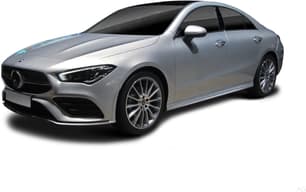
From the front, the CLA 35 exterior oozes style and luxury.
Up front, the sleek and slender headlights emphasise the width of the fascia, while the large Mercedes logo sits proudly front and centre of the CLA’s nose.
There are subtle hints to the CLA 35’s sportiness too, with a slightly bulging bonnet and chiselled lower chin.
The grille is also unique on the 35, with a dual-horizontal slat design instead of the non-AMG CLA’s diamond pattern or the CLA 45’s Panamericana grille.
To my eye, the front of the CLA 35 is actually a bit too tame in styling for an AMG model. I prefer the in-your-face aggression of the CLA 45’s widened track and front grille, while the CLA 35 opts for more subtle styling cues. To each their own, though.
The silver paintwork of our test car probably doesn’t help, and if it was my choice I'd pick 'Sun Yellow' or 'Denim Blue' to stand out a bit more from the sea of black, grey and white German cars out there.
Move to the rear of the car though, and a large rear diffuser, big dual-exhaust outlets and a bootlid spoiler are much more befitting an AMG model.
Step inside the CLA and you will see it adopts the same dashboard design as all new-generation Mercedes vehicles built on the MFA2 platform, with the 'MBUX' dual-screen layout, large air-vents and central touchpad.
Our car was specced out with red-leather interior, which is a bit too loud for my tastes, but a two-tone black leather/titanium grey combo can also be had at no extra cost.
Sitting inside the CLA 35, you can tell it’s a modern car thanks to the clean layout of all the controls, while the screen-heavy dashboard definitely makes it feel tech-focused.
Want to start a vigorous car enthusiast discussion (more a verbal punch-up)? Simply ask whether a four-door car can be a coupe.
Traditionally, the answer is no, but over time numerous automotive brands have applied that description to cars with more than two doors, including SUVs!
So, here we are. A four-door ‘Gran Coupe’, and the M8 Competition version retains the smoothly tapering turret and frameless side glass that help give selected BMW four-door models the same swoopy, coupe look.
At close to 4.9m long, a fraction over 1.9m wide, and under 1.4m high, the BMW 8 Series Gran Coupe has a firmly planted, low-slung, wide-track stance. Always a subjective call, but I for one, think it looks stunning, especially in our test car’s ‘Frozen Brilliant White’ matt paint finish.
In an era of comically oversized BMW grilles, things are relatively under control here, with a bright black finish applied to that ‘kidney grille’, as well as the huge front bumper air intakes, front splitter, front fender vents, exterior mirrors, window surrounds, 20-inch rims, lip spoiler on the boot, rear valance panel (incorporating a functional diffuser), and quad exhaust tips. The roof’s black, too, but that’s because it’s made of carbon-fibre.
Overall the M8 Competition Gran Coupe is a compelling combination of strong, confident character lines along the bonnet and lower flanks, with tightly wrapped curves following the high hip line, and more organically irregular, yet distinctly BMW shapes in the head- and tail-lights.
The interior is a beautifully balanced design with a broad centre console sweeping up to the middle of the dash and wrapping around to focus on the driver, in typical BMW fashion.
The multi-adjustable sports front seats are immaculate, with high-end quilting in the centre section matching a similar treatment in the doors. The dark grey (full) leather trim is offset by carbon and brushed metal trim elements for a cool, calm and focused feel.
Crack the bonnet open and a spectacular ‘BMW M Power’ carbon cover dressing the top of the engine is guaranteed to impress friends and family.
Measuring 4695mm long, 1834mm wide, 1399mm tall and with a 2729mm wheelbase, the CLA 35 is definitely a sizeable sedan in the metal.
This actually makes the CLA 35 slightly longer and wider than a non-AMG C-Class sedan that measures 4686 and 1810mm respectively, but don’t expect the same level of practical interior space.
With a heavily sloped roofline, rear-seat comfort takes a hit. My 183cm (6.0ft) frame could not sit upright behind my driving position without tilting my head, while legroom was also slightly lacking.
With such large C-pillars and a small rear window, the second-row can actually feel a little claustrophobic for full-sized adults, but will seat children quite comfortably.
Second-row amenities include air-vents, two USB-C ports, back-of-seat storage nets, bottle holders in the doors, and two cupholders in the fold-down arm rest.
Just like at a music concert though, the best seats in the CLA 35 are up front, with plenty of room for heads, shoulders and legs.
The cabin is also much more light-filled up front, making for a more pleasant experience.
The front seats are electronically adjustable, as is the steering column, but the headrests are fixed.
Storage options include sizeable door bins, a centre console cubby, glove box, two cupholders and a wireless smartphone charger.
Boot space is 460 litres, but can expand with the rear split-fold 40/20/40 rear seats stowed.
Though the boot looks small and shallow on the outside, the aperture is actually quite large, and can easily accommodate a large suitcase with plenty of room to spare.
Of the M8 Competition Gran Coupe’s 4867mm overall length, 2827 of it sits between the front and rear axles, which is a pretty healthy wheelbase for a car this size (and 200mm more than the 8 Series two-door coupe).
Space up front is generous, and one upside of a four-door, rather than two-door coupe, is you’re not struggling quite so much for space to get in and out when parked next to other cars.
Once inside, there’s plenty of storage up front, with a large lidded box/armrest between the front seats, twin cupholders in the centre console, as well as another covered area for wireless phone charging and extra bits and pieces in front of that. Long door pockets provide space for bottles, and the glove box is a decent size. There’s 12V power as well as USB sockets for media connection, with charging outlets in support.
At first glance you’d swear the rear seat was designed as a two-seater only, but when push (literally) comes to shove a centre passenger can squeeze in, legs straddling the rear console.
In terms of legroom, at 183cm (6’0”) I could sit behind the driver’s seat set for my position with knee room to spare, but headroom is another matter, with my noggin making solid contact with the soft Alcantara headlining. It’s the price you pay for this car’s racy profile.
There’s a neatly trimmed storage box and two cupholders in the fold-down centre armrest, plus door pockets with enough room for small bottles. The rear console houses dual climate controls, twin USB power sockets, and a small oddments tray, as well as buttons for the optional rear seat heating fitted to our test car ($900).
The 440-litre boot is a bit like the car itself - long and wide, but not very high. The rear seat split-folds 40/20/40 if you need more space, and the boot lid is automatic with a hands free function. But don’t bother looking for a spare of any description, a tyre repair kit is your only option.
Priced at $85,500 before on-road costs, the CLA 35 sits $15,300 upstream of the CLA 250 but is $25,700 cheaper than the $111,200 CLA 45.
Standard equipment includes leather interior, dual-zone climate control, electronically adjustable front seats with heating and memory function, keyless entry and push-button start, 64-colour ambient lighting, and a wireless smartphone charger.
AMG specific appointments include 19-inch wheels, a flat-bottomed steering wheel, sports exhaust, high-performance brakes with silver-painted calipers, blacked-out exterior highlights, sports suspension, a racy bodykit and speed-sensitive steering.
Instrumentation is displayed on a 10.25-inch screen, which can be customised and features AMG readouts.
The multimedia system, which includes satellite navigation, digital radio and Apple CarPlay/Android Auto connectivity, is also outputted to a 10.25-inch screen, with inputs including touch, voice commands, centre touch pad or steering wheel controls.
Our test car also came with a ‘Mojave Silver Metallic’ paint finish and 'Vision Package', adding $1190 and $990 to the bottom line each.
The Vision Package adds LED headlights with adaptive high beams, a panoramic glass sunroof and surround-view monitor.
Straddling the lines between a small- and mid-size sedan, the CLA 35 doesn’t really have any direct competitors, which is reflected in its pricing that slots it between the Audi S3 and S4 sedans.
Though the CLA 35 features a long list of equipment, it is still a sizeable chunk of coin, costing more than the C300 sedan and Volvo S60 T8 PHEV, the latter boasting higher engine outputs.
At $349,900, before on-road costs, the BMW M8 Competition Gran Coupe sits in an interesting part of the upper-luxury, high-performance market, the unifying theme being a forced induction V8 engine under the bonnet.
On price, it lines up almost exactly with Bentley’s twin-turbo Continental GT V8 ($346,268), but that’s a more conventional, two-door coupe.
If it’s four doors you’re after, some compelling options, within shouting distance of the M8’s price, include the supercharged V8 Jaguar XJR 575 ($309,380), twin-turbo V8 Maserati Quattroporte GTS GranSport ($299,990), and the presidentially powerful and imposing twin-turbo V8 Mercedes-AMG S 63 L ($392,835).
But, arguably, the competitor that lines up best in terms of intent, performance, and personality is Porsche’s Panamera GTS ($366,700). You guessed it, a twin-turbo V8, also designed to prowl the autobahn’s left lane.
So, in this exalted company you need to bring your quality and features A-game, and the M8 Competition Gran Coupe doesn’t disappoint.
Running through all the car’s standard equipment would be a tedious exercise, if only for the sheer volume of features, and hopefully, the following highlights package will give you a feel for the level we’re talking about here.
Aside from copious amounts of active and passive safety tech (covered in the Safety section) this brutal Beamer features, four-zone climate control, configurable ambient (interior) lighting, keyless entry and start, ‘Merino’ leather trim covering the seats, doors, dash, M steering wheel, and gearshift, ‘Anthracite’ Alcantara headlining, 20-inch alloy rims, active cruise control, a digital instrument panel, head-up display, and laser headlights.
The electrically-adjustable sports front seats are ventilated and heated, while the leather-trimmed steering wheel, front centre armrest, and even the front door armrests can also be dialled up to a toasty setting.
You can also add a 10.25-inch multimedia display featuring navigation (with real-time traffic updates), Apple CarPlay and Bluetooth connectivity, as well as gesture control and voice recognition. The exterior mirrors are heated, folding, and auto-dimming. The Bang & Olufsen surround sound audio system boasts 16 speakers and digital radio.
There’s also a digital dash display, panoramic sunroof, rain-sensing wipers, soft-close doors, power sunblinds on the rear, and rear side windows, and a l-o-t more. Even in this price range, that standard fit-out is impressive.
Powered by a 2.0-litre, turbo-petrol four-cylinder engine, the CLA 35 punches out 225kW/400Nm.
Drive is sent through a seven-speed dual-clutch automatic transmissions to the road via Mercedes’ '4Matic' all-wheel-drive system, enabling a 0-100km/h sprint in the 1603kg sedan in just 4.7 seconds. Top speed is electronically limited to 250km/h.
Though I didn’t get a chance to test the latter, the former certainly feels accurate when taking off from a freeway on ramp, however, there is some hesitation from the turbo in getting on boost.
Peak power comes in at 5800rpm, while maximum torque is available from 3000-4000rpm.
The M8 Competition is powered by an all-alloy, 4.4-litre twin-turbo V8 engine, featuring direct-injection, as well as the latest version of BMW’s ‘Valvetronic’ variable valve timing and ‘Double-VANOS’ variable camshaft control, to produce 460kW (625hp) at 6000rpm, and 750Nm from 1800-5800rpm.
Designated ‘S63’, the engine’s two twin-scroll turbos are located, along with a cross-bank exhaust manifold, in the engine’s (90-degree) ‘hot vee.’
The idea is consistent transmission of exhaust energy to the turbos for improved response, with the reversal of usual practice completed by inlet manifolds positioned on the engine’s outer edges.
Drive goes to all four wheels via an eight-speed ‘M Steptronic’ (torque converter) auto transmission with ‘Drivelogic’, and dedicated oil cooling, as well as BMW’s ‘xDrive’ all-wheel drive system.
The xDrive set-up is built around a central transfer case housing an electronically-controlled, variable multi-plate clutch, with front to rear drive distribution set to a default 40:60 split.
The system monitors multiple inputs including, wheel speed (and slip), acceleration and steering angle, and is able to vary the ratio up to 100 per cent rear thanks to the ‘Active M Differential.’
Officially, the CLA 35 sips 7.5 litres per 100km on the combined cycle, but we managed a 9.9L/100km figure in our week with the car.
The majority of our driving was done in inner-city environments, with the two trips down the freeway to seek out twisty country rounds.
Minimum fuel grade in the CLA 35 is 98 RON.
Claimed fuel economy for the combined (ADR 81/02 - urban, extra-urban) cycle is 10.4L/100km, the M8 Competition emitting 239g/km of CO2 in the process.
Despite the standard auto stop/start function, over a week-long combination of city, suburban, and freeway running we recorded a (dash-indicated) average of 15.6L/100km.
Pretty thirsty, but not outrageous when you consider this car’s performance potential, and the fact that (purely for research purposes) we exploited it regularly.
Recommended fuel is 98 RON premium unleaded, and you’ll need 68 litres of it to fill the tank. That equates to a range of 654km in line with the factory claim, and 436km using our real-world number as a guide.
The CLA 35 might not offer the outright thrills or breadth of capability of the CLA 45, but don’t think the cut-price AMG offers up a cut-rate driving experience.
From the driver’s seat, one of the cool things about the CLA 35 is that it doesn’t actually look any different from its more expensive sibling.
The drive-mode selector that is now embedded on the steering wheel is fantastic, a feature first seen on the Mercedes-AMG GT 4-door, and makes changing the driving dynamics on the fly an absolute breeze.
In fact, we think all cars where you can select drive modes should have a selector on the steering wheel like this, which lets you quickly and easily dial it up or down while keeping your hands on the wheel.
'Comfort', 'Sport', 'Sport+' and 'Individual' modes are available, while the transmission can also be put into manual mode independently for those that prefer to use the flappy paddles.
Suspension settings can also be tweaked regardless of which drive mode you are in, and it’s this level of customisability that we appreciate.
You want loud exhaust pops and the engine in full attack with manual shifting and the softest suspension? Sure, that’s doable here in the CLA 35. And toning it down to its most comfortable settings is just a flick of the wrist away.
The steering feels a little numb on centre and at slower speeds, though feedback picks right up with speed and is communicative enough when the road starts to get twisty.
Fitted with wide and sticky Michelin rubber, as well as the aforementioned all-wheel drive system, the CLA 35 is certainly not lacking in grip.
The suspension does an okay job of absorbing bumps, but uneven surfaces, like Melbourne’s tram tracks, can send uncomfortable jolts into the cabin if travelling quickly.
In fact, we think the ride comfort of the CLA 35 is probably its weakest aspect, offering not enough variability in its Comfort and Sport settings, and instead settling somewhere in between, regardless of drive mode.
The CLA 35 is ultimately still a fun and engaging sports sedan, though there are some sacrifices made to get it there.
There’s something teutonically symmetrical about the way the M8 Competition Gran Coupe delivers its prodigious thrust.
Peak torque of no less than 750Nm is available from just 1800rpm, remaining on full song across a broad plateau all the way to 5800rpm. Just 200revs later (6000rpm) peak power of 460kW (625hp!) takes over to finish the job, with the rev ceiling sitting just over 7000rpm.
That’s enough to slingshot this 1885kg bruiser from 0-100km/h in 3.2 seconds, which is supercar fast. And the engine and exhaust noise produced by the 4.4-litre twin-turbo V8 during such rapid acceleration is suitably brutal, courtesy of electronically-controlled flaps in the system opening up.
On a more civilised drive you can reduce the exhaust noise via an ‘M Sound Control’ button on the centre console.
The eight-speed auto is fast and positive, especially in manual mode, which dials up the fun via wheel-mounted paddles. And when it’s time to direct this car’s forward momentum into lateral movement BMW has brought in the engineering heavy artillery.
Despite its frameless door body structure the M8 Competition Gran Coupe feels solid as a rock thanks in no small part to its ‘Carbon Core’ construction, using four primary components - carbon-fibre-reinforced plastic (CFRP), aluminum, high-strength steel, and magnesium.
Then the ‘Adaptive M Suspension Professional’ (with active anti-roll stabilisation), the tricky xDrive continuously variable AWD system, and active M Sport diff combine to keep everything under control.
Suspension is a double wishbone front, five-link rear arrangement, with all key components in alloy to minimise unsprung weight. In concert with the electronic wizardry on-board, it helps keep the M8 buttoned down with only modest body roll in enthusiastic cornering, as the rear-biased AWD system seamlessly distributes drive to the axle and wheels that can make best use of it.
The price you’ll pay for the track-ready tune is in compromised ride comfort. Even in the ‘Comfort’ setting, the M8 Competition is firm, and feels corrugations and imperfections to a surprising degree.
An alignment of the BMW 8 Series planets left me with the keys to this car and the M850i Gran Coupe (also using the Carbon Core body) at the same time, and the difference between their softest settings is appreciable.
Also be aware that at 12.2m the M8 Gran Coupe’s turning circle is substantial, and it’s just as well all that camera, sensor and self-parking tech is available to help you guide this ship into port.
The M8’s electrically-assisted, variable-ratio steering features an ‘M’ specific calibration to deliver satisfying precision and good road feel. But in similar fashion to the ride a noticeable amount of unwelcome feedback comes through to the wheel.
The fat Pirelli P Zero rubber (275/35 fr / 285/35 rr) grips hard, and the monster brakes (ventilated all around, with 395mm rotors and six-piston calipers up front) wash off speed without fuss or fade.
But overall, you’ll have to live with a less refined drive when you sign on for the M8 Competition. Straight away it feels faster but lacks the M850i’s lighter touch. No matter which drive or suspension mode you select, responses are more aggressive and physical.
To fully explore and enjoy the M8 Competition’s abilities it feels like the race circuit is its most appropriate habitat. On the open road, the M850i is all the Gran Coupe you’re going to need.
The CLA 35 has not been tested by ANCAP or Euro NCAP, but the standard CLA range was awarded a five-star rating in September 2019.
Standard safety equipment in the CLA 35 includes autonomous emergency braking, automatic high beams, nine airbags, drive attention alert, blind-spot monitoring with exit warning, lane-keep assist, traffic sign recognition and tyre pressure monitoring.
The standard CLA also comes with these features, and was awarded 96 and 92 per cent respectively in ANCAP adult occupant and child occupant protection tests.
For the vulnerable road user and safety assist examinations, the standard CLA scored 91 and 76 per cent respectively.
ANCAP says the AEB system works from seven-200km/h.
Of note, adaptive cruise control is not standard in the CLA 35 like it is in the CLA 45. Instead, buyers will have to tick the 'Driving Assistance Package' box for the feature, which also comes bundled with cross-traffic alert and lane change assist.
The BMW M8 Competition Gran Coupe hasn’t been assessed by ANCAP or Euro NCAP, but that doesn’t mean it’s lacking in terms of active and passive safety tech.
As well as expected crash avoidance features like stability and traction controls, this M8 features the ‘Driving Assistant Professional’ suite which incorporates active cruise control (with ‘Stop & Go’ function) and ‘Night Vision’ (with pedestrian recognition).
Also included are AEB (with pedestrian and cyclist detection), ‘Steering and Lane Control Assistant’, ‘Lane Keeping Assistant’ (with active side collision protection”, an ‘Evasion Assistant’, a ‘Crossroads warning’, ‘Wrong-way warning’, as well as front and rear cross traffic alert.
The headlights are ‘Laserlight’ units incorporating ‘BMW Selective Beam’ (with active high-beam control), there’s a tyre pressure indicator, and ‘Dynamic Brake Lights’ to warn those behind of an extreme braking event.
Plus, M8 Competition owners score complimentary enrollment in the BMW Driving Experience Advance 1 and 2 courses.
To help guide your parking efforts there’s a hi-def reversing camera (with panoramic view monitor), rear parking distance control, and ‘Reverse Assist’. But if all else fails the car can park itself anyway (parallel and perpendicular).
If all of that isn’t enough to avoid an impact, you’re protected by 10 airbags (dual front and front side, knee bags for the driver and front seat passenger, as well as side airbags for the second row, and curtain airbags covering both rows).
An automatic emergency call function contacts the BMW call centre for connection to relevant services in the event of a crash. And as has been the case with BMW since the dawn of time, a first-aid kit and warning triangle are on-board.
As with all new Mercedes-Benz models, the CLA 35 comes with a five-year/unlimited kilometre warranty, which is one of the best assurance periods offered by a premium carmaker.
It also comes with five years of roadside assist.
Scheduled service intervals are every 25,000km or 12 months, whichever comes first.
A three-year service plan is available for $2150 for new CLA 35 buyers, saving $500 when priced individually.
Four- and five-year plans are also available, and are priced at $4200 and $4950 respectively.
BMW offers a three year/unlimited km warranty, which is at least a couple of years off the mainstream market pace, and lagging other premium players like Mercedes-Benz and Genesis, both sitting at five years/unlimited km.
Roadside assistance is included for the duration of the warranty period, and the standard ‘Concierge Service’ provides everything from flight information, to global weather updates, and restaurant recommendations, from a real human.
Technically, service is ‘condition based’ with the car telling you when it’s time to hit the workshop, but you can use every 12 months/15,000km as a guide.
BMW Australia offers ‘Service Inclusive’ packages that require customers to pre-pay for servicing, allowing the cost to be covered off in finance or leasing packages and reducing the need for concern about paying for maintenance further down the track.
BMW says there are different packages available, from three to 10 years, or between 40,000 and 200,000km.