What's the difference?
Mazda has a tendency to have a lot of similar looking horses in the stable; blink and you'll miss the (very) subtle differences between the CX-8 and the CX-9 but if you're not super keen on the bulk of the CX-9 and you've outgrown the space of the CX-5... this one's for you.
Especially, if you've been considering its competition - the Hyundai Santa Fe Elite CRDi AWD and Toyota Kluger GXL AWD. Both of which have become known for their features and space.
So, how does it compare? The CX-8 GT SP diesel all-wheel drive seats seven, has a decent boot space (albeit, when the third row isn't in use) and handles like a dream.
Perfect combination? Maybe. I've been driving it for the last week with my family to find out for you.
Recently CarsGuide had a presence at several major electric vehicle shows in Australia and I can tell you, this car was generating a lot of buzz with prospective buyers.
It’s the just-released Zeekr 7X, a pure-electric, five-door, five-seat SUV priced and specified to challenge established EV players in the premium, mid-size SUV segment.
In this test, we’re behind the wheel of the 7X Performance, the dual-motor AWD flagship topping a three-model line-up including single-motor standard- and long-range RWD variants.
So stay with us as we assess everything from price, features, design and practicality to efficiency, driving dynamics, safety and cost of ownership. Let’s go!
So, what did my family think about the Mazda CX-8 GT SP diesel all-wheel drive? I love how it performs on the road - it's super easy to drive and you don't notice how large it is in a car park.
There are some great family-friendly features scattered throughout and I like how practical this is too with the extra seats and top-tether points. The multimedia system isn’t my favourite and I would have preferred to have seen a few extra airbags and a 360-degree view camera, but overall, it’s a good family car and gets an 8.0/10 from me.
My son loved the sun blinds and the cool colour of the seats. He also gives it an 8.0/10.
The first thing that comes to mind in summing up the Zeekr 7X Performance is value. So much standard equipment for the money, stunning acceleration, top-shelf safety and a solid ownership package. It’s also practical, comfortable and the design inside and out is sleek. This electric SUV has thrown down a hefty gauntlet in challenging its existing opposition and there’s no doubt if you’re in this part of the market you should take a close look.
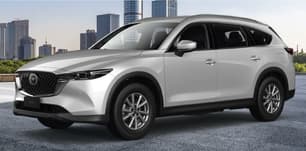
To be honest, I can't really tell the CX-8 and CX-9 apart on the road. They're both large SUVs that sport the classic Mazda bonnet - sharp and long. Up close, the CX-9 has a bulkier shape but otherwise they are remarkably similar.
The CX-8's darkened grille generates some interest with its lattice-work and there are enough shiny chrome accents scattered about the car that it looks pretty.
Yet, the sporty sharpness that Mazda is known for is still hinted at with its shaping and the 19-inch black alloy wheels.
Our model is finished in 'Platinum Quartz Metallic' and it is the highlight for the exterior styling for me. I think because it's such an interesting colour to look at - it varies a lot depending on lighting conditions. Sometimes, it almost has a sheen of pink to it and at others, it looks like pearly sand.
The interior looks polished and refined with its burgundy leather trim and soft-touchpoints. Again, there is a lot of chrome inside to make otherwise dull features, like air vents, pop out.
The 7X was developed at the Zeekr Design and Technology centre in Gothenburg, Sweden and arguably its most distinctive design element is the full-width band across the nose with standard LED headlights and DRL strip below.
They’d be matrix units if we were in China and the black band would house Zeekr’s ‘Stargate’ panel capable of displaying words and digital animations. But ANCAP crash-test requirements put the kybosh on that for Australia and it’s been replaced by the black cover. But there’s still room to play with animations on the lights that remain, including musical accompaniment through internal and external speakers.
Other than that, the car’s overall shape and proportions have a touch of Porsche Macan about them with a bulging mid-section and racy 21-inch rims filling the wheel arches.
There’s a slim, tail-light bar across the rear, a concealed wiper and an integrated spoiler on the top of the tailgate contributing to a smooth, clean look. No surprise, drag co-efficient is a slippery 0.25.
Inside, the fuss-free theme continues with a multi-layered dash design dominated by the 16-inch central media screen, compact digital instrument display and split-level centre console. And we’ll get to interacting with it all shortly.
Admirable restraint has been exercised in the simple surfacing and choice of trim materials with enough decoration to add visual interest.
The CX-8 is a very practical family hauler because there's ample room in all three rows. Yes, even adults will be able to squeeze into that third row without too many complaints!
All rows enjoy well-cushioned seats and up front they are electrically adjustable, but unfortunately, only the driver's side has lumbar support.
The middle row can slide forward manually or by using the electric button found on the side of the seats... but doing it yourself is way faster.
They do slide far enough forward that you won't embarrass yourself too much when you have to clamber into the third row. Where the seats have a 50/50 split-fold and manual adjustments (accessed via the boot).
In the first two rows there are lots of individual storage options but the front enjoys the most. The middle console is deep enough to be useful and I like the dual opening lid. Each row gets a couple of cupholders and drink bottle holders, too.
The charging options are great, with each row getting two USB-C ports and the front getting a wireless charging pad and 12-volt socket.
All of the controls and dials feel within easy reach and the 10.25-inch touchscreen multimedia system graphics are clear.
You can use it as a touchscreen or opt for the rotary dial but switching between the two was awkward for me. Especially, since the touchscreen function is disabled when you are using the wireless Apple CarPlay. This also has wired Android Auto, for those users.
The amenities are practical throughout with a dark headliner, three-zone climate control and heated outboard seats and retractable sun-blinds in the middle row.
Good news for families because there are five top-tether points across the back rows and ISOFIX child seat mounts on the outboard seats in middle row, in case you need them.
You can fit a 0-4 rearward facing child seat and it shouldn’t impact on front passenger comfort.
My six-year old found it super easy to get in and out of this car because of the 205mm ground clearance and wide door apertures. He enjoyed the high seating position, too, but was disappointed he couldn’t see out of the sunroof!
The boot space is a bit cramped with all three rows are in use at 209L but folding the third row opens up a more respectable 775L - perfect for the average family and its stuff!
The loading space is level, with the temporary spare tyre and clever storage compartments housed underneath. There is a retractable cargo blind and net, luggage anchor points and a 12-volt port, too.
And, as always, I love a powered tailgate, which this has!
So, before even getting in the car it’s worth talking about this Performance grade’s auto-opening doors.
The physical door handles are still present but inoperative (except in an emergency), so it’s a press of a button on the B-pillar, or a swipe card if you prefer, and open sesame.
There’s ‘pinch protection’ for the windows on all side doors and impact avoidance which means it will stop short of denting your neighbour at the car park.
After a week of press-button experience I could easily live without this functionality but my significant other loved it. So, personal preference reigns supreme.
At close to 4.8 metres long, a touch over 1.9m wide and around 1.7m tall (with a 2900mm wheelbase) the 7X is a ‘large’ medium SUV and the interior reflects its generous external dimensions.
There’s plenty of breathing space and a bright open feel thanks in part to the standard panoramic glass roof with power-sliding shade.
In the front, in terms of practicality, there’s a large, deep bin between the seats with a lid that opens from the left and right, another section with two swing-out cupholders and a roll-top lid, plus a big area in the lower console plus generous door bins. And there are handy flip-top boxes in the door armrests.
Worth noting on our test example, opening and closing the sliding cover over the cupholder section generated a groaning noise like oversize nails scraping down a blackboard, which didn’t exactly fit the premium vibe.
The glove box is opened with a button on the dash, which feels overly complicated. But then, in terms of power and connectivity there are twin 50W device charging bays and two USB-C sockets in the lower console.
In a big win for parents loading small kids into car seats, the rear doors open to 90 degrees. Then for storage, you’ve got map pockets on the front seat backs, decent door bins, two cup or bottle holders and a lidded box in the pull-down centre armrest, a small oddments tray at the back of the centre console and a pair of drawers under the seat.
And in the back, in terms of space, sitting behind the driver’s seat set for my 183cm position, I’ve got ample headroom, legroom and more than enough foot room.
There are power window shades, individual ventilation outlets in the B-pillars to manage the climate control for the rear section as well as one USB-A and a USB-C socket in the armrest box.
And then, there’s the Occupant Monitoring System, a camera view of the rear seat which instantly does away with the awkward 180-degree parental head turn from the front seats. A small camera in the B-pillar is activated by a dash-mounted button for a wide-angle, picture-in-picture video image on the main media screen.
And don’t worry, if you’re in the back and don’t appreciate the attention, a simple sliding cover over the lens can block the shot.
With the 60/40 split-folding rear seat upright the 7X boasts 539 litres (VDA) of boot space, which is pretty handy, and that number expands to a hefty 1978L with the back seat down.
There’s a load-through hatch, tie-down anchors, multiple bag hooks, specific lighting, a 12-volt socket and two storage compartments under the floor. The height of the power tailgate is adjustable but there’s no hands-free function.
Braked trailer towing capacity is 2.0 tonnes (750kg unbraked) and it’s worth noting vehicle-to-load functionality (using a specific discharge cable in the main charge port) is onboard.
But there’s no spare tyre of any description, with a repair/inflator kit your only option, which in this market isn’t good enough.
The GT SP diesel AWD is one of the premium models, sitting third from the top and will cost you $65,560, before on road costs.
However, its price tag positions it as the most expensive compared to its rivals. With the closest rival being the Kluger at $65,310 and the most affordable being the Santa Fe at $60,000.
You do get a stylish-looking package with lots of features for your cash, like heated front seats, heated rear outboard seats, a tilt and slide sunroof, and premium leather interior trim.
There's some great tech scattered throughout, too, like the 10.25-inch touchscreen multimedia system, wireless charging pad, USB-A ports in the third row, Bose Premium sound system with 10 speakers, wireless Apple CarPlay and wired Android Auto.
The Zeekr 7X starts at $57,900, before on-road costs, for the Single motor RWD version, rising to $63,900 for the Long range RWD and $72,900 for this Performance model.
At that money the 7X Performance lines up against a diverse group of primo EV SUVs like the Cupra Tavascan, Hyundai Ioniq 5, Kia EV5, MG IM6, Skoda Enyaq, Subaru Solterra, Tesla Model Y, Toyota bZ4X and VW ID.5. Not to mention its corporate Geely twin under the skin, the Polestar 4.
But cost-of-entry is one thing. The number of included features for the price is another and this car is properly loaded.
Aside from the performance and safety tech we’ll get to shortly the highlights are Nappa leather trim, 14-way power-adjustable front seats (with memory, heating, ventilation and massage functions), a leather-trimmed, heated and power-adjustable steering wheel, heated power-reclining (to 10 degrees) rear seats, a rear seat ‘Occupant Monitoring System’ (more on this later), a 16-inch multimedia display, 36-inch head-up display and digital instrument screen.
There’s also 2160-watt, 21-speaker audio, three-zone climate control, Android Auto and Apple CarPlay connectivity, multi-colour ‘Ripple Effect’ interior ambient lighting, all LED exterior lighting, auto door opening, a panoramic glass roof (with power sunshade), a power tailgate, heated and power-folding exterior mirrors, rear privacy glass (plus power sunshades) and 21-inch forged alloy rims.
That’s heaps and there’s even more. Enough to put serious pressure on the competitors mentioned above.