What's the difference?
Mazda has a tendency to have a lot of similar looking horses in the stable; blink and you'll miss the (very) subtle differences between the CX-8 and the CX-9 but if you're not super keen on the bulk of the CX-9 and you've outgrown the space of the CX-5... this one's for you.
Especially, if you've been considering its competition - the Hyundai Santa Fe Elite CRDi AWD and Toyota Kluger GXL AWD. Both of which have become known for their features and space.
So, how does it compare? The CX-8 GT SP diesel all-wheel drive seats seven, has a decent boot space (albeit, when the third row isn't in use) and handles like a dream.
Perfect combination? Maybe. I've been driving it for the last week with my family to find out for you.
Do you like swimming against the tide? Do you like to zig when everyone else is zagging? Are you unafraid of making the unpopular choice?
Well, if you align with the above, I have just the car for you.
The Volvo ES90 pushes against most current trends. The luxury sedan used to be the measure of a brand, but not anymore. These days the luxury market is defined by SUVs and sedans have been reduced to an afterthought for many.
But if you’re willing to think outside the SUV-shaped box, there is a lot to like about Volvo’s new luxury offering. Whether it’s a true sedan or not is open to debate, but what it isn’t is an SUV and for those willing to live that counter-culture lifestyle this may be right for you.
So, what did my family think about the Mazda CX-8 GT SP diesel all-wheel drive? I love how it performs on the road - it's super easy to drive and you don't notice how large it is in a car park.
There are some great family-friendly features scattered throughout and I like how practical this is too with the extra seats and top-tether points. The multimedia system isn’t my favourite and I would have preferred to have seen a few extra airbags and a 360-degree view camera, but overall, it’s a good family car and gets an 8.0/10 from me.
My son loved the sun blinds and the cool colour of the seats. He also gives it an 8.0/10.
More stylish than ever before, as quiet and refined as you'd expect from a luxury car and yet the stand out feature might once again be safety. Despite seemingly every new car being loaded to the gills with safety features, Volvo has managed to demonstrate industry best-practice and leads the way again.
I would encourage engineers from every other car brand to drive the ES90 to learn how to better integrate the modern suite of active safety features like forward collision warning and lane departure warning.
But beyond that, is the ES90 a car worthy of consideration? Well, pretty much everything it does the EX90 does too, so if you prefer an SUV that’s definitely worth consideration. But if you don’t want an SUV, if you prefer a sedan or just love to be different, the ES90 is a very attractive proposition in more ways than one.
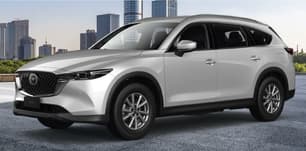
To be honest, I can't really tell the CX-8 and CX-9 apart on the road. They're both large SUVs that sport the classic Mazda bonnet - sharp and long. Up close, the CX-9 has a bulkier shape but otherwise they are remarkably similar.
The CX-8's darkened grille generates some interest with its lattice-work and there are enough shiny chrome accents scattered about the car that it looks pretty.
Yet, the sporty sharpness that Mazda is known for is still hinted at with its shaping and the 19-inch black alloy wheels.
Our model is finished in 'Platinum Quartz Metallic' and it is the highlight for the exterior styling for me. I think because it's such an interesting colour to look at - it varies a lot depending on lighting conditions. Sometimes, it almost has a sheen of pink to it and at others, it looks like pearly sand.
The interior looks polished and refined with its burgundy leather trim and soft-touchpoints. Again, there is a lot of chrome inside to make otherwise dull features, like air vents, pop out.
Discussing Volvo design will draw different opinions depending on your age. As a millennial, I grew up at a time when Volvos were, to quote a famous movie line from the 1990s, ‘boxy, but good’.
But over the past two decades Volvo has smoothed off those boxy edges and become one of the most style-conscious car companies in the world. It has embraced its now-unique place as a Scandinavian carmaker and uses softer edges and more Nordic design themes (such as light coloured interior woods) to ensure the ES90 is simply a good-looking car.
What it isn’t, at least not technically-speaking, is a sedan. That’s because it has a liftback rear-end design, rather than a traditional ‘three-box’ sedan with a conventional boot. That shouldn’t be a deal-breaker for anyone and it means it’s a far more practical design.
It also sits taller than a conventional ‘sedan’, which is an increasingly common trait for modern European sedans as they try to woo would-be SUV buyers. It’s not a lot, you certainly wouldn’t call it a tall or high-riding car, but it is noticeable.
Ends up as an ‘in-between’ design, neither one thing or the other. The closest thing it reminds me of is the short-lived BMW 5-Series GT, which is damning with faint praise, but it speaks to the challenge of making something that simply isn’t an SUV appealing to the modern SUV-obsessed market.
The very stylish cabin features that previously mentioned light coloured wood (at least in our test car) and that unique Scandinavian look. It’s the closest you’ll get to sitting in a Swedish lounge room on wheels.
The CX-8 is a very practical family hauler because there's ample room in all three rows. Yes, even adults will be able to squeeze into that third row without too many complaints!
All rows enjoy well-cushioned seats and up front they are electrically adjustable, but unfortunately, only the driver's side has lumbar support.
The middle row can slide forward manually or by using the electric button found on the side of the seats... but doing it yourself is way faster.
They do slide far enough forward that you won't embarrass yourself too much when you have to clamber into the third row. Where the seats have a 50/50 split-fold and manual adjustments (accessed via the boot).
In the first two rows there are lots of individual storage options but the front enjoys the most. The middle console is deep enough to be useful and I like the dual opening lid. Each row gets a couple of cupholders and drink bottle holders, too.
The charging options are great, with each row getting two USB-C ports and the front getting a wireless charging pad and 12-volt socket.
All of the controls and dials feel within easy reach and the 10.25-inch touchscreen multimedia system graphics are clear.
You can use it as a touchscreen or opt for the rotary dial but switching between the two was awkward for me. Especially, since the touchscreen function is disabled when you are using the wireless Apple CarPlay. This also has wired Android Auto, for those users.
The amenities are practical throughout with a dark headliner, three-zone climate control and heated outboard seats and retractable sun-blinds in the middle row.
Good news for families because there are five top-tether points across the back rows and ISOFIX child seat mounts on the outboard seats in middle row, in case you need them.
You can fit a 0-4 rearward facing child seat and it shouldn’t impact on front passenger comfort.
My six-year old found it super easy to get in and out of this car because of the 205mm ground clearance and wide door apertures. He enjoyed the high seating position, too, but was disappointed he couldn’t see out of the sunroof!
The boot space is a bit cramped with all three rows are in use at 209L but folding the third row opens up a more respectable 775L - perfect for the average family and its stuff!
The loading space is level, with the temporary spare tyre and clever storage compartments housed underneath. There is a retractable cargo blind and net, luggage anchor points and a 12-volt port, too.
And, as always, I love a powered tailgate, which this has!
In terms of space the ES90 is very generous, which it should be given it's a five-metre long car. There’s loads of room front and the back so you’ll seat four adults in absolute comfort, and can squeeze in a fifth if needed. Thanks to the relatively flat floor, as well as the panoramic roof that can either be opaque or clear, the cabin feels spacious and bright even in the rear.
As for luggage space, the boot measures 424 litres, and obviously it’s very easy to access via the power liftgate. But it’s still not as big as an SUV. The EX90 offers up 655 litres of space in its five-seat configuration. Which is at least a small part of the explanation why SUVs have become the more popular choice.
But what really stands out in the cabin isn’t the space, it’s the technology. The ES90 Ultra’s multimedia system is centred around a 14.5-inch touchscreen that runs all the car’s key functions; you also get a 9.0-inch driver’s display.
Notably, Volvo has opted to offer Google’s operating systems built-in, which means while you can still run Apple CarPlay or Android Auto, if you have a Google account you can sign-in and have your contacts, address book and other details integrated into the car.
It’s a really fast system, too, supported by the most powerful software Volvo has ever put inside one of its cars. Having a big tablet-style screen is great and feels very modern, but if it runs slowly, with lag between commands, it’s not as useful. This Volvo system, particularly the transitions between menus and even the voice assistant, reacts with lightning-fast speed.
Then there’s the sound system we mentioned earlier. It’s a 25-speaker Bowers & Wilkins set-up with 'Dolby Atmos' and an app called Abbey Road Studios. This app has been produced in conjunction with the iconic recording studio made famous by The Beatles. The speakers and the app were all developed together to provide a superior audio experience.
The speakers themselves are incredibly powerful while staying crystal clear, with the Abbey Road app providing the ability to change the sound between 'Modern' and 'Vintage' settings that make you feel like you’re inside a recording studio.
Put simply, it is as impressive a sound system as I’ve ever experienced in a car.
The GT SP diesel AWD is one of the premium models, sitting third from the top and will cost you $65,560, before on road costs.
However, its price tag positions it as the most expensive compared to its rivals. With the closest rival being the Kluger at $65,310 and the most affordable being the Santa Fe at $60,000.
You do get a stylish-looking package with lots of features for your cash, like heated front seats, heated rear outboard seats, a tilt and slide sunroof, and premium leather interior trim.
There's some great tech scattered throughout, too, like the 10.25-inch touchscreen multimedia system, wireless charging pad, USB-A ports in the third row, Bose Premium sound system with 10 speakers, wireless Apple CarPlay and wired Android Auto.
The ES90 range consists of two models at the time of publication both powered by a single, rear-mounted electric motor, with the twin-motor option available on the EX90 SUV currently not offered in Australia (emphasis on the word ‘currently’).
The range begins with the Pure from $88,880, before on-road costs, and is completed by the current range-topping Ultra variant, which we're testing, priced from $107,990, plus on-roads.
That means it’s cheaper than its direct rivals in the luxury electric sedan market. Audi’s e-tron GT starts at more than $200,000, the BMW i5 line-up is priced from $155,900 and the Mercedes-Benz EQE range begins at $134,900. So, even with this more expensive Ultra variant, Volvo has a clear head-start on the competition.
And Volvo hasn't managed that by skimping on standard equipment. The ES90 comes loaded with adaptive air suspension, 22-inch alloy wheels, a comprehensive safety package (as you’d expect from Volvo) as well as an electrochromic panoramic roof, a smart key you can add to your phone and 'Nordico' upholstery - Volvo’s sustainable synthetic leather.
There’s also a 25-speaker Bowers & Wilkins sound system, but more on that later…