What's the difference?
Mazda has a tendency to have a lot of similar looking horses in the stable; blink and you'll miss the (very) subtle differences between the CX-8 and the CX-9 but if you're not super keen on the bulk of the CX-9 and you've outgrown the space of the CX-5... this one's for you.
Especially, if you've been considering its competition - the Hyundai Santa Fe Elite CRDi AWD and Toyota Kluger GXL AWD. Both of which have become known for their features and space.
So, how does it compare? The CX-8 GT SP diesel all-wheel drive seats seven, has a decent boot space (albeit, when the third row isn't in use) and handles like a dream.
Perfect combination? Maybe. I've been driving it for the last week with my family to find out for you.
When it comes to Mazda’s luxury aspirations, the CX-90 is it. The big Kahuna. Seven seats of what should be the Japanese brand’s exceptionalism amongst its mainstream rivals.
But does this more than five-metre-long Mazda have what it takes to elevate the brand beyond the likes of Toyota, Hyundai, Nissan and Kia?
Importantly, is this base version - which is closer to Mazda’s traditional price point - a bit of a luxury seven-seat SUV bargain?
We drove a CX-90 G50e Touring (the most affordable CX-90 of the lot) for a week to find out.
So, what did my family think about the Mazda CX-8 GT SP diesel all-wheel drive? I love how it performs on the road - it's super easy to drive and you don't notice how large it is in a car park.
There are some great family-friendly features scattered throughout and I like how practical this is too with the extra seats and top-tether points. The multimedia system isn’t my favourite and I would have preferred to have seen a few extra airbags and a 360-degree view camera, but overall, it’s a good family car and gets an 8.0/10 from me.
My son loved the sun blinds and the cool colour of the seats. He also gives it an 8.0/10.
There are many reasons I quite like this CX-90. It sells the plush luxury promise when it comes to its interior and design, it feels big and purposeful, and has a refreshingly minimalist approach to its cabin tech. As a seven-seat SUV it’s particularly impressive, with plenty of amenity and a third row that can genuinely fit an adult in comfort.
However, there are areas where it could use more polish, from the drivetrain to the ride, and it ultimately strikes an odd point for price and ownership which feels lost between the premium segment and the mainstream rivals.
If you’re a long-term Mazda owner, I still think you’ll love it, and this Touring grade is definitely the best value in the range. It offers the lion’s share of equipment at a price more comparable to Mazda’s traditional mainstream rivals.
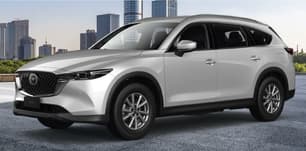
To be honest, I can't really tell the CX-8 and CX-9 apart on the road. They're both large SUVs that sport the classic Mazda bonnet - sharp and long. Up close, the CX-9 has a bulkier shape but otherwise they are remarkably similar.
The CX-8's darkened grille generates some interest with its lattice-work and there are enough shiny chrome accents scattered about the car that it looks pretty.
Yet, the sporty sharpness that Mazda is known for is still hinted at with its shaping and the 19-inch black alloy wheels.
Our model is finished in 'Platinum Quartz Metallic' and it is the highlight for the exterior styling for me. I think because it's such an interesting colour to look at - it varies a lot depending on lighting conditions. Sometimes, it almost has a sheen of pink to it and at others, it looks like pearly sand.
The interior looks polished and refined with its burgundy leather trim and soft-touchpoints. Again, there is a lot of chrome inside to make otherwise dull features, like air vents, pop out.
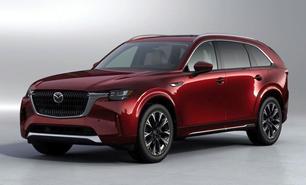
The CX-90 is an impressive car to behold. Moving things onwards and upwards from its CX-9 predecessor, the CX-90 is bigger and even more refined in a lot of ways.
Mazda’s signature design language has evolved into something a bit beefier, trading out the delicate sharp angles and chromes of its front-wheel-drive predecessors for something a bit more upright, with a wide stance and tough proportions.
The long bonnet and expansive body panels stress the long-engined, fluid nature of this car’s design language. It certainly gives it a more premium vibe than the boxy American-influenced style of the Hyundai Palisade, and leans more European than the science-fiction styling of something like the Kia Sorento.
If anything, there’s some clear BMW influence in the shape of the tail and light fittings. Light lashings of chrome keep it in-line with Mazda’s previous design language, and on this base model at least, plastic claddings over the arches toughen it up a bit.
Inside is plush. In fact, it’s treading on Lexus territory when it comes to the design and feel of the seats, dash, doors and there are even padded leather touches down the sides of the centre console for your knees to rest against. Even the standard leather seats are nice (with softer Nappa leather available on higher grades), and I actually find the somewhat monochrome interior treatment on our test car to be the most modest option. It’s off-set by silver trims and a touch of chrome in the steering wheel and doors.
The dash is in a more traditional style (again, it feels influenced by BMW here) with a padded insert across the front, inset vents and a climate control panel leading down to a nice wide console with tasteful patterned trims, and an electronic shifter. The screen in this base car is of modest dimensions compared to most cars today, but those who aren’t sold on giant touchscreens will love it.
Even the digital dash elements are tastefully executed, although they’re not particularly customisable, which is a shame.
The CX-8 is a very practical family hauler because there's ample room in all three rows. Yes, even adults will be able to squeeze into that third row without too many complaints!
All rows enjoy well-cushioned seats and up front they are electrically adjustable, but unfortunately, only the driver's side has lumbar support.
The middle row can slide forward manually or by using the electric button found on the side of the seats... but doing it yourself is way faster.
They do slide far enough forward that you won't embarrass yourself too much when you have to clamber into the third row. Where the seats have a 50/50 split-fold and manual adjustments (accessed via the boot).
In the first two rows there are lots of individual storage options but the front enjoys the most. The middle console is deep enough to be useful and I like the dual opening lid. Each row gets a couple of cupholders and drink bottle holders, too.
The charging options are great, with each row getting two USB-C ports and the front getting a wireless charging pad and 12-volt socket.
All of the controls and dials feel within easy reach and the 10.25-inch touchscreen multimedia system graphics are clear.
You can use it as a touchscreen or opt for the rotary dial but switching between the two was awkward for me. Especially, since the touchscreen function is disabled when you are using the wireless Apple CarPlay. This also has wired Android Auto, for those users.
The amenities are practical throughout with a dark headliner, three-zone climate control and heated outboard seats and retractable sun-blinds in the middle row.
Good news for families because there are five top-tether points across the back rows and ISOFIX child seat mounts on the outboard seats in middle row, in case you need them.
You can fit a 0-4 rearward facing child seat and it shouldn’t impact on front passenger comfort.
My six-year old found it super easy to get in and out of this car because of the 205mm ground clearance and wide door apertures. He enjoyed the high seating position, too, but was disappointed he couldn’t see out of the sunroof!
The boot space is a bit cramped with all three rows are in use at 209L but folding the third row opens up a more respectable 775L - perfect for the average family and its stuff!
The loading space is level, with the temporary spare tyre and clever storage compartments housed underneath. There is a retractable cargo blind and net, luggage anchor points and a 12-volt port, too.
And, as always, I love a powered tailgate, which this has!
The CX-90 is enormous, but despite its long bonnet, it feels on the inside like it makes good use of its dimensions.
Up front, it’s easy to find a seating position thanks to an array of adjustability, from the seats to the telescopic adjust for the wheel, and the cabin is wide and tall enough to accommodate pretty much anyone with ease.
Unlike some Mazdas which have a strange zoom-factor on their rear vision mirrors, the CX-90 doesn't have this problem, and visibility generally out the windows is impressive. I can see the long, tall bonnet and cosy dash design creating visibility issues for shorter drivers, however.
Padded materials are everywhere they should be (and more), and when it comes to storage there’s a large bottle holder in each front door, two more cupholders in the centre console (with a flip-out cover), a split-opening centre console box (which hides USB-C connections, great for cable management) and a wireless charging bay up front below the climate unit.
It’s rare these days to see a full array of physical buttons and toggles for a dual-zone climate set-up, but the Mazda has the whole lot. It’s a breeze to adjust on the fly and integrates into the design in a subtle way.
It’s also worth calling out the multimedia screen isn’t a touch unit. Instead, you need to control it through a handful of buttons and a rotary dial on the centre console. It’s nice to have a physicality to it, and it works well for the relatively simple base operating system, but it’s a clumsy way to interact with phone mirroring.
In my experience Apple CarPlay has simply too many icons and menu features to work around with a dial-operated system, to the point where it’s distracting to use on-the-go (thus, defeating the purpose of having physical controls).
The second row is a real highlight. Set to its default position, I have leagues of legroom behind my own driving position (at 182cm tall). Again, heaps of width and headroom here, and even the huge rear doors open nice and wide, which should make loading luggage and fitting child seats easy.
The seat trim is just as good as it is in the front, with decent side bolstering, and top-notch amenities, with shades built into the windows, decent-sized bottle holders in each door, a further two in the drop-down armrest, soft pockets on the backs of each front seat, and a separate climate zone with independent temperature and fan speed controls.
There are two adjustable air vents with a lock-off, as well as two USB-C ports for power. Top marks.
The third row is usually where things get tricky for SUVs like this, but the CX-90 isn’t out of tricks yet.
Access isn’t the easiest. The second row can fold forward, but the left over aperture for clambering in, even though the doors are quite large, isn’t great, which will make it a no-go for anyone with mobility issues.
However, once you’re back there, I was surprised to find a full-sized adult like me can fit in relative comfort. With the second row set as far back as it can go, my knees are hard up against the back, but when rolled forward for more third-row space, there's still plenty of room in the middle. I was left with ample room for my knees and feet in the back seats. The seat trim also offers decent padding and comfortable trims, which is rare for most three-row SUVs, and while you wouldn’t want to be too much taller than me, the roof was just tall enough to have a little airspace above.
The armrests are hard plastic, unfortunately, but offer two large bottle holders on each side, as well as a USB-C port, and vents with decent air flow, which is again, quite rare for a three-row SUV.
I’d go so far as to say this is one of the best SUV third rows I’ve been in when it comes to space, comfort and amenity.
Now for the luggage space. I was pleased to find, even with the third row up, I could fit the largest (124 litre) CarsGuide luggage case with room to spare on either side. Officially, space here is 257L, but it’s rare to fit a case this size in a three-row SUV.
With the third row folded down, space comes in at 608 litres, which is on-par for this segment, and with the second and third row down, it tops out at 2025L.
With such space on offer it’s probably worth keeping in mind the payload, which is 580kg, and for those who want to add a trailer to the mix, the maximum towing capacity is 2500kg braked or 750kg unbraked for the 50e petrol straight-six versions like the one we’re testing here.
The GT SP diesel AWD is one of the premium models, sitting third from the top and will cost you $65,560, before on road costs.
However, its price tag positions it as the most expensive compared to its rivals. With the closest rival being the Kluger at $65,310 and the most affordable being the Santa Fe at $60,000.
You do get a stylish-looking package with lots of features for your cash, like heated front seats, heated rear outboard seats, a tilt and slide sunroof, and premium leather interior trim.
There's some great tech scattered throughout, too, like the 10.25-inch touchscreen multimedia system, wireless charging pad, USB-A ports in the third row, Bose Premium sound system with 10 speakers, wireless Apple CarPlay and wired Android Auto.
We’ve reported on Mazda’s march upmarket at CarsGuide for quite some time, and while the brand has always led the charge on the pricing front, it’s sometimes surprising how quickly rivals catch up, following Mazda into pricing territory.
Remember when premium mid-size SUVs started at $74,550? It doesn’t feel that long ago, and yet here we are on the eve of 2025 with Mazda asking this price (before on-road costs) for its CX-90, and for a base model Touring G50e no less.
Honestly, this base version is the pick of the range. You still get the big powerful inline six engine, but with a more modest trim on the inside, free of luxuries you might not actually need when you think about it.
And yes, $74,550 before on-roads used to be BMW X5 territory, and it surprised us when the CX-90 launched. But now some of its key rivals are playing in the same space, although their ambition isn’t quite as stratospheric as Mazda in the seven-seat SUV space.
The new-generation Land Rover Discovery-aping Hyundai Santa Fe, for example, has crept up to this price point, although you can have the very plush top-spec Calligraphy for $75,000 and it’s a real hybrid too (as opposed to this Mazda’s sort-of hybrid drivetrain - more on this later), you can also get the Kia Sorento hybrid in top-spec AWD GT-Line form at $73,330, or even a Toyota Kluger hybrid in mid-spec GXL grade at a significantly more affordable $70,990.
Finally of course, and closer on a size and price basis, is Hyundai’s other seven-seat SUV, the more American-styled Palisade, which comes in at $75,900 in petrol six-cylinder 2WD form (also in top-spec guise). In terms of premium rivals, you could also step into a size-down seven-seater like a Mercedes-Benz GLB or a Land Rover Discovery Sport, but they’re nowhere near as big as this giant Mazda family hauler.
At this price you can also shop in the off-road 4x4 segment, which in the mid-to-late $70,000 mark offers anything from GWM’s Tank 500 to Ford’s Everest.
Even though this Touring version of the CX-90 is a base model, it’s packed with standard equipment. Key highlights include the 19-inch wheels, 10.25-inch multimedia screen with wireless Apple CarPlay and Android Auto connectivity, built-in sat-nav, a 7.0-inch info display in the dash, a wireless phone charger, tri-zone climate control, auto-dimming rear-vision mirror, leather seat trim with power adjust and heating for the front two positions and memory settings for the driver, LED headlights, front and rear parking sensors, and a power tailgate.
There’s even some rare stuff, like a 150W full-size power outlet, and if you look further up the spec tree the additional equipment you gain is mainly luxuries like larger wheels, larger screens, additional heated seats, premium audio and a sunroof.
I’d even say some things on this grade, like the smaller wheels which improve ride quality, are an improvement over the higher specs.
Is it a lot of money for a seven-seat family SUV? Still yes, but I can understand the allure of the Mazda against its rivals, especially with the way it looks and feels.