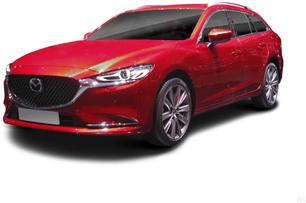
What's the difference?
Has it really been 20 years since the humble Mazda6 station wagon hit our roads? You betcha, but I was more shocked that I remembered when it did!
I have a sudden flashback of questionable fashion choices, glittery butterfly hair clips and how Skipper was making a play at being the coolest 'Barbie' (she wasn't).
I've always had a soft spot for wagons, they are the forgotten heroes for family hauling. It's hard not to glide over them when the market is dominated by SUVs but if you happen to remember they still exist (albeit, barely) you might remember why they were popular back in the day.
Being a 20th Anniversary Edition means there are some nods to the past in this model but unlike the low-slung jeans of my youth, they're stylishly done. With some luxuriously-appointed rivals to contend with, like the Skoda Octavia and Volkswagen Passat, does it offer enough to be considered by a modern family?
My little family of three has been in it all week to find out for you!
Even on its Australian swansong outing, the incredible R35 GT-R continues to perform beyond expectations.
Released in late 2021, the final batch of specials spearheaded by the T-spec in regular GT-R and SV in flagship Nismo guises sold out quickly and are already commanding twice and even thrice their recommended retail prices in private hands.
Nobody ought to be surprised. From its glitzy 2007 Tokyo Motor Show debut (on the eve of a global recession at that), the GT-R has been nothing less than an automotive force of nature, moving with calamitous calm to the beat of its own twin-turbo and all-wheel-drive thrum, like nothing else matters. The R35 has seen off countless assassins in its time, including the Lexus LFA and Honda NSX II.
Some 15 years later, this is what a GT-R in T-spec trim feels like in 2022.
So, what did my family think about the Mazda6 20th Anniversary wagon? Firstly, I like that it drives well and how many luxe features are up front. The trims and body paint look divine but there's a disconnect with family practicality in the back seat. Besides the multimedia system, which 100 per cent needs to be improved, I don't mind the retro-feeling elements in the cockpit but my husband's first comment was that it looked old.
It may be better suited to a smaller and older family that isn't carting around a stack of gear but you get a lot of features for your cash in this model. So, this gets a 7.0/10 from me.
My son didn't spend heaps of time in this one but he liked the colour of it and the seats. He gives it a 7.0/10.
The GT-R of the famous R32 era was a direct response to immortals like the Audi Ur Quattro and Porsche 959 that preceded it in the 1980s.
But the Nissan’s true gift since then is that it has evolved over successive generations, to serve as a glimpse of what these long-discontinued European supercars might be like if they, too, were allowed ongoing development, rather than dropped.
As such, the last R35 GT-R as we know it in Australia is far from disadvantaged, even 15 years on from launch, because it was devised and developed outside of the usual constraints and compromises of mere mass production sports cars.
In 2022, then, the Nissan GT-R remains timeless and transcendental. It’s still an incredibly moving and thrilling driving experience… if you can get hold of one.
At first glance there's not a lot that separates this from its siblings, it's not until you get up close that you notice more shiny chrome accents on the grille, those special anniversary badges on the side and its limited colour options – I hope you like red or white, as those are your only choices!
The wagon manages to look sporty with its 19-inch alloy wheels, full LED exterior lights and the classic protruding nose that Mazda seems known for now.
It's far more obvious in the interior though with the beautiful tan Nappa leather seats, synthetic suede trims and special embossing on the front headrests.
Surprisingly, the dashboard is still headlined by the older 8.0-inch touchscreen multimedia system. There's also the traditional gear-shifter and buttons/dials to deal with. All of which manage to nod to its long history while starting to feel like relics for such a special edition.
Overall, its pleasant and handsome but don't expect to be wowed, Mazda hasn't broken new ground with this one.
At its 2007 unveiling, R35’s design chief, Shiro Nakamura, revealed to your author that the GT-R had to express modern Japanese culture, singling out the giant robots of the Gundam genre.
It also had to look “mechanical”, something highlighted by the squareness and creases. He also mentioned something about “…withstanding fashion trends throughout its lifetime while evolving with the times”, calling out Porsche’s 911 as inspiration. Clearly the circular tail-lights connect with the Skyline originals of the 1960s.
Some 15 years later, mission accomplished.
Six years in the making and with the design locked in during 2004, the GT-R was nevertheless a global project, overseen by Mr Nakamura but with input from Nissan’s US (mainly the rear quarter view) and UK outposts (roofline). The latter remain as striking as ever.
Despite its blocky visage, the R35 boasts an impressive drag coefficient of 0.26 Cd, aided by particular airflow elements and helping it achieve a 320km/h top speed. While the GT-R’s body consists of steel, aluminium and carbon-fibre to contain kerb weight to a very reasonable 1751kg, the latter also partly makes up the platform, further assisting aero.
Hands down, this is the coolest supercar in the world.
The interior is comfortable and well-proportioned but front passengers will enjoy the most room. You'll still feel like you'll be jostling for premium armrest position, though!
Up front, the individual storage is adequate and the open utility tray is large but my phone slid around in it, making it hard to use the wireless charging pad.
There are enough charging options throughout the car to satisfy four people, with two USB-A ports in each row. Curiously, you can only utilise the backseat USBs when the armrest is down, which makes this feel more suited to a smaller family.
The 8.0-inch touchscreen is small and the graphics aren't super clear. You can use it as a touchscreen or opt for the rotary dial but I found switching between the two awkward. Especially, since the touchscreen is disabled while using the (wireless) Apple CarPlay or (wired) Android Auto.
The back seat is quite lean when it comes to amenities and storage. Although, the heated outboard seats are a nice touch, but again, you can only access the controls when the armrest is down.
You can fit up to three (skinny) child seats but with the low roofline, you might not want to be bending over to buckle them in. The door apertures are not too wide either but my six-year-old had no trouble climbing in and out.
For this class, the boot is an okay size at 506L. There is a temporary spare wheel under the level loading space and it's great how the cargo-blind lifts up and away from the space because it's attached to the boot lid.
Unfortunately, this doesn't come with a powered tailgate and I did miss having that feature this week.
“We could have made the cabin much tighter, like a sports car, but we didn’t, because even though it is one of the fastest cars in the world, at the same time we wanted to make enough space to drive every day.”
Those are Mr Nakamura’s words from 2007 again, highlighting how user-friendly the GT-R’s cabin was designed to be.
Ample, sedan-like space is available up front, so people can get in and not feel cramped or hemmed in at all. This is in keeping with the old three-box Skyline philosophy. Australians can see it in the 1973 Datsun 240K, a distant cousin of the GT-R.
Back to 2022, with its fascia angled slightly to the right and the binnacle moving vertically with the steering column, the Nissan's whole focus is on driver welfare, and so making it a better sports car in the process. Storage is excellent, as is ventilation, while vision out is enhanced by the upright windscreen pillars and acutely rectangular side window shapes that offer their own brutalist ambience.
Just a few years ago, the equally squarish dash would have seemed laughably dated – and some of the details still are – but the physical switchgear feels fresh again after an endless wave of newer models with touchscreens and sub-menus that require fiddly prodding, when a button does the job better. That they’re weighty and mechanical in their operation adds to the GT-R’s mystique.
Being a T-spec, swathes of suede-like material also bring real class to the interior, along with the green-on-green colour scheme, chunky gear lever, thick-rimmed three-spoke wheel, hefty paddle shifters and exacting build quality. Actual 3D dials are lovely to behold as well.
Racy, tombstone-style electrically-actuated front seats, too, rise to the occasion, enveloping their occupants with an inviting sumptuousness that brings both comfort and support for hours on end. They also feature a clever curled knob that deftly takes care of reclining and fore-aft duties in one. Does any other car offer such an item?
Several seasons ago, Nissan overhauled the centre console, cleaning up the intimidatingly complicated switches and simplifying the various, customisable digital readouts that provide deeply intricate accounts of engine, driving, performance and vehicle operation data via arcade-game-like analogue-look dials. It’s really over-the-top techy and yet also mid-2000s cool, and that should thrill the curious teenager in us all. The fact that Polyphony Digital of Gran Turismo video-game fame helped develop all this just makes the R35 all the more cooler.
However, the Nissan parts-bin digital graphics, especially in the multimedia system, betray the GT-R's advancing years, as they’re so obviously steeped firmly in another era. They convey info efficiently, but they’re out of place in such as an exciting, hedonistic machine.
Plus, in keeping with a car that was released the same year the original Apple iPhone was, there’s no adaptive cruise control, digital radio and wireless smartphone charger, let alone Apple CarPlay/Android Auto of any description. But you’ll find Bluetooth connectivity as well as active noise cancellation tech at work in there, along with an 11-speaker audio system of outstanding sound quality, a USB port and... even a plug for your iPod.
Moving out to the rear, there are two seats bisected by a centre console that runs the length of the cabin, providing a natural armrest as well as a drink holder and home for a pair of Bose speakers.
The cushions are comfy enough, as are the well-angled backrests, and an average-sized person like your 178cm tester can rest back there for short periods in relative civility as long as they don’t sit too upright to avoid scalps touching the rear window.
Finally, further back, there’s a pleasingly long, deep and wide boot area, offering 315 litres of richly carpeted cargo capacity. A high loading lip and odd shape limit the amount of luggage you can put inside, however, while there’s no in-cabin access like a ski-port or folding backrests. It’s a separate compartment.
But, like the rest of the Nissan’s cabin, the GT-R remains appealingly practical for a supercar. As Mr Nakamura said, “…you can use it for daily life, anywhere and anytime.”
As the name suggests, this is a special edition and it bumps the Atenza from its usual 'top spot' in the model line-up. Yet, for a top-model it is spectacularly well-priced at $54,935, before on-road costs.
That places it below the Volkswagen Passat 162TSI Elegance ($57,190) and above the Skoda Octavia RS 180TSI ($53,090) wagons.
You get all of the features of the Atenza, like the luxurious heated and ventilated front seats, heated rear outboard seats, heated steering wheel and a sunroof.
Then, you'll also be enjoying the 20th Anniversary badging on the exterior, tan Nappa leather seats with that same badging embossed on the headrests and a delightful synthetic suede trim on the dashboard.
Other features include some nice tech, like wireless Apple CarPlay and wired Android Auto, dual-zone climate control and a premium Bose sound system with 11 speakers, but more on tech below.
To bring you up to date, the current GT-R has had to be discontinued in Australia because it fails to meet a recent Australian Design Rules stipulation that requires older-model new vehicles to be side-impact crash tested.
Don’t fret though, because a redesigned version of the current model is expected sometime in 2024, meaning that the next-generation model – probably dubbed R36 – will continue with an albeit revised version of the brilliant 3.8-litre twin-turbo V6.
More of the same, then. And we’re not complaining.
For Japan’s only mass-production supercar, conventional value-for-money parameters never applied to the R35 GT-R. From $193,800 (all prices are before on-road costs), the 419kW/632Nm, 2.7 seconds to 100km/h and 320km/h entry-level Premium significantly undercuts and outruns esteemed competition like the Porsche 911 Carrera (from $241,200) and Mercedes-AMG GT (from $294,077).
Likewise, if you were canny enough to nab one of the 28 examples of the T-spec imported to Australia (out of only 100 globally) from $256,700, then congratulations; you might double your money selling it right now. Rivals with similar performance include the Aston Martin Vantage from $299,462, BMW M850i xDrive from $285,900, Jaguar F-Type 5.0L V8 R P575 AWD from $270,265 and Porsche 911 Turbo from $404,900.
The T-spec fills the gap between the $199,800 Premium Luxury and 441kW/652Nm Nismo from $378,000; the latter ushers in substantial body, chassis, engine, suspension and braking modifications gleaned from GT3 racing experience, that helps shave 0.2s while boosting V-max by 10km/h. Along with the 911 Turbo, this puts the Nissan in league with the Lamborghini Huracan, BMW M8, Aston Martin DB11, Mercedes-AMG GT R, Ferrari Portofino, Maserati MC20 and McLaren 570S. And that’s before considering the even-lighter SV flagship.
Value, then, is relative.
Soaring resale potential aside, whether the T-spec brings nearly $70,000 worth of enhancement to the GT-R experience is debatable. And nowadays, academic.
As in all grades, you’ll find active torque transfer AWD, adaptive dampers, composite ceramic brakes, selectable driving modes, limited slip differential, gearshift paddles, dual-zone climate control, cruise control, an 8.0-inch multimedia touchscreen with satellite navigation, 11-speaker Bose sound system, keyless entry/push-button start, auto LED headlights, rain-sensing wipers, heated/electric mirrors, Brembo brakes, 20-inch Rays wheels wrapped in Dunlop SP Sport Maxx tyres, a carbon-fibre engine brace, titanium exhaust system, heated and powered front seats and semi-aniline leather applied to the upholstery, steering wheel, gear shifter, dashboard and door trims.
The T-Spec meanwhile, scores Brembo carbon ceramic rotors measuring in at 410mm (up 20mm) and 390mm (up 10mm) front and rear respectively, gold-painted 20-inch alloys and a carbon-fibre spoiler, while a dark green hue, quilt-stitched Alcantara roof lining, suede A-pillar trim and special kick plate finishers complete the interior changes. It also brings back two historic colours from the early-2000s R34 – Midnight Purple and Millennium Jade.
Also redolent of the first decade of the millennium are a distinct lack of modern active and driver-assist safety systems, so you won’t autonomous emergency braking (AEB), lane support systems, blind-spot monitoring or adaptive cruise control. Instead, your lot is limited to six airbags, anti-lock brakes with electronic brake-force distribution and brake assist, stability and traction controls, active cornering headlights, a hill holder, front and rear parking sensors, a reverse camera, tyre-pressure monitors and 20-inch runflat tyres. The latter means no spare wheel is fitted.
Progress does not wait for anybody or anything – even a Japanese supercar from 2007.
This shares the same engine with the Atenza and that's a 2.5-litre, four-cylinder turbo-petrol one. It has a max power output of 173kW and 420Nm of torque. Plenty of oomph to get you (and your gear) to where you need to go.
The 20th Anniversary edition is a front-wheel-drive and has a six-speed auto transmission. It's not the smoothest combination at lower speeds but let it stretch its legs and you'll be happy with the results.
Does it get better than this?
The GT-R’s VR38DETT is already steeped deeply in motoring folklore. it really is one for the ages.
But just in case, here are the salient facts. It's a handmade 3799cc 3.8-litre 90-degree V6, with intercooled twin turbochargers, double overhead cams and variable valve timing, pumping out an incredible 419kW of power at 6800rpm and 632Nm of torque from 3300-5800rpm.
Tipping the scales at an entirely admirable 1751kg (kerb), the GT-R boasts a power-to-weight ratio of 239kW per tonne, helping it scream to 100km/h in 2.7s, on the way to a top speed of 320km/h. There’s a launch control system to help the latter out.
Drive is delivered to all four wheels via a six-speed dual-clutch transmission with a trio of modes depending on the level of performance desired, courtesy of Nissan’s traction and yaw-based ATTESSA AWD system. This features an electro-magnetic clutch and 1.5-way mechanical LSD to shuffle between 50 and 100 percent of torque rearwards. Suspension is double wishbones up front and a multi-link out the back.
Weight distribution to 53/47 front-to-rear.
Let's talk about efficiency. It has a combined cycle fuel figure of 7.6L/100km but I only managed to achieve 10.9L. I reckon that's pretty thirsty considering how much open-road driving I did this week but it's not outrageous for a turbo. Expect a higher figure in an urban setting.
Based on the combined figure, you should be able to get a driving range of around 816km, which is perfectly respectable for those wanting to do a road trip.
Given the Euro 5 emissions-rated GT-R’s prodigious performance, a 15.3 litres per 100km result in a mix of urban, freeway and performance driving is actually not too bad. Again, it's all relative.
Nissan’s claims are 12.0L/100km (and 17.2L/100km and 9.0L/100km for the urban and extra-urban runs respectively), for a carbon dioxide emissions average of 281 grams/km.
A sizeable 74 litres of 98 RON premium unleaded petrol is what the recommended tipple is, allowing over 615km between refills.
This is a car that knows what it is and stays in its lane. It's not trying to be the best but it certainly comes close with how it handles itself.
The lower centre of gravity and responsive steering make it hug corners and the car feels firmly situated on the road.
There's enough power that this is a comfy open-roader and you're confident overtaking or getting up to speed but you do feel like you're starting to dig when you hit steeper slopes.
The suspension is a little firm but your backseat passengers will feel that more than you will. Still, it absorbs enough of the bumps that you feel cushioned, even on rough country roads!
The cabin space is fairly quiet but you will get wind noise at higher speeds. Otherwise, all passengers should be able to chat without raising their voices.
I didn't find this to be a bother to park but the 360-degree view camera is terrible. It's very blurry and on the 8.0-inch screen, the image looks small, too.
That said, I love the 11m turning circle and the front and rear parking sensors. Overall, you won't have much trouble parking this one.
Nothing you've driven before is like the experience of familiarising yourself with a GT-R, going from initial intimidation to trust and cooperation. This is a supercar for all moods and seasons.
Above all, though, and even without the launch control activated that helps it get to 100km/h from zero in 2.7 seconds (making it still one of the fastest production cars in the world), the Nissan is ferociously fast.
That’s no shock at all, but what is further imprints on you the GT-R’s outstandingly broad capabilities, since it can pussyfoot about in Comfort mode like any reasonably well-sorted grand-touring sports sedan, like a tame lion. In such circumstances, the car's mechanical congeniality is testimony to the sheer scale of engineering talent going on behind the scenes.
Choose Sport or Race modes, and the forces that the 3.8-litre twin-turbo V6 unleash are nothing short of seismic, swelling up and subsuming you in a tidal wave of relentless thrust that just doesn’t let up. With the exhaust wailing and the scenery blurring by, it is starkly clear that the GT-R is a supercar of tremendous speed.
Over the years, Nissan has improved the dual-clutch transmissions operation, reducing the driveline's abrupt clunkiness that marred earlier versions, for a smoother and yet still bolt-action rifle-rapid shifter that serves to facilitate all that walloping performance. In the sportier modes, with the configurable dampers, torque split and traction settings unshackled, a ham-fisted driver can still illicit a thump from the gearbox as it clumsily engages the ratios required, but overall, it’s a far-more seamless mover and shaker than before.
As you’d expect, the steering walks a fine line between agility and heft, responding calmly yet quickly, for direct and decisive handling. The GT-R feels hunkered down at all times, and it seems to dig in even more as you turn up the wick, unfazed by turns or the state of the road below.
What’s impressive is just how deceptively fast this is, since the car glides along so effortlessly. Yes, there is the engine's alluring aural soundtrack to remind you of the vast speed you potentially might be doing, but the chassis’ incredible control numbs your sense of speed.
While the suspension is set up for firmness, the adaptive dampers help calm the ride, bringing a sophisticated suppleness over most urban terrain. There isn’t much ground clearance at 107mm, but the double wishbones and multi-link arrangement does a terrific job filtering out the bad stuff. Furthermore, backed up by fiercely instantaneous brakes, the Nissan never feels nervous nor unsettled.
Sure, it’s far from quiet, with a decent amount of road noise droning through over some types of country roads, but it’s rarely challenging or distracting. The large turning circle is one of the few faults, in an otherwise satisfying driving and dynamic experience.
It's important to note that, though the styling has hardly changed over the years, the GT-R has evolved and developed for the better over time. For a supercar, its range stretches from benign to ballistic and from mellow to unmerciful, with towering confidence and control.
There are 28 very lucky drivers in Australia right now, wondering whether the replacement will also display Miss Congeniality and Conan the Barbarian with such charming authority. Drive a GT-R to realise how close to greatness it remains to this day.
Safety is important on any car, but more so on a family one. I'm happy this has the usual specs, like daytime running lights, lane keeping aid, lane departure alert, blind-spot monitoring, rear cross-traffic alert, 360-degree view camera, front and rear parking sensors and intelligent seatbelt reminders.
I like the fact the adaptive cruise control now has a stop and go function and that traffic sign recognition and a head-up display are included.
The autonomous emergency braking (and forward collision warning) with car, pedestrian and cyclist detection, is operational from 10–80km/h (a little slower than the average 5.0km/h).
It has a maximum five-star ANCAP safety rating but it was done a while ago in 2018. It only has six airbags which is a bit low for a family vehicle now but that does include curtain airbags covering both rows.
There are ISOFIX child seat mounts on the outboard rear seats and three top-tether anchor points across the back. You may get lucky with three skinny child seats but two will fit best.
A 0-4 rearward facing child seat can be installed but will encroach on front passenger comfort, especially if they're tall.
There is no Euro NCAP or ANCAP crash-test rating for the Nissan GT-R.
Standard safety features include six airbags (a driver’s knee airbag, dual frontal, side chest and head-protecting airbags for the first and second row), rear view camera, parking sensors, anti-lock brakes with electronic brake-force distribution and brake assist, stability control, traction control, tyre-pressure monitors, LED headlights with active cornering and light sensitivity and rain-sensing wipers.
Given the GT-R’s age, you shouldn't expect nor find AEB, forward collision warning, front- or rear cross traffic alert, lane departure warning, lane keep assist, blind spot monitor or any other modern driver-assist tech. This Nissan is from when Silverchair's Straight Lines topped the charts.
There are, however, two ISOFIX points as well as two top tethers for straps in the rear seat area.
The ongoing costs match the purchase price for their affordability. This has a five-year/unlimited km warranty, which is pretty normal for this class.
However, on the five-year servicing plan, services average $501 per service - which is very competitive for this class! Servicing intervals are also reasonable at every 12 months or 15,000km, whichever occurs first.
You're not even getting hit with the fuel pricing you can see on other mid-range models because this accepts a minimum of 91 RON petrol and is even E10 suitable.
The warranty period is for five-years/100,000 kilometres, with service intervals fixed at every six months or 10,000km – whichever occurs first. There is also five years of roadside assistance.
Unlike all other Nissans officially imported in Australia, there is no capped-price servicing for GT-R. And it requires specially trained service technicians so contact Nissan to find out which dealers can carry out the task.