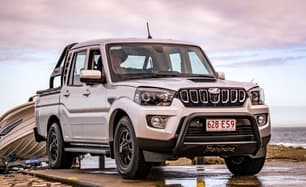
What's the difference?
The current generation Mahindra PikUp has been with us since 2007, which is a long time given major players in this market tend to introduce a new generation every decade, or close to it.
However, with Mahindra reportedly developing an all-new ute, based on the underpinnings of its latest Scorpio SUV, the budget-priced PikUp is destined for retirement within a few years.
Better late than never, the latest MY23 version of the S11 dual-cab has for the first time been equipped with an automatic, which is sure to increase buyer appeal in a market in which self-shifting transmissions rule.
We recently revisited this Indian-built dual cab to see how it measures up for tradies in such a competitive market.
The ninth-generation Toyota HiLux is not really a new HiLux in the true sense of the word, but there’s enough going on with it to have generated plenty of excitement in the ute-loving public.
This ‘new’ HiLux, in essence, is an update but it’s an update with substance: the HiLux now sports a new retro design, new interior layout, new suspension tune (softer rated springs and dampers for improved on-road comfort) – and it even has an electric park brake now.
So, with no major mechanical upgrades, is this HiLux enough of an improvement over past iterations to warrant your attention?
Its sub-$40K pricing undercuts the cheapest Ford Ranger or Toyota HiLux 4x4 equivalents by $10-15K and it’s backed by a decent warranty and 60-strong dealer network (mostly regional). It’s also largely absent from the federal government’s vehicle-recall listings, which suggests solid build quality.
However, it’s also short on safety, has relatively high servicing costs and numerous design quirks. Fact is, such low pricing comes with compromises, so, if you can learn to live with those, this sturdy and willing auto-equipped workhorse could represent good value for those shopping on a budget.
The Toyota HiLux SR5 now feels nicer and more modern inside and out and it no longer lags behind some other utes – even some of the cheaper ones – in terms of comfort, refinement and all-round driveability.
Toyota has in the past been guilty of sometimes doing the bare minimum when it comes to producing a ‘new’ vehicle – especially LandCruisers or HiLuxes – but this time even though this HiLux is definitely not a new model, the exterior revamp and interior refresh have added more than enough to the HiLux package to keep fans and new buyers happy.
This is the best HiLux so far.
The PikUp has a 3040mm wheelbase and 5175mm length, 1820mm width and 1915mm height.
So, compared to a Ford Ranger XL equivalent, it’s 230mm shorter in wheelbase, 195mm shorter overall and 98mm narrower, so it’s relatively compact for a dual cab ute.
Built on a traditional ladder-frame chassis, its twin-wishbone front suspension uses torsion bars instead of the more common coil springs, while under the tail is a leaf-spring live rear axle. Brakes are front discs and rear drums.
With 210mm of ground clearance, its steep 34-degree approach angle is excellent but its 15-degree departure angle is less than half that figure, so it's prone to tail-dragging in the rough stuff.
And its bafflingly large 13.4-metre turning circle (kerb-to-kerb) demands numerous three-point turns.
The interior appears to have a good standard of finish and provides a visually-pleasing mix of black and grey surfaces with satin chrome highlights throughout. Driver controls are easy to see and operate and the front bucket seats are comfortable.
The rear bench seat is quite firm with good lumbar support, but it’s a squeeze for three adults given its relatively narrow width.
Even so, there’s adequate kneeroom and heaps of headroom even for tall adults, which is no doubt appreciated by hat-wearing farmers and tradies.
This HiLux is 5320mm long (with a 3085mm wheelbase), 1885mm wide and 1865mm high. No change there.
It does, however, have a new distinctive front end incorporating a revised design, which includes LED headlights, retro-style ‘Toyota’ brand across the front, and honeycomb-style mesh grille.
Initially I wasn’t keen on the HiLux’s revised front end, but it looks a lot better in the metal than it does in photos and it has grown on me.
This ute’s profile remains the same as before, but the rear end has also been given a sly slap and tickle, giving it a squared-off look.
The interior has also undergone a glow-up – there’s a real 250 Series LandCruiser look and feel to this cabin – and it now has a 12.3-inch touchscreen multimedia system rather than the old 8.0-inch unit.
It still has plenty of hard plastic surfaces but, overall, the HiLux interior doesn’t look or feel anywhere near as old as it used to.
While it remains definitely a HiLux, the new look brings this Toyota ute closer to its rivals, such as the Ford Ranger, in terms of contemporary styling.
With its 2115kg kerb weight and 3150kg GVM, the S11 PikUp offers a 1035kg payload rating so it’s a genuine one-tonner.
It’s also rated to tow up to 2500kg of braked trailer but given Mahindra doesn't publish a GCM rating (or how much it can legally carry and tow at the same time) we don’t know if it can retain its maximum payload while towing that weight.
Strangely, the load tub does not have any internal load-anchorage points. The only option for securing ropes or straps are external hooks, which are located along both upper sides of the tub and across the tailgate.
However, these would be ineffective in securing loads that are lower than the tub sides.
Front cabin storage is limited, as there are only narrow bins and no bottle holders in the front doors and you won’t find any cup/bottle holders or storage for small items in the dash, either. However, there is a single glove box and an overhead glasses holder.
The centre console has an open storage tray at the front and single cup and bottle holders in the centre, which are fine for one occupant but not two.
In contrast to the front doors, there are no bins in the base of each rear door, but they do get a large-bottle holder and what looks like a phone holder at mid-height.
There are also pockets on each front seat backrest, but the fold-down centre armrest does not have any cup/bottle holders.
The rear bench seat’s base cushion is fixed, so it can’t swing up and be stored vertically (like many dual cabs) if more internal cargo space is required.
However, it does at least provide some open storage space underneath for soft items like jackets etc.
The HiLux cabin is very familiar – you know where everything is and how to use it and that’s reassuring – but besides some minor changes and the introduction of an electric park brake the most noticeable change is that aforementioned new 12.3-inch unit.
Apple CarPlay is easy to get working via the multimedia system, and the screen is now big enough and clear enough to operate with ease.
Beyond that, there are plenty of durable hard plastic surfaces, numerous storage spaces, a reasonable number of charging points up front – two USB ports as well as a wireless charging pad and two 12V sockets and a 240V socket inside the centre console.
The driver’s seat is power-adjustable and comfortable without ever being at risk of being described as “plush”.
The rear seat is on the wrong side of squeezy across the shoulders and is best suited to accommodating three children, three jockeys or two adults.
People seated back there have access to two USB-C ports, bottle holders in each door and a dual cupholder in the fold-down centre armrest.
In terms of packability for touring, the SR5’s tub is 1550mm long (1100mm between the wheel arches), 1520mm wide and the load space itself is 490mm deep. Load height is 830mm.
There is nothing extra-special going on in the SR5’s tub – no marine-grade carpet, LED strip lighting, or hidden storage compartments – but it does have four tie-down points.
In terms of practicality, the HiLux, while it does have a barebones approach, still holds its own against the likes of the Ford Ranger.
Our S11 PikUp test vehicle is available only with a 2.2-litre four-cylinder turbo-diesel engine and new Aisin-sourced six-speed automatic, for a list price of $38,500, drive-away.
Our example is also equipped with a Mahindra genuine accessory winch-compatible steel bull-bar which adds $3500 (fitted).
The S11 comes standard with 16-inch alloy wheels and 245/75 R16 tyres with a matching spare.
There’s also LED daytime running lights and dusk-sensing halogen headlights with static bending (which automatically illuminates inside kerbs when cornering at night), front fog lights, rain-sensing wipers, side-steps, rear sports bar, load tub-liner, automatic rear diff-lock, reversing camera and more.
There’s fabric-trimmed seating for up to five occupants, with the front bucket seats equipped with unusual but welcome fold-down inboard armrests.
There’s also a USB port, two 12-volt outlets, centre console air-vents for rear passengers and a multimedia system controlled by a 7.0-inch touchscreen with multiple connectivity options, including links for Apple and Android devices.
Mahindra also offers a genuine accessories range, from towbars, nudge bars and bullbars to engine snorkels, wheel options and lots more.
The SR5 sits in the middle of the HiLux line-up. This version – with a six-speed manual gearbox – has pricing starting at $63,990 before on-road costs. Our test vehicle has Toyota’s premium interior pack ($2500) and premium paint ($675).
Standard features include a 12.3-inch touchscreen multimedia system (with wireless Apple CarPlay and Android Auto plus wireless charging), eight-speaker stereo, dual-zone climate control, and 18-inch alloy wheels.
Other features include high-grade LED headlights, a “comfort-oriented” leaf-spring rear suspension tune, larger front brake discs, power-folding, heated exterior mirrors, an integrated tow-bar, as well as LED tail-lights and LED rear fog lights.
Exterior paint choices include 'Glacier White', 'Frosted White', 'Ash Slate', 'Eclipse Black', Feverish Red' and 'Sunglow'. Some – like 'Stunning Silver' on our test vehicle – cost $675.
The HiLux offers reasonable value for money when cross-shopped against the likes of Ford Ranger, especially the XLT (approx. $64,000) or Sport (approx. $72,000) variants.
The latest version of the S11’s 'mHAWK' 2.2-litre four-cylinder turbo-diesel meets tough Euro 6b emissions standards using AdBlue.
Armed with an intercooler and common-rail fuel injection, it produces a modest 103kW at 3750rpm. Its 320Nm, available across a 1300rpm-wide torque band between 1500-2800rpm, highlights good flexibility particularly under load.
It’s coupled with an equally refined Aisin-sourced six-speed torque converter automatic transmission, driving the rear wheels and offering the choice of sequential manual-shifting.
There’s also a Borg Warner part-time dual-range 4x4 transfer case and an Eaton automatic rear diff-lock.
This SR5 has a 2.8-litre four-cylinder turbo-diesel engine, producing 150kW at 3400rpm and 420Nm at 1400-3400rpm and a six-speed manual gearbox; the six-speed auto SR5 gets 500Nm at 1600-2800rpm and auto HiLuxes also have the 48-volt mild-hybrid technology onboard.
This is a proven engine-and-gearbox combination, with plenty of lowdown torque, and it’s more than a match for the likes of Ranger and D-Max/BT-50 in terms of overall performance.
This SR5 has part-time four-wheel drive and a rear diff-lock.
Mahindra claims an official combined average of 9.3L/100km. At the conclusion of our 265km test, which was conducted without a load and in mostly city and suburban driving, our ‘real world’ figure based on fuel bowser and trip meter readings came in at 9.4 which is lineball.
So, it should deliver an excellent driving range of around 850km from its 80-litre tank.
Official fuel consumption for the manual is listed as 7.1L/100km on a combined cycle. The auto is 7.4L/100km.
Fuel consumption on this test was 9.1L/100km, which is pretty good because I have done a lot of low-range 4WDing.
The SR5 has a 80-litre fuel tank so, going by that fuel figure, you could reasonably expect a driving range of about 879km out of a full tank
The fold-down inboard armrest combined with the door’s armrest allows the driver to evenly rest both elbows, which reduces strain on shoulders and arms particularly during long highway hauls.
This set-up could work even better if the wheel had reach adjustment in addition to its adjustable height.
There’s no rake adjustment in the seat’s base cushion, either, but fortunately there’s a big left footrest to help the driver to maintain a comfortable posture.
The driving position is high relative to the bonnet and the tops of the doors, which is ideal for vehicle placement when off-road driving as it provides commanding views over the front and out the sides.
Unladen ride quality is quite firm, as you’d expect of a 4x4 designed to carry one tonne of payload, but is supple enough to provided acceptable comfort.
The steering weight is linear with easy turning effort; handling and braking response is satisfactory and engine and tyre noise are pleasantly low.
Our only major gripe is the huge turning circle, which is nudging that of a full-size American pick-up. The need to often do three-point turns, in situations that you really shouldn’t have to in a vehicle of this size, is annoying (and in some situations embarrassing).
Although its 2.2-litre diesel has modest outputs, it provides decent performance in city and suburban driving with its smooth-shifting auto.
It’s also a low-stressed highway cruiser, requiring less than 2000rpm to maintain 110km/h which is comfortably within its peak torque band.
We didn’t get to do our usual GVM test due to a hiccup with our weight supplies, but we have previously tested a cab-chassis PikUp with just under one tonne of payload (990kg) which it hauled with an all-round competence that belied its relatively small engine output.
As mentioned, there have been no major mechanical upgrades to the HiLux, but it does now have electric power steering (rather than the hydraulic assistance it’s had in the past). Result? There’s a smoother, more precise feeling to the steering, with a nice weight and balance to it, on sealed and unsealed surfaces.
The HiLux, with a listed kerb weight of 2215kg and a turning circle of 12.6m, is not an insubstantial vehicle but, at the same time, it’s not unwieldy either and manages to feel quite nimble on and off the road.
On sealed surfaces it yields a surprisingly high level of ride and comfort. It’s actually quite compliant, controlled and somewhat refined. That’s largely because this SR5 has multi-purpose suspension on board rather than the heavy-duty suspension, which is on lower-spec, work-focussed HiLux variants for load-carrying duties.
This set-up is intended to offer a softer ride on road – and it does – but off-road it's a different story. Even on minor imperfections (small potholes, minor corrugations and the like) on dirt tracks it tends to thump and bump in and out and it doesn't offer such a comfortable all-round ride as you might be hoping.
I didn’t have much weight onboard – vehicle-recovery gear, a first-aid kit, four Maxtrax and an air compressor – and it will, of course, settle down with more of a load but I was expecting the multi-purpose suspension to be better than it was at soaking up a track’s lumps and bumps – it’s not terrible, but it is noticeable.
However, in terms of pure off-road effectiveness, the HiLux is impressive.
It's never been an underperforming 4WD, it’s simply never been as refined or as comfortably capable as others, such as the Ranger, but it is much more comfortably capable now than it used to be.
There is plenty of power and torque in this HiLux and while this six-speed manual version has 80Nm less than the auto version, it uses what it has really well. The 2.8-litre is a tractable engine and works well as part of an effective powertrain that is well suited to low-range 4WDing. There is a heap of torque at low revs, which is great for low-speed, technical off-roading.
Low-speed throttle response is also impressive, offering nice control when you need it.
I have driven auto HiLuxes in the past and the auto is very clever and it may be your better bet, but I like the manual.
Ground clearance is listed as 224mm and while the HiLux doesn’t have any trouble clearing most jagged rock steps or tree roots you’ll likely encounter on a weekend trip, I didn’t have the opportunity to seriously scrutinise the 700mm wading depth because our testing area was pretty dry. Next time.
Off-road angles – 29-degree approach and 26-degree departure (no rampover is listed) – all check out, even though they are a little shallower than the Rugged or the Rogue variants, they are fine for light-to-moderate 4WDing.
The off-road traction control system in this HiLux is well calibrated and if you do need more dirt-grabbing ability, then this ute does have a rear diff lock.
The only real off-roading weaknesses in the HiLux package are the tyres (Dunlop Grandtrek A/T 31, 265/60R18 110H). They’re not well suited for anything more than light to moderate 4WDing. If you’re planning anything rougher than a well-maintained dirt road in dry weather then consider replacing the showroom tyres with a set of decent all-terrain tires, light-truck construction preferably and away you go.
In terms of towing capacity the SR5 is rated to tow 750kg unbraked, and 3500kg braked.
Payload is a listed 900kg, Gross Vehicle Mass is 3090kg and Gross Combined Mass is 6300kg (a 450kg increase).
While nothing mechanical has changed onboard this vehicle, the combination of 4WD set-up, driver-assist tech, rear diff lock, as well as structural modifications (such as thicker steel in the ladder-frame chassis, a stiffer roll-bar, and reinforced side rails) and suspension tweaks (including retuned dampers and re-rated coil springs at the front, and new dampers and softer spring rates on the live-axle rear) all works well together in this current HiLux package.
The HiLux has now drawn closer to the Ranger in terms of comfortable capability, if not matched it.
ANCAP only awarded it three out of five stars - and that was back in 2012. There are dual front airbags for driver and passenger, electronic stability control and ABS plus a reversing camera and LED daytime running lights.
There are also ISOFIX child seat anchorages and top tethers on the two outer rear seating positions.
The Toyota HiLux SR5 has the maximum five-star ANCAP safety rating, as a result of testing in 2025.
As standard, it has eight airbags (now with a front-centre airbag) and an upgraded suite of driver-assist tech including improved auto emergency braking (AEB), lane-keep assist, adaptive cruise control, and blind-spot monitoring.
Warranty is five years/150,000km. 12 months roadside assist is renewable with each scheduled service at Mahindra dealers.
Service intervals are 12 months/15,000km whichever occurs first.
Capped-price servicing for the first four years or 55,000km totals $2296, or a pricey average of $574 per service.
The HiLux has a five-year/unlimited kilometre warranty.
Service intervals are scheduled for every six months or 10,000km and cost $395 per service.
Toyota Australia has about 300 dealerships across the country.
This type of warranty is pretty standard among the HiLux's rivals so the Toyota ute does remain competitive, in terms of these ownership costs.