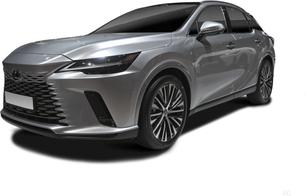
What's the difference?
The Lexus RX holds broad appeal. Families with a bit of money that don’t need a third seating row, older people who love the brand and want a bit of space, and people stepping up into the premium marque from a mainstream brand are all potential buyers.
The fifth-generation version that launched in early 2023 proved to be a significant step up over the previous RX.
Lexus made it more dynamically capable, and there’s been a sharpened focus on refinement, value-for-money and safety credentials.
We spent three weeks getting to know the most affordable RX - the entry-grade Lexus RX350h Luxury two-wheel drive - to see whether it’s worth putting it at the top of your premium family SUV shopping list.
The current-generation Honda CR-V is a deeply impressive vehicle. It’s won a bunch of awards, it’s one of CarsGuide’s top picks for a medium SUV and it’s got decades of heritage.
Despite all this, it’s not as popular as it once was. The Toyota RAV4, Hyundai Tucson and newer rivals, largely from China, have grabbed the attention of Australian buyers.
Halfway through the sixth-generation CR-V's life Honda Australia has improved the offering, and the timing couldn’t be better.
As the fuel crisis looks to be hanging around for a while, Honda has trimmed the pure petrol grades from six to two and added three more hybrid grades. Previously hybrid power was only offered on the flagship e:HEV RS at around $60k drive-away, but now you can get a petrol-electric CR-V for just under $50k.
Not much else has changed with the model year 2026 update aside from some new spec on select grades, but Honda has addressed the CR-V’s biggest criticism by making hybrid power more affordable.
It’s hard to look past the value equation of the RX350h Luxury 2WD when comparing it to almost all its competitors. The pricing is on point, but there are some features missing.
However, there are very few (if any) rivals with a true hybrid powertrain (sorry, mild hybrids do not count), so the RX will capture buyers looking for environmental credentials and efficiency without going full EV.
The drive experience is much better than before and it’s all wrapped up in a very stylish package. The Lexus RX should not be ignored.
What a joy it is to drive such a complete, solid, refined car. Close to three years into its life, the sixth-gen Honda CR-V remains one of, if not the best mid-size mainstream SUV in Australia. I say ‘one of’ as I am yet to drive the new-gen Toyota RAV4 so I’ll wait to test that before giving a final judgement.
The new entry-grade VTi X e:HEV is a winner and you likely won’t need much more kit than what it offers. But you wouldn't regret paying a bit more for the extra spec in higher grades.
Aside from the lack of a space-saver spare wheel in hybrid grades, most of the other negatives are forgivable.
If you are looking for a mid-size family friendly SUV, please go and test drive the CR-V. Very few brands are doing things as well as Honda right now.
Across its five generations, the RX has held significant visual appeal - especially the still-handsome second-gen version that was the first RX sold Down Under. The first-gen model skipped Australia.
The new model that launched in 2023 is a clear evolution of the car that came before, but it’s been softened and sharpened in the right areas, giving it one of the most appealing designs in its segment.
The proportions and design elements like the squat stance, unique C-pillar treatment, slimline headlights and nicely sloping roofline give it a sporty look.
In fact, I reckon it might be the best looking Lexus available today - not including the jaw-droppingly beautiful LC coupe and convertible, of course.
The interior is modern and feels like an evolution of Lexus’ previous cabin design - but elevated. The gloss black section of the dash helps here.
Levels built into the dash break up the bulk, but the interior is very grey. It could do with a dash of colour.
The synthetic leather seat trim doesn’t look premium. If you want a more expensive feeling RX, you need to pay more for a higher grade.
If you’re familiar with the sixth-generation CR-V that launched in late 2023 then you’re familiar with the 2026 version. No visual changes have been made, although the flagship RS now has gloss black mirror caps and door handles.
It is a handsome design for sure, but it doesn’t elevate the medium SUV segment, nor does it do anything different or interesting.
I remember thinking it already looked a bit old when it launched, specifically the entry-grade versions, and given there’s a lot more competition in the segment now, a nip and tuck would've helped.
Nothing has changed design-wise inside. It has an appealing but somewhat conservative design with cool elements like the honeycomb mesh horizontal panel housing the air vents, and the classy chrome dials.
The RX is a five-seat only proposition in this generation - the previous model had a seven-seat option - so if you need a third row you can look at the Lexus LM people mover or massive LX 4x4 SUV, or at any number of other three-row lux SUVs like the Volvo XC90 or new Mazda CX-90.
That doesn’t mean the cabin isn’t practical.
Up front the seats offer excellent comfort levels and ample upper body support, but not a lot of hip support.
Lexus has changed up the door handles for the new RX and it can be complicated - initially.
The interior handles bamboozled every new person that got in my press car over the three week loan. But once you realise it’s a simple push of the thumb on the handle’s thumbpad and a gentle push, it all makes sense.
Lexus calls the electrically activated door handles an ‘e-latch’. Is it tech for tech’s sake? Probably.
I recently reviewed the Lexus LM and commented on how much I like Lexus steering wheels and that’s true of the RX, too.
It has clearly identifiable controls and feels nice in your hands. Thankfully, the cruise control buttons are housed on the wheel too, so no annoying stalk on the wheel.
There’s plenty of space across the front row so you should avoid the awkward driver-passenger elbow bump on the centre armrest.
Under the armrest is a huge central bin that opens on the driver and passenger side. There’s also a big covered storage nook forward of the shifter and another ledge above that, as well as a sizeable glove box.
The doors have ample storage room for bottles, but the space is almost too wide. My bottle slid around when driving so I had to lay it down.
The centre console houses two big cupholders with adjustable depth in one of them. Clever touches like this and the central bin add to the appeal.
As with the Lexus LM, I am a fan of the new Lexus multimedia set-up. It has an easy-to-navigate menu along the side, easy wireless Apple CarPlay connection, and visually appealing graphics.
It’s a world away from Lexus’ previous system. That frustrating touchpad is, thankfully, in the bin.
I quite like the gear shifter with its unusual gate and even the indicator feels and sounds premium.
Small rear windows make for a rear three quarter blind spot, but visibility is otherwise good.
On a side note, the RX has very strong air conditioning - perfect for an Australian summer.
Jumping into the second row, there’s plenty of space all around and no shortage of head, leg, knee and shoulder room. Although foot room under the front seats is tight.
As with the front seats, the rear row offers comfortable seating. Kids should be happy back there.
There’s only a small transmission tunnel so middle-seat legroom is good. And in great news for passengers, the rear backrests recline.
Lowering the 40/20/40 split-fold rear seats for more cargo space is done via a lever on the side of the outboard seats, or by a button in the boot area. There are ISOFIX clips on the two outboard seats.
Other amenities in the second row include map pockets, two USB-C ports, knee-level air vents, climate control, and a pull-down armrest with pop-open cupholders.
Open the power tailgate and you’ll find cargo space of 612 litres with all seats in place, or 1678L with the second row stowed.
That’s a decent amount of space but not class leading. The Mercedes-Benz GLE has 630L and the VW Touareg can swallow 810L.
There’s no under-floor storage because that’s where some hybrid hardware is housed. You will find audio speakers, nice carpet, a cargo blind, two 4.0kg hooks and three top tethers. No spare, only a tyre repair kit.
The CR-V is a medium-size family SUV with a long history of practicality at its core, so it has to get the fundamentals right. And, largely, it does.
Up front the CR-V is a spacious car with ample head room and decent space across. The seats are well-bolstered and comfortable across the model grades. The seats in the RS are almost sports seats with ample side bolsters and black leather-appointed trim with red stitching, but I prefer the cloth trim of the VTi X.
Storage is handled by sizeable door bottle holders, a pair of cupholders up front and a big central bin, with a few other nooks for phones and the like.
Connectivity-wise there’s a pair of USB-C ports and a wireless charging pad on all grades. The multimedia screen is small by today’s standards, but it’s hard to fault its functionality. Large menu tiles are easy to identify and swipe through, and thankfully there is a separate space on the stack for air-con with actual buttons and dials. And the dials look great! Virtually every Chinese brand (and Tesla), please take note.
Google Built-in is a solid system as it allows you to log into your own Google account and access your saved places on Maps. I used this when I reviewed the Accord and barely needed to use Apple CarPlay. On the launch we mostly used CarPlay because of time limitations, and unlike when I attended the original sixth-gen CR-V launch, the Apple connection worked without fault.
Rear-seat space is ample, especially when it comes to leg, knee and toe room, but headroom is impacted in the RS by the panoramic sunroof. There’s scalloping in the roof to help with this, but my head (I’m 6ft tall) almost scrapes the roofliner.
Sadly the CR-V doesn’t have the ‘magic’ seats of other Honda models. That system allows you to fold the base upright on all three rear seats, or even remove the seat entirely, to allow for extra cargo space in the second row. The CR-V just has standard 60-40 split-fold seats.
You also get map pockets on the rear of both front seats, two more USB-C ports, fold-down armrest with cupholders, knee-level air vents and enough space for a small bottle in the doors.
The boot measures a healthy 589 litres for the five-seat petrol, as well as VTi X and L hybrid grades. That drops ever so slightly to 581L for the VTi LX and RS hybrids. And it’s just 150L for the seven-seater with the rear rows in place. The boot in the five-seat versions has a flat floor for easier loading of heavy items, as well as a 12V outlet, hooks, nooks and lights. It’s a decent, practical space.
Only the five-seat petrol grade has a full-size spare wheel. The seven-seat petrol has a space saver spare, while the hybrid has none at all - just a dismal tyre repair kit. That’s not good enough, Honda. Many of your hybrid rivals have at least a space-saver these days.
The range-opening RX350h Luxury 2WD petrol-electric hybrid starts at $86,904, before on-road costs, and for that amount, the standard specification list is healthy. But it doesn’t include everything.
As well as a long list of standard safety gear (see section below), the RX350h comes with three-zone climate control, heated and eight-way adjustable power front seats, electric steering wheel adjust, rain-sensing wipers, a 14-inch multimedia set-up with wired Android Auto and wireless Apple CarPlay, digital radio, sat nav, a 12-speaker audio system, five USB-C (and one USB-A) ports and more.
It is missing a few items, however, that should be standard, such as a head-up display and wireless device charging. Those features are available as part of an options pack - or 'Enhancement Pack' in Lexus speak.
For $5000 more you get those two things and a panoramic sunroof, ventilated seats, a more digital instrument cluster and other goodies.
You can opt for an all-wheel drive version of the 350h and that adds just over $3500 to the price. If you want the same powertrain but more gear then you’ll need to step up to the $110,575 Sports Luxury.
There’s also the petrol-only RX350 in F Sport and Sports Luxury guise, as well as the flagship RX500h F Sport Performance hybrid that tops out at $124,675.
Looking at the opening price of some of its rivals, Lexus has most of them beat.
The Mercedes-Benz GLE300d starts from $144,900, the BMW X5 xDrive30d is $134,900, Porsche Cayenne starts at $138,700 and the Volvo XC90 B5 Ultimate Bright kicks off from $100,990.
Only the Volkswagen Touareg 170TDI ($89,240) and Jaguar F-Pace P250 R-Dynamic ($83,700) are close on price.
There are now six CR-V grades following this model-year update. The two petrol grades are the VTi X and VTi L7. The latter is now the only seven-seat offering after one of the grades was dropped due to low take-up.
Pricing for the petrol versions is actually up a little, with the VTi X kicking off the range at $44,900, a $3000 increase over the former base grade. The VTi L7 is up by $2600 to $54,900. By the way, all Honda pricing is inclusive of on-road costs.
But the hybrids are the big news. The only hybrid used to be the e:HEV RS at $59,900 d/a, but it now starts at $49,900 for the e:HEV X. From there you move up to the e:HEV L at $53,900, then the e:HEV LX at $58,900.
The e:HEV RS is still the flagship and gains some more features as part of the update, but its price has also increased to $64,400.
While Honda should be commended for lowering the price of entry for a hybrid CR-V, the pricing is still a fair bit higher than newer plugless hybrid rivals from China like the MG HS (from $42,990) or GWM Haval H6 (from $40,990 d/a).
Looking at more traditional rivals, the new-gen Toyota RAV4 hybrid starts at $45,990, the Kia Sportage from $44,450, Nissan X-Trail e-Power from $48,915 and Subaru Forester hybrid from $46,490. But remember, these prices are all before on-road costs, whereas Honda’s pricing is inclusive of on-road costs, which can add anywhere from $3000 to $5000. That makes the CR-V more competitive than you might initially think.
For your money the CR-V comes standard with LED headlights and daytime running lights, dusk-sensing headlights, a 7.0-inch digital driver instrument display, dual-zone climate control, keyless entry and start, eight-way power-adjustable driver’s seat, two-tone black fabric seat trim and a retractable cargo cover (not offered on the seven-seat grade).
All grades now get the latest version of Honda Connect which is an app-based system that allows you to remotely lock and unlock the car, as well as remotely controlling climate, lights, the horn and the power tailgate, while also offering car diagnostics, location services and more.
As part of the multimedia setup all CR-Vs now get Google Built-in, which comes with integrated Google Maps, Assistant and Google Play. It also has wireless Android Auto and Apple CarPlay and four USB-C ports.
VTi L grades add black leather-appointed seats, leather-wrapped steering wheel, privacy glass, a ‘Smart’ key card, heated front seats, a 360-degree camera and a 10.2-inch digital driver display which is new to this grade.
The VTi LX adds extra trim flourishes, ambient lighting, DAB+ digital radio, a 12-speaker Bose audio system, auto retractable mirrors (new) and two-tone gloss black 19-inch wheels.
Finally the RS gets unique RS exterior styling, a panoramic sunroof, LED active cornering lights, an extra drive mode, red stitching on the leather-appointed seats and alloy pedals. New to the RS for 2026 is ventilated front seats, heated rear seats, a heated steering wheel and a head-up display.
It’s disappointing to see digital radio only offered in the top two grades when it’s available in $22,000 hatchbacks. And only offering the head-up display in the RS feels cheap, too.
Powering the RX350h is a series parallel hybrid system consisting of a naturally aspirated 2.5-litre four-cylinder petrol engine, a front-mounted motor and a nickel-metal hydride battery.
Lexus doesn’t provide combined torque outputs for the hybrid, but total power for the system is pegged at 184kW.
This drives the front wheels only via a continuously variable transmission (CVT).
Pure petrol powered CR-Vs use Honda’s 1.5-litre four-cylinder turbocharged engine that’s also found in the HR-V and ZR-V SUVs. In the CR-V, it pumps out 140kW of power and 240Nm of torque.
It is paired with a continuously variable transmission (CVT) driving the front wheels only.
The hybrid uses a 2.0-litre petrol engine combined with a hybrid setup and a shift-by-wire E-CVT. The total system output for the hybrid is 135kW and 335Nm. There’s a choice of two front- and two all-wheel-drive hybrid grades.
The CR-V’s power output is less than the RAV4 (143kW) and Forester (145kW), but it offers more torque than the latter (212Nm).
The official combined cycle fuel consumption figure for the RX350h 2WD is 5.0 litres per 100 kilometres, with CO2 emissions of 114g/km. You won’t get figures like that in a petrol or diesel competitor.
Over three weeks of mixed city, country, urban and freeway driving, I recorded 6.8L/100km which is not too bad given some of my spirited driving. The trip computer said 7.0L which is close to my figure.
The RX350h takes premium unleaded petrol and has a 65-litre fuel tank, so expect a range of around 950km based on our real-world consumption number.
Fuel consumption for the petrol grades is 7.1 litres per 100 kilometres for the five seat VTi X, while the VTi L7 is a tad thirstier at 7.3L. CO2 emissions for the petrol SUV is 162-167g/km.
Front-wheel-drive hybrids sip 5.5L and all-wheel-drive versions consume 5.7L. CO2 emissions for the hybrids range from 125-131g/km.
Hybrid versions of the Kia Sportage drink between 4.9-5.3 litres, while the new-gen RAV4 sips just 4.5-4.6L. The CR-V is not the most efficient hybrid in the medium SUV segment, but it’s more frugal than most petrol engines.
The theoretical driving range of the CR-V hybrid is close to 1040km, while the petrol CR-V is 804km.
Both powertrains are rated for Euro 6b and they can both drink 91 RON fuel.
The old RX was competent and even nice to drive but not a patch on the likes of the BMW X5. The new-gen RX improves on that in a big way.
It offers solid acceleration from a standing start. Lexus says 8.1sec from 0-100km/h - without giving you chills. The sportiest RX is the 500h Performance hybrid and that covers the same distance in 6.2sec.
The transition from electric power to petrol propulsion is more evident in this model than it was in the LM350h people mover I tested recently - the RX is a little noisier. The CVT doesn’t help this, offering up an uninspiring engine note.
It is, however, a much more fun car to push into tight bends than the previous RX. It remains reasonably flat in corners, and pulls out of tem with ease, but can’t compare to the dynamics of the dearly departed IS sedan.
The 19-inch tyres have large sidewalls and as a result soak up harsh bumps on the road. The non-adaptive suspension is tuned for better dynamism, meaning the ride quality is on the firm side.
The front-wheel drive RX lost traction for a second on a sweeping uphill section of my drive route, but the electronic traction systems otherwise kept the big SUV in check.
But around town in urban areas, there is very little to complain about behind the wheel of the RX350h.
It’s been about two-and-a-half years since I attended the CR-V launch and it’s always good to reacquaint yourself with a car, particularly one I was so impressed with.
The CR-V has a few more rivals than when it first went on sale. A lot of them are from Chinese brands. But even with the fierce competition in the segment, the CR-V remains an absolute standout.
Honda didn’t have any petrol grades at the launch, which isn’t surprising given the Japanese carmaker expects hybrids will make up a whopping 85 per cent of CR-V sales by the end of this year.
The two-wheel-drive VTi X e:HEV is the most affordable hybrid grade and it should appeal to a lot of potential buyers. This does not feel like a base grade car in terms of the cabin or how it drives. The cloth seats are the only giveaway that it’s not a higher grade.
Honda engineers have managed to produce something rare - a silky-smooth hybrid system. The company is using the word ‘smooth’ in its TV ads for this car, but for once the ad execs got it right.
The powertrain operates on electric power until highway speeds but the transition to the petrol engine is seamless. If you floor the throttle you’ll hear the engine, but it’s a pleasant note. Certainly more appealing than the sound of Toyota’s petrol-electric hybrid on the go.
Acceleration is brisk enough for a car like this. Not overly quick, but it’s linear and the build up to higher speeds feels natural yet still urgent when required.
There is no whine from the electric CVT, in fact it is virtually unclockable. I don’t love the shift-by-wire transmission buttons. I’m fine with buttons rather than a traditional shifter generally, but it’s the layout of the Honda buttons that’s unnecessarily confusing.
When it comes to ride and handling, the CR-V excels.
The launch drive from Melbourne up through the Yarra Valley to Marysville features some of the best driving roads within an hour or so of the city. A carmaker would only include these roads in a test loop if it was confident of the vehicle’s dynamic ability.
In both two- and all-wheel drive guise, the CR-V hybrid exhibits excellent body control, thanks to a well-balanced chassis. It carves through tight, twisty sections like a car half its size and never feels like it will lose control.
The ride quality is hard to fault. Those roads are littered with shockingly large potholes, the sort that could damage a lesser car. The CR-V eats them up with barely a hint of disruption in the cabin. Given the rough ride of some newer rivals it’s a pleasure to drive a car with such a well-sorted suspension setup.
The cabin is well-insulated from external noise, but that engine note will be evident if you switch to Sport mode and give it a bootful.
There’s an overall feeling of quality behind the wheel of the CR-V. This company has been building cars for 60 years and it shows. I would happily live with a CR-V as my daily drive.
The RX comes packed with standard safety gear and the SUV was awarded a maximum five-star crash safety rating from ANCAP in 2022.
Just some of the inclusions are auto emergency braking with pedestrian (day/night), cyclist (day/night) and motorcyclist (day) detection, intersection assist, emergency steering assist, driver monitoring, lane keeping aid and lane departure warning, adaptive cruise control, front and rear parking sensors, blind spot monitor (including stationary) with rear cross-traffic alert and safe exit assist to avoid 'dooring' incidents.
I must say, Lexus’ (and parent company Toyota’s) driver assistance tech has come a long way.
In the early days of the pandemic during a rare non-lockdown period in Melbourne, I drove from Melbourne to Sydney in the previous-generation Lexus RX200 Sports Luxury.
The lane keeping system and adaptive cruise control were shockingly underdone. The cruise control would simply stop working when you encountered even a slight downhill section.
Not anymore. The new, smoother lane keeping set-up uses subtle wheel adjustments, unlike the ping pong effect of the previous RX, and the cruise system is now very much in control of the speed.
The Lexus safety suite now operates without too much intervention and is hard to beat among its key rivals.
Aside from the addition of a head-up display and 360-degree camera on some variants, post-collision braking is now standard across the range. Not much else has changed on the safety front for the 2026 CR-V.
It does come standard with the main active safety gear such as auto emergency braking, forward collision warning, lane-keep assist, traffic jam assist, blind-spot monitoring, adaptive cruise, traffic-sign recognition, rear cross-traffic alert, driver attention monitor, tyre pressure monitor and a road departure mitigation system.
There’s even an acoustic vehicle alert system for the near-silent hybrids.
It has eight airbags, including a front-centre airbag that helps mitigate against injury between driver and front passenger in the event of a side crash. The curtain airbags reach to the third row in seven-seat versions.
It’s great that Honda now offers a surround-view camera but why not just offer it across the entire model range?
The CR-V still has a four-star ANCAP rating from testing in 2024. Honda has no plans to have the car re-tested.
On the road, Honda’s ADAS calibration works as these systems should. It intervenes only when necessary. You will feel a tug of the wheel if crossing a road marking, but it’s unobtrusive and just works away in the background.
Given how over-the-top systems from rivals like Kia, Hyundai, MG, Chery and Geely are, it’s refreshing.
The RX350h is covered by a five-year, unlimited-kilometre warranty, and the servicing schedule is every 12 months or 15,000km.
There’s a capped-price servicing plan lasting five years and it will cost $695 per service. That's significantly less than some rivals like the Mercedes GLE.
The RX is covered by the 'Lexus Encore' loyalty program and includes complimentary service loan cars, fuel offers as well as discounts and other offers with Lexus partners.
Honda’s ownership proposition is solid, thanks to renowned reliability and an extensive dealer network across the country (more than 80).
The CR-V is covered by a five-year/unlimited kilometre warranty.
Yes, that term length looks a bit average by today’s standards when so many have seven and 10-year terms. However, Honda offers an additional three years - bringing it to eight - if you service with Honda dealers.
Nissan and Mitsubishi advertise a 10-year warranty, but it’s conditional, as long as you service with their dealer network. The difference is Honda promotes it as an add-on, whereas Nissan and Mitsubishi splash the 10-year figure first and foremost, with caveats. Honda’s marketing of its warranty just feels a bit more authentic.
Hybrids come with an eight-year battery warranty, too.
The service schedule is every 12 months or 10,000km. That would be more competitive if it was 15,000km.
But the rest of the aftersales offer is excellent. It includes five years of roadside assistance and services are capped at just $199 per visit for the first five years.