What's the difference?
The Lexus LX range has undergone significant updates across the board and the carmaker has also introduced an off-road-focused variant, the Overtrail, to the Aussie market.
The LX500d Overtrail is geared up for 4WDing and, as such, is kitted out with front and rear locking differentials, Toyo Open Country all-terrain tyres on 18-inch rims, as well as a stack of driver-assist aids – including the proven Multi-Terrain Select from Toyota’s LandCruiser 300 Series – all aimed at making you The Absolute King of the Dirty Weekend.
But, being a Lexus, the Overtrail is of course on the right side of premium, replete with a features list as long as … something that is long.
So, how does it perform off-road?
Read on.
The EQE is more than an important car for Mercedes. Not only is it the German titan’s latest electric offering, on all-new underpinnings, but it represents the very future of its passenger car range.
It adopts a completely new shape and design language, but it also puts its fastest foot forward, launching with the 53 AMG variant first in Australia, by the end of 2022.
We travelled to Europe to sample it for the first time ahead of its Australian arrival to find out what the future of Mercedes feels like, but also how its go-fast AMG division has managed to leave its mark on an electric car.
The Lexus LX550d Overtrail holds plenty of appeal for those who’d like to bookend a work week of refined daily driving with a weekend of fun and adventure undertaken in style.
With a full complement of standard features, as well as offering premium comfort and understated design, the Overtrail makes a lot of sense as a potential purchase.
It’s luxurious on the road, capable off-road and the Overtrail holds up quite well if cross-shopped against the likes of Land Rover Defender, Toyota LandCruiser 300 or Nissan Patrol.
In the wild new world of fully electric cars there isn’t really an ‘average’ of what to expect. If there was, I’m sure the EQE 53 would exceed it. Its electrification brings the ambiance of a luxury car, while its performance reminds you of what AMG is capable of.
There’s a bit of the mechanical engagement of AMG missing, a relatively small boot, and some won’t be sold on the function-over-form looks, but the EQE 53 is a pleasantly surprising look at the future of fast Mercedes.
The LX500d Overtrail is 5100mm long (with a 2850mm wheelbase), 1990mm wide, and 1895mm high. It has a listed kerb weight of 2690kg.
It has an almost straight-up-and-down, old-school appearance, and leans more towards the retro-cool end of the design spectrum rather than the sleek end – and that styling, which is THE Overtrail look based on the GX Overtrail, works.
Adding to this 4WD wagon’s overall large-and-in-charge presence are its big front grille, bulging wing mirrors, side steps and those all-terrain tyres.
The Overtrail has black exterior touches (door handles and mirrors, window mouldings, wheel-arch trims), black front and rear bumpers, and bridge-type roof rails that top off its rugged look and further set it apart from its LX stablemates.
There are a lot more identifiably-Lexus, premium-style touches going on inside the Overtrail, including Overtrail-specific premium leather-accented front seats with Monolith colour stitching, Ash Sumi Black ornamentation, a plethora of soft-touch surfaces and a helpful does of durable plastic.
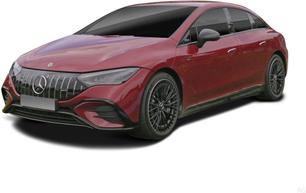
The EQE is certainly a departure from the classic lines of the current E-Class sedan. Mercedes-Benz has chosen to take a completely new approach for the electric era, embracing the need for ultra-low drag designs, and a corresponding newfound love for curvaceous surfaces.
It’s fairly imposing too with enormous wheels and an abundance of panels. Needless to say some will find this new design direction challenging. It proved quite controversial in the CarsGuide office, at any rate.
I can say it looks a bit more approachable when witnessed in the metal, and the AMG branded 53s I sampled for this review added a few more much-needed points of interest to this single curve of a design.
This is particularly notable around the rear of the EQE 53 which adds a little tail spoiler and glossy rear diffuser, which help accentuate the width and terraced design of the rear window.
Around the front is a little more featureless, with the blanked-out grille losing the intricate three-dimensional appeal of this car’s combustion equivalents. There’s just something a bit plain about the EQE’s face, although Mercedes has tried to spice it up with interesting headlight clusters.
The inside is spectacular, with a smorgasbord of screens and lights to match an abundance of glossy touch-based surfaces. Some may not be sold on the over-the-top approach, but it feels as futuristic as an EV should be.
The material choices are nice, too, with soft-touch materials atop the dash, doors, and running down the centre console. The ambient lighting is particularly flashy, and works in with the consistent single-piece sort of design which makes up the whole dash.
While the LEDs might be a little too much for some, there are some more subtle detailing points, like the way the centre air vents are delicately worked into the flow of the dash, and the rotor designs of each vent at the edges are intricate pieces.
Overall, the interior is functional, the build quality is impressive and this is a Lexus so, of course, there are lashings of prestige.
For starters, the seats are comfortable. The 2026 Lexus LX500d Overtrail has a 10-way power-adjustable driver’s seat, and an eight-way power-adjustable front passenger seat and both have four-way Lumbar power adjustment and massager.
The second-row seats in this five-seater are in a 60:40 split folding configuration and are also on the right side of comfortable, which is not always necessarily the case in a 4WD wagon.
The 12.3-inch multimedia touchscreen system dominates the upfront layout and shows navigation, your smartphone desktop, reversing camera view, etc and when off-roading it displays multi-terrain monitor showing the road surface and other conditions.
Underneath that main screen is a 7.0-inch touch display that displays drive modes, adaptive variable suspension, air-conditioning controls and the like.
Both are easy enough to use without hassle.
The driver also gets a head-up display, projected onto the windscreen right in front of the driver, but say hoo-roo to that info once you’ve donned polarised sunnies.
The Overtrail has a powered sunroof/moon roof, whatever you want to call it.
It has plenty of charge points – including two USB-Cs upfront and two for the second-row passengers, and a wireless phone charging pad in front of the cooled centre console – and there are 12-volt outlets front and rear, and a 220V outlet in the rear cargo area.
There are numerous cupholders – upfront and in the second-row armrest – and bottle holders in the doors.
The five-seater Overtrail’s rear cargo area has a 220V/100W socket (to run camp lights, fridge etc), a cargo blind, tie-down points and cup holders on both sides, left over from the seven-seat layout.
Rear cargo space is listed as 1109L with all seats in use, and cargo space is 1960 litres if the second row is folded down.
The rear tailgate is powered and lifts to open rather than swings to the side as the barndoor-style doors do.
Minor gripe: You’d think with the amount of cash you spend on an Overtrail that Lexus would equip the off-road-focused LX with rubber floor mats because its interior should be ready to cop more than its fair share of dirt, sand and mud during its driving days.
The EQE is plenty practical up front, with an odd SUV-like seating position providing a commanding view of the road. This seat positioning isn’t an accident or a necessity of facilitating batteries under the floor, but a deliberate design decision by the brand to try to emulate some design choices which have made SUVs so popular.
The result is surprisingly effective, but doesn’t help the view out of the rear of the car, which is a restricted letterbox aspect courtesy of a slinky roofline and tall boot lid.
Still, peering down on the road lets you position and park this large EV more easily. Adjustability isn’t bad for the front passenger, and space is healthy both in terms of width and height. One dimension which can’t be altered is the particularly tall dash height, and while this is largely overcome by the taller-than-average seat, it could be an issue for shorter drivers.
Storage is great, with a big bottle holder and bin in the doors, a huge cutaway below the floating centre console for storage, with an elastic strap for tying down objects. There are a further two bottle holders in the centre console and a bay with a wireless charger, too, and the split-opening armrest box is deep.
One of the more divisive points of this car’s practicality offering is the screen-based functions. Everything has been moved into the massive centre screen. There are no tactile buttons or dials for this car’s functions, with it all controlled through context menus.
To be fair, with the amount of real estate on offer, the touch elements can afford to be massive, and there is a permanent set of climate controls at the base of the screen, but adjusting these functions on the fly is never as easy without physical feedback.
The same goes for the touch-centric wheel controls. Benz says the idea with the four-zoned touch panels on the wheel is to offer unrivalled ability to control the car’s functions even when the wheel is at an angle, but it is also easy to accidentally hit various touch functions, and they can require some delicate action to use properly.
The back seat is impressive. It maintains the tall seating position of the front, letting you look down on the road as though you’re in an SUV, and the comfortable seating and surfaces continue. Legroom is particularly impressive, with leagues of space behind my own driving position. Headroom is even okay considering the descending roofline. It’s quite dark in the EQE 53 we tested thanks to its black-on-black trim, giving the illusion of a space which is smaller than it actually is.
Storage is good, too, with a big bottle holder in the door cards, quad-zone climate control, complete with a separate touch panel for rear passengers, adjustable air vents, and solid clamshell pockets on the backs of the front seats.
The EQE has a boot capacity of 430 litres which doesn’t seem enormous given the footprint of this car, and no doubt has a lot to do with its slinky aerodynamic design around the rear. There’s no ‘frunk’ either so this is a car perhaps more focused on driving and being driven in than its ability to carry things.
The updated LX range is available as an LX500d in Luxury, F Sport, Sports Luxury or Overtrail spec, all with a 3.3-litre V6 twin-turbo-diesel engine. Or you can opt for the LX600, which is available in Luxury, F Sport, Sports Luxury, Overtrail or Ultra Luxury spec, all with a 3.5L V6 twin-turbo-petrol engine.
Prices start from $158,700 (diesel, excluding on-road costs) or $162,200 (petrol, excluding on-road costs) for the LX Luxury seven-seater through to $220,950 for the petrol-only LX Ultra Luxury.
Our test vehicle, the 2026 Lexus LX500d Overtrail, the supposed off-road hero of the new four-variant LX500d line-up, has a price-tag of $182,300 (excluding on-road costs).
The standard features onboard this five-seater include a 12.3-inch multimedia touchscreen system (with wireless Apple CarPlay and Android Auto), wireless charging, a centre console cool box and more smart device charge points than you can poke a USB-C stick at (six, in fact).
As mentioned, the Overtrail is aimed at being the line-up’s off-road master and to that end it has front and rear locking differentials, Toyo Tires’ Open Country all-terrains (265/70R18 116H) on 18-inch matt grey alloy wheels, an underslung full-sized spare tyre, as well as a stack of driver-assist aids – including the proven Multi-Terrain Select from Toyota’s LandCruiser 300 Series – all aimed at turning you into an off-roading expert.
Exterior paint choices include Moon Desert (on this test vehicle and available only on the Overtrail), Sonic Quartz, Graphite Black, Titanium, Liquid Metal, and Khaki Metal.
All colour choices are standard/no cost on the LX.
We don’t yet know which EQE variants will be offered in Australia. The car we drove for this review, the EQE 53 AMG is the top of the range, and will be the launch variant in Australia, but the brand is yet to settle on how it will fill the line-up underneath.
Representatives said to expect at least two more Mercedes-Benz (as opposed to AMG) branded variants, with the option of a rear-wheel drive entry model and an all-wheel drive mid-grade. Whether they adopt the same spec level as the European-market EQE 350 remains to be seen.
As for the EQE 53, CarsGuide understands a price north of $200,000 is likely when it arrives before the end of 2022.
Its rivals will include other high-end four-door models like the Porsche Taycan, Audi e-tron GT, and the updated Tesla Model S. In the coming years this segment will continue to heat up with the yet-to-launch Hyundai Ioniq 6 and Polestar 5.
The EQE is fairly large, offering dimensions comparable to that of the CLS which came before it, and is quite unconventional in a host of areas.
The standard suite of equipment we sampled is impressive, too, with performance enhancements on the 53 including four-wheel steer, adaptive dampers, a performance brake package, and torque-vectoring all-wheel drive.
Massive 21-inch alloy wheels featured on our car, and there is also the option overseas for even higher performance carbon ceramic brakes.
Outside also features LED headlights, DRLs, and tail-lights, while inside impresses with the massive dash-spanning ‘Hyperscreen’ with panels for the digital dash, centre multimedia screen, and a third panel for the front passenger.
This set-up is optional on the EQE range in Europe, but we’ll have to wait and see what becomes standard for the Australian market. The car we sampled had wireless phone mirroring tech, wireless charging pads, built-in navigation with augmented reality directions, a head-up display with configurable panels, and full USB-C connectivity throughout.
Quad-zone climate also features, as does the brand’s latest steering wheel, in our case clad in Alcantara and leather trim.
The seats, even on the EQE 53 ship standard with the ‘Artico’ synthetic leather trim, although they can also optionally be upgraded to full Nappa leather. Electrical adjustment is standard for the front seats.
It’s a flashy cabin which feels primo, and little touches like unique materials for the EQ range across the dash and ambient lighting configurable to any colour you can dream up are neat, too.
Check in closer to the EQE’s local arrival time before the end of 2022 for more accurate pricing and spec, as well as the list of option packs.
Our test vehicle has a 3.3-litre turbo-diesel engine – producing 227kW at 4000rpm and 700Nm at 1600-2600rpm – a 10-speed automatic transmission and a full-time 4WD system.
This is a big wagon so it takes some encouragement to get going off the mark – it is sluggish rather than zippy around town – but once underway on an open road, especially on a highway, it punts along nicely.
I drove the seven-seater Lexus LX600 Sports Luxury – with a 3.5-litre petrol engine (305kW and 650Nm) – immediately after this test and – with the same dimensions, but 10kg lighter than the Overtrail – it’s more punchy off the mark.
The Lexus LX500d Overtrail has a variety of drive modes including Custom, Comfort, Eco, Normal and Sport S and Sport S+ for on-road driving.
It has front and rear locking diffs, and Multi-Terrain Select (MTS) drive modes for off-roading. Those modes include Auto, Sand, Mud and Rock. Each off-road driving mode adjusts throttle response, transmission shift patterns, wheel-slip control, engine power delivery and braking to best suit the specified terrain.
The EQE 53 punches out huge power, with the standard car producing 460kW/950Nm from its dual electric motor set-up, or with the 'AMG Dynamic Plus Pack', producing even higher figures of 505kW/1000Nm.
Clearly, AMG’s electric vehicles will safely outrun their dramatic combustion predecessors. In fact, with the Plus Pack, the EQE 53 is capable of moving its bulk from 0-100km/h in just 3.2 seconds. Extreme for something carrying a whopping 90.6kWh of batteries under the floor.
Enhancements include torque-vectoring all-wheel drive, all-wheel steer, adaptive dampers, and the choice of standard performance brakes or a carbon ceramic package.
Official fuel consumption is listed as 8.9L/100km (on a combined cycle), but on this test, I recorded 12.8L/100km.
The Overtrail has 110L fuel capacity (80L main tank, 30L sub tank) so, going by my on-test fuel-consumption figure, you could reasonably expect a driving range of about 860km from a full tank.
However, as with any vehicle, once you’ve loaded it with real-world burdens (e.g kids, dogs, camping gear etc) you’ll soon see fuel-use figures increase.
Electric vehicles appear to have the same issues as their combustion counterparts, in that they still drop in efficiency the more powerful you make them. In the case of the EQE 53, this means an average WLTP-rated consumption number between 20.3kWh/100km and 23.2kWh/100km.
'Thirsty' for an EV, although it is on par with the Porsche Taycan and still below Audi’s e-tron S.
When it comes to charging the EQE 53 can charge at a rate of 11kW on the AC standard, or a whopping 170kW on DC - allowing 180km of range to be added every 15 minutes. It also has the convenient option of a 22kW AC charger, a welcome inclusion if you intend to charge your car often at public outlets.
Total range for the 90.6kWh battery is 513km on the WLTP cycle.
On-road, the Overtrail is impressive: refined, comfortable, unstressed and it offers up controlled ride and handling.
The Overtrail sits nicely on sealed road surfaces – it has a wide wheel track and long wheelbase – and it maintains that composed posture even on gravel or dirt tracks.
It does exhibit some body-roll when pitched through country bends but in a large 4WD wagon that characteristic is no real surprise.
Ride quality is impressive and the suspension set-up, including the Overtrail’s adaptive variable suspension which adjusts damping force according to the drive mode selected, manages to smooth out the worst of most surface irregularities. Active height control is worth mentioned here because it's designed to optimise the spring rate to keep this wagon stable during turning, acceleration, and braking.
The 3.3-litre turbo-diesel engine and 10-speed auto are a smooth combination producing plenty of power and torque across a broad rev range.
It's mostly quiet in the cabin though wind noise does emanate from the chunky wing mirrors.
One thing I’m not a big fan of is the digital rear-view mirror. I understand the reasoning behind it as it helps establish visibility where you may not have it – for example, if something you’ve packed in the rear blocks your vision, or a second-row passenger’s massive head blocks your vision – but the slightly distorted view depicted on the mirror isn’t altogether helpful and tends to push me into headache territory on longer drives. That’s my story and I’m sticking to it. Maybe my old eyes need testing?
So, how does the Overtrail perform off-road?
Well, you’d expect it to go pretty well, especially as it is equipped with front and rear locking diffs, and a raft of off-road drive modes.
And it does. Mostly.
Steering is nicely balanced and the driver is afforded so much visibility of the track ahead that, even with a massive bonnet in front of you, it’s easy to get your wheel placement spot-on. The Overtrail also has a 360-degree camera system, so that maximises your chances of putting the vehicle on exactly the correct line.
Courtesy of its off-road modes, diff locks etc, the Overtrail drives with impressive composure through most off-road situations, whether that’s along corrugated dirt tracks, up steep rocky hills or through shin-deep mudholes.
It offers a reasonable amount of wheel travel for a large wagon and it has decent all-terrain tyres – Toyo Open Country (265/70R18) – and they provide plenty of grip on a variety of surfaces: sand, loose gravel, shale, even rain-soaked mud which can be very slippery and can quickly fill up tyre tread.
The LX500d Overtrail has 205mm ground clearance which is industry standard for a larger or upper large SUV, but it isn't great for a vehicle that’s intended as an off-road machine. However, worth mentioning again here is the addition onboard of active height control, which automatically adjusts vehicle height – Normal, High 1, High 2, and Low (for easy ingress and egress) – to match the drive mode you select and the driving conditions at any time.
And while the off-road angles – approach (23 degrees), departure (22) and rampover (22.7) – aren’t fantastic, those measurements are industry standard for a larger and upper large SUV, but again, in a vehicle billed as an adventure machine, those angles could be a lot better. In the Overtrail’s favour the underbody is well protected by substantial bash-plates and the Overtrail’s full-size spare is mounted to the underbody.
Wading depth is an estimated 700mm, which is also in the vicinity of standard for an unmodified 4WD wagon.
The side steps protrude and if you fail to drive with consideration then they'll probably cop a scrape and maybe even a bit of a dent.
Towing capacities are 750kg (unbraked) and 3500kg (braked). Payload is 590kg, which is not a lot once you throw in your kids, dogs, and camping equipment – not to mention anything you might be towing at the time. For reference, a 300 Series LandCruiser's payload, depending on the variant, is between 650kg (VX/Sahara/GR Sport) and 785kg (GX).
The Overtrail’s listed kerb weight is 2690kg, gross vehicle mass (GVM) is 3280kg, and gross combined mass (GCM) is 6780kg.
The way the EQE 53 drives was deeply unexpected. Just looking at this massive sedan, I would have expected it to feel burdened by its batteries, and with its length and shape, cumbersome in the corners. That wasn’t the case at all.
The EQE 53 feels remarkably coherent from behind the wheel. The seating position works well to give a nice view of the road, the steering feels a tad artificial but still direct with some AMG magic having worked its way in.
What surprised me most is how agile it feels. Once you gather some speed and attack some corners, this car shrinks. Control is excellent thanks to the massive tyres, all-wheel drive system, and all-wheel steering. It sounds like a lot of complexity, but you don’t notice any of it. Each system does its part to allow you to simply point the car where you want it to go at pretty much any speed. It is very impressive.
The ride feels supple, too, thanks to adaptive dampers, but offers plenty of control. The speed is Tesla-style violent. Put your foot to the floor in Sport or Sport+ mode and you’re thrown to the back of your seat as the car enters a state of warp. AMG says there won’t be a 63 version of this car, and I can’t imagine why you could possibly need anything faster or more capable than this 53 version. 1000Nm of torque!
This overwhelming number perhaps makes it more impressive that it’s hard to extract a squeak from the tyres. Sure there’s torque-vectoring magic at play, but even at full acceleration they hold on for dear life.
It also makes a noise. AMG is very specific about what went into making the soundscape for the EQE because in the electric era its performance can be achieved silently, and the brand knows full well its badge usually comes hand-in-hand with aural drama.
I stuck it in the stock mode and varied my driving from 'Comfort' to 'Sport+.' The sound builds as the car gains speed, but it also interacts with your accelerator and brake inputs, as well as being one of few EVs with a specific noise for regenerative braking. It sounds… odd.
There’s certainly a kind of drama to it, and to me, it’s better to have it as a way of gaining some feedback from the car. But, its artificial nature and loudness became a little too much for sustained driving in Sport + mode. I found the best balance in the more regular ‘Sport’ mode, or even toned down to ‘Balanced’ which puts it in the background.
This leaves quite a void, though. While the sound is welcome, and the throttle alarming, there’s just something missing from the usually brash AMG badge promise.
As an EV, the EQE 53 has three regen modes quite distinct from one another. Mercedes says the choice to have just three modes is deliberate, as it didn’t want to dilute the personality of the car with an overwhelming choice of regen. The three modes include: basically no regen, moderate regen, and the full regen, essentially a single-pedal driving mode. I preferred the strongest setting for efficiency's sake (plus it brakes for you as you let off!).
The EQE 53 is surprising in so many areas, and much more engaging to drive than its exterior visage might suggest. I’m impressed.
At time of writing, the 2026 Lexus LX 500d Overtrail does not yet have an ANCAP safety rating.
Standard safety equipment includes 10 airbags (driver and front passenger, front knee and side, rear side and curtain), as well as auto emergency braking (AEB), adaptive cruise control, lane departure alert, lane trace assist and lane keeping system (with emergency driving stop system), road sign assist, safe exit assist, facial recognition, driver monitor camera, and more.
Driver-assist tech aimed at making you a better off-roader than you already are includes downhill assist control, hill start assist, crawl control, Multi-Terrain Monitor (MTM) with panoramic view monitor, active traction control, tyre pressure monitor, active height control and more.
We don’t yet know what standard safety equipment will arrive on Australian-delivered EQE variants, but you can expect a high-end suite of gear including auto emergency braking to freeway speeds, lane and blind spot assistance, driver and road monitoring tech, as well as the brand’s rather good autonomous cruise suite.
The EQE pairs the expected set of airbags with an additional driver’s knee airbag and centre airbag for some markets, as well as a second set of side impact airbags for rear passengers. There are dual ISOFIX mounts on the rear outboard seats, and expect there to be the usual three top-tether mounts in Australia, too.
Stay tuned closer to the EQE’s arrival toward the end of 2022 for more accurate specification.
The 2026 Lexus LX500d Overtrail is covered by a five year/unlimited km warranty.
Capped-price servicing applies for five years/100,000km for a maximum of 10 services.
Servicing is scheduled for every six months or 10,000km, whichever occurs soonest and cost per service, at time of writing, is $595.
Mercedes-Benz in Australia currently offers a range-wide five-year and unlimited kilometre warranty, a standard which is spreading to other premium brands.
We don’t know what the service schedule or running costs will look like for the EQE range yet, but expect it to be most affordable when chosen with a multi-year prepaid service plan at the time of purchase. Check back closer to its launch time to see the full details.