What's the difference?
One question frequently discussed in the skunkworks of the CarsGuide office is: What exactly does Lexus stand for?
When the brand debuted its original export-market IS sedan in 1999 the messaging was more or less clear: Toyota’s premium sub-brand was here to be a Japanese BMW.
The brand even employed Nobuaki Katayama – chief engineer on the iconic Corolla AE86 program – to again take the reins of its small rear-wheel drive sedan program.
As the years went on though, Lexus changed. Fundamentally geared toward the US market, the second-generation (wild IS F aside) became a bit more sedate and softer around the edges, while the third generation strayed even further from the sedan’s performance-inspired roots, leaning into a plush interior, hybrid drive, and even CVT transmissions.
This brings us to today’s Lexus IS. Essentially a heavy facelift of the third generation (which arrived back in 2013), the brand has “reimagined” its core sedan with a tweaked design and updated technology for 2021.
Is it enough to keep it relevant against its ever-present European rivals and the newly arrived threat from Hyundai’s Genesis G70? I took a signature IS300h hybrid for a week to find out.
This idea hasn’t always worked out too well. Take a parcel-van (in this case the Ford Transit Custom) strip out the rubber matting and cargo barrier and bolt six or seven seats into what was the load area. Sure, the original vehicle to use this concept, the Volkswagen Kombi way back in the 1950s, got away with it, possibly because there wasn’t anything better around.
Ford has plenty of history with this notion, too. The first Transit of 1965 was also available as a mini-bus, but worked okay because the Transit itself was such a car-like departure from the commercial-vehicle norm.
Things didn’t go so well for Ford in the early 1980s, however, when the Econovan-badged parcel van it shared with Mazda (the E2200) was fitted with eight seats, given some fuzzy velour trim and dubbed the Spectron. And it was dreadful. In fact, so bad, that it made the contemporaneous Mitsubishi Nimbus and the even more forgettable Nissan Prairie seem like vastly superior alternatives to the job of moving people. Only because they were.
Early versions of the Spectron retained the Econovan’s crude suspension, wheezy (and fragile) little engines and even the tiny dual rear wheels that entirely deprived the vehicle of any traction. In fact, dreadful doesn’t even cover it.
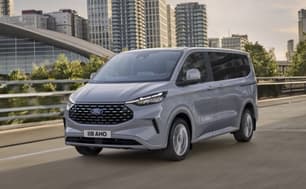
So you can see why Ford might be a bit antsy about me referring to the new Tourneo (a badge that has been around in Europe for decades) as a Transit Custom with extra seats and windows. Yet that kind of sums it up (up to a point, anyway). Luckily, the Transit Custom itself is a pretty sorted thing these days, so maybe Ford has nothing to worry about. Maybe…
Smooth, cosy, quiet, the IS looks and feels better than ever, but without a doubt this hybrid version is a car best suited to cruising the dense metropolis of Chiba at midnight more than it is carving up a bunch of S-bends in the Australian countryside on the weekend.
While that might still limit its appeal for fans of German sports luxury sedans and place it further from the original IS’s ambitions, it does offer an intriguing efficiency and luxury focused alternative, without the compromises brought by rivals with more sporting intent. In a way then, the IS 300h perhaps inadvertently best embodies what Lexus is as a brand.
There’s absolutely no doubt that the van-based people-mover has some distinct advantages over a three-row SUV. The rear seat is bigger, access to it is far better and there’s more luggage space even when all eight seats are occupied. But the Tourneo goes a step or two further with the sliding, swivelling seats that make it one of the most practical and flexible interiors on the market.
True, the driving experience is a bit alien at first, but it’s a case of different, rather than worse. Meantime, the ride is excellent and the performance and economy from the turbo-diesel driveline are both absolutely spot on for this vehicle’s intended purpose.
And perhaps that’s the metaphor for the whole thing: By not trying to be something it’s not, and concentrating on what it needs to do, the Tourneo emerges as a bit of a quiet achiever.
As we said earlier, this type of vehicle concept is never a sure-fire proposition. Parcel vans converted to passenger duties haven’t always worked out. This time, though, it’s different.
Look closely and quite a lot has changed. This is really a story of doing a facelift right. Lexus has kept all the great-looking bits of the car that launched in 2013, like its striking side profile and angular accents, while dumping most of its least popular elements like the spidery front light-clusters and busy front splitter, in favour of something more refined and conservative.
It even adds some new flair in the rear three-quarter, with dramatic LED light-clusters working their way into a trendy highlight strip across the boot lid.
These changes all add up for a much tougher, sportier, and nuanced design compared to the outgoing car. One that manages to make an eight-year old design look as contemporary as ever.
I even liked our test car in its plain black shade, although I'm less sure about those conservative-to-a-fault, almost Camry-esque alloy wheels.
On the inside, sadly not a whole lot has changed. The busy design looked dated when this generation of IS launched in 2013, and it still looks dated now.
The visual assault of buttons, toggles, displays, textures, and trims is a lot to take in, and makes the cabin feel smaller than it is.
It probably didn’t help the sensory overload of this car’s interior as I hopped out of the stripped-back interior in the Tesla Model 3 I had the week before.
My less-than-impressed brother, a student of design, described the IS’s interior best when he told me “It’s a bit maximalist, don’t you think?”
If nothing else, at least Lexus hasn’t blatantly imitated anyone else when it comes to its interior, but the brand remains firm on dorky design items like the laptop touchpad, redundant drive-select dial, and odd vacant panels under the climate unit which do it no favours.
A welcome upgrade for the 2021 model year is the new media screen, a highlight piece perched atop the dash. It’s bright, has excellent contrast, and doesn’t seem to fall victim to glare.
The Apple CarPlay support I used was seamless and sharp and made the most of the available real-estate in its widescreen layout.
I somehow didn’t mind that the instrument cluster in this base car is analog. It almost suits the IS’s character better than a digital set-up would. Also offered is a small information display between the dials which I used for monitoring the hybrid drive.
A final note on the IS’s design. The fit and finish is quality, inside and out. It leaves you with an impression that this is an immaculately built vehicle, one that should be a must for all luxury cars, and always a strong point for Lexus.
Perhaps the biggest revision of the successful Transit Custom formula needed to make the leap from FedEx to Brady Bunch has been to the rear suspension. Where the Transit uses a leaf-sprung arrangement, the Tourneo has switched to coil rear springs. These technically offer much greater ride comfort at the expense of some load-carrying ability. Which is fine, even if your kids are the bigger variety.
The move to powered sliding side doors is a welcome one, but I found out the hard way that the doors will still open a fraction if you push the button while still travelling at low speed. Not sure why that would be, but at least the buttons in question are up front in Adult-Land, not within reach of you-know-who.
The reality is, too, that the Tourneo is destined to run with the air-con on any time you have bodes in the back. That’s because – like a lot of van conversions – there’s no opening side windows beyond the tiny, hinged windows that open an equally tiny amount. This has more to do with the Transit’s basic structure than any desire to oxygen-deprive the young `uns, but as any parent knows, a supply of fresh air on the move is sometimes the only thing between a happy day out and a clean up in Aisle five.
Well, the IS is a sedan, so it doesn’t quite have that high-riding appeal of an SUV, and for this update it has even leaned further into its low-slung proportions with a roofline that descends a further 15mm and a boot lid which is 31mm lower overall.
As with the previous car, the interior is quite closed-in thanks to that busy dash design and large centre console. Rather than feeling claustrophobic though, it is best described as cosy, with lots of plush finishes throughout the doors and centre stack befitting a luxury nameplate.
Adjustability is great for the front two occupants and there are two large bottle holders between the seats, a large but shallow console box under the armrest, bottle holders with adjoining bins in the doors, and a smallish glove box.
That’s about where storage ends though, with no extra trays or bins in front of the oddly placed shifter, just an awkwardly finished plastic panel where it feels like a little tray or storage cutaway should be.
The touchpad for operating the media screen joins an unnecessary drive-select cluster in eating up centre console space where there could be more storage.
The rear seat is quite limited on space despite being lavishly trimmed. I fit behind my own (182cm/6'0") driving position with little knee or headroom to spare.
Again, it’s cosy and very comfortable, but if you're taller or wider than me you may run into issues.
The centre rear seat is all but useless for adults, with the IS’s rear-drive architecture necessitating a huge transmission tunnel that almost comes as high as the seat base itself.
Storage is limited to pockets on the back of the front seats, small bins in the doors that double as handholds, and a drop-down armrest with two bottle holders.
There are no power outlets for rear passengers, but there are dual adjustable air vents.
Boot space is 450L which is a little small for the class. It’s impressive the hybrid only managed to lose 30 litres compared to petrol-only IS variants, though, so best to count your blessings.
The largest CarsGuide travel case easily fit in the wide but short available space.
Here’s where a vehicle like this stands or falls. Because if something like a Tourneo can’t cope with lots of people and their luggage in a single bound, then there’s really not much point to it, is there? I mean you’re not going to buy it for its sporty looks or supercar dynamics, so unless it works brilliantly as family transport, it’s kind of dead in the water. Fortunately Ford seems to have got it right. Mostly, anyway.
That starts up front where the two front seats feel like they’re metres apart. In reality, this huge gap forms a walk-through function for getting access to anything or anyone misbehaving in the second or third row of chairs. But you can’t help wondering what if… What if Ford had ditched the stubby centre console and added a third front-row seat? Wouldn’t a nine-seater be better than eight?
But the seats themselves are comfy and the high-and-mighty driving position gives plenty of vision in every direction. With one exception. And that is when you’re pulling out of a side street on to a main road and need to see what’s coming from the left. Depending on the angle you’re on, the fat frame of the pop-out side window (in the sliding door) becomes a blind spot, especially for taller drivers.
There’s nothing irretrievably wrong with the way the controls are laid out, but they will take some acclimatisation. That goes for the menu system on the touchscreen as well as the column-mounted shifter wand which is about the same size and shape (and in the same place) as a conventional indicator stalk. Tip the lever accidentally and you’ll wind up in neutral, wondering what just happened. The manual-shift mode is also fiddly to use and paddle sifters would be vastly better. Most won’t bother anyway.
The front cabin is home to a shallow lidded bin in the centre console, a deeper bin below that and a couple of charge points. There are also cup-holders in great spots up high in the corner of the dashboard, a shelf across the top of the dashboard and no less than two gloveboxes (the top one is pretty shallow) thanks to moving the passenger’s airbag into the roof lining. Both front doors also feature bins and storage nooks but there’s a fair bit of hard plastic on show, surely a legacy of the Tourneo’s parcel-van DNA.
The Tourneo’s party trick is the way both the second and third rows of seats can be slid to almost any point on a pair of tracks in the floor. The move is simply accomplished via a lever at the front or a rip-cord in the back of the seats, and all three centre-row seats can be moved individually (the third row is split 60:40). The upshot is that you can have all three rows bunched together for a large luggage space, or the rear row pushed right back to form a rear row with huge legroom. Don’t need all eight seats? How about a second row with the two outside chairs in place and the centre one folded forward to expose a work-surface with built-in cupholders.
But it gets even better, because individual seats can be removed to suit the weirdest of loads and the second-row seats even swivel 180-degrees to form a loungeroom on wheels. The kids will be begging you to take them for a drive in this thing.
The seats fold forward, but they don’t tumble. They don’t need to really, and they don’t fold into a bed either. But if you fancy camping in the Tourneo, you can remove both rows of rear seats for a huge flat floor.
The second row is home to storage bins in each sliding door (yes, a door on each side) a pop-put window that opens only about 40mm, temperature controls, air vents and reading lights. The third row, meantime, is not only easily accessed provided the second row isn’t slid all the way back (at which point you wouldn’t be using the third row anyway) but the good news is that the rearmost seat itself is basically three bucket seats with the same comfort levels (high) as the second row. There are also reading lights and a pair of phone pockets and cup-holders in the last row, too. Only the way the track system works and the shape of the seat base means that foot-room is limited to an extent.
With all three rows in place, but pushed as far forward as they can go, there’s a long load area of up to 725mm. But you can also push the second and third rows all the way back and have a cargo area 2622mm long behind the front seats. Maybe the van DNA is a good thing after all.
With all eight seats in place, there’s a minimum of 673 litres of luggage space which can be expanded all the way to a monster 4683 litres with the second and third rows removed.
There’s also a 12-volt power socket and a lighting system in the back, too, although while the side doors are automatic, the tailgate is manual. And you’ll need plenty of real estate to open it, too. Even tall folk will hit the button to open the tailgate, start the strut-assisted opening and then take a step or two back to allow the huge tailgate to rise without clobbering them. An automatic tailgate where you hit the button and run away to a safe distance would be much nicer.
To be precise the variant we’re looking at here is the IS 300h Luxury. It’s the base IS trim with the hybrid powertrain and it wears a before on-road costs (MSRP) of $64,500.
Base car or not, the new IS is very well specified. Now standard are 18-inch alloys (up from 17s), full LED headlight clusters, eight-way power adjustable front seats, dual-zone climate control, 10-speaker audio system, and importantly a brilliant new 10.3-inch multimedia screen with widescreen Apple CarPlay, Android Auto, built-in navigation, and DAB+ digital radio support.
Keyless entry and push-start ignition also continue to be offered, as well as a leather-look interior trim which in our car was in a rather contrasting 'Ochre' colour option.
Our IS 300h was also fitted with the creatively named ‘Enhancement Pack 1’ which adds an openable moonroof for $2000. The significantly more expensive ‘Enhancement Pack 2’ ($5500) adds the moonroof alongside 19-inch alloys, upgraded LED headlights, interior ornamentation, scuff plates, a panoramic reversing camera, 17-speaker premium audio, ‘leather-accented’ interior trim, ventilated front seats, and an electric rear sunshade.
These packs are seemingly largely unnecessary but are also very cheap for a brand at the premium end of the market.
Lexus has made pretty much all of its high-end active safety equipment standard on this base ‘Luxury’ for 2021, alongside some previously unavailable tech which we’ll take a look at in the safety section of this review.
At this price the Lexus IS 300h goes into battle against the Mercedes-Benz C 200 ($66,900), BMW 320i ($70,900), Audi A4 35 TFSI ($55,900), and the ever-looming threat of Hyundai’s Genesis, which offers its similarly-sized G70 in base form at $59,300.
Some of these base-spec rivals are cheaper, some are more expensive, but did you notice none of them are hybrids?
Access to Toyota’s affordable and popular hybrid drive is a real point of difference for the Lexus brand, and we expect it’s a key drawcard for the loyal customer base. More on that later.
If ever the Average Aussie family has been in the grip of a cost-of-living crisis, it’s right now. With that in mind, we’ve chosen the entry level version of the Tourneo, the Active, for this review. At $65,990 before on-road costs, it’s not exactly cheap, but does come in a full $5000 less than the Titanium X version.
And it is pretty well equipped. That starts with 17-inch alloy wheels, 13-inch touchscreen and 12-inch driver information screen, Bluetooth, full connectivity including wireless Apple CarPlay and Android Auto, wireless charging, 10-speaker stereo, tri-zone climate control, automatic wipers, heated front windscreen, keyless entry and start, 10-way powered driver’s seat, heated and cooled front seats, and a pretty nice artificial leather covering for some of the touch-points.
In a continuation of an industry-wide trend that we wish would stop, only white is considered a standard, no-cost paint colour. Every other colour costs extra, but in 2025, should it?
If the budget will stretch the extra five grand, the Titanium X model adds body coloured bumpers, a 14-speaker stereo, a 360-degree camera system, ambient interior lighting, heated outboard seats in the second row, and extra areas of (better) artificial leather trim.
The IS 300h does stand out from the luxury sedan crowd by offering a hybrid drivetrain at a reasonable price. Some rivals offer plug-in options further up the price scale cementing them as a niche option, but the beauty of this Lexus is its very mild $3000 price jump over the base petrol car.
The base car’s 2.0-litre turbo is dumped in favour of a 2.5-litre non-turbo Atkinson-cycle four-cylinder hybrid set-up similar to the one proving popular in the Toyota Camry and RAV4.
The petrol engine produces 133kW/221Nm on its own, and the electric motor produces 105kW/300Nm. Toyota says the “combined system output” of this is 164kW.
Either way, that's less than the base 2.0 turbo. The 300h also swaps out an eight-speed torque converter automatic in favour of a continuously variable transmission. Rare in a rear-wheel drive car.
Because the platform is (mostly) borrowed from the Transit Custom, you get the same driveline. That starts with a 2.0-litre turbo diesel, good for 125kW of power and a useful 390Nm of torque. It drives through a conventional eight-speed automatic transmission and then to the front wheels as a means of keeping the load floor as flat and low as possible.
Ford claims a 2500kg towing capacity with a braked trailer, but on a wet road or damp boat ramp, that’s really going to test the limits of the front wheel’s grip which can be overcome even in the dry if you’re too hasty with the throttle.
The biggest engineering change in the move from Transit Custom to Tourneo has been the switch from leaf springs on the former to coil springs and an independent suspension on the latter. This is all in the name of ride quality and recognises the fact that the Transit will often be called on to cart heavier loads than eight humans.
As you might hope this hybrid IS has an astoundingly low official/combined fuel consumption rating of 5.1L/100km.
I was pleased to find that after a week of mainly urban driving conditions, our IS was returning a figure of 6.9L/100km. Not bad at all, especially for a class where fuel consumption can get a little out of hand with turbocharged engines or V6s.
Of course, using the hybrid system to your advantage over the long term will get this number much lower, as I discovered on my long-term test of the Toyota Corolla hybrid which essentially uses a smaller version of the same system.
Certainly, if fuel consumption is a high concern, you’re better off with this car than the top-spec V6 (IS 350) which will easily see consumption enter double digits.
Lexus recommends a minimum RON rating of 95 for the IS 300h, and the fuel tank is 66 litres regardless of variant, giving the hybrid an impressive theoretical range of around 1000km.
Ford quotes an official combined fuel consumption figure of 7.4 litres for the Tourneo. Over a few days of running in a pretty broad mix of urban and country work, we saw an average of 8.6 litres per 100km which is still pretty good for a vehicle of this size.
With the standard 70-litre fuel tank, that gives the Tourneo a theoretical combined range of around 900km between fills, but the real-world number says closer to 800km is more realistic.
Don’t forget, either, that running costs will be a little higher than some diesels, as the Tourneo requires AdBlue at regular intervals, in line with its Euro 6 emissions levels.
There is no doubt the IS 300h is capable. You can feel it through the car’s solid rear-drive underpinnings, silky smooth steering, and reactive chassis.
What this car doesn’t offer is excitement in quite the same sense as many of its rivals. That’s down to this hybrid’s drivetrain. It just doesn’t have that powerful follow-through in the same way turbocharged BMWs or Audis or Mercedes do.
If it’s that 'sports luxury' experience you’re seeking better off looking to the base 2.0-litre turbo or the V6 and their eight-speed automatics.
The 300h does offer something a bit different. The gentle refined efficiency of Toyota’s signature hybrid system in a luxury rear-drive package that’s smaller than this car’s ES bigger brother.
While it may feel capable thanks to the lighter suspension components and altered track that the brand has committed to for this update, the hybrid drive matches this car’s softer character brought about by its gentle suspension tune and light steering.
This is an easy car to drive around a city, it filters out bumps nicely, while offering near silence in the cabin and breezy steering for every day scenarios like manoeuvring in tight parking lots.
The CVT auto and instantaneous torque available from the electric motor make it best at traffic speeds, being both reactive and predictable, with silent acceleration when inching forward at the lights or cruising along at 50km/h.
As you might expect though, the wheezy Atkinson cycle engine and CVT conspire for a noisy and less than engaging experience under heavy acceleration.
It’s not as though you’re rewarded with particular vigour either, with this combination being a bit sluggish when a lot is asked of it.
It loses its reactivity and refinement at higher speeds or in the corners on country roads as the transmission elastically tries to keep up with the demands of the driver.
Still, few luxury sedans are quite as purpose-built for the toils of a city, and if you want to get drawn into this car’s hybrid drive antics, it’s easy to make a game out of saving fuel by trying to rely on its low-speed electric motor capability.
Really then, it leans into its urban luxury appeal. A luxury sedan for the streets of Tokyo. An ideal car in this class for the urban environment.
If you don’t care for the thrill of a turbocharger or frequently seek to explore the twists of your nearest B-road, you could do worse than the comfort and ambiance the 300h offers.
If you haven’t driven a one-box van for a decade or more, you’re in for a treat. Just like the Transit Custom on which this car is based, the Tourneo represents a different experience to that of a conventional car or SUV, but one that is not without merit.
For a start, you sit very high which means a great view out across the traffic. And while the driving position is a little less laid-back than a modern car, once you get used to the almost square steering wheel, neither is it the dreaded sit-up-and-beg of older van designs.
The four-cylinder engine doesn’t make the Tourneo a fast vehicle, but it does give it lots of flexibility thanks to all that turbo-torque being available from just off idle. The eight-speed transmission helps, too, but the real surprise is just how quiet the Tourneo is when on a cruising setting. In fact, it’s almost uncanny how such a big, empty metal box could be so silent, but beyond a little tyre noise on coarse surfaces, the Ford pulls it off. As a result, it’s very relaxed and effortless feeling at freeway speeds.
The other surprise is how good the ride quality is. By swapping the cargo van’s leaf rear springs for coils, the Tourneo suddenly displays a very good match between the front and rear axles in terms of how they work to absorb bumps. You do still get some of the front-seat sensation that you’re sitting over the front axle, but it’s not terrible and the reality is that you simply sitting closer to the axle, not right over it.
For many drivers perhaps the over-riding impression will be of the vehicle’s external size. And, yes, it’s a long and wide piece of equipment, but at least the boxy shape means the corners are easy to place and the huge glass area and driver aids like parking sensors and blind-spot warnings help a lot in the daily cut and thrust.
Things are also improved by the fabulously small turning circle of 10.9m kerb-to-kerb (courtesy of the Transit’s role as an inner-city delivery van) that gives an agility the looks don’t suggest. But there’s a sense that the Tourneo is a little wider in the rear track than the front, as you’ll sometimes find the inside rear tyre finding the lips of roundabouts and suburban gutters.
A full active safety suite is now standard across the IS range, including freeway-speed auto emergency braking with pedestrian detection (works during the day and at night) and cyclist detection (works during the day only), and a new intersection braking feature, lane keep assist with lane departure warning, blind spot monitoring, rear cross traffic alert with reverse auto braking, traffic sign recognition, adaptive cruise control, and auto high-beam assist.
There is also an auto SOS function, as recently added to the Toyota Yaris Cross, which automatically triggers if an airbag is deployed. On the topic of airbags, every IS has a thorough suite of 10 (dual front, dual side, quad head, dual front knee).
This all adds up with the standard array of stability, brake, and traction controls for a maximum five-star ANCAP safety rating, although the IS was last assessed way back in 2016.
The IS is built in Japan.
Keeping the whole family safe is the name of the game here, so Ford has extended things like side-curtain airbags right through to the third row, thereby covering every outboard seating position. In fact, there are nine airbags all up, including a centre airbag between the front seat occupants.
Driver assistance programs include forward collision warning which incorporates the autonomous emergency braking (AEB) function, blind-spot monitoring and assistance, rear cross-traffic braking, active cruise-control, tyre pressure monitoring, lane-keeping assistance, front and rear parking sensors and traffic sign recognition.
The AEB works at any speed above 5km/h, and the pre-collision assist at speeds above 30km/h.
Both the second and third rows of seats feature a pair of ISOFIX child-restraint mounting points (for a total of four) while there are five top-tether restraint mounting points as well.
The Tourneo hasn’t been locally crash tested as per the safety-stars system, but the Transit Custom has been assessed overseas as part of a commercial van safety comparison which graded the vehicle at 96 per cent, the highest rating ever achieved by a van undertaking the test program in question.
Lexus gets slightly ahead of the luxury pack with an extra year of warranty. While BMW and Audi still sit on three, Lexus offers four, but it is limited to 100,000km and is still outdone by Mercedes-Benz and Korean newcomer, Genesis, offering five-year/unlimited kilometre promises.
The IS has capped price servicing fixed at $495 for the first three years of ownership with roadside assist, and the brand will even pick up and drop off your car, or offer a free loan car during every 12 month or 15,000km service.
It’s worth noting that German rivals offer pre-paid service packages out to five years, and Genesis is trying to make a splash with free servicing.
Lexus does offer a luxury ownership program dubbed ‘Encore’ which includes invites to experiences and certain partnerships with restaurants and the like to keep potential owners enticed.
Ford offers its standard five-year/unlimited kilometre warranty on the Tourneo. Five years is fair enough, but can’t match the seven years or even more that some of the competition offer. It‘s worth noting, however, that the warranty does match many of the makes and models that will be the Ford’s natural enemies.
Service intervals are 12 months or a very long 30,000km, but it’s unlikely many families will clock up 30,000km in a 12-month period, anyway. There’s no word on capped-price servicing yet, but the mechanically similar Transit Custom has a service plan that limits the cost of each of the first four services to around $500.
The biggest additional running cost for the Tourneo will be the AdBlue additive to control emissions. How frequently you need to top up will be determined by what type of driving you do.