What's the difference?
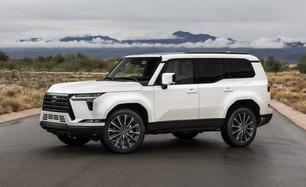
The new Lexus GX 550 showcases a brand new design for its third-generation iteration but the model is new to the Australian market.
And while it hasn't been as hotly anticipated as its cousin, the Toyota Prado, it's still one that should excite. It's a capable full-time four-wheel drive that manages to look good on- and off-road! It feels like a breath of fresh air.
Will it find itself more likely adorning the garage of a city slicker? Perhaps, but you can't deny it has some star power now with its design and it couldn't have come soon enough. Especially when you compare the flagship Sports Luxury grade my family and I have on test to its European luxury rivals, the BMW X7 and Land Rover Defender.
Zeekr is making waves in Australia at the moment but it's not because of the car you see before you.
Nope, it’s the 7X mid-size SUV that’s captured a heap of attention and a whole lot of sales. In fact, of the 1832 sales the brand has managed over the first three months of 2026, just 54 were for the X.
But that was the old X and this is the new one. With more power, more performance, faster charging and a whole heap of pretty special equipment, especially for the small SUV segment.
So, is that enough to finally put the X on the map?
The new Lexus GX 550 Sports Luxury looks fantastic and has enough mod cons to satisfy a family but it’s not as luxurious as you’d expect from a premium brand and the fuel economy and driving range will turn off some. But if you’re still interested, there’s a lot here that will make you happy and it’s one of the smoothest 4WDs I’ve driven.
It's a good thing in a small package, this Zeekr X, and there are a lot of things I like about it. In fact, the only sticking point for me is the price. But that's all about perspective. If you see this as a newcomer Chinese brand, then yes, there are a lot of more affordable options out there. But if you see it as a premium player, it's really a more affordable version of a Volvo.
Note: The author, Andrew Chesterton, is a co-owner of Smart As Media, a content agency and media distribution service with a number of automotive brands among its clients. When producing content for CarsGuide, he does so in accordance with the CarsGuide Editorial Guidelines and Code of Ethics, and the views and opinions expressed in this article are solely those of the author.
The new GX 550 looks massive and while it shares the same platform as the Toyota LandCruiser 300 series, it doesn't share all of its bulk. They both stand at 1980mm wide but differ on length (5015mm vs 4980mm) and height (1670mm vs 1950mm), respectively.
The new design is fabulously rugged but each body panel looks meticulously crafted and is just the right size. This just means the proportions look right and your eye sort of glides over the big body rather than stopping on any one feature.
But having said that, there are a lot of nice features to focus on, like the long LED headlights and rear strip light, auto-folding side steps, 22-inch alloy wheels and sharply styled rectangular side mirrors.
The tailgate window can also be opened if you need to pop something into the boot but don't want, or have the space, to open the tailgate itself.
The styling takes a minor nose dive once you hit the cabin, though, because it doesn't look as sumptuous as you'd expect in a premium SUV.
I love the utilitarian and military vibe of the vertical dashboard, chunky air vents and relatively small windscreen. It looks great but some trims are plasticky and the touchpoints, while soft, are not Lexus-plush.
However, the technology looks gorgeous with an integrated 14-inch multimedia display and a 12.3-inch digital instrument cluster. The fixed sunroof with its two settings (clear or opaque) is also a lovely feature.
But on a whole, the GX 550's European rivals outclass it with their flashier cabins.
The visual changes aren’t massive. This AWD version welcomes a couple of new exterior colours, including the 'Matt Khaki Green' of our test car. It also gets the two-tone black roof and there are new 20-inch alloy designs.
Elsewhere, it's the futuristic-style of design we’re used to which differentiates the X from its Volvo EX30 twin under the skin.
Inside, this is a seriously well-equipped and polished-feeling small SUV, and — unlike some of the newcomer brands to Australia — it all feels very high quality and well put together. And that includes the material choices.
I don’t even hate the fact that most of the functions are controlled via this screen, thanks to the little shortcuts glued to the home screen. I do, however, hate the fact that there’s no easy way to change the wing mirrors or shortcuts for toning down some of the safety stuff.
That aside, though, it’s a nice and high-quality feeling space.
The cabin of the new GX 550 is fairly practical with plenty of head- and legroom in each row (yep, even the third!). When you first hop in, it can feel a big snug on elbow-room but this feeling quickly dissipates.
Despite a 215mm ground clearance, access is pretty good for the front and middle rows due to the wide door apertures and side-steps. Third row access is a bit awkward for an adult but my eight-year old loved scampering back there this week.
The electric front seats are comfortable with their extra functions and I like the way the massage feature extends to the seat cushion as it limits fatigue on longer journeys. However, you sit on top of them rather sink into them which makes it feel a little trucky at times.
The wide middle row has a bench seat that will be comfortable for kids but an adult might get a sore behind on a long trip. The transmission tunnel also compromises foot room for adults but the seat is wide enough to make use of all three top-tether anchor points (there are ISOFIX mounts too).
It was a little bit of an effort to lift my big booster seat into the back because the GX 550 sits so tall but otherwise, there's plenty of room around a child seat for them not to feel like a sardine.
Individual storage is made up of a glove box that fits an owner's manual, a small shelf in the dashboard and a middle console that doubles as a cool box (mini fridge) and can fit up to four cans or bottles in it.
Each row gets four drinkholders and two USB-C ports but the front also enjoys a 12-volt socket and wireless charging pad. There's a 220V domestic plug port in the boot for larger appliances, too.
It's sometimes awkward to use the wireless charging pad because it's easy for your phone to slide around on it and it quite often disengaged from charging.
My son enjoyed all of the other amenities in the middle row, like the reading lights, climate control, two USB-C ports and retractable sunblinds and I applaud carmakers when they position rear directional air vents in the pillars and/or roof. It just makes it so much easier to cool down sweaty kids!
The 14-inch multimedia display has clear graphics and a responsive touchscreen. The layout is easy enough to get used to after spending some time with it and the sat nav is simple to use.
I like that the sat nav directions can be pulled into the 12.3-inch digital instrument cluster and head-up display.
There is a Lexus connected services app, which you get a three-year subscription to. It's easy to connect to the wireless Apple CarPlay and there is also wireless Android Auto.
The system also has Bluetooth and digital radio, which is a delight to use through the 21-speaker Mark Levinson sound system.
The cabin is rounded out by the well-shaped boot which has a massive 1063L of capacity when the third-row is folded. That's been more than enough for my family's needs this week and my German Shepherd was pretty comfy back there, too. The powered tailgate has a kick-function and there is a full-size spare wheel underneath the car.
You know you're in a small vehicle when you can't fit two large (not those crazy American-style jumbo cups, just normal coffee-shop takeaway) coffees in the cupholders, but so it is with the Zeekr X.
The small SUV's 4432mm length, 1836mm in width and 1566mm height doesn't leave much room to spread out up front. There's ample room for driver and passenger, of course, but we are talking about a small vehicle here.
Clever storage helps to mitigate that, though, especially the super-deep storage space in the centre console and the very clever fridge that separates the driver and passenger seats.
Weirdly, though, the space doesn’t feel overly tight in the back seat. We had a massive baby seat in there, and that fit without issue. And full size humans can genuinely get pretty comfortable. I'm 175cm, and I had enough knee and headroom.
In the boot, there’s 404 litres of volume with the rear seats upright and 1247 litres with them folded flat. And it’s worth pointing out this isn’t intended to be a family car, but there’s certainly enough space for the shopping... and a pram.
The Lexus GX 550 shares the same platform as the recently introduced Toyota Prado but both models are now based on the same 'body-on-frame' platform shared by the beastie Toyota LandCruiser 300 Series. So it's bigger and features a more rigid chassis than before.
Surprisingly, that hasn't translated to a massive price tag for the GX 550 and you can pick up the flagship grade on test for this review for $128,200, MSRP.
Which sounds inexpensive when you compare it to the BMW X7 xDrive 40i M Sport which is priced from $171,300 MSRP but the Land Rover Defender 110 P400 X-Dynamic HSE is a lot closer at $128,815 MSRP.
The only issue here is that shared platform, because while they don't share the same powertrain, the flagship Toyota Prado Kakadu ($99,990 MSRP) is still almost $30K more affordable and boasts a similar equipment list. So, ask yourself, is it the brand and engine you're after or the new good looks?
The standard equipment is well-rounded with a 14-inch touchscreen media display with satellite navigation and wireless Apple CarPlay and Android Auto.
A fully digital 12.3-inch instrument cluster, colour head-up display, three-zone climate control and a 21-speaker Mark Levinson sound system round out multimedia requirements.
Other technology includes a digital rear view mirror, two USB-C ports in each row, a 12-volt socket, a 220-volt domestic outlet and a wireless charging pad.
There are two particularly handy features for families, the 'cool box' (basically a mini fridge) middle console and rear retractable sun-blinds.
The fixed panoramic sunroof features two settings allowing you to make it clear or opaque. The electric front seats feature heat, ventilation and massage functions and the rear outboard seats are heated as well. The third row electrically adjusts and there are multiple buttons throughout the car to access this feature.
Upgraded leather-accented upholstery is standard in the flagship grade and is available in three combinations. The Sports Luxury also features 22-inch alloy wheels, a full-size spare wheel and a powered tailgate with kick-function.
This is a small SUV with a LOT of stuff. There are two trims in the Zeekr X range – the entry-level rear-drive model is $48,900, drive-away, while the all-wheel drive version we've tested is $57,900 on the road.
The obvious comparison is to the Volvo EX30, which shares its platform with the Zeekr X through both brands' Chinese parent company Geely.
As of right now, the cheapest single-motor Volvo is $56,051, drive-away in NSW, or $49,990 plus on-roads, making the Zeekr version much, much cheaper.
Anyway, outside there are 19- or 20-inch alloys, though our test car is fitted with the optional 20-inch black alloys, paired with a black-with-red-highlights interior treatment, which adds $2000 to the price.
Ours is also fitted with the electric front doors which open or close at the push of a button, and back doors that unlatch, but don’t fully open, the same way, which adds another $2000.
Both trims also get heated and cooled front seats, and heating in the rear window seats, but this AWD version also adds a massage function for front seat riders.
There’s also wireless charging, a 13-speaker Yamaha sound system and — very cool, literally — is the little drinks fridge between the front seats in the AWD variant.
Tech is handled by a 14.6-inch touchscreen with Apple CarPlay and Android Auto and there’s a head-up display for the driver.
All GX 550 grades share the same 3.5L V6 twin turbo-petrol engine which produces up to 260kW of power and 650Nm of torque.
This 4WD has high- and low-gearing, as well as a bunch of driving modes to suit most occasions, like 'Eco', 'Comfort', 'Sport' and 'Sport+'.
The 10-speed automatic transmission shifts through its gears smoothly and it always feels like it's engaged in the right gear. Which isn't always the case for a big SUV!
The Sports Luxury is fitted with a towing hitch and cover but unlike the base Sports grade which has a 3.5-tonne braked towing capacity, this model only has a 3130kg capacity which might not appeal to families with big toys to tow.
The big news here is a more powerful rear motor – meaning you get more grunt whether you opt for the rear-wheel drive or this all-wheel drive.
In rear-drive form, that boosts your outputs from 200kW to 250kW, dropping the sprint to 100km/h to 5.6 seconds. In AWD guise, your new outputs are 365kW (up from 315kW) and 573Nm, and your sprint to 100km/h falls to 3.7 seconds.
I didn’t have high hopes for fuel economy because the official combined (urban/extra-urban cycle figure is a hefty 12.3L/100km but after mostly open-road driving, with some urban stuff mixed in, my real-world average came in at 11.8L.100km! This figure is based on my actual km travelled (358km) and litres of fuel used (42.41L).
While I’m surprised by the fuel usage result, I wouldn’t say this car has good fuel economy compared to its diesel-powered counterparts but it’s not terrible!
The GX 550 has a relatively small fuel tank compared to its Toyota cousins at 80L and based on the combined fuel cycle, you’ll get a theoretical driving range of up to 650km.
Not all that great. Not for a big family mover and not if you’re typically driving in the city, where fuel usage will be a lot higher.
The GX 550 only accepts premium unleaded petrol (95 RON), too.
This is where it starts to get weird. The rear-drive Zeekr X is fitted with a 61kWh LFP battery, which can accept up to 230kW DC fast charging, taking you from 10 to 80 per cent charged in just 18 minutes. Total claimed range is 405km.
The flagship AWD, though, charges at a slower rate. It gets a 66kWh NMN battery and can only be charged at 150kW, meaning the same charge takes 30 minutes. Zeekr is promising a 415km driving range between charges.
Oh my goodness the Sports Luxury is a masterclass on 4WD refinement! You never feel the bulk or weight of this massive SUV when you’re driving it. The power delivery is effortless and there’s lots of grunt available when you hit hills.
The handling is also very good with responsive steering and enough road feedback as a driver to make you feel comfortable with what the car is doing. There is some roll in corners but it can tackle more corners at speed than I thought it would.
The high driving position makes me feel like I can see a long way ahead yet while visibility is mostly good, it can be compromised when you have the side window shades and the third row headrests up. Which is why I love the digital rear view mirror.
Overall, ride comfort is good with forgiving suspension and low cabin noise, even at higher speeds. It’s pretty easy to chat with all rows and there’s not a lot of engine noise which adds to the refinement. I do like hearing a V6 rumble but that’s just a personal preference.
I was a little worried about hitting my local Westfield car park but this is a nimble SUV to manoeuvre and parking it is a breeze with the 360-degree camera system and parking sensors.
Short answer? Pretty good, with some caveats.
I'm partial to a firmer ride. I find some Chinese car companies can feel like they get their suspension bits from Captain Snooze, such is the soft, pillowy ride served up. And to be honest, it makes me a little seasick at times.
The Zeekr is not like that. It has firmness dialled into the ride equation and can feel harsh at times, but also improves the drive experience, delivering connection and engagement at the cost of some sharpness on the wrong road.
It's also faster than the model it replaces, but it's also one of those cars in which the real-life feeling doesn't quite match the on-paper promise.
This thing serves up supercar speed, but it doesn't feel like it from behind the wheel. Instead, the acceleration - especially from a rolling start - feels potent, but not biblical.
From a standing start it pauses for a moment, almost like an internal-combustion vehicle might, before delivering a quick (but not stratospheric) flow of power. None of that is a bad thing, by the way. Who wants their small SUV to accelerate like a supercar?
It's otherwise an entirely pleasant drive. The cabin is serene and quiet and it's a small car that doesn't feel like one. There's nothing light or tinny about the drive experience, instead there's a heft and quality.
The new GX 550 hasn’t been tested by ANCAP and is unrated but its cousin, the Toyota Prado, which shares the same platform just achieved a maximum five-star rating from assessment in 2024. It's fair to expect a good result for this model.
Overall, the Sports Luxury has a long list of standard safety equipment and features nine airbags which is good for a family SUV.
Safety equipment includes adaptive cruise control, lane departure alert, lane keeping aid, traffic sign recognition, emergency steering assist, driver monitoring, safe exit assist, emergency call functionality, blind-spot monitoring, rear cross-traffic alert and tyre pressure monitoring.
The GX 550 has autonomous emergency braking (AEB) with pedestrian, cyclist, motorcyclist and junction turning assist.
The Zeekr X wears a maximum five-star ANCAP safety rating, earned in 2024, which means the long list of required active safety stuff is present and accounted for, all wrapped up in what Zeekr calls its 'Intelligent Driving Assist System'.
There are five cameras, five radars and 12 sensors, which is a crazy number for a car this small.
And this is also not a car in which I was desperately trying to figure out how to deactivate any of the active safety systems – save the overzealous over-speed warning – which is a win these days, too.
There are also seven airbags, including a centre front airbag.
The Zeekr X is fitted with ISOFIX anchors on the rear outboard seats and top tether anchorages for all rear seating positions.
Lexus offers the GX 550 with a five-year/unlimited km warranty, which is fairly standard compared to its Euro rivals.
You get five years capped-priced servicing which costs $5950 but the servicing schedule is a bit of a bear at every six months or 10,000km, whichever occurs first.
Zeekr's coverage is an underwhelming five-year, unlimited-kilometres, while the drive battery is covered for eight-years or 160,000km. There’s five years' of roadside assistance thrown in, too.
Service intervals are 20,000km or 12 months, with five years' of ownership setting you back a hefty $3072; an average of $614 per workshop visit.
There are currently 16 Zeekr dealers in Australia - two of which are 'pop-up' sites rather than full retail centres.
Multiple locations in Melbourne, Sydney and Brisbane with the ACT, Adelaide and Perth also covered. Others include Geelong and the Sunshine Coast but so far you're out of luck in Tassie or the NT.