What's the difference?
The LDV G10 arrived on the scene in the van segment a few years ago, with the aim of upsetting the equilibrium.
It was a budget-priced, Chinese-made mid-size van with its target set squarely on appealing to customers who might have wanted a HiAce, but couldn’t afford one.
After almost four-and-a-half years on the market in Australia, the LDV G10 is better than ever. It has seen new additions in the cabin, more comfortable seats, and still offers big value for money.
But with the van market moving forward at pace, does the LDV G10 offer appeal beyond the sticker price? We tested the diesel auto model to find out.
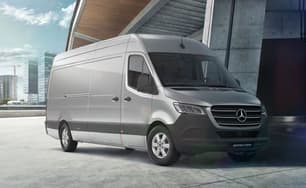
The Mercedes-Benz Sprinter has long been a formidable competitor in the Light Duty (3501-8000kg GVM) division of Australia’s highly competitive Heavy Commercial vehicle market.
The popular range offers a choice of panel van, cab-chassis and minibus body styles, four turbo-diesel engine variants (plus an all-electric drivetrain), three wheelbase lengths and for panel vans plus the choice of two roof heights.
An extensive overhaul of the Sprinter range in 2024 brought extra safety technologies, new comfort and convenience features and other benefits, which Mercedes-Benz claims can help drivers work more efficiently. We recently put one of the latest models to the test.
The LDV G10 is a solid option for those buyers who just want a van that gets the job done. It was decent with weight on board, but is probably better suited to parcel carriers rather than pallet shifters.
Safety levels are the biggest concern, as it is falling behind in the class when it comes to active safety tech, and its weak crash test score could be enough to rule it out for some customers.
Given the original Sprinter was released in 1995, it’s not surprising the current third-generation model feels like it’s benefitted greatly from decades of continuous refinement. Although the list price difference between our test vehicle and its closest Chinese rival is substantial, the 417 MWB Panel Van is hard to fault in terms of driver comfort, safety and all-round competence. It really is very good.
The more you see LDV G10 vans, the more regular they look. Familiarity breeds ignorance, I guess, but I still think the G10 looks smart.
It isn’t quite as boxy as some, with its sleeker front-end styling and almost sedan-like tail-lights helping it stand out from the ‘box-on-wheels’ stigma. It gets 16-inch alloy wheels as standard, and has halogen headlights and misses out on daytime running lights.
But it still is a box on wheels, measuring 5168mm long (on a 3198mm wheelbase), 1980mm wide and 1928mm tall. That makes it a darn sight smaller than the new HiAce, which stepped up significantly in size, and about on par with a Renault Trafic SWB or Ford Transit Custom 300S SWB.
The perceived build quality is mostly okay, though our test car had a few loose plastics on the outside and a seemingly mis-fit windshield rubber.
The 417 MWB Panel Van rides on a 3665mm wheelbase (the shortest of three Sprinter wheelbases) and is almost 6.0 metres long (5932mm), more than 2.0 metres wide (2020mm) and stands almost 2.4 metres tall (2378mm). Its 12.4 metres kerb-to-kerb turning circle is impressively tight for a vehicle of this length.
It rides on simple and rugged MacPherson strut front suspension, with a robust live axle/leaf-spring arrangement under the tail. Steering is via rack and pinion and it has disc brakes all around.
Look beyond the optional silver metallic paint on our example and there’s extensive use of unpainted dark grey plastic on all the external surfaces where hard-working vans are most prone to wear and tear, including the hubcaps, front/rear bumpers, grille, door-handles/mirror shells and along the sides.
Its work-focused exterior styling is nicely integrated, combined with an equally neat and functional interior design that offers a visually-pleasing combination of patterned fabric seat-facings and hard surfaces that blend different shades of grey with splashes of satin chrome and piano black.
We also like the feel and response of mechanical switches (rather than touchscreen prompts) for adjusting settings like cabin temperature, fan speed and media volume.
Those dimensions translate to a cargo space of 5.2 cubic metres, with a load space spanning 2500mm long, 1590mm wide (1270mm between the arches) and 1270mm tall. That mightn’t be big enough for you, and that’s too bad - there is no high roof version, nor a long-wheelbase model; but you could get an LDV V80 if you really need to step up in size… but we wouldn’t suggest you do that.
The payload for this model is 1010kg, which is decent but not benchmark-setting. It has a gross vehicle mass of 3000kg, meaning a kerb weight of 1990kg. The gross combination mass depends on the model: the GCM for diesel models is 5000kg for a braked trailer, while petrol models have a GCM of 4750kg for a braked trailer (auto) and 4500kg (manual). All models have a GCM of 3750kg for unbraked trailers.
The petrol versions have 1093kg of payload, if you prefer that fuel type. Interestingly, the manual versions have leaf spring rear suspension, while the auto models have coil springs as part of a five-link suspension architecture.
The load area has a six floor-mounted and four wall-mounted tie-down hooks, and the floor is lined with a vinyl covering while up to half-height the inner walls are lined, too. There are four lights mounted on the walls, which is handy for after-hours work.
And every LDV G10 comes with dual sliding side doors (some brands charge thousands more for this convenience), while the back door is a tailgate as standard, with the option of barn doors for diesel models.
For those who need to fork loads in, the barn doors are a no brainer, because the side door apertures (at 820mm wide) aren’t broad enough to load in using a lift. The tailgate also makes it very difficult to load weight in, as we found on test, as our mates at Crown Lifts had to use long tines to fork in our 750kg ballast.
When it comes to creature comforts up front, there is a pair of low-mounted pop-out cupholders, and an open storage area between the seats. There isn’t much covered storage, so if you often carry valuables, you may need to keep that in mind.
The seats are comfortable and offer good adjustment, and they’ve been changed since the diesel auto model launched. They’re no longer a cheap-feeling fabric, but rather a faux-leather accented, mesh-lined set of seats, and both have armrests. Nice.
The presentation is okay, but the ergonomics could be better. The touchscreen is mounted down lower than most, and means you may need to take your eyes away from the road because the controls are down even lower. And the USB? Near the floor.
That screen is still a 7.0-inch display, but now has the same software system as the newer models in the LDV range. That means a nice crisp colourful display with the added advantage of Apple CarPlay… if you can get it to work. We had a few issues when reconnecting a phone without re-starting the car.
With its 2215kg kerb weight and 4100kg GVM, our test vehicle has a sizeable 1885kg payload rating.
It’s also rated to tow up to 2000kg of braked trailer and with its 6100kg GCM (or how it can legally carry and tow at the same time), that means it can tow its maximum trailer weight while hauling its maximum payload to ensure optimum versatility.
The cargo bay, which offers a cave-like 9.0 cubic metres of load volume and internal lighting front and rear, has internal dimensions of 3316mm length (with bulkhead), 1732mm width and 1719mm height.
So, with 1350mm between the rear wheel-housings, it can comfortably fit two standard 1165mm-square Aussie pallets or up to four 1200 x 800mm Euro pallets, held in place by a choice of 10 floor-mounted load-anchorage points.
The cargo bay is accessed through a single kerbside sliding door with a wide 1260mm opening, or symmetrical rear barn-doors with large handles on each pillar to assist operator access.
The barn-doors also have internal storage bins and open to a full 180-degrees to assist forklift and loading dock access. Thoughtfully, their hinge design also holds the doors firmly open at 180 degrees, to minimise the chance of wind gusts slamming them shut with potential injury to the operator.
There’s also plenty of cabin storage starting with two tiers of bins in each door, with the highest being spacious enough to hold large bottles.
There's also a deep shelf on the passenger side lower dash, a large lidded compartment in the central dash-pad and overhead shelves with lockable storage on the passenger side. Plus, the dash offers a total of eight cup/small-bottle holders.
The base cushion of the two-passenger bench seat is also hinged at the front, which allows it to tilt forward and provide access to a large hidden storage area beneath.
A crew of three can travel in relative comfort (for a commercial van that is) thanks to a central seating position that provides a sturdy hoop-handle for support, sufficient knee clearance from the dash even for tall people, and a reasonably flat and spacious floor area.
The cabin also features the latest next-gen 'MBUX' multimedia system with 10.25-inch touchscreen, which for the first time offers wireless connectivity for Apple CarPlay and Android Auto.
There’s also digital radio and enhanced functionality including an optional navigation upgrade with seven years of map updates.
If you’re buying an LDV G10, it’s because of the price. The cost of the diesel automatic model we’ve got is usually $32,490 drive-away for ABN holders, but there are promotions running listing it at $29,990 drive-away for ABN holders at the time of writing. If you’re not an ABN holder, just get one, because you’ll save heaps (the G10 diesel auto is $34,147 drive-away for non-ABN holders).
You can get other vans for around this money - the Renault Trafic Trader Life manual, with its gutless 66kW turbo-diesel engine, is $30,990 d/a. But you won’t find a diesel Hyundai iLoad, Peugeot Partner or Toyota HiAce within $10,000 of the LDV.
As for standard spec, you get 16-inch alloy wheels, tyre pressure monitoring, climate control air-conditioning, a 7.0-inch touchscreen with USB connectivity, Apple CarPlay, Bluetooth phone and audio streaming, CD player and AM/FM radio, a digital speedometer, two part fake-leather seats with arm-rests (driver’s side with height adjust), carpet flooring up front, and vinyl floor protective liner in the rear, and a reversing camera.
Standard body fit out is dual sliding side doors and a lift tailgate, though you can get barn doors fitted on diesel models. Unlike some competitors, there is no option for glazing in the rear doors or side panels.
There are also no auto headlights, no auto wipers, push-button start, keyless entry, leather-lined steering wheel, reach adjustment for the steering, and there’s quite a bit missing in the safety section of this review - see below.
Our test vehicle is the 417CDI MWB (Medium Wheelbase) Panel Van with standard roof height, which comes equipped with a 2.0-litre, four-cylinder, turbo-diesel engine and nine-speed automatic transmission for a list price of $86,018.
Our example is fitted with a couple of factory options, including the 'Cargo Pack' ($2265) which comprises a two-passenger bench seat, solid cabin bulkhead with fixed window and side-entrance assist handle, wooden cargo bay load floor and floor-to-roof wall-trim using 5.0mm-thick wood panelling.
It also has optional 'High-Tech Silver' metallic paint ($2534) which combined with the Cargo Pack raises the total price to $90,817.
In addition to the latest model’s upgraded safety (see Safety) and comfort/convenience (see Design) features, our test vehicle comes standard with 16-inch steel wheels and 235/65 R16C tyres plus a full-size spare, keyless start, steering wheel paddles for manual shifting, multi-function leather steering wheel, three USB-C ports and two 12-volt sockets, side marker lights and heated exterior mirrors.
There’s also daytime running lights, a parking package with reversing camera and front/rear parking sensors, traffic sign assist, tyre pressure monitoring and lots more.
Under the bonnet of the diesel G10 is a 1.9-litre four-cylinder turbo-diesel with 106kW of power and 350Nm of torque. There’s the choice of a six-speed manual or six-speed automatic, and the G10 is rear-wheel drive. It has a diesel particulate filter, but not stop-start or AdBlue.
Prefer petrol? There’s a 2.4-litre five-speed manual model (105kW/200Nm) or a 2.0-litre turbocharged six-speed auto (165kW/330Nm). Those models are cheaper - $25,990 for the manual for ABN holders, while the turbo-petrol auto is $30,990 d/a.
The (OM654) 2.0-litre, four-cylinder, turbo-diesel, which meets Euro 6 emissions standards using AdBlue, produces 125kW of power at 3800rpm with peak torque of 400Nm served between 1700-2400rpm. The nine-speed torque converter automatic offers the choice of sequential manual-shifting using the steering wheel-mounted paddles.
The combined cycle fuel use claim for the LDV G10 diesel auto is 8.6 litres per 100 kilometres. The manual version uses 8.3L/100km according to the brand.
On test we saw a fuel use return of 9.7L/100km at the pump, across a mix of urban, highway and freeway driving, with and without a load.
Petrol models use a claimed 11.5L (manual) and 11.7L (auto) per hundred.
The dash display was claiming average combined consumption of 9.5L/100km when we stopped to refuel at the completion of our 281km test, of which about one third of that distance was hauling a heavy payload (see Driving).
Our own figure of 11.7 (based on actual fuel bowser and tripmeter figures) was higher but still reasonable economy for a vehicle in this GVM class in mostly urban use.
So, based on our own figures, you could expect a ‘real world’ driving range of around 800km from its 93-litre tank, which has been enlarged from 71 litres as part of the latest upgrades.
You probably wouldn’t choose an LDV G10 as a daily driver if you didn’t intend to use the cargo zone at least 80 per cent of the time.
But if - for whatever reason - you really want to use a van like this on a day-to-day basis, you won’t hate it.
The G10 drives pretty nicely for this type of vehicle. It isn’t as bouncy when unladen as some of the other vans out there, with the suspension proving very quick to settle and mostly very compliant across mixed surfaces.
The steering wheel can jostle a bit over sharp edges, but it steers well, with decent (not too heavy) weighting and predictable response at all speeds.
Without weight on board the engine feels reasonably urgent in its response, which is a bit of a surprise because it’s not a powerhouse based on its outputs. It revs smoothly and pulls with good strength, with little turbo lag to contend with. While it is a bit of a grumbly engine at times, the response is better than adequate.
Plus the transmission is well sorted, with smooth shifts that are predictable.
The braking response is definitely better without weight on board, with a decent progression to the pedal and decent bite when you press hard on the anchors.
Large handles on the doors and overhead shelves assist climbing aboard and there’s enough adjustment in the well-bolstered seat and leather-rimmed steering wheel to find a comfortable position.
Driver views from all angles are excellent thanks to well-designed mirrors along with cameras supported by active aids like blind-spot monitoring etc.
The cabin, with its high roof relative to seat height, has a spacious and airy feel and all controls are reasonably intuitive and easy to reach.
Unladen ride quality is surprisingly supple for a vehicle with a 6.0-tonne-plus GCM rating, combined with excellent steering feel that strikes a fine balance between minimal turning effort at low speeds (for loading etc) and firm handling response at higher speeds.
The drivetrain is also energetic, pulling strongly and cleanly from 1000rpm even though its maximum torque is tapped higher in the 1700-2400rpm zone. The automatic transmission has admirable refinement, with near-seamless shifting between its nine ratios.
The Sprinter is also impressively quiet at speeds up to 80km/h. Tyre and wind noise (the latter mainly around the large door mirrors) naturally increase at highway speeds, but remain far from intrusive. And with the engine requiring less than 2000rpm to maintain 110km/h, it’s well-suited to highway work.
To test its load-carrying ability, we forklifted 1.3 tonnes into the cargo bay which with driver equalled a payload of 1.4 tonnes. That's still almost half a tonne less than its limit.
Not surprisingly, it handled this load with ease, as handling and braking were largely unaffected and the ride quality became smoother thanks to such a big increase in sprung weight. Even so, the rear springs only compressed about 30mm.
It easily conquered our 13 per cent gradient, 2.0km-long set climb at 60km/h with this load onboard, as the auto downshifted to fourth gear to tap maximum torque when hauling this load to the summit.
Engine-braking on the way down, in a manually-selected second gear, wasn’t as robust but not unexpected given a 2.0-litre engine trying to restrain 1.4 tonnes of payload on a steep descent. Even so, the quartet of disc brakes efficiently kept speeds in check.
Overall, it was an impressive performance. However, we did note that the speed sign recognition function was not working for the duration of our test. And some welcome enhancements would be a driver’s left footrest and a fold-down inboard armrest for the driver’s seat, as fitted to its smaller Vito sibling.
If safety matters to you, this could be your reason not to buy an LDV G10.
The van scored a mediocre three-star ANCAP crash test safety score - which would be more acceptable if that was under the current, strictest criteria, but it was actually tested in 2015. Which means it would be even lower if tested today.
One of the reasons is the safety equipment - there’s not a lot of it. You get dual front airbags, but no side airbags or curtains. There is no advanced tech like auto emergency braking (AEB), no lane keeping assistance or lane departure warning, no blind spot monitoring or rear cross-traffic alert… But you do get a reversing camera and rear parking sensors.
ANCAP ratings do not apply to Heavy Commercial vehicles. Even so, in addition to the Sprinter’s existing long menu of passive and active safety features, the latest range adds significant enhancements as standard equipment including thorax-protecting airbags for driver and passenger, lane-keeping assist, traffic sign assist, rain-sensing wipers, tyre pressure monitoring and a parking package with reversing camera and front/rear sensors.
Also new is ‘Moving Off Information Assist’ which utilises a camera mounted in the grille plus six ultrasonic sensors to monitor an area 3.7 metres in front of the steered direction of the vehicle and 0.5 metres to the side.
This automatically activates at start-up and remains active up to 10km/h. So, if a road user is detected in the monitored area, the driver is alerted by audible and visual signals.
The latest range also introduces ‘Sideguard Assist’ which provides extended detection in the blind-spot on the passenger side. It activates when the vehicle is stationary and at low speeds, providing an extra set of eyes during parking, low-speed manoeuvring and traffic congestion.
LDV isn’t close to the leaders in the segment for ownership, with a behind-the-times three-year/100,000km warranty (admittedly with the same cover for roadside assist), and no capped price servicing plan.
Service intervals are every 12 months/10,000km, which is short, and you need to get an initial service done at 5000km, too.
If you’re worried about long-term longevity, you can check out our LDV G10 problems page.
Warranty is five years/250,000km whichever occurs first and includes a roadside assist support package.
Scheduled servicing is every 12 months/40,000km. Pay-as-you-go capped-pricing for the first five scheduled services totals $5905, or a pricey average of $1181 per year. Service plans are also available.