What's the difference?
The LDV G10 arrived on the scene in the van segment a few years ago, with the aim of upsetting the equilibrium.
It was a budget-priced, Chinese-made mid-size van with its target set squarely on appealing to customers who might have wanted a HiAce, but couldn’t afford one.
After almost four-and-a-half years on the market in Australia, the LDV G10 is better than ever. It has seen new additions in the cabin, more comfortable seats, and still offers big value for money.
But with the van market moving forward at pace, does the LDV G10 offer appeal beyond the sticker price? We tested the diesel auto model to find out.
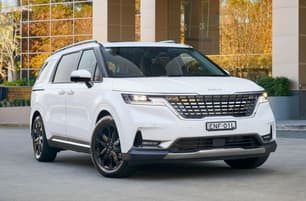
This is actually the Carnival that Kia always wanted.
See, the last Carnival, the one this replaces, was Covid compromised, missing out on key technologies, as well as skipping an in-depth ride and handling localisation program, due to part supply issues and a freeze on international travel.
This one, though, addresses all of that, which is why you get a new cabin experience, new tech, and a complete overhaul of the steering and handling.
It is, however, significantly more expensive, right across the range.
So, is the Carnival still worth it? Let’s find out.
The LDV G10 is a solid option for those buyers who just want a van that gets the job done. It was decent with weight on board, but is probably better suited to parcel carriers rather than pallet shifters.
Safety levels are the biggest concern, as it is falling behind in the class when it comes to active safety tech, and its weak crash test score could be enough to rule it out for some customers.
Ok, here's the rub. Everything you just read could well be pointless. You like the Carnival. In fact, it sometimes makes up close to 90 per cent of the sales in its segment, and outsells all of its competitors combined.
So whether I like it or not, I suspect you'll be buying one anyway.
But I can say this - the new Carnival improves the formula right across the board. Well, everything except for price.
The more you see LDV G10 vans, the more regular they look. Familiarity breeds ignorance, I guess, but I still think the G10 looks smart.
It isn’t quite as boxy as some, with its sleeker front-end styling and almost sedan-like tail-lights helping it stand out from the ‘box-on-wheels’ stigma. It gets 16-inch alloy wheels as standard, and has halogen headlights and misses out on daytime running lights.
But it still is a box on wheels, measuring 5168mm long (on a 3198mm wheelbase), 1980mm wide and 1928mm tall. That makes it a darn sight smaller than the new HiAce, which stepped up significantly in size, and about on par with a Renault Trafic SWB or Ford Transit Custom 300S SWB.
The perceived build quality is mostly okay, though our test car had a few loose plastics on the outside and a seemingly mis-fit windshield rubber.
Surely the greatest trick the Carnival pulls off, and it does so convincingly, is that it manages to make something so quintessentially uncool, the people-mover, and make it look good. Somehow sporty, even.
I like the Carnival's big, bold and blacked-out front end of the GT-Line, and with its two-tone 19-inch alloys, wide stance and low ride height, it looks almost like some mad attempt at a JDM tune car, rather than a sensible people mover.
Elsewhere, the boxy profile, the sharp body creases and the third-row compartment that kind of juts over the rear tyres like a house that's been extended all somehow work, and give the Carnival far more street cred than you might expect.
Inside, we spent time only in the flagship GT-Line and its GT-Line Lite sibling, and both present as calming, comfortable spaces, and Kia's minimalist approach to combining the climate and audio controls into a single strip (it's functionality can be changed by pushing a button) helps keep the cabin fuss free.
The tech in the top-spec models feels modern and on-point, too, and the materials are all nice under the touch. Be warned though, the cabin plastics get progressively worse the further back you sit, and the third row is cocooned by hard and scratchy plastics.
Those dimensions translate to a cargo space of 5.2 cubic metres, with a load space spanning 2500mm long, 1590mm wide (1270mm between the arches) and 1270mm tall. That mightn’t be big enough for you, and that’s too bad - there is no high roof version, nor a long-wheelbase model; but you could get an LDV V80 if you really need to step up in size… but we wouldn’t suggest you do that.
The payload for this model is 1010kg, which is decent but not benchmark-setting. It has a gross vehicle mass of 3000kg, meaning a kerb weight of 1990kg. The gross combination mass depends on the model: the GCM for diesel models is 5000kg for a braked trailer, while petrol models have a GCM of 4750kg for a braked trailer (auto) and 4500kg (manual). All models have a GCM of 3750kg for unbraked trailers.
The petrol versions have 1093kg of payload, if you prefer that fuel type. Interestingly, the manual versions have leaf spring rear suspension, while the auto models have coil springs as part of a five-link suspension architecture.
The load area has a six floor-mounted and four wall-mounted tie-down hooks, and the floor is lined with a vinyl covering while up to half-height the inner walls are lined, too. There are four lights mounted on the walls, which is handy for after-hours work.
And every LDV G10 comes with dual sliding side doors (some brands charge thousands more for this convenience), while the back door is a tailgate as standard, with the option of barn doors for diesel models.
For those who need to fork loads in, the barn doors are a no brainer, because the side door apertures (at 820mm wide) aren’t broad enough to load in using a lift. The tailgate also makes it very difficult to load weight in, as we found on test, as our mates at Crown Lifts had to use long tines to fork in our 750kg ballast.
When it comes to creature comforts up front, there is a pair of low-mounted pop-out cupholders, and an open storage area between the seats. There isn’t much covered storage, so if you often carry valuables, you may need to keep that in mind.
The seats are comfortable and offer good adjustment, and they’ve been changed since the diesel auto model launched. They’re no longer a cheap-feeling fabric, but rather a faux-leather accented, mesh-lined set of seats, and both have armrests. Nice.
The presentation is okay, but the ergonomics could be better. The touchscreen is mounted down lower than most, and means you may need to take your eyes away from the road because the controls are down even lower. And the USB? Near the floor.
That screen is still a 7.0-inch display, but now has the same software system as the newer models in the LDV range. That means a nice crisp colourful display with the added advantage of Apple CarPlay… if you can get it to work. We had a few issues when reconnecting a phone without re-starting the car.
The Carnival measures 5115mm in length, 1995mm in width and 1775mm in height, and it rides on a sizeable 3092mm wheelbase.
And those mini-van dimensions have a predictably positive impact on luggage space, with room growing from 627 litres with all seating rows in place, to a massive 2827 litres with the third row stowed.
The key practicality perk here, though, is space, and lots of it. At 175cm, there was ample room for me in the middle row, and you can configure the cabin to your liking, too. You can slide the row on rails, for example, to prioritise leg room where you need it, and the middle seat folds down to reveal cupholders in a kind of hard plastic travel tray.
But even in the third row I could easily get comfortable, though head room begins to get a little tighter. There are cupholders and USB connection points, too, and I can honestly say you could send full-size humans back there and not feel overly guilty about it.
The Carnival will tow 2000kgs braked, too.
If you’re buying an LDV G10, it’s because of the price. The cost of the diesel automatic model we’ve got is usually $32,490 drive-away for ABN holders, but there are promotions running listing it at $29,990 drive-away for ABN holders at the time of writing. If you’re not an ABN holder, just get one, because you’ll save heaps (the G10 diesel auto is $34,147 drive-away for non-ABN holders).
You can get other vans for around this money - the Renault Trafic Trader Life manual, with its gutless 66kW turbo-diesel engine, is $30,990 d/a. But you won’t find a diesel Hyundai iLoad, Peugeot Partner or Toyota HiAce within $10,000 of the LDV.
As for standard spec, you get 16-inch alloy wheels, tyre pressure monitoring, climate control air-conditioning, a 7.0-inch touchscreen with USB connectivity, Apple CarPlay, Bluetooth phone and audio streaming, CD player and AM/FM radio, a digital speedometer, two part fake-leather seats with arm-rests (driver’s side with height adjust), carpet flooring up front, and vinyl floor protective liner in the rear, and a reversing camera.
Standard body fit out is dual sliding side doors and a lift tailgate, though you can get barn doors fitted on diesel models. Unlike some competitors, there is no option for glazing in the rear doors or side panels.
There are also no auto headlights, no auto wipers, push-button start, keyless entry, leather-lined steering wheel, reach adjustment for the steering, and there’s quite a bit missing in the safety section of this review - see below.
Bad news first. The price is higher this time around, right across the five-trim line-up, with the prices up between around $2600 and $5300, depending on which trim level you’re shopping for.
Prices start at $50,150 for the entry-level S petrol, and climb to $72,910 for the top-spec GT-Line diesel. There’s also a GT-Line Hybrid, which tops the group at $76,210, but it’s not here yet, so we’ll cross that electrified bridge when we get to it and stick with the ICE range for now.
The range opens with the S ($50,150 petrol, $52,380 diesel), which scores 17-inch alloys, LED headlights and DRLs, heated mirrors, cloth seats, an electronic parking brake, and a smart key with push-button start, which is new for this update.
On the tech front, there is a new integrated 4.0-inch driver display, and a new 12.3-inch central screen with Apple CarPlay and Android Auto, linking with an eight-speaker sound system, now with a surround-sound function.
Stepping up to the Sport ($56,050 petrol, $58,280 diesel) adds 18-inch alloys, rear LED combination lamps, a leather steering wheel and shifter, and dual-zone climate up front with single-zone temperature control in the second row. New for this update is a wireless charging pad and artificial leather seats.
Next is the Sport+ ($62,380 petrol, $64,610 diesel), which gets a whole host of new safety equipment, which we will come back to in a moment, along with a powered tailgate, automatic sliding doors and auto windows, and heated seats in the first and second rows. It also ups the tech, with twin 12.3-inch screens taking care of multimedia and driving info duties.
Then comes the GT-Line Lite ($66,350 petrol, $68,580 diesel), which is fitted with bigger 19-inch alloy wheels, scores LED interior lighting, gets a dual-pane auto sunroof and some chrome embellishments on the exterior. The trade-off, though is that the powered windows are now for the driver only, as is the powered front seat.
Finally, there’s the flagship GT-Line ($70,680 petrol, $72,910 diesel), which nabs dual-projection headlights, a heated steering wheel, a 12-speaker BOSE sound system, ventilated seats up front, a big head-up display and a digital rear-view mirror, along with a slightly better interior treatment and the return of the auto window and powered seat to the passenger side of the car.
Under the bonnet of the diesel G10 is a 1.9-litre four-cylinder turbo-diesel with 106kW of power and 350Nm of torque. There’s the choice of a six-speed manual or six-speed automatic, and the G10 is rear-wheel drive. It has a diesel particulate filter, but not stop-start or AdBlue.
Prefer petrol? There’s a 2.4-litre five-speed manual model (105kW/200Nm) or a 2.0-litre turbocharged six-speed auto (165kW/330Nm). Those models are cheaper - $25,990 for the manual for ABN holders, while the turbo-petrol auto is $30,990 d/a.
There are two ICE options on the table here. The first is what I reckon is the lesser of the two, a 3.5-litre petrol V6, producing a rev-happy 216kW and 355Nm.
The better option, I think, is the 2.2-litre, four-cylinder diesel, which makes 148kW and 440Nm, and just suits the nature of the car a little better.
Both pair with an eight-speed automatic, and send their power to the front tyres.
The combined cycle fuel use claim for the LDV G10 diesel auto is 8.6 litres per 100 kilometres. The manual version uses 8.3L/100km according to the brand.
On test we saw a fuel use return of 9.7L/100km at the pump, across a mix of urban, highway and freeway driving, with and without a load.
Petrol models use a claimed 11.5L (manual) and 11.7L (auto) per hundred.
The petrol engine will sip a claimed 9.6 litres per hundred kilometres on the combined cycle, and produce 220g per kilometre of C02. The diesel lowers both those numbers, to 6.5 litres and 170 grams.
Both models are fitted with a 72-litre fuel tank, which means you’ll be sailing well north of $100 to fill one up.
You probably wouldn’t choose an LDV G10 as a daily driver if you didn’t intend to use the cargo zone at least 80 per cent of the time.
But if - for whatever reason - you really want to use a van like this on a day-to-day basis, you won’t hate it.
The G10 drives pretty nicely for this type of vehicle. It isn’t as bouncy when unladen as some of the other vans out there, with the suspension proving very quick to settle and mostly very compliant across mixed surfaces.
The steering wheel can jostle a bit over sharp edges, but it steers well, with decent (not too heavy) weighting and predictable response at all speeds.
Without weight on board the engine feels reasonably urgent in its response, which is a bit of a surprise because it’s not a powerhouse based on its outputs. It revs smoothly and pulls with good strength, with little turbo lag to contend with. While it is a bit of a grumbly engine at times, the response is better than adequate.
Plus the transmission is well sorted, with smooth shifts that are predictable.
The braking response is definitely better without weight on board, with a decent progression to the pedal and decent bite when you press hard on the anchors.
Forgive the horrific paraphrasing, but it seems rumours of the death of diesel have been greatly exaggerated, at least when it comes to the Kia Carnival.
Get this – diesel sales make up some 90 per cent of the Carnival's total haul, with petrol providing a pittance towards the sales total, presumably being picked up by fleet buyers.
And to be honest, that means nine out of 10 people are making the right choice here. Yes, the petrol makes more power, but it's the torque on offer from the diesel that makes pushing the Carnival around feel far more effortless.
The petrol engine can definitely get you moving, but it feels a bit too rev-happy and thrashy when you really put your foot down, and its significantly thirstier to boot.
The diesel isn't perfect – the thrum of the engine is a constant companion whenever you put your foot down, and there's actually too much torque on offer at times, like if you're accelerating up hill from a standstill on a damp road, and so the front tyres can scrabble and scramble for grip.
But it otherwise so perfectly suits the nature of the Carnival that it is definitely the best and most satisfying choice.
Another big change for this update is the fact that Kia's complete ride and handling program has been rolled out here. Kia says local work done on the outgoing car, the one this replaces, was curtailed by Covid and bushfires, and so ended up being done by correspondence.
This one, though, has had the whole enchilada thrown at it, and it shows. They've succeeded in making a bigger car feel smaller around you. It's not a sports car by any measure, but nor does it ever feel too big and unwieldily.
Part of that is down to the steering, which is direct and confidence inspiring, but mostly I suspect it's because of the ride, which is firmer than you might expect in a family hauler, but also offers a connection to that road below that makes you feel in control.
Whether a firm-ish ride is a perk or negative is up to you, but it definitely works for me.
If safety matters to you, this could be your reason not to buy an LDV G10.
The van scored a mediocre three-star ANCAP crash test safety score - which would be more acceptable if that was under the current, strictest criteria, but it was actually tested in 2015. Which means it would be even lower if tested today.
One of the reasons is the safety equipment - there’s not a lot of it. You get dual front airbags, but no side airbags or curtains. There is no advanced tech like auto emergency braking (AEB), no lane keeping assistance or lane departure warning, no blind spot monitoring or rear cross-traffic alert… But you do get a reversing camera and rear parking sensors.
Part of the change package for this updated Carnival is in its safety kit, some of which simply wasn’t available when Kia launched its predecessor.
Which is why every model now gets a centre side airbag, 'Forward Collision Assist AEB', 'Rear Occupant Alert', 'Trailer Stability Assist' and front parking sensors, joining the rear ones that were already there.
Sport+ Models and up now add a 'Blind Spot View Monitor' and rain-sensing wipers, as well as rear AEB through the 'Parking Collision Avoidance' function.
I have to say, though, when your entry-level car is $50k-plus, there’s no real excuse for limiting the best safety kit to the upper-spec models.
Also standard are lane keep assist, with 'Lane Follow Assist', multi-collision braking, a speed-limit warning (which you will turn off) and a reversing camera.
The Carnival range carries a five-star ANCAP safety rating, which it earned in 2021.
LDV isn’t close to the leaders in the segment for ownership, with a behind-the-times three-year/100,000km warranty (admittedly with the same cover for roadside assist), and no capped price servicing plan.
Service intervals are every 12 months/10,000km, which is short, and you need to get an initial service done at 5000km, too.
If you’re worried about long-term longevity, you can check out our LDV G10 problems page.
Like all Kias, the Carnival arrives with a seven-year, unlimited-kilometre warranty, with capped-price servicing throughout.
Kia’s servicing costs are higher than some of its competitors, though, so you might want to compare them, as well as compare what’s included, and the diesel model will usually cost slightly more to maintain than the petrol version.
Service intervals are every 12 months or 15,000kms, and while the brand is still finalising the petrol servicing costs, the diesel prices are $386, $682, $480, $869, $434, $845 and $461, covering the first seven years of ownership.