What's the difference?
The LDV G10 arrived on the scene in the van segment a few years ago, with the aim of upsetting the equilibrium.
It was a budget-priced, Chinese-made mid-size van with its target set squarely on appealing to customers who might have wanted a HiAce, but couldn’t afford one.
After almost four-and-a-half years on the market in Australia, the LDV G10 is better than ever. It has seen new additions in the cabin, more comfortable seats, and still offers big value for money.
But with the van market moving forward at pace, does the LDV G10 offer appeal beyond the sticker price? We tested the diesel auto model to find out.
For many tradies and mobile service providers, a single cab one-tonne ute in cab-chassis form is a versatile platform that can be equipped to suit virtually any task, from off-the-shelf drop-side trays to complete custom-made canopies and service bodies.
However, utes of this size typically have payload ratings of 1.0 to 1.3 tonnes and a sizeable chunk of that can be eaten up by the combined weight of a tray/service body and essential accessories like ladder racks, tow-bars etc. And that can leave you with a much smaller payload than you need for your tools of trade and materials.
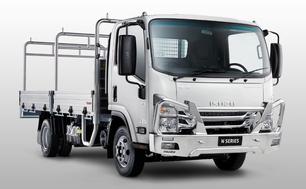
Isuzu offers a convenient ‘turn key’ alternative with its compact N-Series range. This well-designed package comes with its sleeves rolled up ready for work, equipped with a versatile service body and big GVM and GCM ratings that leave one-tonne utes in the shade. And it can be driven using a normal car licence. We recently put one to the test.
The LDV G10 is a solid option for those buyers who just want a van that gets the job done. It was decent with weight on board, but is probably better suited to parcel carriers rather than pallet shifters.
Safety levels are the biggest concern, as it is falling behind in the class when it comes to active safety tech, and its weak crash test score could be enough to rule it out for some customers.
Work out the weight of all the tools, equipment, materials, crew and (if applicable) trailer that you need to haul around each day and measure it against this truck’s formidable GVM and GCM ratings. When combined with its compact dimensions, robust design and build quality, solid warranty and ready-to-work pricing, you may find it’s hard to beat if you’re prepared to think outside the square on what a single cab-chassis ute can look like.
The more you see LDV G10 vans, the more regular they look. Familiarity breeds ignorance, I guess, but I still think the G10 looks smart.
It isn’t quite as boxy as some, with its sleeker front-end styling and almost sedan-like tail-lights helping it stand out from the ‘box-on-wheels’ stigma. It gets 16-inch alloy wheels as standard, and has halogen headlights and misses out on daytime running lights.
But it still is a box on wheels, measuring 5168mm long (on a 3198mm wheelbase), 1980mm wide and 1928mm tall. That makes it a darn sight smaller than the new HiAce, which stepped up significantly in size, and about on par with a Renault Trafic SWB or Ford Transit Custom 300S SWB.
The perceived build quality is mostly okay, though our test car had a few loose plastics on the outside and a seemingly mis-fit windshield rubber.
This vehicle looks compact in comparison to a one-tonne ute - and the tape measure confirms it. Compared to a Ranger 4x4 dual cab ute for example, its 5020mm overall length is a surprising 339mm shorter, its 2490mm wheelbase is 730mm less and its 1855mm width is line-ball.
The Isuzu’s 2172mm height is 357mm taller, which could present a challenge if access to underground or multi-storey carparks is required. However, its remarkably small 8.7-metre turning circle is a whole 4.0 metres tighter than the Ranger, so it's highly maneuverable.
Built on a heavy-duty steel ladder-frame chassis, it has independent wishbone/coil spring front suspension, a leaf-spring live rear axle, power-assisted rack and pinion steering and four-wheel disc brakes. It also runs a 24-volt electrical system with twin batteries.
The single cab provides fabric-trimmed seating for up to three (driver bucket, passenger bench) but our test vehicle was fitted with seat covers from the Isuzu accessories range. With torsion bar assistance, the cab can be easily tilted forward to rest at a 45-degree angle and provide full access to the engine.
The service body, which is a blend of lightweight aluminium and steel, has a tough powder-coated finish. It comprises a large main storage compartment with big gull-wing doors on each side, plus a compact rear tray with checker-plate floor, drop-sides and load anchorage points. There are also rear underbody storage boxes on each side, plus sturdy body-mounted roof racks, safety yellow non-slip steps and sturdy grab handles front and rear.
Those dimensions translate to a cargo space of 5.2 cubic metres, with a load space spanning 2500mm long, 1590mm wide (1270mm between the arches) and 1270mm tall. That mightn’t be big enough for you, and that’s too bad - there is no high roof version, nor a long-wheelbase model; but you could get an LDV V80 if you really need to step up in size… but we wouldn’t suggest you do that.
The payload for this model is 1010kg, which is decent but not benchmark-setting. It has a gross vehicle mass of 3000kg, meaning a kerb weight of 1990kg. The gross combination mass depends on the model: the GCM for diesel models is 5000kg for a braked trailer, while petrol models have a GCM of 4750kg for a braked trailer (auto) and 4500kg (manual). All models have a GCM of 3750kg for unbraked trailers.
The petrol versions have 1093kg of payload, if you prefer that fuel type. Interestingly, the manual versions have leaf spring rear suspension, while the auto models have coil springs as part of a five-link suspension architecture.
The load area has a six floor-mounted and four wall-mounted tie-down hooks, and the floor is lined with a vinyl covering while up to half-height the inner walls are lined, too. There are four lights mounted on the walls, which is handy for after-hours work.
And every LDV G10 comes with dual sliding side doors (some brands charge thousands more for this convenience), while the back door is a tailgate as standard, with the option of barn doors for diesel models.
For those who need to fork loads in, the barn doors are a no brainer, because the side door apertures (at 820mm wide) aren’t broad enough to load in using a lift. The tailgate also makes it very difficult to load weight in, as we found on test, as our mates at Crown Lifts had to use long tines to fork in our 750kg ballast.
When it comes to creature comforts up front, there is a pair of low-mounted pop-out cupholders, and an open storage area between the seats. There isn’t much covered storage, so if you often carry valuables, you may need to keep that in mind.
The seats are comfortable and offer good adjustment, and they’ve been changed since the diesel auto model launched. They’re no longer a cheap-feeling fabric, but rather a faux-leather accented, mesh-lined set of seats, and both have armrests. Nice.
The presentation is okay, but the ergonomics could be better. The touchscreen is mounted down lower than most, and means you may need to take your eyes away from the road because the controls are down even lower. And the USB? Near the floor.
That screen is still a 7.0-inch display, but now has the same software system as the newer models in the LDV range. That means a nice crisp colourful display with the added advantage of Apple CarPlay… if you can get it to work. We had a few issues when reconnecting a phone without re-starting the car.
With a hefty 2825kg tare weight and 4500kg GVM, the Isuzu has a big 1675kg payload rating. It’s also rated to tow up to 4000kg of braked trailer and with its sizeable 8000kg GCM, it can legally tow that weight with a 500kg reduction in payload. Or you can cap the towing weight at 3500kg and keep the full payload. Either way, these are substantial GVM and GCM ratings for any number of working roles.
In terms of cabin storage, there’s no glove box but both doors have narrow storage bins and there are overhead shelves with restraint netting to keep loose items in check. There’s also a pop-out dual bottle/cup holder in the centre dash along with two small storage nooks, but more places to store things would be welcome in this space.
If you’re buying an LDV G10, it’s because of the price. The cost of the diesel automatic model we’ve got is usually $32,490 drive-away for ABN holders, but there are promotions running listing it at $29,990 drive-away for ABN holders at the time of writing. If you’re not an ABN holder, just get one, because you’ll save heaps (the G10 diesel auto is $34,147 drive-away for non-ABN holders).
You can get other vans for around this money - the Renault Trafic Trader Life manual, with its gutless 66kW turbo-diesel engine, is $30,990 d/a. But you won’t find a diesel Hyundai iLoad, Peugeot Partner or Toyota HiAce within $10,000 of the LDV.
As for standard spec, you get 16-inch alloy wheels, tyre pressure monitoring, climate control air-conditioning, a 7.0-inch touchscreen with USB connectivity, Apple CarPlay, Bluetooth phone and audio streaming, CD player and AM/FM radio, a digital speedometer, two part fake-leather seats with arm-rests (driver’s side with height adjust), carpet flooring up front, and vinyl floor protective liner in the rear, and a reversing camera.
Standard body fit out is dual sliding side doors and a lift tailgate, though you can get barn doors fitted on diesel models. Unlike some competitors, there is no option for glazing in the rear doors or side panels.
There are also no auto headlights, no auto wipers, push-button start, keyless entry, leather-lined steering wheel, reach adjustment for the steering, and there’s quite a bit missing in the safety section of this review - see below.
Our test vehicle, to use its full model name, is the NLR 45-150 SWB AMT Servicepack X. It’s the most compact model in the N-Series range and as a result is similar (and in some cases much smaller) in key dimensions to a one-tonne ute. It only comes in one specification with 3.0-litre turbo-diesel, six-speed automated manual transmission (we’ll get to that) and dual-rear wheels, for a list price of $87,789.
In addition to its service body, this hard-worker comes standard with half a dozen 16-inch steel wheels, 195/75R16C Michelin tyres and a full-size spare. The single cab is well-equipped with useful features like keyless entry with central locking of cab and service body, big door mirrors with power adjustment, heating and lower wide-angle view, driver’s bucket seat with mechanical suspension and weight adjustment up to 130kg, two-way adjustable steering column, cruise control and bright LED interior lighting. Also standard is a 4000kg-rated tow-bar, reversing camera, loud reversing alarm and door-mounted cornering lamps.
There’s also an infotainment system with smallish 6.2-inch control screen and DAB+ radio. Even though there’s no Apple CarPlay or Android Auto, it has multiple connectivity including internet radio via smartphone, external camera inputs, navigation, reversing sensors and tyre pressure monitoring. The driver also gets a multi-information display and there’s plenty of the latest safety tech headlined by AEB.
Under the bonnet of the diesel G10 is a 1.9-litre four-cylinder turbo-diesel with 106kW of power and 350Nm of torque. There’s the choice of a six-speed manual or six-speed automatic, and the G10 is rear-wheel drive. It has a diesel particulate filter, but not stop-start or AdBlue.
Prefer petrol? There’s a 2.4-litre five-speed manual model (105kW/200Nm) or a 2.0-litre turbocharged six-speed auto (165kW/330Nm). Those models are cheaper - $25,990 for the manual for ABN holders, while the turbo-petrol auto is $30,990 d/a.
Isuzu’s 4JJ1-TCS 3.0-litre four-cylinder turbo-diesel is closely related to the 4JJ3-TCX in the current D-Max ute and MU-X wagon. Tuned for hard work and long life, it produces 110kW at 2800rpm and 375Nm across a 1200rpm-wide torque band between 1600-2800rpm. It’s also equipped with a vacuum-controlled exhaust brake which can be switched on or off.
Isuzu’s MYY-6E is a six-speed fully-automated manual transmission, which may sound like a contradiction in terms, However, like the engine, it's designed for a long service life under continuous heavy loads. It uses an electro/hydraulically controlled wet clutch and lock-up torque converter to provide either fully automatic or clutch-less manual shifting. There’s also slow/fast gear engagement control, first gear start (for heavy loads) and normal or economy drive modes.
A handy power take-off (PTO) facility can drive numerous on-site implements, with drive coming from a counter gear on the left-hand side of the transmission case.
The combined cycle fuel use claim for the LDV G10 diesel auto is 8.6 litres per 100 kilometres. The manual version uses 8.3L/100km according to the brand.
On test we saw a fuel use return of 9.7L/100km at the pump, across a mix of urban, highway and freeway driving, with and without a load.
Petrol models use a claimed 11.5L (manual) and 11.7L (auto) per hundred.
Average combined fuel consumption figures are not required for commercial vehicles in this weight division. Even so, the dash display was claiming 13.2L/100km at the end of our 295km test which included about one third of that distance hauling a heavy payload. So, based on those figures you could expect a real-world driving range of around 570km from its 75-litre tank.
You probably wouldn’t choose an LDV G10 as a daily driver if you didn’t intend to use the cargo zone at least 80 per cent of the time.
But if - for whatever reason - you really want to use a van like this on a day-to-day basis, you won’t hate it.
The G10 drives pretty nicely for this type of vehicle. It isn’t as bouncy when unladen as some of the other vans out there, with the suspension proving very quick to settle and mostly very compliant across mixed surfaces.
The steering wheel can jostle a bit over sharp edges, but it steers well, with decent (not too heavy) weighting and predictable response at all speeds.
Without weight on board the engine feels reasonably urgent in its response, which is a bit of a surprise because it’s not a powerhouse based on its outputs. It revs smoothly and pulls with good strength, with little turbo lag to contend with. While it is a bit of a grumbly engine at times, the response is better than adequate.
Plus the transmission is well sorted, with smooth shifts that are predictable.
The braking response is definitely better without weight on board, with a decent progression to the pedal and decent bite when you press hard on the anchors.
The doors open 90 degrees for easy access and there are decent boot-sized steps plus big handles on the windscreen pillars to help you climb aboard.
It’s a different driving position to a ute, as you sit high above the engine with your feet ahead of the front wheels and hands on a bus-style flat steering wheel. There’s also a big left footrest with lots of open floor around it, so there’s ample space to rest your foot given there’s no clutch pedal.
The suspension seat can be easily adjusted to suit a driver’s weight and works well in providing a more comfortable ride. The seat’s base cushion has no rake adjustment but there is some movement available in the backrest. Large glass areas deliver a commanding view ahead and to the sides while the big door mirrors provide excellent coverage of what’s behind.
Its harsh ride quality when unladen is to be expected as it’s designed to carry permanent payloads between 1.0 and 1.5 tonnes. You do get thrown around, particularly on poor road surfaces with large bumps and dips. However, it’s no worse than the rodeo ride we’ve experienced in some unladen single-cab chassis utes which don’t have the luxury of a suspension seat.
The cab’s insulation ensures low engine and tyre noise, particularly during highway use where the turbo-diesel requires 2200rpm to maintain 100km/h and 2500rpm at 110km/h. The most noticeable noise at these speeds comes from wind buffeting around the mirrors, roof racks etc but it’s far from intolerable, as conversations can still take place at normal volumes.
Braking (particularly when using the exhaust brake) and steering response are good but the automated manual transmission takes some getting used to, as it shifts gears at about the same leisurely speed you would do manually.
These long pauses between cogs can be frustrating when climbing hills, as you naturally want to downshift quicker to avoid losing momentum, but you can’t do it in either automated or manual modes. Isuzu claims that the duration of these automated shifts can be shortened, but after consulting the owner’s manual to make this adjustment, we didn’t notice much if any difference (or perhaps we just didn’t do it correctly).
The engine has good flexibility and does not respond well to aggressive treatment. A more relaxed approach is best, using low rpm to optimise torque.
If safety matters to you, this could be your reason not to buy an LDV G10.
The van scored a mediocre three-star ANCAP crash test safety score - which would be more acceptable if that was under the current, strictest criteria, but it was actually tested in 2015. Which means it would be even lower if tested today.
One of the reasons is the safety equipment - there’s not a lot of it. You get dual front airbags, but no side airbags or curtains. There is no advanced tech like auto emergency braking (AEB), no lane keeping assistance or lane departure warning, no blind spot monitoring or rear cross-traffic alert… But you do get a reversing camera and rear parking sensors.
There’s no ANCAP rating required for vehicles in this weight class. Even so, it does have numerous passive and active safety features including driver and passenger airbags plus advanced driver assistance systems (ADAS) including AEB, forward collision warning, distance warning, lane departure warning, traffic movement warning, cab-tilt warning and more. There’s also a reversing camera, reversing alarm (the loud beep-beep type) and door-mounted cornering lamps.
LDV isn’t close to the leaders in the segment for ownership, with a behind-the-times three-year/100,000km warranty (admittedly with the same cover for roadside assist), and no capped price servicing plan.
Service intervals are every 12 months/10,000km, which is short, and you need to get an initial service done at 5000km, too.
If you’re worried about long-term longevity, you can check out our LDV G10 problems page.
There's a reassuring standard warranty of six years or 250,000km (unlimited operating hours) whichever occurs first. Includes three years/unlimited km coverage for body equipment, plus six years of 24/7 roadside assistance with unlimited km. Scheduled servicing every 15,000km/12 months whichever occurs first. Choice of servicing packages available.