What's the difference?
I know what you're thinking: "How is this thing legal?" And to be honest, somewhere between a rock flung from the tyre of a passing car colliding with my forehead like it had been fired from a pistol, and the pouring rain lashing my exposed face like a damp cat-o'-nine-tails, I'd begun wondering the same thing.
The answer is barely. The product of a years-long fight to overcome our import rules, this madhouse KTM X-Bow R is now finally free to roam Australian roads and racetracks - though, with sales capped at 25 per year to comply with the Specialist Enthusiast Vehicle Scheme.
The price? A slightly eye-watering $169,990. That's quite a lot, and places the X-Bow R miles above its closest lightweight, carbon fibre-tubbed competitor, the Alfa Romeo 4C ($89,000).
But then, the KTM X-Bow R is unlike anything else on the road today. Part super bike, part open-wheeler and all mobile madness, the 'Crossbow' is fast, furious and completely insane.
Expect no doors, no windscreen, no roof. On-board entertainment is limited to the turbo whistling behind your head, the car's standard safety list is as barren as the interior and the climate control is dependent on the temperature of the wind that's smashing into your exposed face.
And we couldn't wait to take it for a spin.
Aussie buyers could be excused for being wary of SsangYong, given the marque’s chequered history involving numerous ownership changes, crippling debts and in 2021 its rescue from the jaws of receivership by Korean industrial conglomerate KG Group.
However, the KG Group’s corporate rehabilitation of the troubled carmaker was completed in 2022, allowing the renewed SsangYong Motor (renamed KG Mobility in Korea) to hopefully focus on its core business of producing 4x4 SUVs and pick-ups, with increasing use of electrification planned for future model development.
As part of this renewal, in late 2023 SsangYong Australia announced MY24 updates to refresh its local 4x4 Musso ute and Rexton seven-seater SUV ranges, which, combined with a Merv Hughes-hosted marketing campaign, is aimed at building brand appeal and sales through its 70-plus national dealer network.
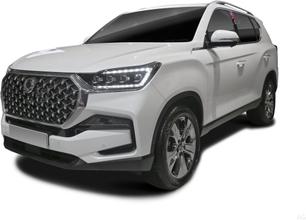
We were recently handed the keys to the latest Rexton, which competes for buyers in Australia’s fiercely competitive ‘Large SUVs under $80K’ segment that hosts more than 20 rivals.
Okay, so rain is not your friend. Neither is brutal sunshine, strong winds or any speed bump anywhere. There are probably a handful of times you'll want to drive it, and when you do you will definitely get hit in the face with rocks and bugs, and spend most of your time wondering just how the hell this thing is legal.
And yet, we are hopelessly, head-over-heels in love with it. It's an absolute weapon on a track, a joy on anything even resembling a twisting road and it is one of the few genuinely unique cars on the road today. And the fact it exists at all is a cause for absolute celebration.
If KG Group can provide the long-term stability and new model investment that has eluded SsangYong for so long, the brand could have a promising future in Australia judging by the MY24 Rexton Adventure. It’s a solid package and what it lacks in benchmark ANCAP safety and third-row comfort is offset by a compelling driveaway price, generous warranty and national dealer network. So, if you’re looking for a feature-packed 4x4 seven-seater SUV for less than $55K, you might be pleasantly surprised by this competent Korean.
The X-Bow R is built for purpose in the most wonderful of ways. From the visible suspension components to the rocket-style exhausts, to the stripped-bare interior, it's fairly obvious that form came a distant second to function in the X-Bow's design process.
And, for us at least, that's a tremendous thing. It looks raw and visceral, and a bit like Harvey Dent post-fire - you can see all the normally hidden components doing their thing. It's mesmerising.
With its 4850mm overall length and 1960mm width, the Rexton rides on a 2865mm wheelbase with a compact 11-metre turning circle.
Its smooth ride comes from four-coil suspension with double-wishbones up front and an independent multi-link arrangement in the rear. For those venturing into the rough stuff, it has 20.5 degrees approach and departure angles, 20 degrees ramp break-over angle and 203mm of ground clearance.
Looks are subjective, of course, but we reckon it has attractive and cohesive styling, with its prominent and ornate diamond-style grille complimented by distinctive side-body contours that can’t be mistaken for other SUVs.
The interior has a premium look and feel, with lots of exposed stitching along soft-touch seams and a tasteful blend of contrasting surfaces including chrome, satin chrome, piano black and textured patterns.
There’s good attention to detail and build quality is excellent, but there are some annoying design quirks like the need for the front passenger to access a touchscreen menu just to adjust the audio volume.
The second-row of seating has a/c vents in the centre console and is spacious even for tall people like me (186cm). When sitting behind the driver’s seat in my position, there’s about 60mm of clearance between my knees and the driver’s seat backrest, which combined with ample head and shoulder room makes for a comfortable ride.
By contrast, the third-row seating is strictly for young kids, as there are no adjustments for the second-row’s backrest angle or fore/aft base cushion positioning to accommodate taller frames like mine. The side windows in the thick rear roof pillar are also conspicuously small, which adds to a claustrophobic feel.
Fortunately, access to the third-row is made easier by the 60/40-split second-row, which can be folded and tumbled forward.
However, given I’ve found tolerable third-row comfort in some rival seven-seaters, the Rexton’s third-row is my only gripe for those with longer limbs.
Short answer? It's not. People are unlikely to test drive an X-Bow R and start looking for cupholders and storage space, but if they did, it wouldn't take long.
Aside from the twin seats, a four-point racing harness, a high-mounted gearshift, a pull-lever handbrake, and detachable steering wheel, the cabin is as bare as Old Mother Hubbard's cupboard.
Luggage space is limited to what you can carry in your pockets (though wearing cargo pants will help) and even getting in and out of the thing takes some fleet-footed antics. With no doors you need to literally jump in. And the side sills are only rated to 120kg, so heavier types will need to avoid stepping on them at all, and instead attempt a kind of running leap into the cockpit.
With its 2130kg kerb weight and 2960kg GVM, our test vehicle has a sizeable load capacity of up to 830kg, which should be ample for five occupants and their luggage.
It’s also rated to tow up to the class-benchmark 3500kg of braked trailer and its 350kg maximum tow-ball download is compatible with that requirement.
Plus, its generous 6460kg GCM (or how much it can legally carry and tow at the same time) means it can legally tow its maximum trailer weight while carrying its maximum car-load, which is a practical set of numbers for just about any recreational requirement.
Front-row cabin storage includes cup/bottle-holders and a small bin in each front door, plus a single glove box. The stylish centre console has a bin up front with sliding-lid, two cupholders in the middle with another sliding-lid, plus a box at the rear with hinged padded-lid that doubles as a driver’s elbow rest.
Those seated in the second-row get a cup/bottle holder and bin in each door, plus pockets on each front seat backrest. The fold-down centre armrest has two more cupholders and a handy hidden compartment that’s ideal for small items. Third-row occupants get storage bins on each side but no cup/bottle holders.
Accessing the cargo area through the power tailgate reveals 236 litres (VDA) of load volume with the third-row seats upright. This expands to 641 litres with the third-row folded flat and 1806 litres (or more than 1.8 cubic metres) with the second and third-rows folded.
The cargo area’s rear floor has a two-tiered design, with the top floor lying flush with the third-row seats when folded but it can be removed to reveal a lower floor that provides a second level of storage. There’s also a usefully large bin in the right-hand-side wall cavity. The only things missing are sturdy load-anchorage points at floor level to secure cargo nets or straps.
Keen readers of this site will recognise this as the area where we outline the many and varied features that come along with a normal new car purchase, but that's just not going to work this time. In fact, it'll be considerably easier to talk about what's missing, so let's start with the obvious: doors, windows, roof, windscreen. All conspicuously absent from this weird and utterly wonderful X-Bow.
Inside, you'll find two thinly (and we mean thin - we've seen thicker contact lenses) padded seats fixed into the tub. You'll also find push-button start, a digital screen reminiscent of those found on motorbikes (KTM is an Austrian-based motorcycle company, after all) and a pedal box that slides backward and forwards to offset the height of the pilot. Oh, and that steering wheel can pop off to make getting in and out easier.
Climate control? Nope. Stereo? Nope. Proximity unlocking? Well, kind of. With no doors, you'll always find it unlocked when you enter its proximity. Does that count?
But what it does have is a turbocharged two-litre engine. And in a car that weighs a sprightly 790kg, that means it's quick, pulling like a rabid sled dog in every gear, rear tyres chirping with every change.
Our test vehicle is the new ‘Adventure’ model, which serves as the middle-grade offering between the entry-level ELX and top-shelf Ultimate.
It’s equipped with the same 2.2-litre four-cylinder turbo-diesel, eight-speed automatic and part-time 4WD as other Rextons, for a drive-away price of only $54,000 (our 'Space Black' metallic paint is a $595 option).
That pricing looks razor-sharp compared with mid-grade 4x4 seven-seaters offered by segment leaders like the Isuzu MU-X LS-U ($61,400), Ford Everest Trend ($66,790) and Toyota Prado GXL ($69,530).
And they are 'list' prices (not including on-road costs) whereas the Rexton is 'drive-away-no-more-to-pay'.
The MY24 upgrades include a new dash layout and high-mounted 12.3-inch multimedia touchscreen with Apple/Android wired connectivity. There’s also a restyled dual-zone climate control hub with touchscreen, plus new lower body mounts for improved ride quality.
The Adventure brings numerous luxuries like a walk-up welcome system (mirrors unfold and puddle lamps illuminate), touch-sensing front door locks with walk-away auto door-locking, power tailgate and soft-touch synthetic leather seats with the fronts offering power adjustment, heating and cooling.
The second-row outer rear seats and steering wheel are also heated, plus there’s speed-sensitive power steering and tyre pressure monitoring.
These appointments are in addition to the base ELX’s generous standard equipment list including 18-inch 'diamond-cut' alloy wheels with 255/60 tyres and a full-size alloy spare, LED dusk-sensing headlights/DRLs/front fog lights/tail-lights, heated door mirrors, a four-way-adjustable leather steering wheel and 12.3-inch driver's digital instrument display.
There are also four USB-C ports (two front and two in second row centre console), three 12-volt outlets (front console box, second row centre console and cargo area), electric parking brake, reversing camera, front and rear parking sensors and more. It's fair to say the Rexton Adventure is feature-packed.
The X-Bow R's power comes from an Audi-sourced, turbocharged 2.0-litre engine, paired with a VW Group six-speed manual transmission (and one of the stubbiest gearsticks in existence). That mid-mounted marvel produces 220kW at 6300rpm and 400Nm at 3300rpm, and ships it off to the rear tyres with the assistance of a Drexler mechanical limited-slip differential.
Thanks to its lithe and lightweight body, that's enough to propel the X-Bow R from 0-100km/h in a blistering 3.9 seconds, and on to a top speed of 230km/h.
The quiet and refined 2.2-litre, four-cylinder, turbo-diesel, which meets Euro 6 emissions standards, produces 149kW at 3800rpm and 441Nm across a 1000rpm-wide torque band between 1600-2600rpm. It provides energetic response in city and suburban use.
This engine is paired with an equally refined eight-speed torque converter automatic, with overdrive on its sixth, seventh and eighth ratios ensuring low-rpm operation and optimum fuel economy at highway speeds.
Sequential manual-shifting is available using the steering wheel-mounted paddles and there's a choice of three drive modes ('Power'/'Winter'/'Eco') which can be selected using a console button.
The part-time, dual-range 4WD system is controlled by a console dial, offering the choice of 2H (2WD high-range), 4H (4WD high-range) and 4L (4WD low-range). It also has an auto-locking rear diff to optimise traction as required.
KTM lists the X-Bow R's claimed/combined fuel figure at 8.3 litres per hundred kilometres (though we were managing mid-12s after an, ahem, very spirited test), with emissions pegged at 189 grams per kilometre.
The X-Bow R is also fitted with a 40-litre fuel tank, accessed via a side-mounted inlet. Instead of a fuel gauge, expect a digital reading showing how many litres you have left.
SsangYong claims an official combined cycle average of 8.7L/100km. At the completion of our 307km test, which comprised mostly city and suburban driving with a bit of highway travel, mostly in Eco mode with up to five occupants on some trips, our figure calculated from fuel bowser and trip meter readings came in at 11.0L/100km.
Although higher than SsangYong’s claim, it was within the usual 2.0-3.0L/100km discrepancy between official and ‘real-world’ figures. So, based on our numbers, you could expect a driving range of more than 600km from its 70-litre tank, which is not bad. Based on the official figure, driving range extends to around 800km.
It couldn't be more Fast and Furious if it had Vin Diesel growling under its (non-existent) bonnet. We have technically driven faster cars, but we have never driven anything that feels quite so fast as this utterly insane X-Bow R.
Climb in, strap into the four-point harness and select first via the surprisingly easy-to-manage gearbox and clutch set up, and, at slow speeds, wrestle with the dead weight of the completely unassisted steering, and it's immediately clear that this is a driving experience like nothing else currently road-legal in Australia. Even at walking pace, the X-Bow R feels poised for an assault on the future, and it attracts attention on the road like nothing else we've ever driven.
Its road-scraping ride height and diminutive dimensions make tackling traffic an intimidating prospect, with regular hatchbacks suddenly taking on truck-like proportions and actual trucks now looking like passing planets. There's a constant concern that you're sitting well below the traditional blind spot, and that you could be crushed at any moment.
Combine all that with the bad weather that cursed our final day of testing, and the X-Bow R is all sorts of watery hell. It is truly homicidal in the wet, too, with the back end breaking grip at the slightest provocation. And the turbocharged 2.0-litre offers plenty of that.
But on a sunny day, and on the right road, it's pure driving bliss. The acceleration is brutal, the grip endless and the Audi sourced gearbox an absolute treat. And it pulls in every gear, tackling 35km/h corners in third and absolutely blasting out the other side.
Cornering is scalpel sharp, and the steering - so heavy at slow speeds - is light and efficient at pace, requiring only the most minuscule of movements to bite into a bend.
It is anything but perfect in the city, and even a light sprinkling of rain will have you seeking shelter (and a refund), but on the right road, on the right day, there are few if any cars that offer the kind of razor-sharp thrills and intoxicating excitement of KTM's monstrous X-Bow R.
The Rexton’s overall refinement and build quality are evident when you get behind the wheel. It offers good adjustability for driver comfort and the fundamentals of the vehicle are sound, as there were no red flags during our test.
The engine is smooth and quiet with good all-around performance, the automatic transmission shifts quickly and smoothly, the steering is nicely weighted and communicative, the brakes provide reassuring response and the ride quality is supple over bumps yet disciplined enough to provide good handling response.
It’s also pleasantly quiet at highway speeds, with low tyre and wind noise. Engine noise is also minimal, given that it requires only 1600rpm to maintain 110km/h, ensuring low-stress cruising.
Most of our driving time was spent in Eco mode, as we found performance in this setting more than adequate for our purposes. We did briefly use the Power mode but didn’t notice any significant change in response.
Next to none. There is no ABS, traction or stability control. No airbags, powered steering or ISOFIX attachment points, either. If you break traction (which, in the wet, is more than a little bit likely) it'll be up to you to ensure you straighten up again. Helpfully, there's a ton of grip from the Michelin Super Sport tyres.
As part of the compliance program, Simply Sports Cars (the company responsible for introducing the X-Bow R) actually crash tested two cars in Europe, and raised the ride height by 10 millimetres. Oh, and there's now a seatbelt warning sign, too.
No ANCAP rating (as yet). Even so, it comes with numerous passive and active safety features highlighted by dual front, side and curtain airbags plus a driver’s knee protection bag (but no centre airbag between driver/front passenger).
There’s also AEB, lane assistance, blind-spot warning and rear cross-traffic alert, trailer sway control, hill descent control, front/rear parking sensors, reversing camera and more, but a notable absentee is speed-sign recognition and the cruise control is non-adaptive. There are also ISOFIX child seat anchorages on the two outer second-row seating positions plus top tethers for all three.
The X-Bow R is covered by a two-year, unlimited-kilometre warranty, and while service prices aren't capped, Simply Sports Cars estimates an average serve cost at about $350.
Warranty cover is seven years/unlimited km warranty plus seven years roadside assist.
Scheduled servicing is every 12 months/15,000km whichever occurs first.
The first seven scheduled services run to $375 each, up to seven years/105,000km, for a total of $2625.