What's the difference?
Jeep's Renegade might be late to the mini-SUV party but it comes with a pretty impressive back catalogue to suggest that this is a SUV that can cash the cheques its name can write.
The top of the range Trailhawk can write even bigger cheques than the lower models, bringing with it a range of off-road tech toys to let you really get down and dirty.
It’s safe to say that SsangYong’s reintroduction to Australia back in late 2018 didn’t go as planned.
Since the relaunch, the world was plunged into an industry-disrupting pandemic and the brand has had to manage bankruptcy in its Korean home market.
But that has also created an opportunity, as big-name brands like Toyota, Mazda, Hyundai, Kia and Mitsubishi continue to push upmarket, it leaves price-sensitive customers with fewer and fewer options.
As a cut-price alternative alongside Chinese brands like MG, LDV and GWM Haval, SsangYong could very well carve out its niche as more Australians look to get into new wheels without breaking the bank.
And while the Musso ute and Rexton large SUV are the brand’s biggest sellers, it’s the Korando mid-size SUV that could make the biggest impact in turning SsangYong’s fortunes around as it competes in the booming mid-size SUV market.
So, does the SsangYong Korando have what it takes to steal sales away from big dogs like the Toyota RAV4 and Mazda CX-5? Or are you better off waiting months and months for a known quantity?
Rugged, dependable and good off-road are the most obvious qualities of the Trailhawk. It stands out from the rest of the mini-SUVs by being able to do the S and the U with plenty of vigour.
It's just a shame that its on-road manners can't match that of its big brother, the Cherokee. Unless you're planning on proper off-roading, the Trailhawk might not be quite what you're looking for.
SsangYong’s Korando diesel might not break the mould in any meaningful area, but it certainly has its place as a no frills, feature-rich SUV.
However, buyers that stay in the inner city should probably forgo the diesel in favour of the petrol Korando which costs less to buy, and at this stage, less to fill up.
The diesel engine is a little undercooked and the styling is far from exciting, but the long equipment list, sensible pricing and lengthy warranty period should at least give buyers deadset on a Hyundai Tucson, Mazda CX-5 or Nissan Qashqai pause.
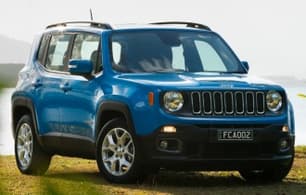
In what is absolutely not a coincidence, the Renegade immediately conjures up the Wrangler. Upright grille from the Willys Jeep (references abound here), round headlights, squared off wheel arches to mimic the Wrangler's guards, short overhangs and big rear view mirrors.
The 17-inch wheels look completely lost in the wheelarches which are even more cavernous owing to the Trailhawk's 50mm of extra ride height. The wheels are also a bit cheap looking but will probably survive the belting the car is intended to take.
Less rugged is the interior, despite a fairly self-conscious effort to make it look and feel chunky. The front seats are flat and unsupportive with the rears just as lacklustre making sure everyone is sliding around together. Luckily, front passengers get a dash-mounted grab handle.
It seems quite well put together, however, but with carpets and easily-marked plastics, you'll hope your passengers don't bring the mud in with them too often. And the "Since 1941" stamped into the steering wheel can go.
The dashboard is reasonably clear and has plenty of information to share via the screen between the dials but whoever thought marking the redline with a water splash graphic in bright orange should probably rethink their design decisions.
Storage is limited to two cupholders up front, door pockets in each door and nets on the front seat backs.
At first glance, the SsangYong Korando might look a bit derivative or even bland, blending elements of the Kia Seltos and Hyundai Tucson.
But did you know the SsangYong Korando predates both aforementioned models? Yep, the fourth-generation broke cover in early 2019, about six months ahead of the Seltos and more than 12 months before the latest Tucson surfaced.
Just because it was first in however, doesn’t mean it is still the best dressed.
To our eye, the Korando is just missing that X factor in aesthetics to really help it stand out from the crowd.
From a distance, it just looks like any other SUV, and isn’t all that distinctive from its rivals.
Sure, the SsangYong grille, sharp front end and foglight arrangement are distinctive enough, but maybe it’s the white of our press car that makes it just seem a little … ordinary.
In profile, the Korando is even more inconspicuous, and even its unique wheels and thick C-pillars do nothing to grab your attention.
The rear end of the Korando might be its best angle, with stand-out tail-light graphics, a chrome centre strip and chunky bumper combining for a little visual pizazz.
Inside, the Korando continues the ho-hum theme with a standard, but lacklustre, dashboard layout and cabin materials.
There’s leather and gloss-black bits to liven things up, but from the centre stack design to the seat inserts, there’s just nothing standout or special about the interior of the Korando.
Don’t get us wrong, we don’t hate the way the Korando looks and feels, its just a bit too Clark Kent and not enough Superman for our tastes.
But if you wanted a mid-size SUV that is inoffensive and blends into the background, this could the car for you.
The Renegade range starts at $28,000 for the 1.6-litre Renegade Sport manual front-wheel drive, climbing between $2000 and $3000 through the Sport Auto, Longitude Auto, Limited Auto with a final jump of $4000 to the 2.4-litre auto-only Trailhawk.
Standard is a nine-speaker stereo with Bluetooth and USB, 17-inch alloys, dual-zone climate control, reversing camera, rear parking sensors, keyless entry and start, cruise control, electric front seats with heating, satellite navigation, automatic bi-xenon headlights, auto wipers, leather trim, roof rails, front and middle bash plates, full size spare, heated leather steering wheel, privacy glass, trailer sway control and tyre pressure monitoring.
The lairy Omaha orange is $500, part of an eleven colour palette with only two no-cost paint options (black and white).
You can add lane departure warning, auto-parking and a black painted roof for $500 each, a removable and retractable roof called My Sky Roof for $2200 or a more conventional electric sunroof for $1900.
The Beats-branded nine-speaker stereo is run via Fiat-Chryser's UConnect system, accessible through the 6.5-inch touchscreen. While it improves with every attempt, it's still quite clunky and when the sat-nav is added, becomes a bit of a mess.
Thankfully, not every function has been crammed into the touchscreen interface, so you'll spend more time with your hands on the wheel rather than working out which bit of the screen has the climate control.
SsangYong’s Korando range kicks off at $29,990 driveaway for the EX grade, and tops out at $40,990 for the Ultimate Diesel that we have on test here.
While nearly $40,000 might seem like a lot to spend on a SsangYong mid-size SUV, the Korando Ultimate Diesel is actually the most affordable oil burner in its class, competing against the Hyundai Tucson (from $45,400 before on-road costs), Kia Sportage (from $39,845), Mazda CX-5 (from $45,880), Peugeot 3008 (from $53,540) and Volkswagen Tiguan (from $55,990).
So, for those after a diesel SUV for the family on a budget, the SsangYong Korando should definitely be on your list.
And don’t think that SsangYong has skimped on the equipment to bring the price down either, as there is a long list of standard gear that includes 19-inch wheels, front and rear fog lights, auto-folding mirrors, heated and cooled front seats, LED daytime running lights, rear privacy glass, a sunroof, dual-zone climate control, heated steering wheel, power adjustable front seats, and push-button start.
The multimedia system measures 8.0 inches, and features touchscreen functionality with Apple CarPlay and Android Auto support.
There’s also a 10.25-inch all digital instrument cluster that lets you adjust the readout to display the information you want.
However, with a small family to juggle, it’s the powered tailgate and keyless entry that were appreciated the most, as well as the biscuit-crumb-resistant leather seats.
All in all, the Korando is fitted with a comprehensive list of equipment that would make similarly-priced offerings from Hyundai and Kia jealous, but there are a couple of glaring omissions – digital radio and a wireless smartphone charger.
To be fair, wireless charging is a nice-to-have feature – not a must have – but in 2022 when technology is quickly becoming the focus for new vehicles, it is strange to see both of these items not included on the top-spec variants of new vehicles.
The Trailhawk is powered by Fiat's 2.4-litre four naturally-aspirated four-cylinder producing 129 kW and 230 Nm. Jeep reckons you'll get 7.5L/100km on the combined cycle. Our mostly city driving with a longish motorway run produced an 11.0L/100km average over a week.
The transmission is a nine-speed ZF automatic driving all four wheels.
The Trailhawk also has Jeep's five mode Selec-Terrain system which should cover pretty much every eventuality – Auto, Sport, Mud, Sand and, just for the Trailhawk, Rock. The Trailhawk is rated to tow 400kg unbraked and 907kg braked.
Powering the SsangYong Korando Ultimate Diesel is 1.6-litre turbo-diesel engine.
Peak power is 100kW at 4000rpm, while maximum torque of 324Nm is available from 1500-2500rpm.
Those outputs are well down on rival cars, which range from 137kW/416Nm in the Tucson and Sportage, to 140kW/450Nm in the CX-5 – though competitors all use larger engines.
Drive is sent to all four wheels via a six-speed automatic transmission, making the diesel-powered Korando the only SsangYong mid-size SUV that is not front-wheel drive.
SsangYong also includes a drive-mode selector, with functionality for Normal, Sport and Winter settings.
The Trailhawk name suggest that things are going to get muddy – compared to the rest of the range, the range-topper rides 50mm higher and has exposed, easy-to-reach tow hooks in the fairly unlikely event you get stuck. It also has a 20:1 low-range crawl ratio and Active Drive 4x4 which means it can switch between front and all-wheel drive. It'll also wade through almost half a metre of water. It's a genuine mud-plugging proposition and will take on some much bigger machinery out in the bush.
On the road, where we spent all our time in the Renegade, it's not what you'd call particularly inspiring. There's a number of sources of noise that contribute to a less than quiet cabin and having to constantly correct your course at freeway speeds adds to the tiring nature of the Renegade.
It's much better at lower speeds, pottering around but then again, its nine-speed transmission needs a lot more work on the shift mapping because it seems to forget which gear it needs to be in when you sink the right foot. If you don't need the Trailhawk's extra off-road goodies, consider the 1.4 litre Limited or Longitude.
If the brief for the Korando is to be easy and unintimidating to drive, then SsangYong has nailed it.
From the driver’s seat, the Korean mid-size SUV makes you feel comfortable and confident, and the steering – while a little on the numb and light side – is communicative enough at slower speeds around town.
The diesel engine as found in our test car, however, does feel lacklustre, even if just accelerating to 60km/h.
The asthmatic powertrain struggles even more at freeway speeds, and coming up to speed at an onramp really highlights how gutless the 100kW/324Nm engine is.
However, the flip side of all this is that the Korando doesn’t really do anything unexpected or surprising.
In the same way you might order a salad for brunch, the Korando’s engine feels just about adequate enough to keep you going and is a safe choice for those that might not be all that adventurous.
However, there is a drive-mode selector on offer to change things from Normal to Sport or Winter.
Switch it over to Sport mode, and things liven up with the Korando feeling more responsive, but we can’t help but feel this mode should be the default tune.
One oddity we did note is that switching from Normal mode to Sport requires a turn of the dial to the right, but turning the dial to the left does not return it to the default setting.
In fact, turning the dial to the left does nothing, and to get it back into normal mode, it’s another turn to the right.
All of this is to say, the ergonomics of the Korando feel a little half-baked, and a little more time in development could have ironed out these issues.
Seven airbags (including driver's knee bag), traction and stability controls, roll mitigation, blind spot monitoring, ABS and brake assist.
The Renegade does not yet have an ANCAP star rating although it scored five EuroNCAP stars in 2014.
SsangYong’s Korando was awarded a maximum five-star ANCAP safety rating from testing in 2019, notching particularly strong results for adult occupant (88%) and child occupant protection (86%).
Standard safety equipment across the entire Korando range include autonomous emergency braking (AEB), forward collision warning, lane-keep assist, automatic high beams, a reversing camera, rain-sensing wipers and hill descent control, while the ELX grade adds blind-spot monitoring, rear cross-traffic alert, and front and rear parking sensors.
The top-spec Ultimate scores all the fruit, as well as tyre pressure monitoring, adaptive cruise control and lane centre following assist.