What's the difference?
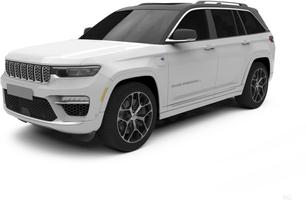
Jeep Australia's first plug-in hybrid, the Grand Cherokee 4xe, has arrived at a time when the company’s sales figures need a decent shot in the arm.
Though it’s seemingly spearheading a large and extra-large SUV hybrid push into the Aussie market, with the likes of a Toyota LandCruiser 300 Series hybrid on its way, the marque’s debut PHEV is only available here in the range-topping Summit Reserve spec, and only as a five-seater.
So, does the 4xe have enough of a jump on any large SUV hybrid rivals – including a rumoured but postponed Ford Everest hybrid – and is it enough to give the brand a much-needed boost?
Read on.
There is nothing quite like a car company occasionally building a car that could be considered a risk. And there are all kinds of risks in the car business - the market isn't ready for that car, people don't identify your brand with this or that type of vehicle, the list goes on. And it's long. It's very easy for me to sit on the sidelines and say, "Pft, what were they thinking?" Few cars land on your driveway without years of thinking having already gone into their development.
The Kia Stinger is the kind of car that would have caused lots of thinking and plenty of hand-wringing at Kia HQ in Korea. Not because it was a bad idea - it wasn't. Not because it's a bad car - it is, in fact, the opposite. And not because SUVs have already changed the way we look at cars - Kia has done well out of that.
It's just that Kia has never produced a car like the Stinger. A five-door coupe-sedan, rear-wheel drive and with a focus on driver dynamics. Most of us know very well how the Stinger GT burst on to the scene in a blaze of well-deserved glory. It's not all about the GT, though. There's a whole range of Stingers and just below that very accomplished sports sedan is the Stinger GT-Line.
A wise man* once said "Being first can sometimes feel like being wrong" and perhaps that's how it is with the 4xe, but at least Jeep Australia is giving the large SUV hybrid realm a good ol' try.
* Former CarsGuide Big Kohuna, Glen Knowles.
The company's first plug-in hybrid, the Grand Cherokee 4xe, is not perfect by anyone's standards, however, it is a definite move in the right direction.
It's a quiet and refined drive, it retains the brand's renowned 4WD capability, and even its hefty price-tag likely won't dissuade Jeep loyalists from giving it a go.
The Stinger GT-Line is a great machine. It looks good, feels good to drive and while it's not the cheapest large sedan, it's also not a Camry. With a strong European vibe, it's a nice bridge between boring-dependable and out-of-reach European. Boasting a strong link to Europe in its chassis DNA, it has it all apart, maybe, from the badge.
But Kia has a habit of doing unexpected things and the Stinger was a bold move worth making just for the halo effect of having such a cool car in the range. It has done good things for the company's reputation, as though the rest of the range isn't proof already.
The Stinger looks fantastic. I know the car has its detractors, but there's a massive Euro influence here that sits well in my visual cortex. It's maybe not as ooh-aah as the A5 or the outgoing BMW 4 Series Gran Coupe, but the Stinger can and should be mentioned in the same breath. It looks terrific, even if it is a bit fussier in the details.
From the signature grille, the low beltline, big wheels and sports coupe roofline, it looks sleek and sophisticated.
Inside is a bit more conventional, with some real classic touches such as circular air vents, conventional-looking gear selector and a flat-bottomed steering wheel. It's cool, clean and, with the big new screen, a bit more techy-looking than before. There are lots of nice materials and the odd rogue one, but it's a good cabin that feels well put-together.
The Jeep Grand Cherokee Summit Reserve 4xe PHEV retains the regular model’s level of functionality but adds a reasonably classy touch to everything.
All seats offer adequate comfort, support and room.
There are plenty of storage spaces, cupholders etc, and charging points - two USB-A and two USB-C plus a 12V socket in the front and two USB-A and two USB-C plus a 230V point in the back.
Controls are generally easy enough to locate and operate although some buttons are positioned in awkward places – including drive-mode buttons under the steering wheel – and it sometimes takes a few finger-stabs at the multimedia touchscreen to get to where you want to go in the operating system.
In terms of packability, the rear cargo area has a listed 1067 litres of space, and, with the second row folded and out of the way, that space opens up to 2004 litres.
This is really a four-seater car. While there is good legroom in the rear, the falling roofline, small door aperture and huge transmission tunnel box you in a bit, almost rendering the middle seat useless for all but the shortest of folks. You do get your own air vents, though, which is generous.
The low roof also means limited headroom, made a little worse by the standard sunroof. I had room but taller people might brush the headlining. There are two cupholders front and rear for a total of four and each door has a bottle holder.
The boot is a modest-for-this-size 406 litres, rising to 1114 litres with the seats down. Access to the boot is good if not spectacular; the hatch opens wide but a slightly narrow aperture means loading and stowing flat packs and things like that could be a struggle.
The five-seat Jeep Grand Cherokee Summit Reserve 4xe PHEV has a MSRP of $129,950 (excluding on-road costs).
Standard features include a 10.1-inch multimedia system (with Apple CarPlay and Android Auto), a 10.25-inch digital instrument cluster, 19-speaker audio system, quilted Palermo leather-trimmed seats, air suspension and 21-inch alloy wheels.
It also has a heated steering wheel, 12-way power-adjustable seats and four-way power lumbar adjustment with memory for driver and front passenger, driver and front passenger seat massage function and heated and ventilated seats (driver, front passenger and rear outboard passengers).
A Mode 2 charging cable is also included.
An 'Advanced Technology Group' pack is available as a $5500 option and that includes a head-up display, a 10.25-inch screen for the front passenger, wireless phone charger, and night vision camera.
Exterior paint options include 'Bright White', 'Diamond Black', 'Silver Zynith', 'Velvet Red', 'Baltic Grey', 'Rocky Mountain', 'Midnight Sky' and 'Hydro Blue'.
As is the custom at this time of the year, the Stinger scored a mild update for that minty-fresh taste at the dealer. Not much has changed in the looks department (good) and the most obvious tweak is the brand-spanking new media system already seen in the brilliant new Sorento.
The GT-Line is one of two four-cylinder variants of the Stinger, priced at $57,230 or $60,690 driveaway, a solid $7000 more than the 200S and it's $730 more than the MY20. It's also uncomfortably close to the 330S, which has the delicious twin-turbo V6, but obviously a lower equipment level.
For your money you get 19-inch alloy wheels, a 15-speaker stereo, dual-zone climate control, camera package that includes a reversing camera, side cameras and front camera, keyless entry and start, front and rear parking sensors, active cruise control, powered heated and ventilated front seats, sat nav, automatic LED headlights, head up display, leather seats and wheel and even more besides. It's a lot, which is fair given the price.
The 15-speaker stereo is run by the excellent new media system on the excellent new 10.25-inch touchscreen. It's great to look at, has some really cool ideas in it (including the hilarious soundscapes list which includes, for some reason, a noisy cafe environment), DAB and Apple CarPlay and Android Auto.
The Jeep Grand Cherokee Summit Reserve 4xe PHEV has a 2.0-litre four-cylinder turbo-charged petrol engine, two electric motors (one on each axle) and a 17.3kWh battery.
Combined engine and electric outputs for power and torque are 280kW and 637Nm, respectively. The 4xe has it over any of its stablemates equipped with the 3.6-litre Pentastar V6 petrol engine because that yields 210kW and 344Nm.
The 4xe has an eight-speed automatic torque-converter transmission and regenerative braking.
Drive modes include 'Hybrid' (with combined engine and electric motor providing “maximum instant torque and impressive acceleration”, according to Jeep), 'Electric' (“zero emissions”) and 'eSave' (aims to save battery power).
There are a few options available when it comes time to charge the 4xe.
The 4xe vehicle has a Mode 2 charging cable so you can charge it at home in less than 10 hours, according to Jeep.
With a full charge, the 4xe has a claimed driving range, on electric charge alone, of 52km.
Jeep reckons a Mode 3 (wall box) single-phase electric vehicle charger will fully charge the 4xe in less than three hours.
If out and about and looking for a charge, a 4xe driver can use the onboard 'UConnect' system to locate an appropriate public charging station.
Under the GT-Line's bonnet is Kia's Theta II 2.0-litre four-cylinder turbocharged engine. It's the same as before, with a stout 182kW and 353Nm. Driving the rear wheels is an eight-speed automatic from the Hyundai-Kia empire.
It's pretty rapid, knocking out the 0-100km/h spring in just six seconds, a mere 1.1 seconds slower than its faster sibling's 4.9 for the benchmark.
As mentioned, the 4xe has a listed electric-only driving range of 52km.
On our official test day, we drove just under 50km on a full electric charge and then the rest of the trip was courtesy of the good ol’ petrol engine.
Jeep's official figure for the combined cycle is just 3.2L/100km, but that's predicated on keeping the hybrid battery charged at all times. On fuel-only we recorded 11.6L/100km.
The 4xe has a 72-litre fuel tank (you need 95RON premium to fill it), so going by that on-test fuel-consumption figure, you could reasonably expect to get a driving range of about 620km out of a full tank.
Add an approximate electric range of about 50km on a full charge to that figure and you have a total estimated driving range of 670km.
Kia's claimed combined cycle figure is 8.8L/100km. As the Stinger goes without trickery like stop-start or mild hybridness, it's no surprise that my week with it yielded an indicated 10.4L/100km, which isn't bad for a 1750kg sports sedan that was not molly-coddled and also spent some time in a resurgent case of crap traffic in Sydney.
It also drinks standard unleaded, which is a nice touch.
We’re all time-poor, right? So, why should I take up your time and rattle on about the 4xe for a thousand words when I can get the essence of it across to you, the reader, in a few sentences? Call me, Mr Thoughtful.
This is generally a big, quiet and refined, easy-steering large SUV, but it feels bulky at times and tends to be quite fussy on irregular surfaces, exhibiting a jittery ride on even brief sections of light corrugations on dirt tracks.
The 4xe’s PHEV set-up is smooth and highly responsive on-road and you can switch between the aforementioned drive modes to suit the circumstance.
Driving range on electric only is listed as 52km. I only recorded a total distance of just under 50km, and it’s a very quiet and smooth drive while relying on electric power.
It regenerates power rather quickly down big hills and via braking, but we’d exhausted all electric charge by the time we’d reached our 4WD test track.
As expected, this Grand Cherokee tackled every off-road challenge without any strife.
The air suspension, set to full off-road height, is a bonus.
Our 4WD test track consists of difficult set-pieces, including one small steep rocky hill that I’ve seen heavily modified vehicles struggle to conquer and, to the Jeep’s credit, it climbed the incline, no sweat.
The 4xe’s efforts were only ever hampered by its 'all-season' Continental CrossContact tyres (275/45R21) which are much better suited to blacktop driving and the fact the 4xe costs upwards of $129,950 and I didn’t want to risk any damage to it.
The 4xe has a listed wading depth of 610mm but our test track was dry so I never had the chance to do any water crossings.
The Grand Cherokee has a solid enough rep as a towing vehicle but, take note, the 4xe is rated to tow 2722kg.
I have driven and loved the Stinger GT. It's tremendous fun, goes like a rat running away from a cut snake, which itself is being chased by a mongoose with its bottom on fire, and it handles like a proper sports sedan.
The GT-Line is obviously not that quick, but it's not slow, either. But it does take a bit of the GT's DNA and delivers a driving experience eerily reminiscent of an E90 BMW 3 Series. That seems like an out-of-date reference, but it was a beautiful car to drive with a lovely balance of ride and handling.
The steering has good feel and you know what's going on underneath the front wheels. You sit towards the centre of the car, also a BMW trademark. Turn the wheel and the car goes with you, despite its bulk, and it's happy to dance a bit with its limited-slip diff.
The 2.0-litre turbo does a good job in most conditions but you feel it coming up short when you're hustling it. It's never breathless, but the torque deficit to the turbo six is clear. If you've not driven the faster Stinger, you may not notice, but there's a touch of lag in the 2.0 that contributes to the idea it's working hard to move the big sedan.
But back off a little and it becomes a fluid, fun drive. In town it's firm but very comfortable, gently bumping rather than crashing into potholes. The rear suspension is a complicated five-link set-up that costs money and eats into boot space but delivers the goods.
Given its length the Stinger is a bit tough to manoeuvre in tight spaces and its 11.2m turning circle isn't too flash either, but you soon get used to it.
The Jeep Grand Cherokee Summit Reserve 4xe PHEV has the maximum five-star ANCAP safety rating from assessment this year.
Safety gear includes AEB with pedestrian detection, blind-spot monitoring with rear cross-traffic alert, adaptive cruise control, lane-keep assist, driver monitoring, traffic sign recognition, intersection collision assist, and a surround-view parking camera.
The Summit Reserve spec brings with it 'ParkSense' parallel and perpendicular park assist and (low-level autonomous) 'Active Driving Assist'.
It has eight airbags including front, side, and knee (for driver and front passenger), sides (for second-row passengers) and full curtain airbags.
The Stinger ships with an impressive safety package that includes seven airbags, ABS, stability and traction controls, high- and low-speed forward AEB with pedestrian and cyclist detection, intersection assist, lane-keep assist, steering assist, driver attention alert, high- and low-speed forward collision warning, front cross traffic alert and rear cross traffic alert.
You get two ISOFIX points and three top-tether anchors.
The Stinger scored five ANCAP stars in 2017.
The Jeep Grand Cherokee Summit Reserve 4xe PHEV has a five-year/100,000km warranty and a lifetime roadside assist service.
Servicing is set at 12-month/12,000km intervals and capped price servicing keeps what you pay for each appointment at $399 for the first five.
Kia's ground-breaking seven year/unlimited kilometre warranty along with roadside assist for the first 12 months. Each time you service your car at Kia, you get an extension on your roadside assist for up to eight years.
Perhaps the only thing that makes you go, "Oh, what?" about the Stinger is the 12 months (Good)/10,000km (Oh...) service intervals. That's pretty common with Kia's turbo engines but is a little inconvenient. Then there's the cost - prices range from $312 to $685, which adds up to $3459 over the first seven services. If you stay under 10,000km/year, that's not bad going at under $500 per year for servicing, but if you're a high-miler, it will add up.
The servicing isn't outrageous - and the prices are capped - but it's not cheap, either.