What's the difference?
As a child, my parents - who aren't car people - would see a Jaguar and point. It didn't matter if it was an XJ, Daimler Double Six or a Mark II, there was a great deal of mystique around these bastions of Britishness. It also didn't matter that these weren't necessarily good cars. The Seventies and Eighties saw the brand slide into a funk while being passed between owners like hot potatoes.
Somehow, the brand survived its brush with Ford's useless Premier Automotive Group strategy which only came good towards the end as Jaguar's management woke up and put in place a change in direction that produced the Ian Callum-designed XF. Riding high on that design, Jaguar then promptly introduced the very pretty Jaguar XJ.
It has been on sale for ages, but with the addition of a few bits and bobs to stay competitive, it's as compelling as ever. Most importantly, the performance-focused R has kept its unique supercharged V8.
To say the BMW M4 CS is a hot ticket in Australia is something of an understatement.
Consider this. There is an even more expensive one, the M4 CS Edition VR46 – at a cool $346,900 – and it sold out in less than an hour. Now, granted, Australia only got four examples, but still, demand was running hot.
That car makes this one, the regular M4 CS, seem like an absolute steal. It's only $254,900 (yes, the word 'only' is doing a lot of heavy lifting in that sentence), and it shares the same upgrades, and makes the same monstrous power, as the VR46 – for Valentino Rossi’s 46th birthday – only it does it for around $100K less.
See? A bargain. At least, that's how I'd be justifying it to myself if I had a quarter of a million burning a hole in my pocket.
So, this or a Porsche 911? Read on.
It might be old and facing German competition bursting with advanced technology, but the XJR is still a car you can buy with heart and head. But mostly your heart. It goes like stink, has a much better interior than the Quattroporte and is more interesting than just about anything this big or this grand.
It's also a better car than the Maserati Quattroporte if you want to get on with the driving yourself and is far prettier than the Porsche Panamera. It's a wonderful thing and even more wonderful that Jaguar continues to build it. Long live that supercharged V8 and the XJ is a great home for it.
Brutal, bruising and utterly brilliant, the M4 CS will be an acquired taste due to its no-compromise approach, but those willing to take the leap will find a performance car like few others at their disposal.
The XJ has a marvellously exaggerated length, with a rear overhang redolent of Jag's sporting coupe and roadster pair of the time of its launch, the XK. There's nothing else in the segment like it, with the three Germans - Mercedes' S-Class, Audi's A8 and BMW's 7 Series - having gone all Hugo Boss and and in the latter two's case, almost shrinking violet. The only credible Japanese alternative, the Lexus LS, looks like a Lexused 7 Series. The XJR is a more emotional car, like Maserati's Quattroporte.
The R adds an aggro grille, 20-inch wheels with low-ish profile tyres, a bootlid spoiler, red brake calipers and vents in the bonnet. Bits and pieces get the black gloss treatment and there are V8 and R badges, as well as a rather large leaper on the bootlid. Capping it all off are four exhausts poking out from the bumper and distinctive vertical taillights.
Inside remains largely unchanged. The cabin is big and luxurious, leather-lined and very, very comfortable. The front air vents have to be modelled on the de Havilland Comet's integrated jet engine intakes and, again, the dash design stays away from the horizontal lines of its obvious competition.
There is probably a bit much chrome for my liking, particularly on the centre console and around the rotary dial shifter, which reflects sunlight into your face during the day.
The lovely 'Riva Hoop' - a band that sweeps from door to door across the top of the dash - is a great touch and remains a defining feature in the cabin. The last update brought an Audi-like digital dashboard, including maps, but it's not nearly as slick as the German. The graphics for the dials are good (and quick) but the maps are a bit so-so.
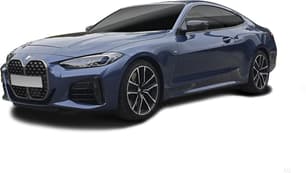
The M4 CS is familiar in all the right ways, but definitely looks significantly jacked up compared to its lesser siblings.
Part of that is the extensive use of carbon everywhere, from its bonnet panels to its roof, front lip, side skirting and boot spoiler. But also because of its super-muscular angles and creases, including the huge dome in its bonnet.
Also exclusive to this M4 CS is the light treatment, with the front LEDs lighting up with yellow highlights the brand says are supposed to be reminiscent of GT racing cars.
At the back, the rear lights are flush with fibre optic lighting, lending a flowing and unique light signature that looks epic at night.
Inside, it's a sea of carbon, with the lightweight racing seats, the dash inserts and the centre console all lined in it. It is a perfectly finished space, though, and one that's also flecked with red, including a 12 o'clock band on the thick-rimmed steering wheel, the seat backs, the contrast stitching and the paddle shifts.
Be warned, though, it takes some acrobatics to climb into or out of the CS. The seat bottoms have these super high edges that double as grab handles, but require some awkward contortions to navigate.
In short, it looks angry, this M4 CS, inside and out.
It might be over five metres long, but the Jag's cabin isn't as gigantic as that might suggest - luckily, if you want space, the XJ L has it. The SWB version is roomy enough, though, just not palatial. You can fit five people, but the big transmission tunnel will limit the size of that fifth.
Front and rear passengers have a pair of cupholders each, with rubber bubbles to help hold smaller cups in tight. The front and rear doors have pockets but aren't really for bottles.
Boot space is a reasonable 520 litres, with a space saver spare under the floor.
It all boils down to how you classify practicality in a car like this. I mean, the basic stuff is all there – it's got two doors, four seats and a boot capacity of 440 litres.
It measures 4801mm in length, 1918mm in width and 1399mm in height, and room for front seat riders is good, but less so for anyone you squeeze into the back. There are even ISOFIX points for a child seat.
But if you consider practicality the practical pursuit of performance, then the M4 CS has plenty of perks.
As is expected at this level, Jaguar was not mucking about with price or specification - the XJR starts at a mildly terrifying $299,995, which is very close to the rather more tranquil Autobiography long-wheelbase relax-o-mobile.
Standard are 20-inch alloys, a 20-speaker stereo, power everything with three memory positions, four-zone climate control, keyless entry and start, front and rear parking sensors, heated and cooled front and rear seats, sat nav, LED headlights and DRLs, leather everywhere, auto wipers and (LED) headlights, electric boot lid, heated steering wheel and a space saver spare.
The Meridian-branded stereo is an absolute cracker, powered by the improved but still laggy 'InControl Pro' system. Oddly, it's all crammed into an 8.0-inch touchscreen when there is seemingly room for the larger (and better-performing) 10.0-inch screen. The software is far superior than the version that preceded the last update, but the screen is hard to use, as targets are placed right in the corners and are hard to hit.
Apple CarPlay and Android Auto are also absent, and the sat nav is still fairly dopey.
A long list of options are available, some of which should probably be included in the big sticker price - DAB+ ($620), premium paint is a splutter-worthy $2060 (although, to be fair, the vast majority of the 19 colours are free), adaptive cruise with queue assist ($2200), adaptive headlights a further $2620 and 'Parking Assist', which adds side sensors and a front camera, a further $2780. Reverse cross traffic alert, blind spot monitoring and forward collision warning cost yet another $1460. Ouch.
We're talking a $254,900 entry price for the M4 CS, which – despite my attempts at justification – is a lot. Remember, the regular M4 is $168,700, and the M4 Competition is $186,500, so we're talking a sizeable premium here.
BMW justifies that price increase in two ways. The first is scarcity, with the M4 CS limited to just 50 examples in Australia. And the second is by dialling up every aspect of the M4's performance to terrifying levels.
The engine outputs are up, the weight is 20kg down, there are better brakes, better seats, a louder exhaust, a stiffer chassis – it goes on and on.
We'll get to some of the performance stuff in a moment, but here's what else your money buys you with the M4 CS.
It starts outside with staggered alloys, 19-inch up front and 20-inch at the rear, wrapped in track-ready rubber. There's also hi-po 'M Compound' brakes with red calipers, lightweight carbon racing seats that are heated up front, an Alcantara-trimmed steering wheel, the 'M Carbon' exterior package with carbon bonnet and roof, adaptive 'M Suspension' and a titanium exhaust that howls like the winds of hell.
The less performance-focused stuff is similar enough to the other M4 models including a 12.3-inch centre screen with digital radio, Apple CarPlay and Android Auto, a second 14.9-inch screen that handles your driving data and a head-up display. There's also twin-zone climate control, Merino leather upholstery and ambient interior lighting.
But all of that is secondary, really. This is about performance, specifically of the brutal kind.
Jaguar's lovely 5.0-litre V8 with supercharger continues under the XJ's long and shapely bonnet, delivering a walloping 404kW and a tyre-shredding 680Nm. The sprint to 100km/h for all 1875kg of XJR is completed in an impressive 4.6 seconds, which was very competitive at the car's launch in 2009.
Power reaches the rear wheels via ZF's eight-speed automatic and you can control it with the tacky plastic paddles on the steering wheel. Oh, and it has stop-start.
BMW has found yet more grunt lurking in its trusty 3.0-litre 'M TwinPower' six-cylinder petrol engine, with the M4 CS now pumping out 405kW and 650Nm.
That's a decent jump from the 390kW and 620Nm served up by the M4 Competition, and a giant leap from the outputs of the 'base' M4 – 353kW and 550Nm.
Predictably, then, the CS is the fastest of the lot, knocking off the run from 0-100km/h in 3.4 seconds, compared to 3.5 and 4.2 in the Competition and M4, respectively. The top speed is also dialled up to 302km/h.
All that power is channeled through an eight-speed automatic and sent to all four wheels on demand, with the help of an 'Active M Differential'.
The combined cycle figure for the V8 is listed at 11.1L/100km but fully expect to see the 16.1L/100km we got, especially as you try and fail to tyre of the monstrous power delivery and lovely (if muted) V8 roar.
Luckily, even if you're belting it, the 82 litre tank is a generous size and you'll cover a fair amount of ground.
The M4 CS is fitted with a 59-litre fuel tank, which – given the BMW's official fuel claim of 10.2 litres per hundred kilometres – should deliver a driving range on a full tank of 541 kilometres.
But... BMW also says the regular M4 – you know, the one that makes 52 fewer kilowatts and 55Nm less torque – uses 10.1L/100km, so do with that information what you will.
Indecently quick, surprisingly agile and heaps of fun. While the first descriptor applies purely because of its size, the next two shouldn't when you're in command of 5.13 metres of motor vehicle. As with the Audi and now the 7, the Jag has a lot of aluminium to help keep the kilos off and good gracious, it has worked.
The R is based around the short wheelbase version of the XJ for perhaps obvious reasons. Even so, it appears to be the shorter-again XF's because this thing turns in like a demon. No, it won't stay with the dearly-departed XF-R but it does a mighty fine impression of one, just with a better ride quality.
Rear seat passengers should be prepared to feel a lot of wheelslip, especially when in Dynamic mode, as even the fat Pirelli P-Zero's struggle for purchase when the right foot hits the carpet. The V8 rumbles rather than bellows, but the rears cheerfully spin up until the computers and active differential rein things in. Traction control off and you've got a proper tyre-smoker if you're not playing by the rules. Jag's engineers are clearly hooligans at heart.
As always, ZF's eight-speed transmission does an incredible job of marshalling the horses in a rearward direction and when you're not after a bit of sound and light, have achieved a tremendous amount with the damping. When in normal mode, the car glides along, so much so that the lady of the house wasn't so sure it was a sporting sedan.
Once she was apprised of dynamic mode (you have to cycle the button through winter mode first, for some reason), her only complaint was that it was too long and the steering wheel too big for this type of car. I was persuaded of the latter, especially after stepping out of an Audi S3 which has a tiny wheel. Long story short, the XJR is now 'her' car (to be more accurate, the XFR is, but that hasn't arrived yet, so...), as it felt smaller than it was when not parking and she's a sucker for a torquey V8.
The hardest and angriest M4 of all time is, perhaps unsurprisingly, hard and angry. This is a race track specialist, but because I don't happen to own one of those, my first experience with the barking (and barking mad) M4 CS was navigating my way back from BMW's inner-city dealership.
Like it or lump it, you're going to read some Porsche comparisons here, because you're talking not too far off base 911 Carrera money, and suddenly I find the two Germans doing battle for a spot in my dream garage.
First things first, the BMW won't be much chop for daily driving for most people. Happily, I have a sickness for uncomfortable sports cars. It tells me that no compromises have been made in the pursuit of punishing performance.
A good thing, too, because the BMW, at city speeds, can be punishing. Everything feels heavy, the seats aren't overly comfortable – especially the hard bits that tend to dig in when cornering – and it stiff-arms its way over road imperfections, that exhaust booming and barking as it does.
Again, I loved it, and you probably will, too. But it's still not the kind of car I'd relish sitting in the morning peak hour rush in.
But escape the confines of the city and the BMW M4 CS suddenly makes a whole heap of sense. The acceleration is genuinely brutal, and wonderfully theatrical, with that quad-tipped titanium exhaust barking and snarling as you rocket towards 100km/h.
The steering is brilliant, with feedback fed to your wrists via that thick-rimmed wheel, and the entire experience feels sharp, super engaging and edgy.
You can push the M4 hard and fast, and I'm certain my limited talents would run out far before the BMW's would, but there's this thrilling sense of peril sparked by the aggression of the experience, that I love.
It's like the magic of a roller-coaster, I guess. Even if you know nothing is going to happen, you never really know, right? And in that lies the magic.
But back to original question, this or a Porsche 911? There's no doubt a Carrera is a better all-rounder, in terms of comfy commuting and race track fun, but this angry M4 is all shouty theatrics, all of the time.
I bloody love it.
The whole XJ range has six airbags, ABS, stability and traction controls, emergency brake assist, reversing camera, three top tethers and two ISOFIX points. The XJ doesn't have an ANCAP safety rating.
Expect no ANCAP rating here, I'm afraid. But the BMW 4 Series does wear a five-star rating from 2019.
The M4 CS gets six airbags (driver and passenger, side airbags, head airbags), along with what BMW calls its 'Driving Assistant Professional', which bundles active cruise control (with stop and go function), front and rear cross-traffic warning, 'Steering & Lane Control' and 'Lane Keeping with Side Collision Warning'.
Jaguar offers a three year/unlimited kilometre warranty and roadside assist for the same period.
Like the F-Type, XJ owners benefit from three years/100,000km free servicing.