What's the difference?
Jaguar raised more than a few eyebrows in 2016 when it entered the rapidly expanding world of premium SUVs with the mid-size F-Pace. And the product development boffins at Coventry HQ liked it so much they cooked up another one.
The compact E-Pace (and subsequent electric I-Pace) has re-positioned the brand from luxury sedans, wagons, and performance sports cars, to all that with SUVs now leading the brand and product charge.
The F-Pace is a beautifully composed five-seater. Does this smaller E-Pace package deliver even more good things?
This might be the biggest gamble in Porsche's history. It's the latest version of its best-selling car, the Porsche Macan, only this one has a very big difference.
You see, this time, it’s all-electric. There is not an internal-combustion engine (ICE) in sight. And that makes climbing into an entry-level Macan significantly more expensive than ever before.
So, will this bold shift help or hinder the Macan in Australia? And is this the country’s best all-electric SUV?
There’s only one way find out.
The Jaguar E-Pace Chequered Flag P250 is a compact, polished premium SUV package. Good value, super safe and spacious, it combines brilliant practicality with comfort and healthy performance. It’s a little thirsty, there are some relatively minor dynamic niggles, and Jaguar’s ownership package needs to lift its game. But for those who don’t have a lot of room to spare, yet don’t want to skimp on the luxury experience, it’s a compelling option in a highly competitive category.
There is no doubting the substance of the Porsche Macan Electric. Its ride, steering and poise make it a joy to drive on twisting roads, and it ticks the practicality boxes, too.
The only lingering question is whether enough people are ready to make the all-electric switch. Only then will we know if Porsche's Macan gamble has paid off.
Note: CarsGuide attended this event as a guest of the manufacturer, with travel, accommodation and meals provided.
Ian Callum. Jaguar’s design director for 20 years, from 1999 to 2019, evolved the brand’s look and feel from traditional and conservative, to cool and contemporary, without throwing the heritage baby out with the new design bath water.
The E-Pace will be one of the last Jaguars to emerge under his full-time direction (Callum remains a consultant to Jaguar) and at the time of its global launch in 2018 he was keen to highlight the car’s gender neutrality, summing it up as, “Not too genteel; muscular and curvaceous at the same time.”
And it’s hard to argue the point. The E-Pace follows the distinctive Jaguar design template set in place by breakthrough models like the F-Type sports car, and larger F-Pace SUV.
At just under 4.4 metres long the E-Pace is smaller than mainstream medium SUVs like the Mazda CX-5 and Toyota RAV4, but it’s appreciably wider, giving it a broad footprint and athletic stance.
Ultra short front and rear overhangs, and black 19-inch, five-spoke alloy rims enhance that impression, at the same time highlighting a relatively lengthy 2681mm wheelbase.
The Chequered Flag’s dark mesh grilles across the nose, and long tapered LED headlights, complete with ‘J-blade’ LED DRLs around their outer edges, create a recognisably feline face, with dark accenting on the fender grilles and window surrounds adding an extra air of intensity.
A raked, almost coupe-style roofline, tapered side glass, and broad haunches combine to accentuate the E-Pace’s dynamic look, the long, slim, horizontal tail-lights and fat chrome-tipped exhaust outlets both current Jaguar hallmarks.
The interior feels as tightly wrapped and carefully designed as the exterior with the instruments, media screen and key controls clearly oriented towards the driver.
In fact, a specific defining edge sweeps down from the top of the dashboard, around the centre stack and across the console to form a flying buttress barrier (complete with left-side grab handle) between the driver and front passenger.
And if you’re still associating Jags with walnut veneer interiors, think again. An understated ‘Noble Chrome’ finish is used to highlight the gearshift surround, instrument panel, and other details across the dash and doors.
The upright sports gearshifter is a distinct departure from the rotary controller used in older Jaguar models, yet according to Jaguar, the beautifully tactile front ventilation dials were inspired by the rings of a classic Leica camera lens.
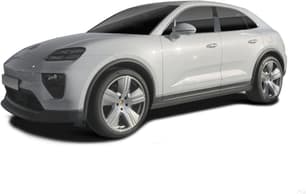
The Macan Electric looks sharp, all aerodynamic and swept-back like a range-maximising electric SUV should.
There’s functional method behind all this swoopy styling, too. The headlights look as though they’ve been chiselled into the body work, and at the grille, you’ll find active venting to help with cooling when needed.
There is also a sizeable front splitter that looks very much like the Macan is sticking its jaw out. All of which is to assist with aero and range.
It’s also a dual charging port layout with access left and right, though the latter is AC charging only, while the one on the left does both.
Step inside the Macan and you’ll find a familiar and very welcoming space. I especially like the twin-screen set-up that looks great in the way it's kind of embedded into the dash. Each is big, clear and easy to use.
I also really like the control panel that gives you quick-button access to the climate control, and the haptic feedback is next level, with the whole screen clicking in or out whenever you hit a button.
That said, in Turbo-guise you’re dropping almost $200,000, and some of the materials feel too hard and plasticky at that price point.
For a car measuring less than 4.4 metres between its bumpers, a 2681mm wheelbase is lengthy, and interior space is also enhanced thanks to the E-Pace’s broad beam and relative height.
Somehow the front part of the cabin feels cozy and spacious at the same time, this strange dichotomy created by the steeply sloping dash and centre console increasing the feeling of space, yet keeping key controls and storage options within easy reach.
Speaking of which, front seaters are provided with a generous lidded storage box/sliding armrest between the seats (housing two USB-A ports, a micro SIM slot, and 12V outlet), two full-size cupholders in the centre console (with a smartphone slot between them), a loose items tray ahead of the gearshifter, a sizeable glove box, an overhead sunglasses holder and big door bins with enough room for large bottles.
Special note on the centre storage box. The space extends forward, a long way under the console, so a pair of 1.0-litre bottles can be laid down flat, with plenty of space still on top. And a net pocket on the underside of the lid is great for small, loose items.
Move to the back, and again, despite the E-Pace’s diminutive size accommodation is good. Sitting behind the driver’s seat, set for my 183cm (6.0ft) position, I enjoyed plenty of leg and headroom, even with the inclusion of a standard glass sunroof.
Shoulder room is pretty handy, too. And backseaters are provided with a lidded storage box and two cupholders in the fold-down centre armrest, netted pockets on the front seatbacks, and useful door bins, with enough room for standard bottles. There are also adjustable centre air vents housed with a 12V outlet and a trio of storage hidey holes.
Cargo space is another plus for the compact E-Pace, offering 577 litres with the 60/40 split-fold rear seat up, expanding to a substantial 1234 litres with it folded down.
Multiple tie-down anchor points are helpful for securing loads, there are handy bag hooks either side, as well as a 12V outlet on the passenger side, and a netted bay behind the driver’s side wheel tub. A power tailgate is also a welcome inclusion.
Towing capacity is 1800kg for a braked trailer (750kg unbraked) and a ‘Trailer Stability Assist’ system is standard, although a tow hitch receiver will set you back an extra $730. A steel space spare sits under the cargo floor.
There is a little open-sesame magic at play with the Macan, and that starts at the frunk, where, if you lovingly caress the bonnet, it will automatically pop open for you, revealing an 84-litre storage space.
Rubbing the charging port will see it slide open, too, but just in case you’re not the kind of person who likes to fondle their car in public, you can use the key.
The Macan’s boot is a little more traditional, opening to reveal 540 litres (but just 480 litres in the 4S or Turbo) of storage with the rear seats in place, with a wide, flat and very useable area for your goodies.
The back seat of the Macan feels spacious enough, without being outstanding. There’s more than enough space for my 175cm frame, with enough knee and head room, but the way the middle console juts out will definitely eat into leg room for any middle-row passenger.
Elsewhere you get air-con controls with vents, along with bottle storage in each of the doors. There is also a pull-down divider that’s home to two extra cupholders.
At $63,600, before on-road costs the Jaguar E-Pace Chequered Flag P250 lines up against a formidable bunch of Euro and Japanese compact SUV competitors, like the Audi Q3 40 TFSI Quattro S Line ($61,900), BMW X1 xDrive25i ($64,900), Lexus NX300 F Sport ($61,700), Mercedes-Benz GLA 250 4Matic ($63,000), and Range Rover Evoque P200 S ($62,670). All tough nuts to crack, and all AWD, except the FWD Lexus.
And when you’ve entered the $60K bracket it’s fair to expect a lengthy list of standard features, and aside from the safety and powertrain tech detailed in the Safety and Driving sections, the top-of-the-pyramid Chequered Flag grade delivers a fixed panoramic glass sunroof, grained leather seat trim (with contrast stitching), 10-way adjustable heated electric sports front seats, dual-zone climate control, and a 10-inch ‘Touch Pro’ multimedia screen (with swipe, pinch and zoom control), managing audio (including digital radio), Android Auto and Apple CarPlay connectivity, sat nav, and more.
Other boxes ticked include the ‘Black Exterior Pack’, adaptive cruise control, 19-inch alloy wheels, heated and power-folding door mirrors (with approach lights), rain-sensing wipers, auto LED headlights, LED DRLs, fog lights (front and rear), and tail-lights, a power tailgate, ‘Ebony’ headlining, ‘R-Dynamic’ leather steering wheel, black gearshift paddles, keyless entry and start, ‘Chequered Flag’ metal scuff plates, and bright metal pedals.
Our ‘Photon Red’ test example was also optioned with a head-up display ($1630), Meridian audio ($1270), privacy glass ($690), and rear animated directional indicators ($190).
In fact, the Jaguar E-Pace options list is stuffed with individual features and packs, but the standard fit-out delivers good value in terms of the asking price and category competition.
The Macan arrives with four trim levels, the entry-level Macan, the Macan 4, Macan 4S and then the flagship Macan Turbo. The latter is just a name Porsche now applies to its go-fast models — obviously there isn’t an actual turbo in action.
The new electric range opens with the Macan, which lists at $128,400, before on-road costs. A reminder here that the old entry-level Macan with an ICE powertrain would have set you back less than six figures, so this one represents quite the jump.
Now, it should be pointed out that you can still buy the previous-generation ICE Macan, at least until supply runs dry. The brand isn’t getting any more, but suggests there are enough in the country to satisfy demand until around Q2 next year.
Next is the 4, which is $134,400 and adds a second e-motor. Then comes the 4S, yours for $149,300, before the range tops out with the Turbo, which climbs to $184,400. All prices before on-road costs.
Those are big numbers, but at least Australian-delivered cars are some of the best-specified on the planet.
That starts with the Macan, which gets a 12.6-inch digital instrument cluster, and a second 10.9-inch central touchscreen with Apple CarPlay and Android Auto.
It rides on 20-inch alloys, has synthetic-leather seats that are heated up front and Australian cars get things like the clever 'Porsche Active Suspension Management' (PASM) system as standard.
Next up is the Macan 4, which adds a second electric motor, but otherwise largely mirrors the base car’s spec. Next on the list is the 4S, which rides on a different 20-inch alloy, picks up LED matrix headlights, sports a better Bose stereo, a panoramic roof and four-zone climate control.
Finally, the Turbo is the big dog of the electric Macan range, packing serious power, but also arriving with its own 20-inch alloy wheel design (with 21-inch wheels a no-cost option) — an augmented reality head-up display, and things like the 'Porsche Electric Sport Sound', the 'Sport Chrono Package' and a performance-focused 'Sport+' drive mode.
The E-Pace Chequered Flag P250 is powered by a 2.0-litre, turbo-petrol version of Jaguar Land Rover’s modular ‘Ingenium’ engine, based on multiples of the same 500cc cylinder design.
This ‘AJ200’ unit features an aluminium block and head with cast iron cylinder liners, direct injection, electro-hydraulically-controlled variable intake and exhaust valve lift, and a single, twin-scroll turbo. It produces 183kW at 5500rpm, and 365Nm from 1300-4500rpm.
Drive goes to all four wheels via a (ZF-sourced) nine-speed automatic transmission, and an 'Active Driveline’ all-wheel drive system. With a default rear axle bias, it constantly monitors driving conditions, updating torque distribution every 10 milliseconds.
Two independent, electronically-controlled (wet-plate) clutches distribute drive between the rear wheels, the system able to send 100 per cent of that torque to either rear wheel if required.
The entry-level Macan is equipped with a single rear-mounted electric motor, and it will make a total 250kW (265kW with launch control activated) and 563Nm, which is enough to push the cheapest Macan to 100km/h in 5.7 seconds.
The 4 then adds a second electric motor for AWD, upping the grunt to 285kW (300kW with the launch function) and 650Nm, and drops the sprint to a brisk 5.2 seconds.
The 4S is probably the performance sweet spot, with its dual-motor set-up generating 330kW (380kW in launch) and 820Nm, and a blistering sprint of just 4.1 seconds.
But the Macan Turbo is a true monster. We’re talking 430kW (470kW with launch control), 1130Nm and a sprint to 100km/h that’s as fast as a Carrera Cup race car – just 3.3 seconds.
It’s twin-motor, all-wheel drive and offers the kind of brutal acceleration that gives you a little facelift every time you step on the accelerator.
Claimed fuel economy for the combined (ADR 81/02 - urban, extra-urban) cycle is 7.7 litres/100kmL/100km, the Chequered Flag P250 emitting 174g/km of CO2 in the process.
In our week with the car, over close to 150km of city, suburban and freeway conditions (including a cheeky B-road run) we recorded an average of 12.0L/100km, which is getting up there for a compact SUV. That number equates to a real-world range of 575km.
And it’s worth noting that despite the use of lightweight aluminium for key body panel and suspension components, at a touch over 1.8 tonnes the E-Pace is line ball for kerb weight with its larger F-Pace sibling.
Minimum fuel requirement is 95 RON premium unleaded, and you’ll need 69 litres of it to fill the tank.
Every Macan is fitted with a big 100kWh lithium-ion battery, which helps deliver a solid driving range no matter which one you choose.
The entry-level Macan will cover the most distance, at a claimed 654km, while the 4, 4S and Turbo will travel 624km, 619km and 616km, respectively.
The Macan rides on an 800V architecture, and is set up for 270kW DC high-speed charging, which will take 21min to go from 10 to 80 per cent. It will also accept 11kW AC charging, which should take 10 hours to go from empty to full.
Worth noting, though, that most home wall boxes are around 7.0kW, which means a full charge would take more like 13 hours plus.
The E-Pace’s bonnet, front guards, roof, tailgate and key suspension components may be made of weight-saving alloy, but this chunky little SUV still tips the scales at a sturdy 1832kg. Nonetheless, Jaguar claims the Chequered Flag P250 will accelerate from 0-100km/h in 7.1sec, which is quick, if not blindingly so.
The 2.0-litre twin-scroll turbo-petrol engine delivers a solid block of (peak) torque (365Nm) from just 1300rpm all the way to 4500rpm, which combined with no less than nine auto gear ratios means healthy mid-range punch is always available.
The transmission’s adaptive shift system reads the way you’re driving to tailor its behaviour accordingly, and it works well. But shifting gears manually via the wheel-mounted paddles adds to the fun and accuracy.
Thing is, despite being finished in racy black, the paddles themselves are plastic which feels ordinary and is a letdown in an otherwise high-end environment.
Suspension is strut front, ‘integral’ multi-link rear, and ride quality is surprisingly cushy for a high-riding car of this size. No tricky active dampers here, just a well-engineered set-up tuned to cope with a variety of conditions.
That said, the ‘JaguarDrive Control’ system offers four modes - ‘Normal’, ‘Dynamic’, ‘Eco’ and ‘Rain/Ice/Snow’ - tweaking things like the steering, throttle response, transmission shifts, stability control, torque vectoring, and AWD system.
Dynamic is the sweet spot, buttoning everything down just a little tighter, without any major effect on refinement, the car remaining quiet and composed even when driver enthusiasm starts to take the upper hand.
The variable ratio ‘Speed proportional’ electrically-assisted steering is nicely weighted and points nicely, but road feel is mediocre. On the flip side, the torque vectoring system, which uses the brakes to put the squeeze on a wheel breaking traction in cornering, works seamlessly.
Brakes are 349mm vented discs at the front and 300mm solid rotors at the rear, and although they arrest the car well enough, initial pedal feel is ‘grabby’, especially at slow speeds. It’s a challenge to grease your pedal application to the point where the effect goes away.
Under the heading of General Notes, the ergonomic layout is hard to fault with super clear instruments and user-friendly switchgear, but the ‘Ebony’ headlining darkens the interior too much. Even though the huge (standard) glass sunroof lets in a lot of light, we’d prefer the lighter ‘Ebony’ shade available on other E-Pace grades (but not this one).
Speaking of the interior, the sports front seats are grippy yet comfortable on longer runs, and their (standard) heating is a big plus on chilly mornings, the (21:9) wide format hi-res media screen is a pleasure to use, and the level of quality and attention to detail all around the cabin is impressive.
Porsche seemed at pains to prove that, though the all-electric Macan has lost its ICE heart, it's still worthy of the badge, and still very much a Porsche.
First stop, then, was the Norwell race circuit in Queensland, to put the Macan through its paces with 0-100km/h sprints, drifting (well drift attempts... ) on a watered-down skid pan and finally some high-speed running on the circuit.
And two things immediately became very clear. The first, and most obvious, was that, like the first men on the moon, we were likely among only a handful of people that might ever take their all-electric Porsche mid-size SUV to a race track. And second, this is one seriously sorted electric car.
Happily, for the many (read: every) owners who won't be pulling out of a pit garage at their next local track day, the Macan is actually more enjoyable on the road than it is on the track.
On the latter, there's a freedom to push too hard – what with the lack of trees, guard rails or oncoming traffic – and cracks do appear, mostly from the screaming tyres struggling with the two-tonne-plus weight.
But on public roads, where a thick fog of consequence prevents you pushing too hard, the Macan is a gem.
Porsche tends to have a knack for these things, I know, but the Macan is a seriously smooth and satisfying drive.
The ride is bang-on (comfortable enough on rougher surfaces, firm and grippy enough on twisting roads) and the steering is direct and confidence-inspiring.
Body-roll has been largely banished, too, with the Macan staying flat, stable and satisfying, even on the tighter stuff.
In much the same way the ICE Macan defined what it meant to be a driver's SUV, I think this one does the same in the EV space. And the fact that it does it with five seats and a decent boot is a sizeable bonus.
But there's no denying it lacks in the emotion department. That sense of excitement, the sound track, the hard-to-define fizz – as competent its this, and as weaponised as the EV powertrain is – it does feel a little clinical, like a tool doing its job and doing it well.
One important caveat. We've driven the 4 and Turbo to date. The entry-level Macan and the mid-tier 4S are still incoming. And I suspect I wouldn't be dropping my deposit on the Turbo.
Yes, the power is ridiculous, but I don't reckon you need it. For me, the 4 is more than enough, but I suspect the real performance sweet spot will be with the 4S.
The Jaguar E-Pace received a maximum five-star ANCAP assessment in 2017, and boasts a solid roster of active and passive safety technology.
To help you avoid a crash, there are the expected features like ABS, BA, and EBD, as well as stability and traction controls. While more recent innovations like AEB (city, interurban, and high-speed, with pedestrian and cyclist detection), blind-spot assist, adaptive cruise control (with ‘Queue Assist’), ‘Emergency Brake Light’, lane keeping assist, park assist, and rear cross-traffic alert, are also included in the Chequered Flag spec.
A reversing camera, a ‘Driver condition monitor’, and ‘Trailer Stability Assist’ are also standard, but a 360-degree surround camera ($210), and tyre pressure monitoring ($580) are options.
If an impact is unavoidable six airbags are located inside (dual front, front side, and full-length curtain), while a pedestrian protection system features an active bonnet that lifts in a pedestrian impact to provide greater clearance from hard parts in the engine bay, and a specific airbag to offer greater protection at the base of the windscreen.
There are also three top tether points for baby capsules/child restraints across the rear seats, with ISOFIX anchors in the two outer positions.
The Porsche Macan Electric is yet to be assessed by ANCAP, or by Europe’s NCAP, but it doesn’t appear to be missing any key equipment from its safety list.
That includes curtain airbags that extend all the way to the boot, AEB with pedestrian detection, lane keeping assist, a surround view camera and 'Intersection Assist'.
Jaguar’s three-year/100,000km warranty, is well off the mainstream pace, which is five-years/unlimited km, with some brands at seven years. And even in the luxury segment, newcomer Genesis, and the most established of them all, Mercedes-Benz, have recently dialled up the pressure with the offer of a five year/unlimited km warranty.
Extended Warranty Insurance is available for 12 or 24 months, up to 200,000km.
Service is scheduled every 12 months/26,000km, and a ‘Jaguar Service Plan’ is available for a maximum five years/102,000km, for $1950, which also includes five years roadside assistance.
The Porsche ownership experience is frankly underwhelming by modern standards, with the brand offering just a three-year/unlimited kilometre warranty, plus an eight-year/160,000km battery warranty.
The positive, though, is that servicing should only be required every two years or 30,000km. You also buy a prepaid service plan for three, four or five years, priced at $1495, $2795, $2995.