What's the difference?
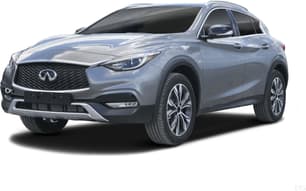
Tim Robson road tests and reviews the 2016 Infiniti QX30 at its Australian launch with specs, fuel consumption and verdict.
There’s no doubt that the compact crossover segment is a vitally important place for any carmaker to be. Nissan’s luxury arm, Infiniti, is no different, and thanks to a decision from its Japanese masters, the diminutive premium brand will go from having no players on the field to having two marquee players in a matter of just a few months.
The architecturally identical front-wheel-drive Q30 launched only a month ago in three variants, and now it’s the turn of the all-wheel-drive QX30 to take to the pitch.
But is there enough of a difference between the two to actually consider them different cars? Is it adding a layer of complexity for the prospective Infiniti customer? As it turns out, the differences run more than skin deep.
Kia admits that, even a handful of years ago, a car like the EV4 likely wouldn't exist in Australia. With a forecast of 70 sales a month, or 840 a year, it won't come close to the brand's biggest all-electric sellers, and senior executives and product planners alike would have been wondering if it was worth the effort.
But times have changed, and so have regulations, and Kia is happy to roll the dice on as many EVs as it can get its hands on to lower its fleet emissions in the wake of the New Vehicle Efficiency Standard (NVES).
If you'll forgive the long and rambling intro, I'll now get to the point. Long live the NVES, because the EV4 is a good (if a little bizarre-looking) thing. It's quite lovely to drive, will cross vast distances in its long-range guise, and will undoubtedly make our roads a more visually interesting place.
But would you have one over the Tesla Model 3 or BYD Seal? Read on.
Even though it’s almost identical to the Q30, the QX30 manages to feel sufficiently different in suspension tune and cabin ambiance to be considered different.
It’s a disappointing oversight, though, by Infiniti to deny the base GT such basic safety fundamentals as a rear view camera (which Infiniti assures us is being worked on).
An electric sedan is really shrinking the buyer pool, which is why Kia has such gentle expectations for the EV4 in Australia. But it's a lovely driving EV with plenty of perks, and the design alone will brighten up Australia's roadways. For my money, I'd either be going for the cheapest one that's sharp value with plenty of kit, or the flagship GT-Line that gets the big battery and the works in terms of equipment. The Earth for me sits in no-man's land.
Note: CarsGuide attended this event as a guest of the manufacturer, with travel, accommodation and meals provided.
Note: The author, Andrew Chesterton, is a co-owner of Smart As Media, a content agency and media distribution service with a number of automotive brands among its clients. When producing content for CarsGuide, he does so in accordance with the CarsGuide Editorial Guidelines and Code of Ethics, and the views and opinions expressed in this article are solely those of the author.
The QX30 is one of the first projects to result from a technology partnership formed between the parent company of Mercedes-Benz and the Nissan-Renault Alliance.
In a sign of how worldly the car industry is becoming, the QX30 is built in Nissan’s Sunderland plant in the UK, using the German Mercedes-Benz A-Class platform and powertrains, all under Sino-French ownership via the Nissan-Renault Alliance.
On the outside, the design that first aired on the Q30 is pretty unique. It’s not a subtle car, with deep crease lines along its sides that, according to Infiniti, is an industry first in terms of manufacturing complexity.
When it comes to differences between the two vehicles, it’s minimal at best. There is a 35mm increase in height (30mm from taller springs and 5mm from roof rails), an extra 10mm in width, and extra trims affixed to the front and rear bumpers. Aside from the all-wheel-drive underpinnings, that is pretty much it for the exterior.
The same black plastic overfenders that are fitted to the Q30 are present on the QX30, with 18-inch rims on both the base model GT and the other variant, the Premium.
The dimensions of the QX30 are also an exact match for those on the Mercedes-Benz GLA, with the long front overhang acting as the main visual connection between the two cars.
The slippery-looking unit that adorns this page is the EV4 sedan. There’s also a hatch, but it comes out of Europe, while this one comes out of Korea, and that would likely make the hatch far more expensive than this bad boy. It's under study, apparently, but yet to be confirmed.
Anyway, to steal a hackneyed football analogy, for mine this is a game of two halves. I actually really like the front end. It looks sleek and slippery and there’s a real presence from the swollen arches.
I am, however, a little less sold on this rear end, which looks sharp and blocky and almost like it has been bolted on. Also annoying is the fact that it looks like it should be a liftback, with the boot hinged up above the rear windscreen. But nope, it's hinged below it, so you still get a dinky little opening to squeeze your stuff through.
Kia's international designers are pushing the boat out at the moment, and they deserve credit for making things different. Whether it sinks or swims with the general public, though, will be the real test.
Inside, it's all pretty traditional Kia, with all three models sharing the twin 12.3-inch digital displays, along with the little climate panel in the middle. Kudos to Kia for keeping some physical buttons, too. I'm less sold on the use of some cheap, hard plastics, even in the top-spec cars.
The QX30 is obviously very similar to the Q30 in many respects, but the interior is slightly different, with larger, less cosseting seats up front and slightly higher seats in the rear.
The cabin is also lighter in overall appearance, thanks to a paler colour palette.
There are plenty of neat inclusions, including a pair of USB ports, plenty of door storage, a space for six bottles and a sizable glove box.
A pair of cupholders resides up front, along with a pair in the fold-down armrest in the rear.
There is no particularly logical location for the storage of smartphones, though, and the lack of Apple CarPlay or Android Auto is down to Infiniti opting for its own phone connectivity suite.
A decent 430 litres of luggage space behind the rear seats is contrasted by a cramped rear area for all but the smallest of passengers, while sharply shaped rear door apertures making getting in and out a bit of an ask.
There are two ISOFIX baby seat points and a 12-volt socket in the rear, as well.
At 4730mm long, 1860mm wide and 1480mm tall, the EV4 sits between the Model 3 and the Seal in terms of its outright dimensions. Kia says the EV4's wheelbase and interior packaging has been designed to maximise backseat space, which I must admit, there is plenty of.
Sitting behind my own 175cm driving position, I had miles and miles of leg room, and enough head room, though there is some kind of optical illusion that occurs in the backseat of the EV4 – even though you definitely have enough space, the dark materials of the GT-Line still leaving me feeling a little claustrophobic somehow.
Something else not to be sneezed at is the inclusion of the household-style power plug in the back. My laptop died while I was taking notes on my test, and I plugged it straight in and powered it up. Super handy.
At the back, there is 490 litres of boot space, which is about middle ground. The Seal is more like 400 litres, but the Model 3 offers more.
Sadly the EV4 is yet another EV that does not have a spare wheel of any kind. Instead you have to make do with a tyre repair kit.
The QX30 will be offered in two variants; the base model GT at $48,900 plus on-road costs, while the Premium will cost $56,900.
Both come equipped with the same engine; a 2.0-litre four-cylinder turbocharged petrol engine that’s sourced from Mercedes-Benz and also used on the Q30 and Merc GLA.
Eighteen-inch rims are standard on both cars, while an electronic handbrake, 10-speaker Bose audio, 7.0-inch multimedia screen and a full set of LED lamps all round are fitted across both variants as well.
Unfortunately, the QX30 GT misses out on a reversing camera all together, a fate it shares with the Q30 GT.
Infiniti Cars Australia told us that this was an oversight at the time the cars were being specced for Australia, particularly in light of the other technologies that the car would receive, like automatic emergency braking.
The company says it’s working hard to bring a reversing camera to the GT.
The top-spec Premium gets leather trim, a powered driver’s seat, and additional safety equipment like a 360-degree camera and radar cruise with brake assist.
The only optional extra on each car is metallic paint.
In modern Kia EV style, the EV4 arrives in three trim levels — the Air, Earth and GT-Line — and then in Standard Range or Long Range battery sizes.
The range opens with the Air, which is a pretty sharp-feeling $49,990 before all of your on-road costs. Kia says drive-away pricing is coming, but how much it will be is still to be figured out.
That money buys you the Standard Range battery, which we will come back to in a moment, along with 17-inch alloys, flush-finishing door handles, LED lighting, rain-sensing wipers and heated wing mirrors.
Inside, there are two-tone cloth seats, an artificial-leather steering wheel and dual-zone climate with rear vents, while tech is handled by Kia’s loveable dual 12.3-inch screens (one for your entertainment, and another for your diving info), with a smaller 5.0-inch screen between them that handles climate settings. There’s wireless Apple CarPlay and Android Auto, a six-speaker stereo and four USB-C connections, too.
All EV4 model grades get two vehicle-to-load (V2L) connections (so you can plug things in with a normal household plug), with one in the backseat and the other as part of the exterior charger – though the latter is an accessory on the Air. All also get access to the Kia Connect app and over-the-air updates, too.
Stepping up to the Earth ups the spend to $59,190, which is a gigantic financial leap, but you’re mostly paying for the bigger battery and longer driving range, as well as 19-inch alloys, cloth-and-synthetic-leather seats, a powered seat for the driver, and Kia’s very cool and comfortable mesh headrests.
Finally, the GT-Line tops the range, and is yours for $64,690. It gets a more polished look, courtesy of the exterior plastics being swapped out for gloss-black detailing, and it rides on its own 19-inch alloy design. It also gets a sunroof, a powered boot, dynamic welcome lights and projection headlights.
Inside, there’s a heated steering wheel, full synthetic-leather seats, relaxation seats to get comfy when charging, and ambient interior lighting. You also get ventilated front seats, a better eight-speaker Harman Kardon stereo and wireless device charging.
That is a big, broad pricing spectrum, and something tells me Kia has worked very, very hard to get that entry-level model below $50k, where it can compete with the likes of the BYD Seal ($46,990) and Tesla Model 3 ($54,900).
Just the one engine is used across both cars; the 155kW/350Nm single-turbo 2.0-litre four-cylinder petrol engine from the Q30 and A-Class.
It’s backed by a seven-speed transmission and wired into an all-wheel-drive system that is biased towards a front-drive configuration.
Sourced from Mercedes-Benz, up to 50 per cent of drive can be sent to the rear wheels, according to Infiniti.
All EV4 models are front-wheel drive, with a single front-mounted motor producing 150kW and 283Nm, fed through a single-speed gearbox. That’s enough, Kia says, to knock off the sprint to 100km/h in around 7.5 seconds. The Air is the fastest, at 7.4s, while the heavier Earth and GT-Line claim 7.8s. Top speed is a claimed 170km/h.
Infiniti claims a combined fuel economy figure of 8.9L/100km for the 1576kg QX30 across both the variants; this is 0.5L thirstier than the Q30 version.
Our brief test yielded a dash figure of 11.2L/100km over 150km.
Let’s talk about range for a moment, because it's bloody impressive. Not quite the best out there, but the furthest any electric Kia has ever travelled between charges.
There are two battery options, a 58.3kWh NCM battery in the Standard Range, and a 81.4kWh unit in Long Range models. The Standard will deliver 456kms in driving range, but the Long Range ups that to 612kms, both on the WLTP cycle.
The EV4’s 400-volt architecture does slow down charging a little, though, with DC fast charging capped at 128kW. That means going from 10 to 80 per cent in around 30 mins when using the fastest chargers. If you’re using a 50kW charger, it’s up to almost an hour and 20 minutes for the bigger battery, which is a long coffee stop.
Plugged in at home, provided you have an 11kW wallbox, it’ll take just under five and a half hours, or just over seven hours, to go from 10 per cent to fully charged, so an overnight charge no matter the battery size.
Again, it would be easy to think that the QX30 would feel almost identical to its lower-riding sibling – but that would be incorrect. We criticised the Q30 for being a bit too buttoned down and unresponsive, but the QX30 feels more lively and involving, thanks to its unique spring and damper set-up.
Even though it’s 30mm higher than the Q, the QX doesn’t feel it at all, with a benign, pleasant ride with good body roll control and competent steering.
Our front-seat passenger complained of feeling a little ‘hemmed in’, which is a valid point. The sides of the car are very high, and the roofline is quite low, exacerbated by the steeply raked windscreen.
The 2.0-litre four-potter is smooth and punchy, and the gearbox well suited to it, but it’s lacking in aural character. Luckily the QX30 does a terrific job of suppressing noise before it gets into the cabin, then…
I learned something new and exciting (well, to me, at least. You might be very bored) from Kia's ride and handling guru on this launch. And that is that the tuning frequency for common city road imperfections, like bridge expanders, is actually the same as for the bigger, bouncier undulations you get on country roads. And so you can tune to prioritise one or the other, not both.
In real terms, it means a car that feels custom-built for the city, gliding over urban roads with mega comfort (which is exactly what the EV4 does), feels slightly less at home out of town, where there is more obvious movement in the cabin.
Bored yet? Ok, the point is that, while never uncomfortable, the EV4 feels right at home in the city, which is where it's expected to spend most of its time, but weirdly firmer on longer adventures.
This really is easy, city EV motoring, done well. There's no alienating floatiness to the ride, no lifeless lightness to the steering, it's comfortable, quiet and – despite no headline-grabbing power figures – more than potent enough to get you up and moving.
There's nice weight to the steering, and though the front tyres gave up their grip a couple of times when pushed with some steering lock on, there isn't much in the way of aggressive body roll, and it all feels pretty confidence inspiring.
The power is most effective from around 10km/h to 80km/h, before the urgency starts to fall away – it's slower to respond at freeway speeds – but that too just leans into its city credentials.
There's really not much to complain about here. It feels well sorted, and quite fun to drive. There is nothing that really stands out as spectacular about the drive experience, but nor is there anything to complain about. It's just really solid motoring, which isn't always guaranteed these days.
The QX30 gets seven airbags, auto emergency braking, forward collision warning and a pop-up bonnet as standard across the line.
The base GT does, however, miss out on a reversing camera.
The Premium model also offers a 360-degree camera, blind spot warning, radar cruise control and brake assist, traffic sign detection, reverse motion detection and lane departure warning.
There’s no ANCAP rating on the EV4 yet, but the brand says it's confident it will adopt the five-star scores issued in Europe. All models get seven airbags, like active cruise control, AEB autonomous emergency braking (meaning it will anchor up if it senses an accident), front and rear parking sensors, an active blind spot monitor that will take evasive action if it senses a collision, and lots, lots more.
Only the GT-Line switches up the standard safety kit offered on the other two grades, adding a surround-view monitor, a camera that shows what’s happening in your blind spot, powered child locks and a reverse parking aid that will brake for you if it thinks you're going to hit something.
The Q30 is offered with a four-year, 100,000km warranty, and servicing is suggested every 12 months or 25,000km.
Infiniti offers a fixed three-year service schedule, with the GT and the Premium both costing an average of $541 over the three services provided.
Kia ownership proposition is simple, and pretty strong. You get a seven-year warranty no matter how far you travel, an eight-year warranty for the high-voltage systems, again no matter how far you travel, and capped-price servicing. Pre-paying your service costs will set you back $688 for three years, just over $1300 for five years, or just under $2000 for seven years.