What's the difference?
Anybody who doubts that Hyundai is gunning for the number one in the world has rocks in their head. Big heavy ones. Korean companies do not settle for anything less than number one. The second-generation Genesis (our first taste here in the Antipodes as the gen-one had its steering wheel on the wrong side) is proof.
What's different about Hyundai's unstoppable rise is the way they're going about it. They've always done their own thing in Korea, reinventing themselves time and again when they strayed off the beaten path.
The Genesis is a gamble for a Korean company in foreign markets whose default setting for luxury is marked, Britain or Germany. If Hyundai gets the Genesis wrong there will be howls of derision, or at best patronising pats on the back - "Nice try, you'll get there one day". But if they get it right...
Welcome to the future - where your Mercedes-Benz is a Nissan and your Nissan is a Mercedes-Benz.
Lost already? Let me catch you up. Infiniti is the premium arm of Nissan, in much the same way Lexus is the premium arm of Toyota, and the Q30 is Infiniti’s hatchback.
Thanks to the state of various global manufacturing alliances the Q30 is mechanically, largely a previous-generation Mercedes-Benz A-Class, with a similar arrangement seeing the new Mercedes-Benz X-Class ute comprised largely of Nissan Navara underpinnings.
Recently, the Q30 has had its range of variants trimmed from a confusing five down to two, and the one we’re testing here is the top-spec Sport.
Make sense? I hope so. The Q30 Sport joined me on an 800km trip along the east coast in the height of summer. So, can it make the most of its German/Japanese roots? Read on to find out.
The Genesis is not quite a match for cars twice its price but it makes you think what's possible. It doesn't have the dynamic brilliance of a BMW or the self-assured faultless execution of a Mercedes. Lexus ought to be worried, though - why would you have an LS when you could have this? The only answer is 'badge'.
The Genesis is an epoch-making car for the Korean manufacturer. As the company has got better, there are fewer excuses for overlooking it. While the Genesis is pitched into a shrinking market, it's not really meant for the average i30 buyer to buy, but to see.
It's bristling with tech and is not only a halo car but a shot across the bows of both Lexus and the Germans. Attached to that shot is a note: "We're coming for you." In other words, Hyundai got it right.
The Q30 Sport is a left-field choice in the premium hatch segment. For those who don’t care about badge equity and are looking for something different, the Q30 provides maybe 70 per cent the feel of its well-established competition while offering decent value courtesy of standard safety and spec inclusions.
The biggest letdown is how much better it could be with just a little extra in every department. Even in this top-spec the drive experience is a bit generic, and it’s missing an up-to-date multimedia experience limiting its appeal to a younger audience.
Even with its promising mixed heritage, the Q30 hardly feels more than the sum of its parts.
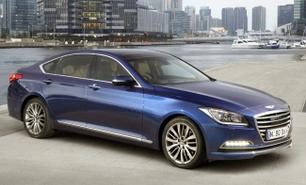
The Genesis is like no other Hyundai. For a start, it's gigantic - it looks easily as big as a BMW 7 Series (it isn't) with the road presence to match. There's a lot of BMW from most directions, but with a sharper approach to the creasing and character of the sheet metal.
Towards the rear it's more BMW 6 Series Gran Coupe and is all the better for it. The style is understated and technocratic.
Inside is also very Germanic, but with a bit more of a Lexus feel
The big wheels from the Ultimate pack help make it look lower and sleeker, too.
Inside is also very Germanic, but with a bit more of a Lexus feel. Our car had the lighter leather which meant that the wood and the metal materials didn't necessarily work well together.
The interior is expertly put together and feels like it will last forever.
The only jarring moment is the gear selector is shared with our long-term Hyundai i30 - it looked a bit cheap in what is otherwise a beautifully executed cabin - it needs more heft.
On Australian-delivered cars there is just one Hyundai badge, sitting proudly on the boot - you get the feeling this was debated long and hard and when the decision was made to go for it, a big one was chosen.
However, the winged Genesis branding takes pride of place everywhere else. When you approach the car at night and the puddle lamps come on, the Genesis logo is projected on to the ground, crisp and clear.
The Q30 drew more than just looks for its badge. It genuinely looks like a concept car from a motor show stand. Not the paper mache Mars rover early prototype kind, more like the six-months-before-production kind.
It’s all swoopy with curves cutting all down the sides, and Infiniti has done a good job imprinting the brand’s signature design queues – like the chrome-framed grille and notched C-pillar - on the front and rear three-quarter views.
It’s genuinely hard to tell it shares major componentry with the last-gen (W176) A-Class from the outside and I’d place the overall look somewhere between Mazda and Lexus’ design languages for better or worse.
While the front is swoopy and resolved the rear is a bit busy with lines everywhere and bits of chrome and black trim all over the place. The tapered roofline and high bumpers set it apart from your regular hatchback fare.
It might grab the eye for the wrong reasons, but it certainly gives the Q30 a slick look when viewed in profile. I wouldn’t call it a bad looking car, but it is divisive and will appeal only to certain tastes.
Inside is simple and plush. Perhaps a little too simple when compared with the new (W177) A-Class with its entirely digital dashboard or the 1 Series with its M bits. One could even argue the Audi A3 has done ‘simplicity’ better.
The seats are nice in the two-tone white-on-black trim and the Alcantara roof is a premium touch, but the rest of the dash is a bit too basic and dated. There’s a smattering of buttons down the centre stack which are replaced with more intuitive touchscreen functions on most rivals, and the 7.0-inch touchscreen looks small, distantly embedded in the dash.
The materials are all nice to the touch, with most important touch-points clad in leather, but it also feels a little claustrophobic, with the abundance of dark trim, thick roof pillars and a low roof-line, especially in the back seat. The switchgear, which is mostly dropped straight out of a Benz A-Class, feels good.
The only way to describe the Genesis' pricing is aggressive - kicking off at $60,000, it's the most expensive Hyundai money can buy, but with a spec list like this, you won't feel at all short-changed.
Your sixty large buys you a huge cabin with a seventeen speaker stereo, auto headlights and wipers, LED ambient lighting inside and out, dual-zone climate control, keyless entry and start, powered front seats which are heated and cooled, satnav, front and rear parking sensors, and plenty of other bits and pieces.
Our car had the $22,000 Ultimate package, adding 19-inch alloys, blind spot sensor, front and side cameras, around-view display, real leather, more adjustments for the driver's seat, ventilated seats in the front, heated rear seats, panoramic glass sunroof, acoustic glass, heads-up display, powered bootlid and LED foglamps.
The Genesis is like no other Hyundai
You can have a lot of the more useful features in the $11,000 Sensory Pack. It's a good middle ground that, for example, features the excellent heads-up display.
The 9.2-inch screen splits the asymmetric air-conditioning vents. The software is unique to the Genesis and a huge leap forward over the rest of the Hyundai range - classy, smooth graphics, a good responsive screen.
You control the seventeen speaker stereo from here, which kicks out a rich sound and an impressive Bluetooth performance - rear seat passengers can also run the stereo from their armrest. The satnav is detailed and chatty, while the excellent heads-up display shows a configurable information set in strong, clear graphics.
If you’re shopping in this segment, there’s a good chance you’re not looking for a bargain buy, but the Q30 shines in some areas its competition doesn’t.
A promising start is the complete lack of a lengthy and expensive options list with items which should be standard. In fact, apart from a reasonable set of accessories and the $1200 premium 'Majestic White' paint, the Q30 has no options in the traditional sense.
The base Q30 scores 18-inch alloy wheels, LED headlights with high-beam assist, heated leather seats, flat-bottomed leather steering wheel, leather trim on the doors and dash, Alcantara (synthetic suede) roof-lining and a 7.0-inch multimedia touchscreen supporting DAB+ digital radio and built-in navigation.
Our Sport adds a 10-speaker Bose audio system (which could have been better…) dual-zone climate control, a fixed panoramic sunroof, fully-electric front seats and Nissan’s 360-degree ‘around view monitoring’ parking suite.
It might have premium aspirations, but value-wise Q30 is still specified like a Nissan.
The standard safety suite is also reasonably impressive, and you can read more about it in the safety section of this review.
Our Q30 Sport comes in at a total of $46,888 (MSRP) which is still premium money. The price pits it against the BMW 120i M-Sport (eight-speed auto, $46,990), Mercedes-Benz A200 (seven-speed DCT, $47,200) and fellow Japanese premium hatch act - the Lexus CT200h F-Sport (CVT, $50,400).
Herein lies the Q30’s biggest problem. Brand recognition. Everybody knows the BMW and Benz hatches by virtue of their badges alone and the Lexus CT200h is known by those who care about it.
Even without the extensive options list, it makes the price of entry against such established competition tough. While you might see a couple of them around Sydney, the Q30 is a relatively rare sight which garnered more than a few quizzical looks in the towns of NSW’s mid-north coast.
The standard spec is also missing the all-important Apple CarPlay and Android Auto connectivity. It rendered the 7.0-inch multimedia screen clumsy and largely useless, although the old-fashioned built-in nav gives peace-of-mind when you’re out of phone reception range.
If you have an Apple phone you can make use of the iPod music playback feature via the USB port.
The Genesis is powered by Hyundai's own 3.8-litre V6 developing 232kW and 397Nm, mated to Hyundai's eight-speed automatic transmission.
Despite weighing just under two tonnes, the Genesis completes the dash to 100km/h in 6.5 seconds.
It has a claimed 11.2L/100km on the combined cycle. In what must be a first, we got below that, averaging 10.8L/100km over two weeks. And that's without stop-start fuel-saving to blunt the effect of lot of city driving.
The Genesis is not going to tempt you into a track day, even with rear wheel drive
We'd still like to try the V8 - only available in left-hand drive markets - though.
For 2019 the Q30 has had its list of engines trimmed from three to just one. The diesel and smaller 1.6-litre petrol engines have been culled, leaving a 2.0-litre petrol.
Thankfully, it’s a strong unit producing a once-V6-range 155kW/350Nm across a wide band from 1200-4000rpm.
It feels responsive and isn’t let down by a slick-shifting seven-speed dual clutch automatic transmission.
The new-generation A-Class equivalent, even in 2.0-litre A250 guise produces less torque with outputs of 165kW/250Nm, so for the money the Infiniti scores a solid serving of extra punch.
At five metres long, with a ride firmly pitched in the luxury camp, the Genesis is not going to tempt you into a track day, even with rear wheel drive.
Blindfold your passengers and swap them between a Lexus, a BMW and a Genesis and the overwhelming impression they'll get is one of incredible smoothness.
If you're wanting sudden movements, this isn't the car for you
Sitting in the back of the Genesis, it's easily as good as the German and luxury Japanese competition. The seats are hugely comfortable, there's ample head, leg and shoulder room and it feels lot nicer than anything within a bull's roar of its price.
No matter where you sit, it's an incredibly quiet car. The engine is a distant whoosh, the tyre noise muted and there's almost no wind or ambient noise. It's supremely comfortable and the excellent stereo will wash away what little noise does invade.
It certainly feels its weight from the driver's seat, with a competent, soft turn-in, but if you're wanting sudden movements, this isn't the car for you.
The Genesis is an epoch-making car for the Korean manufacturer
On fast flowing roads you can have some fun, but things will get floaty and that will quickly kill that fun. The ride and isolation from the rest of the world is completely worth it.
Thanks to its shared underpinnings with the A-Class the Q30 Sport drives largely like you would expect a premium hatch to drive. It’s just lacking a bit of character.
The engine is responsive, the transmission is fast and the availability of peak torque from just 1200rpm will lead to spinning the front wheels if caution is not applied. Power is no real issue.
Although Infiniti says it has tuned the Q30 in Japan and Europe, the ride has an undeniably Germanic flavour. It doesn’t feel quite as tight as the A-Class or 1 Series but it doesn’t feel as soft as the CT200h, so it strikes a decent balance.
The Q30 uses MacPherson strut suspension in the front and multi-link at the rear, more suited to a premium car than the torsion bar rear on the new Benz A 200.
The wheel has a nice amount of feedback, and thankfully doesn’t use the larger Q50’s strange ‘Direct Adaptive Steering’ which has no mechanical connection between the driver and the road.
If you’ve driven a decently-specified A-Class before the drive experience will feel familiar. The added ride height seems to remove a bit of feel from the corners, however.
There’s also the inclusion of three drive modes – Economy, Sport and Manual. Economy mode seems to be the default with Sport simply holding gears for longer. Steering-wheel mounted paddle-shifters could be used to mill through the seven gears in 'Manual' mode, although this didn’t add much to the experience.
The addition of active cruise control and adaptive high beams proved to be fantastic for reducing fatigue on long highway stints during the night, but the lack of a padded surface on the inside of the transmission tunnel proved uncomfortable for the driver’s knee on longer trips.
I persisted with the stop-start system to test it, but it proved slow and irritating. Under normal circumstances it would be the first thing I’d turn off.
Visibility was also a bit limited out the rear three quarter courtesy of the low, swoopy C-pillars.
Nine airbags, traction and stability control, lane departure warning, forward collision control, ABS, brake force assist and distribution and traction and stability control bring the ANCAP count to five stars.
The Sensory and Ultimate packs add blind spot sensors and around view cameras.
The Q30 scores some decent active safety goodies alongside the usual refinements. Active safety items include auto emergency braking (AEB) with forward collision warning, blind spot monitoring (BSM), lane departure warning (LDW) and active cruise control.
There’s also Nissan’s signature ‘Around View Monitor’ 360-degree reversing camera which sounds more useful than it is. Thankfully there is also a standard reversing camera.
The Q30 carries a maximum five-star ANCAP safety rating as of 2015 but has not been tested to the more demanding 2019 standards.
The rear seats also benefit from two sets of ISOFIX child seat mounting points.
As previously mentioned, there’s no spare wheel in the Q30 Sport, so best of luck with the inflator kit if you end up with a flat in the outback.