What's the difference?
Anybody who doubts that Hyundai is gunning for the number one in the world has rocks in their head. Big heavy ones. Korean companies do not settle for anything less than number one. The second-generation Genesis (our first taste here in the Antipodes as the gen-one had its steering wheel on the wrong side) is proof.
What's different about Hyundai's unstoppable rise is the way they're going about it. They've always done their own thing in Korea, reinventing themselves time and again when they strayed off the beaten path.
The Genesis is a gamble for a Korean company in foreign markets whose default setting for luxury is marked, Britain or Germany. If Hyundai gets the Genesis wrong there will be howls of derision, or at best patronising pats on the back - "Nice try, you'll get there one day". But if they get it right...
Following the money comes pretty naturally to carmakers. It’s what happens when the product planning department smells a new direction on the breeze and then handballs that to the design and engineering folks who turn a perceived market trend into a showroom reality. And when everybody gets it right, you have a new default product. And everybody else has to keep up. Some even have to catch up.
We’ve seen it plenty of times before, too. Think about those early 1980s days when the default small car went from a sedan to the five-door hatchback. Didn’t that catch on? You might also remember more recently when a family car had to be a four-wheel drive. And what about the dual-cab ute revolution of the last 15 years?
The other strident market segment right now is the SUV, of course. And within that, most recently has been the march to electrification, starting with conventional hybrid technology and now progressing to the new must-have, a plug-in hybrid platform.
The fact is, if you’re a Chinese carmaker intending to sell on a world stage, you can’t ignore the plug-in SUV in any of its various sizes and marketing segments. There’s a good basis for this, too. Plug-in hybrids just make good sense. They offer the urban running-cost advantages of any hybrid, the option of zero tailpipe emissions, all-electric running over a normal commuting distance and – crucial for a big country like this one – they’ll keep motoring along for as long as the owner puts petrol in them.
Okay, so they can be heavy with all that tech on board, and there’s no denying that two power sources (petrol and electric) make for a more complex machine, but the advantages outweigh the downsides for many buyers.
The other graph you can plot with great certainty is that new tech will get cheaper as the industry moves forward. Which is exactly where BYD finds itself right now by being able to offer a plug-in hybrid variant of its Sealion 5 mid-sized SUV at a price that will have much of the opposition running scared. But how scared should the others be?
The Genesis is not quite a match for cars twice its price but it makes you think what's possible. It doesn't have the dynamic brilliance of a BMW or the self-assured faultless execution of a Mercedes. Lexus ought to be worried, though - why would you have an LS when you could have this? The only answer is 'badge'.
The Genesis is an epoch-making car for the Korean manufacturer. As the company has got better, there are fewer excuses for overlooking it. While the Genesis is pitched into a shrinking market, it's not really meant for the average i30 buyer to buy, but to see.
It's bristling with tech and is not only a halo car but a shot across the bows of both Lexus and the Germans. Attached to that shot is a note: "We're coming for you." In other words, Hyundai got it right.
Cars that don’t always appeal to enthusiast buyers are often seen by manufacturers as a way of not bothering with the dynamics. Good enough is, apparently, good enough. Thankfully, BYD hasn’t taken that path here and the local suspension tweaks have turned what could have been a me-too product into a bit of a dynamic class leader. And even if buyers can’t verbalise the benefits of that, they will still be subliminally enjoying them with every kilometre.
The other stand-out feature is the price-tag which represents an awful lot of car for the money. And, in such a price-sensitive market as this one, that will get the BYD over the line for a lot of families. That it also offers a vastly better driving experience simply makes the value equation – and the purchasing proposition – even stronger.
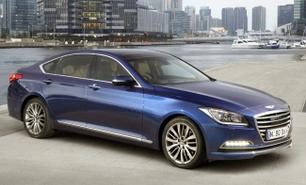
The Genesis is like no other Hyundai. For a start, it's gigantic - it looks easily as big as a BMW 7 Series (it isn't) with the road presence to match. There's a lot of BMW from most directions, but with a sharper approach to the creasing and character of the sheet metal.
Towards the rear it's more BMW 6 Series Gran Coupe and is all the better for it. The style is understated and technocratic.
Inside is also very Germanic, but with a bit more of a Lexus feel
The big wheels from the Ultimate pack help make it look lower and sleeker, too.
Inside is also very Germanic, but with a bit more of a Lexus feel. Our car had the lighter leather which meant that the wood and the metal materials didn't necessarily work well together.
The interior is expertly put together and feels like it will last forever.
The only jarring moment is the gear selector is shared with our long-term Hyundai i30 - it looked a bit cheap in what is otherwise a beautifully executed cabin - it needs more heft.
On Australian-delivered cars there is just one Hyundai badge, sitting proudly on the boot - you get the feeling this was debated long and hard and when the decision was made to go for it, a big one was chosen.
However, the winged Genesis branding takes pride of place everywhere else. When you approach the car at night and the puddle lamps come on, the Genesis logo is projected on to the ground, crisp and clear.
The interior of the Sealion 5 feels pretty well-made and there are soft-touch surfaces on most of the touch-points. The steering wheel, too, is thick and chunky and nice to hang on to. But there’s a lot going on in terms of different colours, textures and surfaces, and it can all look a bit busy, despite the high-tech boardroom overall flavour. It’s also worth mentioning the trim material is synthetic but does a great job of looking and feeling like real leather.
Externally, there’s not a lot to grab the eye. Sure, it’s not an unpleasant looking vehicle, but neither does it stand out from the mid-size SUV pack. At least BYD decided against those cheap-looking plastic tack-ons on each wheel-arch.
The only way to describe the Genesis' pricing is aggressive - kicking off at $60,000, it's the most expensive Hyundai money can buy, but with a spec list like this, you won't feel at all short-changed.
Your sixty large buys you a huge cabin with a seventeen speaker stereo, auto headlights and wipers, LED ambient lighting inside and out, dual-zone climate control, keyless entry and start, powered front seats which are heated and cooled, satnav, front and rear parking sensors, and plenty of other bits and pieces.
Our car had the $22,000 Ultimate package, adding 19-inch alloys, blind spot sensor, front and side cameras, around-view display, real leather, more adjustments for the driver's seat, ventilated seats in the front, heated rear seats, panoramic glass sunroof, acoustic glass, heads-up display, powered bootlid and LED foglamps.
The Genesis is like no other Hyundai
You can have a lot of the more useful features in the $11,000 Sensory Pack. It's a good middle ground that, for example, features the excellent heads-up display.
The 9.2-inch screen splits the asymmetric air-conditioning vents. The software is unique to the Genesis and a huge leap forward over the rest of the Hyundai range - classy, smooth graphics, a good responsive screen.
You control the seventeen speaker stereo from here, which kicks out a rich sound and an impressive Bluetooth performance - rear seat passengers can also run the stereo from their armrest. The satnav is detailed and chatty, while the excellent heads-up display shows a configurable information set in strong, clear graphics.
The plug-in hybrid in question is the BYD Sealion 5. It has a claimed EV-only range of better than 100km, relatively quick charging, a decent sized battery, adequate performance, enough interior space for a family, good safety and lots of equipment. Oh, and it costs just $33,990, before on-road costs, in its entry-level Essential form. Incoming!
Equipment-wise, that sub-34K sticker gets you a 10.1-inch central info-screen, an 8.8-inch driver display, digital radio, a six-speaker stereo, wireless connectivity for Android Auto and Apple CarPlay and dual-zone climate control.
Throw another four grand on the table and you move up to the Premium version which adds plenty of kit for the $37,990 ask. That includes a panoramic sunroof, automatic tailgate, roof rails, heated and electrically folding mirrors, one-touch power windows, a six-way powered drivers seat and four-way powered co-pilot’s chair, a heated and ventilated driver’s seat and wireless charging.
The step up from Essential to Premium also includes a battery upgrade, and we’ll cover that off in the Under the Bonnet section below.
The Genesis is powered by Hyundai's own 3.8-litre V6 developing 232kW and 397Nm, mated to Hyundai's eight-speed automatic transmission.
Despite weighing just under two tonnes, the Genesis completes the dash to 100km/h in 6.5 seconds.
It has a claimed 11.2L/100km on the combined cycle. In what must be a first, we got below that, averaging 10.8L/100km over two weeks. And that's without stop-start fuel-saving to blunt the effect of lot of city driving.
The Genesis is not going to tempt you into a track day, even with rear wheel drive
We'd still like to try the V8 - only available in left-hand drive markets - though.
Both variants of the Sealion 5 have the same driveline – mostly. They each use a 1.5-litre petrol engine teamed with a single electric motor, both driving the front wheels. Unlike the bigger Sealions, there’s no all-wheel drive version. Power peaks at 156kW and torque at 300Nm.
Why a non-turbocharged engine? BYD tells us the non-turbo engine helps keep cost out of the vehicle and, since the engine really only runs to power the electric motor and charge the batteries, it does so at a relatively constant engine speed, negating the need for a wide spread of petrol power.
The only major difference is that the Essential version has a 12.9kWh battery-pack, while the Premium gets a bigger, 18.3kWh pack for longer range, but precisely the same output and, therefore, performance.
A single-speed transmission is part of the BYD driveline package, also made possible by the fact that the vast majority of the driving of wheels is done by the electric motor.
At five metres long, with a ride firmly pitched in the luxury camp, the Genesis is not going to tempt you into a track day, even with rear wheel drive.
Blindfold your passengers and swap them between a Lexus, a BMW and a Genesis and the overwhelming impression they'll get is one of incredible smoothness.
If you're wanting sudden movements, this isn't the car for you
Sitting in the back of the Genesis, it's easily as good as the German and luxury Japanese competition. The seats are hugely comfortable, there's ample head, leg and shoulder room and it feels lot nicer than anything within a bull's roar of its price.
No matter where you sit, it's an incredibly quiet car. The engine is a distant whoosh, the tyre noise muted and there's almost no wind or ambient noise. It's supremely comfortable and the excellent stereo will wash away what little noise does invade.
It certainly feels its weight from the driver's seat, with a competent, soft turn-in, but if you're wanting sudden movements, this isn't the car for you.
The Genesis is an epoch-making car for the Korean manufacturer
On fast flowing roads you can have some fun, but things will get floaty and that will quickly kill that fun. The ride and isolation from the rest of the world is completely worth it.
You don’t have to drive very far to realise that the local input into the Sealion 5’s suspension and steering have been worth the effort. BYD Australia has a local engineering team on call these days, and it shows here.
Actually, the steering is not the highlight; it has some weight but not a whole lot of feel, or, indeed, feedback for the driver. The ride and handling combination is what stars. Obviously well-damped, the suspension allows for a ride that is both complaint and quiet, without causing the car to wallow around like some jacked-up designs can with their higher centre of gravity.
In fact, the BYD is athletic to the point where keener drivers will find it an entertaining drive; hardly something that can be said for the majority of medium SUVs.
Performance is strong without being overwhelming and even though the Sealion 5 has that signature electric-drive feeling of effortlessness, the accelerator pedal has been calibrated to avoid the neck-snapping surge of grunt off the line. As such, it emerges with a fairly flat acceleration curve, and no hint that the petrol motor is cutting in or out.
Until, that is, you bury the throttle all the way at which point the petrol engine takes a few second to join in. And when it does, it’s pretty vocal – shrill, almost – as it catches up with the rest of the car and starts directly driving the wheels. To be fair, though, this is not going to be a common occurrence in everyday life thanks to the flexibility of the petrol-electric system for 99 per cent of circumstances.
On the move, the cabin is perhaps most notable for its soft, plush seats that are a nice change from the church pews of some manufacturers. And although the driving position is about right, taller drivers might prefer a steering column that extends out another few millimetres.
The driver display screen is another source of annoyance. It’s pretty small and contains lots and lots of information, to the point where the typeface is too small to be read on the run by anybody who relies on reading glasses.
Nine airbags, traction and stability control, lane departure warning, forward collision control, ABS, brake force assist and distribution and traction and stability control bring the ANCAP count to five stars.
The Sensory and Ultimate packs add blind spot sensors and around view cameras.
Passive safety in the Sealion 5 starts with no fewer than seven airbags including full-length side-curtain bags.
There’s also a front-centre airbag, something we’d like to see in more cars, particularly at this price-point. Child restraint points in the rear seat are the ISOFIX type.
The BYD gets pretty much the full suite of driver aids, including autonomous emergency braking, blind-spot monitoring, rear-cross traffic alert with active assistance, stability control, active cruise-control, traffic-sign recognition, front and rear collision warning and tyre pressure monitoring.
The Sealion 5 also incorporates a driver-attention monitor which seems better calibrated than some earlier efforts from some of the Chinese carmakers. Also improved in calibration terms is the lane-keeping assistance which is still too violent for our tastes, but more subtle than some of the competition’s systems. But while the savagery of this system has been toned down, it appears to have been at the expense of sensitivity and, time and time again, the cameras missed road markings that were faded or dirty.
The major safety benefit in paying more for the Premium variant is the addition of front parking sensors and a 360-degree camera instead of the Essential’s simple reversing camera.
The Sealion 5 has not been ANCAP tested as yet, although BYD says this is largely down to ANCAP’s scheduling rather than any hesitance on BYD’s part.