What's the difference?
Like many car brands, Honda is storming the hybrid field. The new HR-V brings with it a hybrid powertrain and external facelift but is it enough to keep it competitive in the small SUV segment?
As with any cosmetic surgery you may wonder whether the facelift has been successful.
No tricks – I’ll tell you straight up the new external design might be what you’re looking for if you’re on the hunt for a small SUV that doesn’t look like it moonlights as an Uber for Mr Big Ears (a Noddy reference for any youngsters out there).
We're testing out the top hybrid model, the L, to see what else this urban dweller gets right and what it sometimes gets wrong.
Zeekr is making waves in Australia at the moment but it's not because of the car you see before you.
Nope, it’s the 7X mid-size SUV that’s captured a heap of attention and a whole lot of sales. In fact, of the 1832 sales the brand has managed over the first three months of 2026, just 54 were for the X.
But that was the old X and this is the new one. With more power, more performance, faster charging and a whole heap of pretty special equipment, especially for the small SUV segment.
So, is that enough to finally put the X on the map?
The Honda HR-V e:HEV L offers a respectable driving experience in the city but compared to its rivals, it’s features list and safety don’t always stack up. It sort of straddles the fence between basic and lux at times, which is an odd place for a top-model to be but its sharper styling will win hearts and the cabin is still practical.
It's a good thing in a small package, this Zeekr X, and there are a lot of things I like about it. In fact, the only sticking point for me is the price. But that's all about perspective. If you see this as a newcomer Chinese brand, then yes, there are a lot of more affordable options out there. But if you see it as a premium player, it's really a more affordable version of a Volvo.
Note: The author, Andrew Chesterton, is a co-owner of Smart As Media, a content agency and media distribution service with a number of automotive brands among its clients. When producing content for CarsGuide, he does so in accordance with the CarsGuide Editorial Guidelines and Code of Ethics, and the views and opinions expressed in this article are solely those of the author.
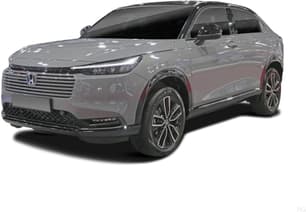
The small SUV segment can often be littered with odd-looking cars that highlight pillowy or severely angular body-shapes (lookin' at you C-HR) but the HR-V offers something stylish and modern instead.
The 2025 HR-V has a sharper design that accentuates the coupe styling, slim LED headlights and crisp-looking grille. A feature highlight is the eye-catching full-length tail-light treatment which makes the design pop at the back.
The interior is gorgeous with a streamlined dashboard that features just the right number of buttons and dials for those who want more tactility in a world where screens rule.
While the technology screens are on the smaller end, they look great against the synthetic leather trims and soft touchpoints that are liberally splashed throughout the cabin.
The cockpit is driver-orientated with everything within reach and easy to use while on the go. The steering wheel looks sporty and feels wonderful.
Everything looks well-built and feels solid; it's a cabin you’ll be pleased to spend time in.
The visual changes aren’t massive. This AWD version welcomes a couple of new exterior colours, including the 'Matt Khaki Green' of our test car. It also gets the two-tone black roof and there are new 20-inch alloy designs.
Elsewhere, it's the futuristic-style of design we’re used to which differentiates the X from its Volvo EX30 twin under the skin.
Inside, this is a seriously well-equipped and polished-feeling small SUV, and — unlike some of the newcomer brands to Australia — it all feels very high quality and well put together. And that includes the material choices.
I don’t even hate the fact that most of the functions are controlled via this screen, thanks to the little shortcuts glued to the home screen. I do, however, hate the fact that there’s no easy way to change the wing mirrors or shortcuts for toning down some of the safety stuff.
That aside, though, it’s a nice and high-quality feeling space.
For a small SUV, the cabin is large. Both seating rows feature excellent access with the 195mm ground clearance not eliciting one grunt from my occupants (even the oldies).
Head- and legroom is decent in both rows but taller passengers might brush the ceiling on bumps when seated in the back.
The only area that lacks this feeling of space is the boot, as it only has 304L of capacity available when all seats are in use and that's on the tiny side compared to its rivals. The Kia Niro has 425L which rivals some sedans!
Seat comfort is best in the front where thick padding and a longer cushion offer more comfort on a longer journey, despite lacking lumbar support.
The rear seats are harder and shorter and you should expect some big stretches from adults after a road trip. However, the directional air vents and other amenities keep it from feeling too basic on comfort.
There are lots of storage options with a glove box that's large enough to fit a manual with room to spare, a small middle console, two large 'stacked' shelves in front of the gearshift, four cupholders, four drink-bottle holders and two map pockets that also feature a device holder large enough to fit my iPhone 15 Pro Max.
The HR-V has 'Magic' seats in the rear which means the base can fold up or the backs can be folded flat. It’s a cool feature that opens up extra storage options.
The technology is simple to use and responsive. The touchscreen multimedia system has built-in satellite navigation, the Honda Connect app, wireless Apple CarPlay and wired Android Auto. The CarPlay is easy to set up and maintains a steady connection.
Charging options are good with a single USB-A and three USB-C ports, as well as, a 12-volt socket but you miss out on a wireless charging pad despite the L being the top grade.
You know you're in a small vehicle when you can't fit two large (not those crazy American-style jumbo cups, just normal coffee-shop takeaway) coffees in the cupholders, but so it is with the Zeekr X.
The small SUV's 4432mm length, 1836mm in width and 1566mm height doesn't leave much room to spread out up front. There's ample room for driver and passenger, of course, but we are talking about a small vehicle here.
Clever storage helps to mitigate that, though, especially the super-deep storage space in the centre console and the very clever fridge that separates the driver and passenger seats.
Weirdly, though, the space doesn’t feel overly tight in the back seat. We had a massive baby seat in there, and that fit without issue. And full size humans can genuinely get pretty comfortable. I'm 175cm, and I had enough knee and headroom.
In the boot, there’s 404 litres of volume with the rear seats upright and 1247 litres with them folded flat. And it’s worth pointing out this isn’t intended to be a family car, but there’s certainly enough space for the shopping... and a pram.
There are three HR-V variants available, starting with the petrol base-model Vi X, moving to the mid-spec e:HEV X and on to the top-grade e:HEV L; which is the model on test here.
The L is priced from $42,900, drive-away (2000, NSW postcode), which positions it as the most affordable compared to its similarly graded rivals. The Kia Niro HEV GT-Line is $55,487, drive-away, and the Toyota C-HR Koba is $55,180, drive-away.
Despite having a much higher price tag, the rivals sport a few extra features including electric front seats, ventilated front seats, larger media screens, wireless Android Auto, a wireless charging pad and upgraded sound systems... just to name a few.
Oh, and the HR-V is only a four-seater, so the rivals also boast a fifth seating position.
That being said, the L isn't a total lump in the features department and the standard equipment is still pretty good (just not full-bodied like it's rivals).
The L comes with synthetic leather and cloth mixed upholstery and trims, heated front seats, a heated steering wheel and 18-inch alloy wheels.
Technology includes a 9.0-inch touchscreen multimedia system with satellite navigation, wireless Apple CarPlay, wired Android Auto, six-speaker sound, the 'Honda Connect' app, a 7.0-inch digital instrument cluster, one USB-A port, three USB-C ports, a 12-volt socket and Bluetooth connectivity as well as AM/FM and digital radio.
Practicality feels well-rounded with keyless entry and start, rain-sensing windscreen wipers, dusk-sensing headlights, dual-zone climate control and a powered tailgate.
This is a small SUV with a LOT of stuff. There are two trims in the Zeekr X range – the entry-level rear-drive model is $48,900, drive-away, while the all-wheel drive version we've tested is $57,900 on the road.
The obvious comparison is to the Volvo EX30, which shares its platform with the Zeekr X through both brands' Chinese parent company Geely.
As of right now, the cheapest single-motor Volvo is $56,051, drive-away in NSW, or $49,990 plus on-roads, making the Zeekr version much, much cheaper.
Anyway, outside there are 19- or 20-inch alloys, though our test car is fitted with the optional 20-inch black alloys, paired with a black-with-red-highlights interior treatment, which adds $2000 to the price.
Ours is also fitted with the electric front doors which open or close at the push of a button, and back doors that unlatch, but don’t fully open, the same way, which adds another $2000.
Both trims also get heated and cooled front seats, and heating in the rear window seats, but this AWD version also adds a massage function for front seat riders.
There’s also wireless charging, a 13-speaker Yamaha sound system and — very cool, literally — is the little drinks fridge between the front seats in the AWD variant.
Tech is handled by a 14.6-inch touchscreen with Apple CarPlay and Android Auto and there’s a head-up display for the driver.
The L is a hybrid which combines a 1.5L four-cylinder petrol engine with an electric motor and together they produce up to 96kW of power and 253Nm of torque.
Which is plenty to make the L feel like a zippy city car but on the open road, the engine has a tendency to over-rev and can get whiny going up a hill, which may be a by-product of the continuously variable auto transmission.
The big news here is a more powerful rear motor – meaning you get more grunt whether you opt for the rear-wheel drive or this all-wheel drive.
In rear-drive form, that boosts your outputs from 200kW to 250kW, dropping the sprint to 100km/h to 5.6 seconds. In AWD guise, your new outputs are 365kW (up from 315kW) and 573Nm, and your sprint to 100km/h falls to 3.7 seconds.
The HR-V L has a low combined (urban/extra-urban) fuel cycle figure of just 4.3L/100km which is not far off the 4.0L/100km claims of its rivals. Combined with the 40L fuel tank, you have a theoretical driving range of up to 930km, which is pretty darn good!
After doing a lot of urban driving, with a couple of longer trips thrown in, my real-world usage came out at 5.1L, which is isn't too far off the claimed figure, is still a good result overall and computes to a range in excess of 780km.
This is where it starts to get weird. The rear-drive Zeekr X is fitted with a 61kWh LFP battery, which can accept up to 230kW DC fast charging, taking you from 10 to 80 per cent charged in just 18 minutes. Total claimed range is 405km.
The flagship AWD, though, charges at a slower rate. It gets a 66kWh NMN battery and can only be charged at 150kW, meaning the same charge takes 30 minutes. Zeekr is promising a 415km driving range between charges.
The HR-V L is an SUV perfectly suited to city life. Its power delivery is responsive around town, allowing for quick bursts when needed and the well of power feels deep until you get onto the open road. And as mentioned, that’s when it’s let down a bit.
The HR-V has a tendency towards mild understeer in quicker sweeping bends but is otherwise surefooted on the road. The suspension is firm, and you’ll notice the bumps here and there, but ride comfort still manages to be okay most of the time. Also road noise isn’t too high around town.
The visibility is great until you’re trying to look out of the back window and have a passenger to your left or a car seat installed. A digital rearview mirror would have been quite welcome in these scenarios.
Like most small SUVs the HR-V is easy to park and it’s small enough to be your best friend in a tiny car park. However, the reversing camera doesn’t reflect the grade level as the quality of the feed isn’t the best.
Short answer? Pretty good, with some caveats.
I'm partial to a firmer ride. I find some Chinese car companies can feel like they get their suspension bits from Captain Snooze, such is the soft, pillowy ride served up. And to be honest, it makes me a little seasick at times.
The Zeekr is not like that. It has firmness dialled into the ride equation and can feel harsh at times, but also improves the drive experience, delivering connection and engagement at the cost of some sharpness on the wrong road.
It's also faster than the model it replaces, but it's also one of those cars in which the real-life feeling doesn't quite match the on-paper promise.
This thing serves up supercar speed, but it doesn't feel like it from behind the wheel. Instead, the acceleration - especially from a rolling start - feels potent, but not biblical.
From a standing start it pauses for a moment, almost like an internal-combustion vehicle might, before delivering a quick (but not stratospheric) flow of power. None of that is a bad thing, by the way. Who wants their small SUV to accelerate like a supercar?
It's otherwise an entirely pleasant drive. The cabin is serene and quiet and it's a small car that doesn't feel like one. There's nothing light or tinny about the drive experience, instead there's a heft and quality.
The HR-V has a four- out of a possible five-star ANCAP safety rating from testing done in 2022. It only features six airbags and its individual assessment scores aren’t as high as its rivals.
In fact, both the rivals I’ve mentioned performed much better and have additional safety features to boot, including safe exit assist, 360-degree view camera systems and rear occupant alert. Which the HR-V misses out on.
The top model HR-V benefits the most in safety compared to the lower grades and includes blind-spot monitoring, front fog lights, forward collision warning, rear cross-traffic alert, lane keeping aid and departure warning, traffic sign recognition, intelligent seatbelt warning, adaptive cruise control and a reversing camera as well as front and rear parking sensors.
Some notes, though. The lane departure and keeping aids seem to 'activate' whenever they feel like it. I had them come on more on unmarked roads than marked.
The adaptive cruise control can be too sensitive at times and having the car slam on brakes when you're passing a parked car on the highway going 100km/h is a scary experience to say the least.
The HR-V has AEB with car, pedestrian, and cyclist detection which is operational from 5.0 to 100km/h (170km/h for car).
Being a four-seater, you only get two ISOFIX child seat mounts and two top-tether anchor points and while it is easy to fit a child seat in, the top of it wipes out your rearview vision.
The safety is pretty disappointing as it lets down an otherwise solid SUV.
The Zeekr X wears a maximum five-star ANCAP safety rating, earned in 2024, which means the long list of required active safety stuff is present and accounted for, all wrapped up in what Zeekr calls its 'Intelligent Driving Assist System'.
There are five cameras, five radars and 12 sensors, which is a crazy number for a car this small.
And this is also not a car in which I was desperately trying to figure out how to deactivate any of the active safety systems – save the overzealous over-speed warning – which is a win these days, too.
There are also seven airbags, including a centre front airbag.
The Zeekr X is fitted with ISOFIX anchors on the rear outboard seats and top tether anchorages for all rear seating positions.
Honda offers the HR-V with a five-year/unlimited km warranty and an eight-year battery warranty which is on the lower end considering it's rivals can get up to seven-years unlimited km warranty now.
The five years capped-priced servicing program offers excellent value, however, as services are a flat $199, which is great for the class.
Servicing intervals are at every 12 months or 10,000km, whichever occurs first and that should be fine for the average city dweller. But it could get annoying if you put higher than average kays on your car every year.
Zeekr's coverage is an underwhelming five-year, unlimited-kilometres, while the drive battery is covered for eight-years or 160,000km. There’s five years' of roadside assistance thrown in, too.
Service intervals are 20,000km or 12 months, with five years' of ownership setting you back a hefty $3072; an average of $614 per workshop visit.
There are currently 16 Zeekr dealers in Australia - two of which are 'pop-up' sites rather than full retail centres.
Multiple locations in Melbourne, Sydney and Brisbane with the ACT, Adelaide and Perth also covered. Others include Geelong and the Sunshine Coast but so far you're out of luck in Tassie or the NT.