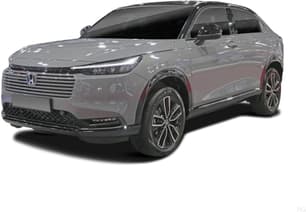
What's the difference?
Like many car brands, Honda is storming the hybrid field. The new HR-V brings with it a hybrid powertrain and external facelift but is it enough to keep it competitive in the small SUV segment?
As with any cosmetic surgery you may wonder whether the facelift has been successful.
No tricks – I’ll tell you straight up the new external design might be what you’re looking for if you’re on the hunt for a small SUV that doesn’t look like it moonlights as an Uber for Mr Big Ears (a Noddy reference for any youngsters out there).
We're testing out the top hybrid model, the L, to see what else this urban dweller gets right and what it sometimes gets wrong.
The second-generation Mazda CX-9 may have been on sale in Australia for nearly five years now, but it remains the second best-selling large SUV using unibody construction (as opposed to old-school, off-road-focused body-on-frame).
That said, it is getting on a bit, so Mazda’s given it an update with a twist for 2021, hoping to inject a little bit more life into its flagship model.
And when we say twist, we mean it. After all, who would’ve thought there’d ever be a six-seat CX-9? Well, we’ve checked it out to see if it’s the version we needed all along. Read on.
The Honda HR-V e:HEV L offers a respectable driving experience in the city but compared to its rivals, it’s features list and safety don’t always stack up. It sort of straddles the fence between basic and lux at times, which is an odd place for a top-model to be but its sharper styling will win hearts and the cabin is still practical.
The CX-9 is still a great option for families looking for a large SUV, even if it is starting to show its age as new rivals continue to launch with newer technologies.
That said, the availability of a luxury-focused six-seat configuration (Azami LE AWD) for the first time might be enough to convince some buyers to give it further consideration.
But for others who need the versatility of seven seats, this is still the CX-9 we’ve all come to know and love – but just a little bit better – particularly in its best-selling Azami AWD form.
The small SUV segment can often be littered with odd-looking cars that highlight pillowy or severely angular body-shapes (lookin' at you C-HR) but the HR-V offers something stylish and modern instead.
The 2025 HR-V has a sharper design that accentuates the coupe styling, slim LED headlights and crisp-looking grille. A feature highlight is the eye-catching full-length tail-light treatment which makes the design pop at the back.
The interior is gorgeous with a streamlined dashboard that features just the right number of buttons and dials for those who want more tactility in a world where screens rule.
While the technology screens are on the smaller end, they look great against the synthetic leather trims and soft touchpoints that are liberally splashed throughout the cabin.
The cockpit is driver-orientated with everything within reach and easy to use while on the go. The steering wheel looks sporty and feels wonderful.
Everything looks well-built and feels solid; it's a cabin you’ll be pleased to spend time in.
Given its latest update is relatively minor, the CX-9’s exterior largely looks the same as before, which, depending on your point of view, is a very good thing. As far as we’re concerned, it certainly is.
That said, train-spotters will notice some differences, with the GT SP (new), Azami and Azami LE (new) grades getting a refreshed grille that’s slotted and available in two grade-specific finishes unlike the insert their carryover Sport, Touring and GT siblings still have.
And aside from the GT SP, Azami and Azami LE’s new sets of 20-inch alloy wheels (again in grade-specific finishes), the only other exterior change is the Azami and Azami LE’s larger-diameter chrome exhaust tailpipe extensions. Sporty!
Inside, the CX-9 has more changes in store, headlined by the new ‘floating’ 10.25-inch central display all but the Sport and Touring get (they stick with 7.0- and 9.0-inch units respectively).
The new set-up is powered by Mazda’s latest multimedia system, which is certainly an improvement over its predecessor, and a much needed one at that.
Worth noting, touch is not an input method, with the rotary controller on the centre console the only option, which is actually great for safety, so we’re all for it.
The Azami and Azami LE also get new quilted Nappa leather upholstery, which looks and feels great, and adds to the overall high-quality theme.
Otherwise, it’s pretty much business as usual, which is great because the CX-9 has always had a well-designed interior. Yep, if it ain’t broke, don’t fix it.
For a small SUV, the cabin is large. Both seating rows feature excellent access with the 195mm ground clearance not eliciting one grunt from my occupants (even the oldies).
Head- and legroom is decent in both rows but taller passengers might brush the ceiling on bumps when seated in the back.
The only area that lacks this feeling of space is the boot, as it only has 304L of capacity available when all seats are in use and that's on the tiny side compared to its rivals. The Kia Niro has 425L which rivals some sedans!
Seat comfort is best in the front where thick padding and a longer cushion offer more comfort on a longer journey, despite lacking lumbar support.
The rear seats are harder and shorter and you should expect some big stretches from adults after a road trip. However, the directional air vents and other amenities keep it from feeling too basic on comfort.
There are lots of storage options with a glove box that's large enough to fit a manual with room to spare, a small middle console, two large 'stacked' shelves in front of the gearshift, four cupholders, four drink-bottle holders and two map pockets that also feature a device holder large enough to fit my iPhone 15 Pro Max.
The HR-V has 'Magic' seats in the rear which means the base can fold up or the backs can be folded flat. It’s a cool feature that opens up extra storage options.
The technology is simple to use and responsive. The touchscreen multimedia system has built-in satellite navigation, the Honda Connect app, wireless Apple CarPlay and wired Android Auto. The CarPlay is easy to set up and maintains a steady connection.
Charging options are good with a single USB-A and three USB-C ports, as well as, a 12-volt socket but you miss out on a wireless charging pad despite the L being the top grade.
Being an SUV that’s 5075mm long, 1969mm wide and 1747mm tall, practicality is arguably the most important thing for the CX-9, and with the option of six seats for the first time with the new Azami LE, it’s even more versatile.
All seven-seat grades have a 60/40 split-fold second row that manually slides and reclines the same as before, with only the Sport missing out on one-touch tumble operation, which makes accessing the 50/50 split-fold third row even easier, even if it’s still not graceful.
But the six-seat Azami LE is configured differently, given its second row has two captain’s chairs instead of a bench. That said, it operates in a very similar manner, just with power adjustment.
I still had around eight centimetres of legroom and four of legroom behind my 184cm (6'0") driving position, while the large transmission tunnel that’s a foot-space issue in seven-seat versions... isn’t.
One key difference with the very roomy and comfortable Azami LE is it only has four top-tether child-seat anchorage points, while all other grades have five thanks to their extra seat. Either way, four ISOFIX child-set anchorage points are split across the second and third rows.
Alternatively, the third row can be used by adults on shorter journeys, although they won’t have a lot of space to enjoy. Again, I'm 184cm tall and it’s tight back there, with no headroom or legroom on offer, but children will, of course, fare much better.
The CX-9’s boot is still pretty usable with all three rows in action, with 230L of cargo capacity available, but you can stow the two rear seats to get 810L in total.
And if you want maximum cargo capacity, the middle seats can also be folded, but not in the Azami LE, annoyingly.
Either way, the CX-9 doesn’t have a load lip but does have a flat floor, so loading bulkier items is a cinch, while two bag hooks and four tie-down points are on hand for securing loose items if they can’t fit in the double map pockets on the front seat backrests.
There are two cupholders in the third row, another two in the second row’s fold-down armrest (seven-seater versions) or large centre console (Azami LE), and another two in the first row’s larger centre console, while the front and rear door bins can also take bottles – and other knick-knacks.
All grades get USB ports in the first row, while the Touring and above also have them in the second row, and the GT and above also feature them in the third row. It’d be nice if there was no differentiation, though.
There are three HR-V variants available, starting with the petrol base-model Vi X, moving to the mid-spec e:HEV X and on to the top-grade e:HEV L; which is the model on test here.
The L is priced from $42,900, drive-away (2000, NSW postcode), which positions it as the most affordable compared to its similarly graded rivals. The Kia Niro HEV GT-Line is $55,487, drive-away, and the Toyota C-HR Koba is $55,180, drive-away.
Despite having a much higher price tag, the rivals sport a few extra features including electric front seats, ventilated front seats, larger media screens, wireless Android Auto, a wireless charging pad and upgraded sound systems... just to name a few.
Oh, and the HR-V is only a four-seater, so the rivals also boast a fifth seating position.
That being said, the L isn't a total lump in the features department and the standard equipment is still pretty good (just not full-bodied like it's rivals).
The L comes with synthetic leather and cloth mixed upholstery and trims, heated front seats, a heated steering wheel and 18-inch alloy wheels.
Technology includes a 9.0-inch touchscreen multimedia system with satellite navigation, wireless Apple CarPlay, wired Android Auto, six-speaker sound, the 'Honda Connect' app, a 7.0-inch digital instrument cluster, one USB-A port, three USB-C ports, a 12-volt socket and Bluetooth connectivity as well as AM/FM and digital radio.
Practicality feels well-rounded with keyless entry and start, rain-sensing windscreen wipers, dusk-sensing headlights, dual-zone climate control and a powered tailgate.
The CX-9 has become more expensive, with some grades up a little, while others are up a lot. The range now starts from $45,990, plus on-road costs, and reaches $73,875 (see pricing table below), but there is more standard equipment now.
Either way, two new grades have joined the now-comprehensive CX-9 line-up, bringing the total to six, with the new GT SP slotting in above the mid-range GT but below the previously flagship Azami, which is now bettered by the new Azami LE.
The entry-level Sport and Touring round out the line-up, with each grade coming with front-wheel drive as standard, although all-wheel drive is an expensive $4000 option for all but the Azami that instead asks for a $4435 premium, and the Azami LE which gets it as standard.
Features-wise, the Sport gets dusk-sensing LED headlights, rain-sensing wipers, 18-inch alloy wheels, push-button start, a 7.0-inch central display, satellite navigation, Apple CarPlay and Android Auto support, digital radio, a six-speaker sound system, a head-up display, three-zone climate control and black cloth upholstery.
While the Touring has the same 18-inch alloy wheels, it steps up with keyless entry, a 9.0-inch central display, paddle-shifters (new), power-adjustable front seats with heating, and black leather upholstery.
The GT goes even further with 20-inch alloy wheels, a hands-free power-operated tailgate, a sunroof, the aforementioned 10.25-inch central display (new), a 12-speaker Bose sound system, a wireless smartphone charger (new) and heated outboard middle seats.
As its name suggests, the new GT SP is the sportier version of the GT, adding a unique black finish to its 20-inch alloy wheels and side-mirror caps as well as burgundy leather upholstery and red stitching for just $500 more.
Meanwhile, the Azami has 20-inch alloy wheels with a bright finish (new) as well as adaptive LED headlights, LED daytime running lights, a 7.0-inch multifunction display, a heated steering wheel and 'Pure White' or 'Walnut Brown' quilted Nappa leather upholstery (new).
And finally, the new Azami LE mimics the Azami but replaces its middle bench with two power-adjustable captain’s chairs with heating and cooling plus a dedicated centre console, so six seats in total instead of the usual seven.
Also of note, the CX-9 has a new metallic paintwork option: 'Polymetal Grey', which helps it stand out from the crowd.
For reference, the CX-9’s rivals include the soon-to-be-replaced Toyota Kluger ($44,850 to $68,574) and the recently launched facelifted Hyundai Santa Fe ($43,990 to $61,660) and new-generation Kia Sorento ($45,850 to $63,070).
2021 Mazda CX-9 pricing before on-road costs
The L is a hybrid which combines a 1.5L four-cylinder petrol engine with an electric motor and together they produce up to 96kW of power and 253Nm of torque.
Which is plenty to make the L feel like a zippy city car but on the open road, the engine has a tendency to over-rev and can get whiny going up a hill, which may be a by-product of the continuously variable auto transmission.
All CX-9 grades are powered by a carryover 2.5-litre turbo-petrol four-cylinder engine, which produces 170kW of power at 5000rpm and 420Nm of torque at 2000rpm.
A six-speed torque-converter automatic transmission is standard, and again, you get the option of front- or all-wheel drive for all grades but one, the AWD-only Azami LE.
If you’re after a diesel-powered seven-seater, Mazda also has the similarly sized CX-8 in its line-up, but it still doesn’t offer a hybrid option in any of its SUVs, even though many rivals are moving in that direction, including the aforementioned Kluger, Santa Fe and Sorento.
The HR-V L has a low combined (urban/extra-urban) fuel cycle figure of just 4.3L/100km which is not far off the 4.0L/100km claims of its rivals. Combined with the 40L fuel tank, you have a theoretical driving range of up to 930km, which is pretty darn good!
After doing a lot of urban driving, with a couple of longer trips thrown in, my real-world usage came out at 5.1L, which is isn't too far off the claimed figure, is still a good result overall and computes to a range in excess of 780km.
According to the official combined fuel consumption figures (ADR 81/02), FWD variants of the CX-9 sip 8.4 litres per 100km, which isn’t too bad for a petrol-powered large SUV that weighs just shy of 1900kg. Claimed carbon dioxide (CO2) emissions are 197 grams per km.
And given they weigh a whisker more than two tonnes, AWD versions of the CX-9s drink a slightly higher 9.0L/100km and emit 211g/km.
We covered 188km in the Azami AWD and Azami LE AWD at the CX-9’s launch and recorded 11.5L/100km after primarily driving on country roads and highways.
While that figure is nearly 30 per cent higher than Mazda's claim, it’s not outlandish considering the type of vehicle the CX-9 is. Either way, results will vary.
For reference, AWD variants have a slightly large fuel tank (74L) than their FWD counterparts (72L), but they all take more affordable 91RON petrol at minimum.
The HR-V L is an SUV perfectly suited to city life. Its power delivery is responsive around town, allowing for quick bursts when needed and the well of power feels deep until you get onto the open road. And as mentioned, that’s when it’s let down a bit.
The HR-V has a tendency towards mild understeer in quicker sweeping bends but is otherwise surefooted on the road. The suspension is firm, and you’ll notice the bumps here and there, but ride comfort still manages to be okay most of the time. Also road noise isn’t too high around town.
The visibility is great until you’re trying to look out of the back window and have a passenger to your left or a car seat installed. A digital rearview mirror would have been quite welcome in these scenarios.
Like most small SUVs the HR-V is easy to park and it’s small enough to be your best friend in a tiny car park. However, the reversing camera doesn’t reflect the grade level as the quality of the feed isn’t the best.
As far as large SUVs go, the CX-9 is one of the better ones to drive. It’s certainly not confused; it knows what it needs to do and does it well.
The engine is properly punchy down low, serving up plenty of initial torque, so much so that you rarely need to chase its top-end power. In that way, it’s very diesel-like, despite being petrol. Needless to say, acceleration is surprisingly brisk. Not bad, then!
And the transmission it’s matched to also does its job well. Gear changes are pleasingly smooth, if not quick, while it's receptive to heavy applications of the accelerator, kicking down a ratio or two with little hesitation. Yep, don’t bother with its Sport mode.
The CX-9 also rides pretty well thanks to its independent suspension set-up, which consists of MacPherson-strut front and multi-link rear axles with passive dampers. Indeed, the kids aren’t going to be upset when they’re onboard.
Again, we mainly drove on country roads and highways, but it proved to be comfortable, particularly at high speed. And even during those rare, in-town, low-speed moments, it still impressed, on lower-quality roads or not.
And while the CX-9’s electric power steering is well-weighted, some buyers might be left wishing it was a tad lighter, especially when parking, but that’s more about personal preference than anything else.
What is more universal, though, is the system’s lack of feel. Obviously, we’re not dealing with a sports car here, but a little communication through the wheel wouldn’t go astray, particularly on a twisty road.
Speaking of which, the CX-9 handles its mass pretty confidently around a corner. That said, while it is relatively tied down, it still regularly exhibits a fair degree of body roll to remind you that you’re dealing with a large SUV.
The HR-V has a four- out of a possible five-star ANCAP safety rating from testing done in 2022. It only features six airbags and its individual assessment scores aren’t as high as its rivals.
In fact, both the rivals I’ve mentioned performed much better and have additional safety features to boot, including safe exit assist, 360-degree view camera systems and rear occupant alert. Which the HR-V misses out on.
The top model HR-V benefits the most in safety compared to the lower grades and includes blind-spot monitoring, front fog lights, forward collision warning, rear cross-traffic alert, lane keeping aid and departure warning, traffic sign recognition, intelligent seatbelt warning, adaptive cruise control and a reversing camera as well as front and rear parking sensors.
Some notes, though. The lane departure and keeping aids seem to 'activate' whenever they feel like it. I had them come on more on unmarked roads than marked.
The adaptive cruise control can be too sensitive at times and having the car slam on brakes when you're passing a parked car on the highway going 100km/h is a scary experience to say the least.
The HR-V has AEB with car, pedestrian, and cyclist detection which is operational from 5.0 to 100km/h (170km/h for car).
Being a four-seater, you only get two ISOFIX child seat mounts and two top-tether anchor points and while it is easy to fit a child seat in, the top of it wipes out your rearview vision.
The safety is pretty disappointing as it lets down an otherwise solid SUV.
ANCAP awarded the CX-9 its maximum five-star safety rating in 2016, and despite the test occurring nearly five years ago, its results still stand.
Needless to say, the game has moved on, with the Santa Fe and Sorento recently resetting the standard, while the Kluger is soon to follow suit.
The CX-9 does, however, get front and side airbags as well as curtain airbags that cover all three rows, whereas the Santa Fe and Sorento only cover the first and second rows.
All grades of the CX-9 also get front and rear autonomous emergency braking, lane-keep assist, blind-spot monitoring, rear cross-traffic alert, adaptive cruise control with stop and go functionality, traffic sign recognition, high-beam assist and driver attention alert.
A reversing camera and rear parking sensors are also standard in all grades, but the Touring and above add front parking sensors, while the Azami and Azami LE also get surround-view cameras.
Honda offers the HR-V with a five-year/unlimited km warranty and an eight-year battery warranty which is on the lower end considering it's rivals can get up to seven-years unlimited km warranty now.
The five years capped-priced servicing program offers excellent value, however, as services are a flat $199, which is great for the class.
Servicing intervals are at every 12 months or 10,000km, whichever occurs first and that should be fine for the average city dweller. But it could get annoying if you put higher than average kays on your car every year.
As with all Mazda models, the CX-9 comes with a five-year/unlimited-kilometre warranty with five years of roadside assistance, both of which are average when compared to Kia’s market-leading seven-year terms with ‘no strings attached’.
Service intervals are 12 months or 10,000km, with the distance on the shorter side, although capped-price servicing is available for the first five visits, costing $2022 in total at the time of the writing, which is very reasonable.