What's the difference?
Brand Finance self-effacingly describes itself as "the world's leading independent branded business valuation and strategy consultancy". And adds that it regularly picks apart the current and future value of more than 3500 brands across multiple market sectors around the world.
These London-based boffins reckon Delta trumps American Airlines, Real Madrid has knocked off Manchester United, and Haval is a more powerful SUV brand than Land Rover or Jeep. So, no surprise Haval promotes the research on its Australian website.
Just to split hairs, Land Rover leaps to the top of the rankings when it comes to overall value, but in terms of an upward trajectory and potential for future growth, Brand Finance says Haval is the one.
The irony is you probably wouldn't know a Haval if it ran into you, which obviously isn't good in any sense, but a factor of the Chinese Great Wall subsidiary's relatively brief time, and so far, limited sales in the Australian market.
One of three models released in late 2015 to launch the Haval brand locally, the H2 is a small, five-seat SUV competing against a hot bed of more than 20 established players including the segment-leading Mitsubishi ASX, ever-popular Mazda CX-3, and recently arrived Hyundai Kona.
So, is Haval's potential reflected in its current product offering? We spent a week living with the sharply priced H2 City to find out.
The arrival of the GWM Tank 500 Ultra PHEV is noteworthy because it’s the first plug-in hybrid Tank model in Australia.
It’s also a major event for the Aussie adventure-travel community because it’s a plug-in hybrid 4WD with five seats, high- and low-range gearing, and a front, centre and rear diff lock.
The Tank 500 PHEV gets more power and torque than its hybrid stablemate, offers about 120km electric-only driving range (listed), and it can be used as a 6kW mobile power station (V2L) at your campsite. Towing remains at 3000kg.
There’s a lot in this Tank’s favour: it’s a body-on-ladder-frame chassis large 4WD with a packed standard features list and real off-road adventure potential.
All of that – and more – for under $80 grand.
But does the plug-in set-up add anything substantial in terms of daily driveability or does it simply make this Tank an $80,000 camp-site generator?
Read on.
How you define value will determine whether the Haval H2 City is the right small SUV for you. In terms of metal for money it delivers heaps of space, a reasonable standard features list and adequate safety. But it's let down by mediocre performance, sub-par dynamics and a surprising thirst for (premium) unleaded. Brand Finance may rank Haval high on the power index, but the product needs to climb a few rungs higher before that potential's realised.
The GWM Tank 500 Ultra PHEV is an impressive five-seat 4WD wagon. It’s reasonably nice to drive, it’s comfortable and it’s a capable 4WD. These vehicles keep improving and are increasingly stacked with characteristics to like.
There are still glaring range-specific issues with some of its driver-assist tech and its plug-in hybrid set-up doesn’t offer the fuel economy you’d hope for. At least not under real-world testing conditions. But the Tank 500 is packed with features and represents decent value-for-money when cross-shopped against the likes of its stablemate the regular hybrid, or the Prado and Everest.
Inoffensive but uninspiring is a blunt yet fair summation of the Haval H2 City's exterior design, especially when you think about rivals like the dramatic Toyota C-HR, edgy Hyundai Kona, or funky Mitsubishi Eclipse Cross.
The nose is dominated by a huge, slatted and chromed grille with bright metal mesh behind it, and vaguely Audi-of-10-years-ago shaped headlights either side.
The lighting treatment is elaborate with projector halogen main beams and reflector halogen high-beam units surrounded by a dotted-line string of LEDs looking uncomfortably like aftermarket inserts available via your online auction site of choice.
Standard fog-lights are recessed into a blacked-out area under the bumper, with another line of LEDs, functioning as DRLs, below that. And just to complicate matters, the upper LEDs only illuminate with the headlights, while the lower units come to life when the headlights are off.
A sharp character line runs along the H2's flanks from the trailing edge of the headlights to the tail, with an equally distinct swage line running from front to back, narrowing the car's mid-section and accentuating the bulge of its wheelarches, filled adequately by standard 18-inch multi-spoke alloy rims.
The rear is similarly reserved, the only hint of flash confined to a roof-top spoiler, cool typeface chosen for the prominent Haval badging across the hatch door, and a diffuser with chrome exhaust tips poking through either side.
Inside, the look and feel is early noughties plain, The dashtop is a nice soft-touch material, but there are lots of buttons and old-school analogue instruments combined with a media and ventilation interface that might have been acceptable on a mainstream model 20 years ago.
Don't even think about Android Auto or Apple CarPlay. The tiny LCD screen (sitting below a CD slot) wins the smallest, most basic graphics award. A miniscule scale reflecting the manual air-con's temperature setting is a particular low-light.
A small 3.5-inch screen between the tacho and speedometer displays fuel economy and distance information, but frustratingly no digital speed read-out. Standard cloth trim has a distinctly synthetic but tough feel, while the polyurethane plastic steering wheel is another throwback.
Sure, we're at the budget end of the market here, but be prepared for low-tech design combined with cheap and cheerful execution.
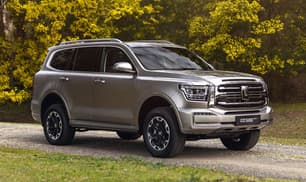
In terms of dimensions, the Tank 500 Hi4-T PHEV is 5078mm long (with a 2850mm wheelbase), 1934mm wide and 1905mm high. It has a listed kerb weight of 2820kg, so it’s not an insubstantial vehicle.
There are plenty of old-school 4WD design cues in the Tank 500’s appearance. It’s mostly chunky and straight up and down, with some softer curves here and there as concessions to contemporary styling.
It's clear to see where the GWM Tank 500 takes its cues from – most of the current crop of popular 4WD wagons, such as the Toyota LandCruiser 300 Series.
The Tank 500 is a large vehicle straddling that line between large and extra-large 4WD wagons. It is longer than any 300 Series, but it’s narrower and shorter.
It has a sunroof, roof rails, electric side steps (that extend when doors are opened and retract when doors are shut) and 18-inch alloy wheels.
The interior is well laid-out and functional with some understated class to it. There are soft-touch surfaces and genuine Nappa leather seating throughout.
At 4.3m long, 1.8m wide, and just under 1.7m high the Haval H2 is a big small SUV, and there's plenty of room inside.
Up front, storage runs to a bin (with sliding top) between the seats, two large cupholders in the centre console and a lidded oddments tray in front of the gearshift, as well as a sunglass holder, average-sized glove box and door bins with room for bottles. You'll notice the pennies saved with non-illumination of the sunvisor vanity mirrors.
Rear seat passengers pick up generous head, leg, and importantly, shoulder room. Three large adults across the back will be tight but do-able for short trips. Kids and young teenagers, no problem.
A centre fold-down armrest houses neatly integrated dual-cupholders, there are bins with space for bottles in each door and map pockets on the front seat backs. No adjustable air vents for backseaters, though.
Connectivity and power runs to two 12-volt outlets, a USB-A port and an 'aux-in' jack, all in the front.
Although a strong seller in the small SUV segment, the Mazda3's Achilles heel is its modest 264-litre boot, and while the H2 exceeds that number, it's not by much.
The Haval's 300-litre capacity is way less than the Honda HR-V (437 litres), Toyota C-HR (377 litres) and Hyundai Kona (361 litres). But it's enough to swallow the bulky CarsGuide pram or three-piece hard suitcase set (35, 68 and 105 litres), and (as with all contenders in the segment) a 60/40 split-fold rear seat increases flexibility and volume.
If you're into towing, the H2's limited to 750kg for an un-braked trailer and 1200kg braked, and the spare tyre is a full-size (18-inch) steel rim shod with narrower space-saving (155/85) rubber.
This Tank 500 has five seats because the two at the very rear have been removed to accommodate the hybrid battery.
The front seats are Nappa leather, power-adjustable (eight-way for the driver, six-way for the front passenger), as well as being ventilated with massage and memory functions.
The three-position second row – set up in a 60/40 split-folding configuration – breaks the usual 4WD wagon second-row seat tradition of being fine but not fantastic. The second-row set-up in this Tank is a first-class-cabin-style back seat with a flip-down control console (which includes air-con controls) instead of a basic centre armrest.
As mentioned there is no third row in this Tank 500 because of its underfloor battery.
Up front, the 14.6-inch multimedia screen (with wireless Apple CarPlay and Android Auto) dominates the dash. It's generally easy enough to use, although I had difficulty getting my iPhone hooked up to the system and the cabin set-up remains clunky and counter-intuitive in its operation.
The cabin has wireless charging, front and rear USB ports, as well as 12V and 220V power outlets.
The second row folds away to expand the rear storage capacity. Cargo volume is a listed 640 litres when all seats are in use and 1400 litres when the second row is stowed away.
The rear cargo area has tie-down points and a cargo slide cover.
At the time of publication, the Haval H2 City was carrying a drive-away price tag - $19,990 for the six-speed manual version and $20,990 for the six-speed auto (as tested here).
So, you're getting a lot of metal and interior space for your money, but what about the standard features taken for granted in the H2's main competitors?
Included in that drive-away price are the 18-inch alloys, keyless entry and start, reverse parking sensors, (manual) air-conditioning, cruise control, front and rear fog lights, LED daytime running lights, ambient interior lighting, heated front seats, rear privacy glass, and cloth trim.
But the headlights are halogen, the audio is four-speaker (with Bluetooth and single CD player), the safety tech (covered in the Safety section below) is relatively basic, and 'our' car's 'Pewter' (silver metallic) paint is a $495 option.
Equivalent entry-level competitors from Honda, Hyundai, Mazda, Mitsubishi and Toyota will set you back between five and $10k more than this H2. And if you're happy to live without features like a media touchscreen, digital radio, leather accented wheel and gearshift, rear air vents, reversing camera, etc, etc, etc, you're onto a winner.
The GWM Tank 500 PHEV is only available in high-spec Ultra trim and has a listed drive-away price of $78,990.
Standard features in the Ultra include a 14.6-inch multimedia touchscreen (with wireless Apple CarPlay and Android Auto), three-zone climate control, 18-inch alloy wheels, electric side steps, a 360-degree view monitor plus 'clear chassis view', auto parking assist, auto reversing assistance, lane departure warning and lane keep assist, all-terrain driving modes and an electronic rear diff lock.
Worth noting the Tank 500’s 37.11kWh battery supports Vehicle-to-Load (V2L) functionality, which means you can power your camping gear (lights, fridge etc). It offers up to 6.0kW of off-grid power, according to GWM.
'Marble White' paint is standard. Metallic paint, including 'Crystal Black' ($495), 'Dune Gold' ($595), and 'Onyx Silver' ($595) costs extra.
The Haval H2 City (as tested) is powered by a 1.5-litre direct-injection, turbo-petrol, four-cylinder engine driving the front wheels through a six-speed automatic transmission.
Peak power (110kW) arrives at 5600rpm, with maximum torque (210Nm) delivered at 2200rpm.
Every Tank 500 Hi4-T PHEV has a 2.0-litre turbo-petrol engine, a 37.11kWh lithium-ion battery and an electric motor. And that combination produces a total* of 300kW and 750Nm.
* Electric motor 120kW, petrol engine 180kW at 6000rpm. Motor 400Nm, engine 380Nm at 1700-4000rpm.
This system is mostly seamless in operation but as for GWM’s claims that it delivers “outstanding efficiency, performance, and refinement smooth, responsive take-offs, strong acceleration, and exceptional fuel savings - while ensuring minimal noise and maximum driving confidence”. Well, let’s just say this Tank 500 gets off the mark well for a large 4WD but the prompting requires a heavy right foot.
It is generally quiet and comfortable and yields a smooth driving experience. And as for fuel saving, flick your eyes down to ‘Efficiency’ to see how it did on this test.
This Tank 500 has a nine-speed automatic transmission, low- and high-range 4WD gearing, as well as a front, centre and rear diff lock.
Claimed fuel economy for the combined (ADR 81/02 - urban, extra-urban) cycle is 9.0L/100km, the 1.5-litre turbo four emitting 208g/km of CO2 in the process.
Not exactly outstanding, and over roughly 250km of city, suburban and freeway running we recorded 10.8L/100km (at the bowser).
Another rude surprise is the fact the H2 requires 95 RON premium unleaded fuel, of which you'll need 55 litres to fill the tank.
Official fuel consumption is 2.1L/100km on a combined cycle on regular unleaded fuel (91) with low-charge consumption at 8.4L/100km. For reference, low-charge fuel consumption on this test was 10.2L/100km as recorded. Okay, but not a particularly compelling result.
The Tank 500 has a 70-litre fuel tank so, going by those fuel figures, you could reasonably expect a driving range of about 686km out of a full tank.
Cold weather and internal-combustion engines are usually firm friends. Lower ambient temperature means denser air entering the cylinder (even under the extra pressure of a turbo), and as long as more fuel arrives at the same time, you'll have a bigger bang and more power.
But the H2 City's 1.5-litre four must have missed the memo, because cool morning start-ups result in a distinct reluctance to proceed at normal pace.
Sure, there's forward motion, but pinning the right-hand pedal to the floor won't shift the speedo needle much above a brisk walking pace. Unsettling.
Even after a few minutes, when things settle into a more predictable pattern, this Haval hovers at the sluggish end of the performance spectrum.
Not that any of the compact SUVs it competes with are rocketships, but you can generally expect a turbo-petrol engine to serve up a decent dose of low-down grunt.
However, with a maximum output of 210Nm delivered at a relatively high 2200rpm the 1.5-tonne H2 won't be threatening the land speed record anytime soon.
Suspension is strut front, multi-link rear, with the H2 City riding on (235/55x18) Kumho Solus KL21 rubber, and on typically pock-marked and bumpy urban roads ride quality could be better.
The steering displays some nervousness on centre, which combines with a lack of road feel and a mildly disconcerting top-heavy sensation in cornering. It's not that the car lurches or suffers from too much body roll; more that something isn't quite right in the front-end geometry.
On the upside, although firm, the front seats are comfortable, the exterior mirrors are nice and big, overall noise levels are moderate, and the brakes (vented disc front / solid disc rear) are reassuringly progressive.
On the downside, the media system (such as it is) is woeful. Plug your mobile device (mine's an iPhone 7) into the car's single USB port and you'll be met by a 'Loading-USB error' message, the heating and ventilation read-outs on the letterbox slot screen are a joke, and to top it all, select reverse and the audio cuts out altogether.
The Tank 500 Hi4-T PHEV is decent on road – and that’s good news for anyone thinking about buying this large 4WD.
It has more power and torque than its hybrid stablemate (300kW/750Nm vs 255kW/648Nm) for general day-to-day drivability while it retains all of the regular hybrid’s positive driving characteristics and few of the negatives.
This Tank 500’s turbocharged petrol engine and the electric motor work seamlessly together, with no discernible clunking or shifting between systems in the powertrain.
This is a big, heavy four-wheel drive – even heavier in this plug-in hybrid form than the regular hybrid because of this vehicle’s battery. But it is nicely settled and composed because of that weight.
This flip side is the extra heft on-board means there is some body-roll to this vehicle. It’s noticeable, but not a deal-breaker.
On highways, sealed surfaces or well-maintained bush tracks the Tank 500 is quite impressive. It’s settled, controlled and quite nice to drive.
Overall, this Tank 500’s suspension – double wishbone independent with coil springs at the front, and multi-link live axle with coil springs at the rear – is firm. There has been talk of it having been retuned for Australian conditions, but it remains stiff and jittery at pace, especially through backcountry bitumen in poor condition and lightly corrugated dirt roads. However, GWM informs me that the suspension set-up will undergo more retuning for Australian conditions and those changes will be incorporated into 2026 production vehicles.
Besides that, the engine, electric motor and transmission work quite well together. It is a reasonably smooth 4WD wagon to drive.
There are, however, glaring issues with the driver-assist tech, which is quite annoying in its operation. It’s either very jarring or intrusive in its application (example: adaptive cruise control braking way too early), or bloody annoying/dangerous (example: road-sign recognition abruptly tried to cut my speed from 100km/h to 40km/h because it registered the school zone sign off to the side of the highway. At the time it was outside school drop-off and pick-up times anyway.).
You can switch off the driver-assist features every time you start up, but the system resets and defaults to being annoying again when you switch off.
When it comes to 4WDing though, the good news returns.
This hybrid retains all of the regular Tank 500’s 4WD mechanicals, including the (BorgWarner-sourced) transfer case with high- and low-range 4WD, and it offers up plenty of torque across a decent spread of revs.
The off-road traction control system is suitably dialled in, hill descent control is effective, keeping you to a nice controlled low speed and there’s low-speed cruise control or the equivalent that keeps the vehicle to a controlled pace across varying terrain.
Not forgetting, the Tank 500 is triple locked – front, centre and rear diff locks – so there are few excuses to not be able to crawl over most off-road obstacles.
However, the tyres on this vehicle (Giti Xross HT71 SUV - 265/60R18) aren't up to scratch when it comes to off-roading beyond anything other than well-maintained tracks in the dry. The Tank 500 as is well suited, straight out of the dealership, for light to moderate off-roading. But if you swap in a decent set of aggressive all-terrain tyres the Tank 500 will be able to more comfortably take on more challenging terrain.
But it's capable of climbing. I took on a 30-35 degree incline of rock steps and the Tank 500 did it easily and comfortably on its standard highway tyres.
Most of the plug-in hybrid Tank’s off-roading characteristics check out. Approach, ramp over and departure angles are as per the regular hybrid Tank 500 (30, 22.5 and 24 degrees) and wading depth is a listed 800mm although the country was so dry at our proving ground that I never had the chance to test that claim.
Ground clearance on the Tank 500 Hi4-T PHEV is listed as 213mm (it’s 224mm in the normal hybrid) but that doesn't negatively impact this vehicle's off-roading capability if you drive it with control and consideration.
It is big, so it can be a little bit tricky to steer around, especially when the track becomes tighter and the obstacles become a bit more cheeky, but generally this can be driven very safely and with the utmost control through a lot of tricky four-wheel driving challenges.
It's not as polished in its off-road performance as something like the Toyota Prado or Ford Everest, but it does the job and there's a bit of a gruff edge to it, which some people might consider part of its charm.
As mentioned, the Tank 500’s 37.11kWh battery supports Vehicle-to-Load (V2L) functionality, which in theory means you’ll be able to power your camp-site (lights, fridge etc), but I’ll reserve final judgement on this set-up until I have the opportunity to test it over a long weekend with several appliances drawing power at the same time.
If you’re thinking about using this Tank PHEV as an adventure touring vehicle then it’s handy to know its payload is listed as 610kg, while it’s noted as 790kg in the Tank 500 HEV. Throw two adults, two teenagers, a dog, and camping gear in and you’ll hit that 610kg mark in no time.
The Tank 500 is rated to tow a 750kg unbraked trailer and 3000kg braked. Gross vehicle mass is 3430kg and gross combined mass is 6430kg.
In terms of active safety the H2 City ticks the 'cost-of-entry' boxes, including ABS, BA, EBD, ESP, rear parking senors, tyre-pressure monitoring and emergency brake hazard lighting.
But forget about more recent systems like AEB, lane keeping assistance, blind spot monitoring, cross traffic alerts or adaptive cruise. And you don't get a reversing camera.
If a crash is unavoidable the airbag count runs to six (dual front, dual front side, and dual curtain). And there are three child restraint/baby capsule top tether points across the back seat, with ISOFIX anchors on the outer two positions.
The Haval H2 scored a maximum five-star ANCAP rating in late 2017, a rank it would not replicate when assessed against 2019's more challenging criteria.
The Tank 500 has the maximum five-star ANCAP rating from testing in 2024. As standard, it has seven airbags and a comprehensive suite of driver-assist tech including AEB, lane departure warning, adaptive cruise control, tyre pressure monitoring, front and rear parking sensors and a 360-degree around-view camera.
Haval covers all new cars it sells in Australia with a seven year/unlimited km warranty with 24-hour roadside assistance provided for five years/100,000km.
That's a strong statement from the brand, and well ahead of the major players in the mainstream market.
Service is recommended every 12 months/10,000km, and no capped-price servicing program is currently in place.
The Tank 500 is covered by a seven-year/unlimited km warranty, seven years' roadside assistance and seven years' capped price servicing.
The Tank 500’s 37.1kWh traction battery has an eight year/unlimited km warranty.
The first service is scheduled at 12 months/10,000km; the rest of the servicing appointments are set for every 12 months/15,000km. Lowest price per services is $335, highest is $975.
GWM has 122 dealerships nationwide at time of writing.