What's the difference?
Sometimes it really is all a matter of timing.
GWM was always going to offer up the plug-in hybrid version of its Tank 300 4X4, but for it to arrive in showrooms right now must be being looked on as some kind of blessing at GWM HQ.
Consider the circumstances: The Tank 300 Hi4-T PHEV (to give it its full name) not only saves fuel by making use of plug-in hybrid tech, but the fossil stuff it does use is petrol, not diesel with that fuel’s buck-a-litre cost penalty right now.
And with the planet on a knife’s edge waiting for the next increase in brinkmanship from those referred to as our world leaders, overseas travel has never seemed sketchier to the average Aussie. Which is when keeping it local and hitting the outback in a four-wheel drive suddenly looks really, really good. Except for the cost of fuel, that is, which is where we circle back to square one.
All of which means the GWM Tank 300 Plug-in hybrid concept could not really have come at a better time. But does the reality match the promise?
Need a dual-cab ute? You’re in luck. Not only does Australia have access to a huge variety of makes and models in the dual-cab space, there is also a huge range of prices and equipment levels.
The sweet spot for Aussie buyers, though, seems to be the dual-cab layout with four-wheel drive and enough convenience and safety gear to make the vehicle a viable family car as well as a work truck when necessary. Which is precisely where the Chinese brands including GWM, BYD and LDV have targeted their current ranges.
There’s been a lot of chat about such vehicles lately, but rather than let the formula stagnate, LDV has ushered in the Terron 9, a dual-cab that, size-wise, falls roughly between the familiar makes and models and the full-sized American-made stuff. This is a crucial point, too, as the Terron 9’s extra size might be a hint on where the dual-cab market is going generally. Certainly, every other class of car and ute is creeping up in size, why not dual-cabs too?
Like the other Chinese brands, of course, the Terron 9’s appeal will largely be based on value for money, so it’s worth picking the car apart to find out how it stands in that regard. But this is 2025, so the Terron 9 is also going to have to produce the goods in terms of driving ability and safety, that modern dual-cab buyers are looking for.
There’s a lot to like here. The GWM Tank 300 in any of its forms is a competent vehicle from the helm and backs up its off-road claims with real ability. The ride quality, in particular, is a highlight, and it’s a good size for couples or young families. Its value for money is also quite brilliant.
Add this plug-in hybrid driveline to the mix and the performance is quite astounding, while the petrol engine and EV potential have arrived at a critical point in history where such things carry more weight than ever before. It remains to be seen what happens globally and what effect that has on fuel prices, specifically the price gap between petrol and diesel. There’s also the question of what happens electronically when you dunk the Tank into Nolan’s Brook on the track to Cape York. But for now, this is a car whose time appears to have come.
But while the overall concept deserves praise, there’s still some work required in terms of the way the car drives and in its attempts at keeping its occupants safe. The calibration of both the throttle response and some of the driver aids is, frankly, in need of some final polish. And though it sounds odd, the Tank 300 would be a better thing to live with if GWM ditched the contentious driver aids and took the points hit on its ANCAP rating. Even better would be to stick with the tech but refine it to the point where it works in the background and not as an irritant.
There’s no doubt that the current crop of Chinese utes are better than previous versions. Similarly, there’s little doubt that private buyers are having a big say in which way the market is headed, particularly when it comes to alternatives to the Thai-built legacy players. And that’s precisely where the Terron 9 plays its best game. The value for money is hard to argue with, and the sheer size of the thing gives it an extra dimension if that’s what you think you need in a dual-cab. While we have no quarrel with the driveline of the Terron 9, it will be nice when somebody finally adds an on-bitumen four-wheel-drive mode to one of these in this price range. Until then, the Terron 9 can’t be criticised for this omission. In the meantime, the Terron 9 exhibits quite a bit of refinement in the way both the engine and transmission work together. Our biggest complaint is the way the driver-assistance systems have been calibrated. The driver-distraction warning is almost comical (for the first five minutes, anyway) in its zeal, and the lane-keeping assistance program is bordering on scary in the wrong circumstances. Again, LDV is not alone in this regard, but as a clean-sheet design, sketched up in a driver-assisted world, perhaps we were expecting a little more from this ute.
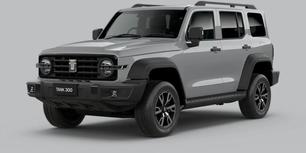
Derivative is a strong word, but from most angles there’s a little bit of something else in the Tank 300’s exterior. We can easily see a bit of Suzuki Jimny in profile, and a dash of new Ford Bronco in the lights and grille. And if you squint there’s a blob of Jeep Wrangler in the wheel-arch extensions.
Which should mean it’s just a mash-up. Yet somehow, it isn’t, and the Tank has its own vibe.
Inside, that vibe suddenly becomes a bit overdone, and the plastic garnish above the glove box, in particular, looks like it will date pretty quickly (if it hasn't already). There's also a lot going on in here; this is a busy place and even the gear selector looks like a prop form the Star Wars franchise.
While the Terron 9 remains a ladder-chassis design with the body plonked on top (just like traditional four-wheel drives and most other dual-cabs) there is one important departure in design terms. And it’s one that rules out a whole sub-class of this type of vehicle.
Because the body sides are one piece in the Terron, with no gap between the rear bulkhead and the tray, there’s no way to turn the thing into a cab-chassis with a drop-side tray or service body. Yes, you can add a canopy to the existing design (LDV is working on its accessory line-up for the Terron right now) but there’s no cab-chassis variant now or in the works.
That might seem a bit odd, but when you consider the vast majority of dual-cabs are, in fact, styleside utes, maybe the sales hit won’t be a huge one. That’s especially so when you consider many of the Chinese utes rely on private buyers, not fleet customers, for their sales volumes. And in any case, says LDV, the way the body is constructed allows for a little more rear seat legroom and a touch more cargo space length for the same overall length. Which the company believes is a trade-off worth sticking with.
There’s also been a clear brief for the Terron 9 to make a visual statement. While it’s dimensions put it somewhere between the mainstream dual-cabs and the full-sized American pick-ups we see, the styling definitely leans towards the latter. The grille is huge, the vertical tail-lights very Stateside and the whole thing looks imposing. I’ll personally draw the line at attractive, but it’s definitely imposing.
The most adventurous piece of interior design must be the electronic door handles which need just a simple press to open the doors. There’s a manual, cable-operated door opener hidden in each door pocket if things go wrong electrically at some stage.
While GWM is by no means the worst offender, we still reckon the Tank’s interior would be better without such a degree of reliance of touchscreens and menu-driven functionality. While it’s obvious that there’s a lot going on in the cabin, it still seems odd that important functions such as shifting from conventional hybrid mode to EV mode would require a dive through the on-screen menus when a simple switch would be faster, easier and simpler.
And even when GWM has provided switches, the end result is muddy. Take the volume controls for an example. There’s no central volume knob accessible by both front seat occupants, so you rely on the steering wheel mounted up and down buttons to change the volume. Except they’re not marked as volume controls in any specific way. Okay, if you know, you know. But if you don’t know, you’ve just missed the news headlines.
Overall, it's disappointing. And I resent the fact that GWM (or anybody else) thinks it’s okay for me to have to learn to operate a car all over again. The dashboard is also full of tiny symbols and lettering making things difficult to decipher if you normally wear glasses to read, but not to drive.
We’ll take issue with the indicator stalk, too, which has an indistinct feel when trying to discern whether you turned the indicators on for an intersection, or just tipped them on for three flashes for a lane change. And if you have accidentally gone too far and they’re still flashing away merrily after the lane change, turning them off manually is a lottery that might see you succeed, or mistakenly turn on the other side flashers.
The rest is better with proper buttons for the various off-road drive modes, diff locks and hill holder. There’s even an analogue clock for some real nostalgia. You’ll also find a single USB-A and USB-C charge port in the dash, and a pair of cupholders buried deep in the centre console which also has a lid and sliding drawer.
It’s obvious that this is a smaller vehicle than some, and the four-door layout dictates shorter doors. But that doesn’t alter the fact that the driver’s seat slides back a few centimetres every time you shut the car down. The trouble with that if you’re tall, is that the seat is now tucked back in behind the B-pillar, meaning you have to climb out and around it to exit the car. Perhaps you can switch off this slide-back function, but I didn’t have the spare hour to troll through the menus to do so. Oh, and there should be a driver’s grab handle on the A-pillar, too. There isn’t.
The rear seat is better with an adjustable backrest that provides proper comfort, and leg and knee room that hides the 300’s smaller dimensions well. There’s lots of glass and light and a pair of USB charge points. You also get a pair of rear reading lights and central vents, but no climate controls.
Even the cargo area is a decent size with the five seats in place (360 litres, up to 1520L with 60/40 rear seats lowered) but the under-floor storage space has been consumed by the hybrid battery, meaning the jack and tools and charging cable live in the cargo area and the spare tyre is bolted to the tailgate.
The single-piece tailgate is hinged at the side, and needs a fair bit of real estate to be swung open fully.
The Tank features vehicle-to-load capability, too, which means you can operate your power tools using the vehicle as the power source, and there’s a 220-volt socket in the luggage area to do just that. But when camping, too, this feature can also power induction cookers, microwaves, and all the other stuff you probably should have left at home. And if the hybrid battery runs out of charge, the Tank can run its petrol engine to act as a generator (your camping neighbours are going to love that).
The real gadget freaks out there can also download the Tank app which allows you to operate functions such as power windows, climate control, seat heaters, central locking and check your charging status all from the comfort of your smartphone. You can also use this functionality to flash the hazard lights to help spot your Tank from everybody else’s in the carpark.
A longer, wider cargo bed is probably one of the Terron 9’s best party tricks. Compared with the T60, the Terron is larger in every direction and extends that lead into the tub’s dimensions where it emerges with 1230mm between the wheel arches and a cargo bed length of 1600mm (90mm more than the T60 Pro).
That’s partly all possible by the extra wheelbase which, at 3300mm, is about as big as it gets in this class of ute, although the turning circle has grown to 13.1m compared with the T60’s tighter 12.7m.
A spray-in tub liner is standard as is the spring-assisted tailgate. Pony up for the ritzier, Evolve version, and you add cargo rails atop the tub sides and cargo-bed lighting.
Inside the tray, there are four decent tie-down hooks nice and low in the tub and plastic side toppers to prevent damage to the tub’s top rail. The tailgate is a clever design that is supported by springs and struts so that it drops in a controlled way and is very light to lift back up. The latch on the top corner of the tray is odd, but the tailgate can be opened via the key fob, too.
The biggest omission in the tray is the lack of any power socket.
Inside, the cabin is wide and features a pair of cup-holders down low in the centre console, as well as a USB-A, USB-C and a 12-volt socket placed somewhat awkwardly in the centre bin. The front arm-rest looks like it should incorporate a wireless phone charger, which it doesn’t. Yet. Watch this space, is the whisper. A reach and height adjustable steering column is also a nice addition at this price-point. And, thankfully, LDV has worked out that most people don’t want to go fishing through a menu to adjust the climate control. So the Terron 9 has actual buttons on the dashboard. Hallelujah.
Side steps are standard and help you in and out of the cabin, and there are grab-handles in the right places, too. Rear seat space is generous and even the cloth trim of the entry-level version is not the cheap-and-nasty sort, even if it’s far from sporty looking.
The indicator wand is on the `wrong’ side for Australia, partly because the gear selector is a wand on the other side of the steering column. Some users will spend the first few days hitting the gear selector in error. The starter is a push button, but placed in the conventional position of a standard ignition key. Nice touch.
The Tank 300 PHEV is available in two trim levels, starting with the Lux at $55,990 drive-away. That gets you 18-inch alloy wheels, roof rails and side steps and, perhaps a little surprisingly, a sunroof.
There’s also power folding mirrors, keyless entry and start, paddle shifters, adaptive cruise-control and a rear differential lock.
Inside, there are leather accents for the seats, a pair of 12.3-inch multimedia, ambient lighting, digital radio, wireless connectivity, wireless phone charging, wireless Apple CarPlay and Android Auto, automatic headlights, full LED lighting, and dual-zone climate control. That’s quite a bit of gear for the money.
But throw another four grand on the sales rep's desk, and you into the Ultra grade which adds heated, cooled and massaging front seats, eight-way power adjustment for the driver’s chair, Nappa leather inserts, underbody protection, a front differential lock and no less than 64 colour choices for the expanded ambient lighting package.
Fundamentally, then, your extra $4000 is buying the clever front seats and front diff lock, but that’s easily worth the money anyhow. That said, the entry-level variant is one of the better equipped at that price-point, so either way, you won’t be slumming it.
The Terron 9 will be available initially in entry-level Origin specification and, following that in the next few weeks, a plusher Evolve variant with a mixed bag of additions, some of which extend its off-road appeal, and some of which don’t.
Kicking off with the $50,990 Origin (drive-away for ABN holders) or $53,674 drive-away for private buyers, the range then ramps up to the Evolve model at $55,990 for ABN holders and $58,937 drive-away for private buyers. But if you are an ABN holder and you get in quick, there’s $1000 discount on both grades as a launch deal.
The base vehicle is equipped with 18-inch alloy wheels with a highway-oriented tyre as opposed to the more off-roady All Terrains some competitors use. A tow-bar is standard kit as are LED headlights, a tailgate helper spring, wireless Apple CarPlay and Android Auto phone connectivity, roof rails, twin 12.3-inch digital screens, automatic headlights, six-way powered font seats, rain-sensing wipers, front and rear parking sensors and a 360-degree camera system.
Clues that this is the entry-level car come in the form of the cloth upholstery and the four-speaker sound system, although the standard paddle shifters suggest otherwise.
Move up to the Evolve (when it arrives) and you’ll be adding 20-inch alloy wheels and tyres fitted with similar on-road oriented rubber to match. Sure, the 20s are blingy, but they won’t do anything for off-road ability. More relevant perhaps, is the addition of a front differential lock to join the rear locker standard on the base version.
On the luxe front, the Evolve adds eight-way adjustment for the powered front seats, heating and ventilation for those chairs as well as a massage function, heating for the rear seat, an eight-speaker stereo, ambient lighting, auto-folding exterior mirrors, and a trailer back-up assistance program.
Given the price-tag, the LDV puts up a strong value-for-money argument. Very few dual-cab utes at this price-point offer disc brakes on all four wheels, nor a standard tow-bar. And some of the ones that do supply only the hitch receiver, while LDV supplies the receiver, hitch and wiring loom.
The Tank’s plug-in driveline, starts with a petrol engine measuring 2.0-litres and contributing 180kW to the overall picture. But then there’s a single electric motor, sandwiched between the petrol engine and the nine-speed transmission. That means the Tank is still a mechanical four-wheel-drive platform, and when both powerplants are singing together, there’s an eye-opening 300kW and 750Nm of torque on tap.
The four-wheel-drive system operates as a rear-wheel drive on dry bitumen, and there’s the usual 4WD high range and 4WD low range. What there isn’t, is a 4WD-auto setting that allows you to use four-wheel drive in the dry on a paved road. That sounds minor, but for towing in particular, having all four wheels doing the driving is a major safety bonus.
All Tank 300s get a rear differential lock, but this version, the Ultra, also gets a locking front diff as well. Typically, the Tank also features a range of driving modes (no less than nine of them!) for the four-wheel-drive function, tailoring throttle, transmission and differential response according to the type of terrain being covered.
The Tank 300 is built the old fashioned way with a ladder-chassis upon which the body is bolted, and it still uses a live rear axle, too. But the front suspension is independent and the GWM uses coil springs rather than old-school leaf springs for much better ride quality.
While peak outputs of both the Terron 9 and its smaller stablemate T60 seem similar on paper, in actual mechanical terms, there are a few important differences.
While the T60 uses a 2.0-litre four-cylinder diesel with a pair of turbochargers, the Terron 9 is, on paper, a bit more simplified, but a lot newer in design terms. It’s a 2.5-litre unit, but reverts to a single turbocharger for a power peak of 163kW (three up on the T60, at slightly lower revs) and max torque of 520Nm (20 more). Fuel economy should be about line-ball with the T60 (more of that later).
Like the T60, the Terron 9 features an independent, coil-spring front end, but loses the T60 Plus’ coil-sprung rear axle for a leaf-sprung live axle.
The Terron 9 sticks with an eight-speed automatic transmission (although a different unit to the T60’s eight-speed unit) and also gets four-wheel drive with a low-ratio transfer case for proper off-roading. What’s missing (but nobody else at this price-point has it either) is Auto 4WD mode which allows the vehicle to be driven in four-wheel drive on bitumen surfaces. In the case of towing on a wet road, this is a huge boost to overall safety.
While the extra torque over the T60’s smaller engine seems welcome, it pays to remember that the larger Terron 9 is about 300kg heavier than its little brother. That said, the payload is a little higher at 1100kg for the Origin and 1005kg for the Evolve but with the vehicle’s full 3500kg on the tow-hitch, that payload falls to 600kg and 505kg respectively, thanks to the Terron’s 6500kg Gross Combination Mass. It’s far from alone in this regard.
The headline number here is GWM’s official fuel consumption number of just 1.9 litres per 100km. Or it would be if it had anything to do with the real world. As it is, nobody is going to achieve that, and our mix of urban running netted an average of about 11.0 litres per 100km, with that dropping to 8.5 litres per 100km in country conditions.
The truth is, your consumption in this vehicle can go from zero to, say, 12 litres per 100km depending on how and where you drive and how much battery charge you have available.
Speaking of charging, the Tank 300 can use a commercial fast charger to absorb voltage at a rate of 50kW. At that rate, it can go from 30 to 80 per cent charged in about 24 minutes. A wall box (GWM offers one as a factory option) can take the 37.1kWh battery from 15 per cent to fully charged in 6.5 hours. And, of course, you can also charge the Tank from a domestic wall socket in a claimed 14.4 hours. We managed to add about 6km worth of charge per hour on such an outlet during our time with the car.
As far as range goes, GWM reckons there’s 115km (NEDC) of EV-only range, while starting a journey with a fully charged battery and a full 70-litre fuel tank should see you covering somewhere between 900 and 950km between top ups.
LDV’s official fuel consumption figure for the Terron 9 is 7.9 litres per 100km. That’s a number that you might – just might – see on a gentle highway run, but the 9.0 litres per 100km we recorded on our own test drive is probably closer to the day-to-day mark. That’s still pretty good, though and speaks of the tall gearing in the eight-speed automatic transmission.
Against the 80-litre standard fuel tank, that gives a useable range of close enough to 850km on the open road before you need to start watching the fuel gauge.
It’s also worth mentioning that the Terron 9 is Euro 5 complaint rather than meeting the tougher Euro 6 emissions targets. As such, it does not require the addition of AdBlue, representing another running cost saving.
GWM claims a 0-100km/h acceleration time of just 6.3 seconds for the Tank 300 PHEV, and that’s impressive. There are two caveats here. The first is that you need at least 40 per cent battery charge on board to extract maximum thrust. And, secondly, even in those circumstances, the Tank never feels that brisk. It’s more effortless than genuinely rapid, although the torque up hills is genuinely impressive.
There’s no getting around the refinement inherent in using volts for some of the time. And when the petrol engine does chime in, it’s all but imperceptible. You’ll eventually hear the engine if you wring it right out, but even then, vibrations are minimal.
All in all, the Tank’s relatively compact dimensions work in its favour in an urban setting, and the range of camera views (including an off-road one showing you the obstacles you’re about to encounter) make parking a lot easier than it might have been. Only a high degree of distortion in the birds-eye-view camera mode takes a bit of getting used to.
On the move the ride quality is quite exceptional, and those coil springs really do make a difference. Even the usual council speed bumps don’t bother the Tank and the short wheelbase pitching we’ve seen in some similar vehicles just never emerges. Well chosen damper rates help, too, and there has been some Australian input into the way the Tank handles. It shows.
Steering, too, feels light and natural, although the almost constant fidgeting at the helm by the lane-keeping assistance program is annoying. And switching it off is not only a multi-button job, it needs to be done every time you start the vehicle.
Far and away the biggest hurdle in living with the Tank, however, is a throttle calibration that is way off the mark. Pressing the accelerator pedal initially doesn’t seem to do much at all, and then suddenly, the power comes in and you discover you’ve input too much throttle as the Tank surges away down the road, threatening to actually spin its tyres if there’s any gravel about. But not until that initial hesitation has caused the driver behind you to wonder aloud (I can lip-read) if you’re ever going to move at all. This needs to be fixed as a running change.
The all-important off-road driving experience is pretty sharp and the Tank 300 is a genuine competitor in this discipline. It’s extremely stable and capable on unsealed roads and tracks and the front and rear diff locks make it a proper adventurer’s rig.
It’s relatively demure dimensions also mean that it fits down the tracks and trails that have been created by decades of vehicles of a similar size, unlike some of the bigger new off-roaders we’re seeing that simply don’t fit in to the terrain so neatly.
Ultimately, the Tank’s stock tyres will be the limiting factor, but there are plenty of alternatives out there for a bit more off-road bite.
The first impression is that this is a very big vehicle. The passenger’s seat seems miles away and the bonnet is high, wide and mighty. That might not play too well off road where such a huge bonnet can hide the obstacles you’re about to fall off or drive over, but at least the forward facing camera system gives you a fighting chance. The other problem off-road is likely to be the sheer girth of the LDV where it might struggle a little for elbow room on tracks formed by smaller vehicles.
On the bitumen, the Terron 9 feels pretty relaxed with a gear for every occasion and an unstressed engine that is clearly tuned for mid-range oomph rather than top-end power. It’s smooth and relatively refined and, left to its own devices, the eight-speed automatic shifts up seamlessly.
The only complaint would be a degree of driveline shunt in the example we drove that could be both heard and felt, most notably in the transition from off-throttle to on-throttle, but also during the odd upshift. In 2025, this seems very odd indeed. We checked with LDV and they reckon this is a one-off glitch and possibly down to the car’s early build. Certainly, the second Terron 9 we sampled didn’t exhibit the same problem.
Ride quality is generally good and while the leaf-sprung rear axle can feel a little lively at times, it’s not a bad match for the front end, meaning that the car feels of a piece rather than two halves of a car fighting each other. While there is plenty of suspension movement, it also feels quite well controlled despite the obvious amount of unsprung mass. Cabin noise is commendably low, too. Thanks to tall gearing and that noise suppression, the Terron is a relaxed highway performer.
The steering is better than average for this type of vehicle with a good relationship between feel, weight and reaction speed. This is one ute than can be hustled along if it needs to be, and one on which the paddle-shifters are a meaningful inclusion (although they’re also a huge bonus when off-roading).
By far our biggest complaint is one that is far from exclusive to LDV. And that’s the (what we consider to be) poor calibration of some of the driver aids. The lane-keeping assistance is the main offender and, on a narrow road with a well-defined edge, the Terron 9 will intervene to prevent a wheel dropping onto the gravel. Unfortunately, at higher speeds, it does so with what feels like a stabbing action; violent enough to scare you the first time it happens. Could it frighten a timid or inexperienced driver into a crash? It’s a possibility we can’t ignore.
The driver-distraction warning is also, ironically, its own distraction. Take your eyes off the road for long enough to read the otherwise excellent dashboard display, and you’ll have the warning stepping in with a beeping admonishment as well as a visual warning that overrides the information you were trying to read in the first place. Again, LDV is hardly alone in this, but there’s definitely some recalibration required before the systems are as good as some of the (more expensive) competition’s equivalents.
The Tank has a strong safety story to tell, especially on paper.
Regardless of what specification you buy, you’ll get seven airbags including full-length side-curtain bags and a centre airbag to reduce head injuries in a side-impact crash.
There are rear parking sensors, a range of camera angles including an overhead view, tyre-pressure monitoring, Isofix child-restraint mounts, and the usual driver aids including autonomous emergency braking, rear cross-traffic alert and braking, blind-spot monitoring, traffic-sign recognition and rear collision warning.
But away from the brochure, features such as the lane-keeping assistance and the driver-fatigue monitor need work on their calibration. GWM is by no means on its own here, but it’s a fact that some other makers do a better job of making this tech transparent and vastly less intrusive.
The original Tank 300 launched in Australia in 2022 scored five safety stars in ANCAP testing, and that rating has been carried over to this car.
Both versions of the Terron 9 will feature the same safety package, starting with the latest driver aids such as autonomous emergency braking (AEB), forward-collision warning, lane-keeping assistance, adaptive cruise control, traffic-sign recognition, blind-spot monitoring, rear cross-traffic alert, and a door-exit warning to help prevent `dooring’ cyclists. But as we mentioned earlier, the inclusion of these assistance systems is not enough; they also need to be calibrated properly.
Meantime, the forward-collision warning and autonomous braking functions work in a speed range of 8km/h to 140km/h.
It’s also good to see standard tyre pressure monitoring which really should be included on every vehicle aimed as heavily towards towing duties as this one.
The Terron 9 in all its forms also sports seven airbags including a centre-front air bag to minimise head clashes in a side impact.
The Terron 9 has not been assessed by ANCAP for a crash-safety rating, but it’s expected that ANCAP will, indeed, study overseas data on the vehicle and make a judgment in due course.
GWM offers a seven year/unlimited kilometre warranty on the Tank 300, as well as eight years of cover for the hybrid battery (also with no kilometre limit). There’s also seven years of roadside assistance thrown in, too.
Capped-price servicing is available for the first seven years, with the first service due at 12 months or 10,000km and subsequent services every 12 months of 15,000km after that. Prices for each service (in order) are: $320, $460, $460, $685, $685, $1075, and $370.
GWM has a network of 123 new-car dealerships able to handle servicing, and the company tells us that regional centres have not been forgotten.
The Terron 9 is covered by LDV’s rather excellent seven-year/200,000km warranty. Service intervals are every 12 months or 15,000km with the exception of the very first service which is due at 10,000km to account for the running-in oil the engine is filled with from the factory. This sounds like an extra impost, but mechanical sympathists will love this attention to detail.
LDV is looking into capped-price servicing but there’s no announcement to be made yet, nor any hint of what the price structure of that might look like if it happens.