What's the difference?
GAC might still be a new name to a lot of Aussie new car buyers, but the Emzoom Luxury isn’t here to quietly blend in. It’s sharply styled, keenly priced and carries just enough attitude to turn a few heads - which is a good start in a crowded small SUV segment.
It also keeps things simple. There’s just the one trim level on offer locally, and it comes in swinging against some well-established rivals like the GWM Haval Jolion Premium, Kia Seltos Sport+ and MG ZS Vibe Turbo.
But standing out on paper is one thing, backing it up with enough personality to stay interesting over time is another.
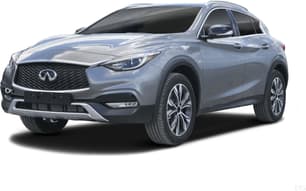
Tim Robson road tests and reviews the 2016 Infiniti QX30 at its Australian launch with specs, fuel consumption and verdict.
There’s no doubt that the compact crossover segment is a vitally important place for any carmaker to be. Nissan’s luxury arm, Infiniti, is no different, and thanks to a decision from its Japanese masters, the diminutive premium brand will go from having no players on the field to having two marquee players in a matter of just a few months.
The architecturally identical front-wheel-drive Q30 launched only a month ago in three variants, and now it’s the turn of the all-wheel-drive QX30 to take to the pitch.
But is there enough of a difference between the two to actually consider them different cars? Is it adding a layer of complexity for the prospective Infiniti customer? As it turns out, the differences run more than skin deep.
GAC isn’t messing around with the Emzoom Luxury. It’s undeniably eye-catching, priced well and carries just enough of a premium aesthetic to draw attention.
Is it the best small SUV I’ve driven? No. It does enough to avoid being overlooked, but it’s not quite reinventing the wheel.
What it does well is deliver a comfortable, easy urban runaround with strong equipment for the price. However, the safety calibration and overall breadth of systems feel like areas that still need attention.
All up, it gets a lot right for the money, but doesn’t quite land a knockout punch.
Even though it’s almost identical to the Q30, the QX30 manages to feel sufficiently different in suspension tune and cabin ambiance to be considered different.
It’s a disappointing oversight, though, by Infiniti to deny the base GT such basic safety fundamentals as a rear view camera (which Infiniti assures us is being worked on).
Up front, the Emzoom offers the most space and it’s where it feels most comfortable. The seats are supportive enough for longer trips, and while only the driver’s side is electrically adjustable, that’s not unusual at this price point. Wide door apertures make getting in and out easy and there’s enough elbow room so it doesn’t feel cramped.
In the rear, space is also surprisingly generous for the segment. The flat floor helps with legroom and headroom remains good despite the panoramic sunroof.
Storage is well thought through and generous. Up front, there’s a glove box, a deep centre console and a dual-phone tray that incorporates a ventilated wireless charging pad. There are two cupholders and a drink holder in each door storage bin. You also get an additional shelf underneath with both USB-A and USB-C ports, which helps keep cables and clutter out of the way.
In the rear, amenities are solid, with rear air vents, a fold-down armrest with two cupholders, map pockets and even small device pockets for added practicality. There's a drink bottle holder in each door and a single USB-A port behind the centre console.
Around the back, the boot offers a wide opening and a level load space, making it easy to use day-to-day. Capacity sits at 341 litres, which is enough for a weekly grocery run or a weekend away. There’s a spare tyre tucked under the floor and a powered tailgate is standard.
The tech is easy to live with, too. The media system is intuitive with clear graphics and a responsive touchscreen. Wireless Apple CarPlay connects quickly without fuss, and there’s also wireless Android Auto. Sound quality from the six-speaker system is crisp and the digital radio and Bluetooth hold a steady connection (where some rivals can struggle).
The QX30 is obviously very similar to the Q30 in many respects, but the interior is slightly different, with larger, less cosseting seats up front and slightly higher seats in the rear.
The cabin is also lighter in overall appearance, thanks to a paler colour palette.
There are plenty of neat inclusions, including a pair of USB ports, plenty of door storage, a space for six bottles and a sizable glove box.
A pair of cupholders resides up front, along with a pair in the fold-down armrest in the rear.
There is no particularly logical location for the storage of smartphones, though, and the lack of Apple CarPlay or Android Auto is down to Infiniti opting for its own phone connectivity suite.
A decent 430 litres of luggage space behind the rear seats is contrasted by a cramped rear area for all but the smallest of passengers, while sharply shaped rear door apertures making getting in and out a bit of an ask.
There are two ISOFIX baby seat points and a 12-volt socket in the rear, as well.
For now, the GAC Emzoom range is about as simple as it gets. There’s a single, well-specified Luxury grade on offer, priced from $25,590, before on-road costs.
That puts it right in the mix with key Chinese rivals like the GWM Haval Jolion Lux, which starts at $28,990 (MSRP) and the MG ZS Vibe Turbo at $24,990 (MSRP). It also significantly undercuts more established mainstream options such as the Kia Seltos Sport+, which opens at $37,550, before on-roads.
The Luxury arrives well equipped. You get an electric driver’s seat with ventilation, synthetic leather upholstery, a panoramic sunroof with tilt and slide function, and auto-flush door handles. There’s also a leather-wrapped steering wheel, a 360-degree camera system, parking assist and a blind-spot view monitor.
Technology leans towards the premium end, too. A 14.6-inch central display is paired with a 7.0-inch digital instrument cluster, along with ambient lighting, wireless Apple CarPlay and Android Auto and a wireless phone charger. There are two USB-A ports, a single USB-C port up front, a 12-volt socket and a six-speaker DTS sound system.
It’s the smaller details that round things out nicely. Auto LED headlights, rain-sensing wipers, dual-zone climate control, a temporary spare tyre and a powered tailgate are all included as standard.
All up, it’s a strong package for the price.
The QX30 will be offered in two variants; the base model GT at $48,900 plus on-road costs, while the Premium will cost $56,900.
Both come equipped with the same engine; a 2.0-litre four-cylinder turbocharged petrol engine that’s sourced from Mercedes-Benz and also used on the Q30 and Merc GLA.
Eighteen-inch rims are standard on both cars, while an electronic handbrake, 10-speaker Bose audio, 7.0-inch multimedia screen and a full set of LED lamps all round are fitted across both variants as well.
Unfortunately, the QX30 GT misses out on a reversing camera all together, a fate it shares with the Q30 GT.
Infiniti Cars Australia told us that this was an oversight at the time the cars were being specced for Australia, particularly in light of the other technologies that the car would receive, like automatic emergency braking.
The company says it’s working hard to bring a reversing camera to the GT.
The top-spec Premium gets leather trim, a powered driver’s seat, and additional safety equipment like a 360-degree camera and radar cruise with brake assist.
The only optional extra on each car is metallic paint.
The Emzoom Luxury is front-wheel drive and powered by a 1.5-litre turbo-petrol engine producing 125kW and 270Nm.
That gives it a slight edge over the GWM Haval Jolion, which sits at 105kW and 210Nm and puts it more in line with the MG ZS Vibe Turbo and Kia Seltos Sport+. On paper at least, it’s competitive for the segment and suggests there’s enough performance on tap for daily driving.
It’s paired with a seven-speed dual-clutch auto transmission. Around town, it can feel a little clunky at lower speeds, particularly in stop-start traffic, but it settles down as you pick up pace and feels much smoother on the open road.
Just the one engine is used across both cars; the 155kW/350Nm single-turbo 2.0-litre four-cylinder petrol engine from the Q30 and A-Class.
It’s backed by a seven-speed transmission and wired into an all-wheel-drive system that is biased towards a front-drive configuration.
Sourced from Mercedes-Benz, up to 50 per cent of drive can be sent to the rear wheels, according to Infiniti.
The Emzoom Luxury has a 47-litre fuel tank and a claimed combined cycle (urban/extra-urban) consumption figure of 6.6L/100km, which gives it a theoretical driving range of up to 712km. That’s more than enough to comfortably get through a week of mixed driving.
In the real world, my trip computer returned 6.2L/100km after a mix of mostly urban driving and a longer highway run. That’s a strong result and reinforces its credentials as an easy urban runabout.
Infiniti claims a combined fuel economy figure of 8.9L/100km for the 1576kg QX30 across both the variants; this is 0.5L thirstier than the Q30 version.
Our brief test yielded a dash figure of 11.2L/100km over 150km.
On the road, the Emzoom has enough power to feel spritely and capable, whether you’re darting around town or merging onto the highway. That said, the way it delivers that power at lower speeds can feel a little inconsistent. There were moments where lifting off the accelerator didn’t translate to an immediate response, with the car continuing to surge forward briefly. Which made for a few 'eek…' moments during the week.
Handling is on the sharper side for the segment. The steering and suspension are well judged, giving it a slightly zippy, eager feel through corners without tipping into harshness. Braking, however, can feel a touch spongy underfoot, which takes away from that otherwise confident set-up.
Visibility is a mixed bag. Thick pillars, a relatively low window line and a small rear view can make it feel hemmed in from the driver’s seat. Though, the blind-spot camera feed popping up on the display takes some of the guesswork out of lane changes.
Ride comfort is solid overall. It handles bumps well enough, and a longer drive proved comfortable, although there is a low level of road noise that creeps in at higher speeds.
Where the Emzoom really shines is around town. It’s easy to manoeuvre, with an 11.2-metre turning circle that makes tight streets and car parks feel manageable. The 360-degree camera system is clear and makes parking a relatively stress-free experience.
Again, it would be easy to think that the QX30 would feel almost identical to its lower-riding sibling – but that would be incorrect. We criticised the Q30 for being a bit too buttoned down and unresponsive, but the QX30 feels more lively and involving, thanks to its unique spring and damper set-up.
Even though it’s 30mm higher than the Q, the QX doesn’t feel it at all, with a benign, pleasant ride with good body roll control and competent steering.
Our front-seat passenger complained of feeling a little ‘hemmed in’, which is a valid point. The sides of the car are very high, and the roofline is quite low, exacerbated by the steeply raked windscreen.
The 2.0-litre four-potter is smooth and punchy, and the gearbox well suited to it, but it’s lacking in aural character. Luckily the QX30 does a terrific job of suppressing noise before it gets into the cabin, then…
The GAC Emzoom hasn’t been tested by ANCAP yet and is unrated. It comes with six airbags, which is on the lower side for this class, and there are a few notable omissions.
Features like rear cross-traffic alert, side exit assist and emergency call functionality aren’t included. While there is a blind-spot view monitor that displays a live camera feed when you indicate, it doesn’t appear to have a traditional blind-spot warning system with indicator lights in the side mirrors.
The core safety suite is there. You get autonomous emergency braking, forward collision warning, lane- keeping aid and lane-departure warning, along with seatbelt reminders for all seats, a tyre pressure monitoring system and hill descent control. There are also two ISOFIX points and three top-tether anchor points for child seats.
Where it falls short is in execution. The steering assist function tied to the adaptive cruise control is overly intrusive, with noticeable inputs that make it difficult to use comfortably. Given the amount of highway driving I do each week, it’s not a system I found myself wanting to rely on.
Overall, the safety offering doesn’t feel as comprehensive or as well calibrated as it could be, which takes some shine off an otherwise well-equipped package.
The QX30 gets seven airbags, auto emergency braking, forward collision warning and a pop-up bonnet as standard across the line.
The base GT does, however, miss out on a reversing camera.
The Premium model also offers a 360-degree camera, blind spot warning, radar cruise control and brake assist, traffic sign detection, reverse motion detection and lane departure warning.
The Q30 is offered with a four-year, 100,000km warranty, and servicing is suggested every 12 months or 25,000km.
Infiniti offers a fixed three-year service schedule, with the GT and the Premium both costing an average of $541 over the three services provided.