What's the difference?
Toyota’s legendary LandCruiser 70 Series has built a loyal following as rock-solid as Uluru across remote regions of Australia, thanks to a combination of back-to-basics ruggedness, bulletproof dependability and heavy load-hauling ability.
However, Ford has recently launched a compelling alternative with the Ranger Super Duty, which it claims has been engineered from the ground up to meet the toughest demands of remote work environments. And with 2.0-tonne payload and 4.5-tonne tow ratings superior to Toyota’s outback legend, the Super Duty is in a class of its own that did not previously exist.
We recently spent a working week aboard the new Ford to assess if it’s worthy of the revered Super Duty nameplate and how it measures up for urban and regional tradies alike.
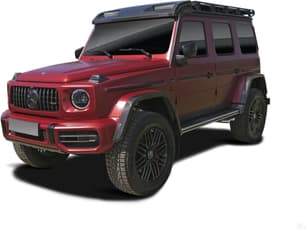
Imagine jumping in the time machine, zapping back to the late 1970s and bringing the team that produced the original Mercedes-Benz G-Wagen into 2025 and showing them where their creation has landed close to half a century later.
They’d be amazed a vehicle looking so much like their military-focused, first-generation model even existed! And once they’d absorbed that incredible fact they’d be stunned to see what lurks under its familiar bodywork.
Because this is the most recent iteration of what’s now referred to as the G-Glass, the pure-electric G580 featuring four individually controlled electric motors - one at each wheel - collectively producing enough energy to power a small town.
Stay with us as we explore this take-no-prisoners EV 4WD that has multiple show-stopping, high-tech party tricks lurking up its sleeve.
The Super Duty is the most formidable workhorse in the Ranger fleet. It projects a feeling of immense strength each time you drive it, reflecting payload and tow ratings well beyond traditional limits for vehicles of this size combined with formidable all-terrain capabilities. For tradies wanting the ultimate Ranger workhorse, the Super Duty is clearly in a class of its own - a class which it created.
As per the 1979 original, the current G-Class is produced by Magna Steyr in Arnie’s home town of Graz in Austria. And many fundamental things haven’t changed since then. But clearly this EV monster’s exotic electric powertrain is a huge departure.
It retains impressive off-road ability and straight-line speed. But will it hit the mark with top-end luxury 4WDers? Short story, this thing is wild, and it will be irresistible for a likely narrow band of tech-focused ‘must have the latest and greatest’ buyers. Nothing like impressing friends and family with a tank turn.
Note: CarsGuide attended this event as a guest of the manufacturer, with travel, accommodation and meals provided.
The Super Duty, originally based on Ford’s F-series full-size US pickup range, has been a mainstay on farms, building sites and in remote terrain since its inception as a standalone model in 1998, but this is the first time the nameplate has been applied to the Aussie designed and developed Ranger.
Ford claims the Ranger Super Duty resulted from extensive consultation with workers in industries that depend on their trucks in the harshest remote environments, from forestry crews and emergency service workers to land managers and fleet teams.
The challenge was to create a medium-sized truck with higher payload/tow ratings and greater all-terrain capability, as the only vehicles strong enough to carry their gear were too big and unwieldy to access critical locations.
In response, the Ranger Super Duty features a unique reinforced version of the Ranger’s chassis frame, incorporating readily accessible mounting points for a variety of aftermarket accessories and specialised equipment.
There’s also a new heavy-duty rear axle assembly with the largest and strongest differential ever fitted to a production Ranger for enhanced load-carrying capacity, paired with a unique uprated version of the US Bronco Raptor’s front diff.
The two-speed transfer case also has larger and stronger components than the regular Ranger and its low-speed gearset has been upgraded to match the F-series Super Duty.
Other chassis enhancements include uprated eight-stud wheel hubs with stronger bolts, improved cooling system to manage engine temps under heavy loads and during sustained off-road driving, a sealed engine snorkel and high-mounted breathers for the drivetrain/fuel system to enable its 850mm wading depth (50mm deeper than standard Ranger) and more. There was also a brutal and prolonged durability testing program to validate its Super Duty status.
Off-road credentials include steep 36.3 degrees approach, 26.9 degrees ramp breakover and 29.3 degrees departure angles, 299mm ground clearance and an expansive 13.6-metre turning circle which is the largest of all Ranger variants including the wide-tyred Raptor.
Okay, so Mercedes-Benz says, with a straight face, that “with the aim of optimising the vehicle’s aerodynamics” classic G-Class elements have been revised, including the reprofiled bonnet, ‘air curtain’ vents in the flares over the rear wheel arches, A-pillar cladding and the small spoiler on the edge of the roof.
At the same time, the 20-inch wheels are also claimed to be "aerodynamically optimised” and underneath, a 26mm underbody casing made from a mix of materials, including carbon-fibre (attached to the ladder frame with more than 50 steel screws), protects the battery from dust, dirt and rocks.
In ticking off the Edition One, car-spotters should look for black rims with blue brake callipers behind them, blue inserts in the exterior protective strips as well as black door handles and a new rectangular design box on the rear door for storing items such as charging cables, tools or snow chains. If you want a spare wheel, choose the standard model.
An optional black-panel radiator grille ($3800) features tinted lighting units as well as an animated LED light band and chrome surround. The light band can be activated as a running light or an animation when locking and unlocking the vehicle.
And it’s worth noting Mercedes-Benz and the car’s contracted manufacturer, Magna Steyr, have invested much time and many Euros in retaining the car’s classic handle and door lock design. G-Wagen owners will recognise its sound from several kilometres away.
Inside the G580 it’s clear this is one area where the G-Class has progressed enormously over the decades. It’s still quite upright in terms of the dash design, but you’re confronted by twin 12.3-inch screens, supporting the Mercedes-Benz user interface.
All very high-tech, but that’s balanced by an old-school grab-handle for the front passenger to latch onto during off-road work.
The signature turbine-style air vents are located within squared-off panels, and in the limited Edition One you have a blue fleck running through carbon-fibre inserts on the centre console, door cards and that front grab handle. In the standard car it’s a (very attractive) walnut open-pore wood rather than carbon.
A luxurious interior for sure.
Proof of the increased solidity of the Ranger Super Duty single cab-chassis is its hefty 2518kg kerb weight, which in bare cab-chassis form (without tray) is 625kg more than a standard 2.0L Ranger XL single cab-chassis 4x4 equivalent.
The Super Duty’s 4500kg GVM results in a huge 1982kg payload limit. It’s also rated to tow up to 4500kg of braked trailer and with its towering 8000kg GCM (or how much it can legally carry and tow at the same time) it can tow its maximum 4.5 tonne trailer weight while hauling almost one tonne of payload.
These are big numbers when compared to our standard XL Ranger example, given that the Super Duty has a 645kg higher payload rating, 1000kg higher tow rating and 1650kg higher GCM rating.
The galvanised full steel tray is equipped with six internal load anchorages, each rated up to 1800kg, which lie flush with the checker-plate floor when not in use.
There’s also external rope rails beneath the tray along each side and a sturdy front bulkhead with wire-mesh rear window protection.
As previously highlighted, this tray ensemble includes a driver-side lockable toolbox and passenger-side water tank (complete with handwash pump bottle) mounted behind their respective rear wheels.
Its work-focused interior is a comfortably familiar place for Ranger single cab-chassis workhorse owners, with fabric bucket seats, wipe-clean vinyl floor and large ‘Super Duty’ lettering embossed in the passenger side dash.
Cabin storage includes a bottle-holder and bin in each door, pop-out cupholders on each side of the dash, an overhead glasses holder, upper/lower glove boxes plus a well-equipped centre console with wireless phone charging, USB ports, two cupholders, 400W (230V) inverter and a storage box with internal 12V socket and padded lid that doubles as an elbow rest.
For the record, the G63 is just over 4.6m long and a little more than 1.9m wide with a 2890mm wheelbase. So, not huge, but its close to 2.0m height is hard to ignore.
In the front there’s lots of breathing space, and in terms of storage you have generous bins in the doors with plenty of room for big bottles. Then there’s a centre armrest, which doubles as the top of a deep storage box housing a USB-C port inside.
A sliding roller cover in the centre console reveals two cupholders, another two USB-C sockets, a 12-volt outlet and a wireless charging pad. Add in a big glove box and you’ve got plenty of options in terms of storage, power and connectivity.
In the back, sitting behind the driver’s seat set for my 183cm position I’ve got tons of foot and legroom and, no surprise, lots of headroom.
There’s a fair bit of sculpting in the rear seat, which is as nice as it is unusual (makers often avoid bolsters on the rear seat as it makes the backrest harder to fold flat). And in terms of three-abreast accommodation, a smaller adult will be okay in the centre spot for shorter journeys. Three up to mid-teenage kids will be swimming in it.
Then, for practicality you again have generous bins in the doors. And if you need even more capacity, fold down the centre armrest which houses two different size cupholders.
In the rear of the centre console you’ve got two USB-Cs, a 12-volt power outlet, individual climate control and directional vents.
There are map rockets on the front seatbacks and more air vents in the B-pillar. So, when it comes to comfort, powering up devices and storing ‘things’ you’re well taken care of.
The side-opening tailgate door opens from right to left, which isn’t ideal when parallel parked on the left hand side of the road, but boot volume is over 600 litres (VDA) with all seats upright, expanding to nearly 2000 litres with the 60/40 split-folding rear seat lowered.
There are multiple tie-down hooks, a netted pocket, two lights, a 12-volt outlet as well as a ‘ski-port’ door and sliding cargo cover to enhance practicality and security.
As mentioned earlier, the full-size spare in the standard model, but the Design Box replaces it on the Edition One, although Mercedes-Benz says it’s aiming to make a spare available as an option later in the year.
The Ranger Super Duty is currently available in a trio of cab-chassis configurations comprising single cab, extended cab and dual cab body styles, with a dual cab ute variant and higher-grade XLT trim option due in mid-2026.
Our test vehicle is the single cab-chassis, which like all Super Duty variants comes standard with a 3.0-litre V6 turbo-diesel, 10-speed automatic and full-time 4WD, for a list price of $82,990 plus on-road costs.
Its standard equipment list includes rugged 18-inch steel wheels with 33-inch tall General Grabber 275/70 R18 all-terrain tyres and a full-size spare.
There’s also LED headlights/front fog lights/daytime running lights, zone lighting (360-degree lighting around the vehicle), a sealed engine snorkel, 4500kg tow-bar with integrated trailer brake controller and towing assistance features, onboard scales to help calculate payloads, composite side steps, heated door mirrors with puddle lamps, a frame-mounted steel bumper, twin recovery points front and rear, high-strength steel underbody armour, a big 130-litre fuel tank and more.
The work-focused interior features smart key entry and push-button start, an electric parking brake, 400W (230V) inverter, 12V socket, three USB ports, wireless phone charging, overhead auxiliary switch bank, dual-zone climate and more.
The driver is treated to a configurable 8.0-inch colour digital instrument cluster plus a big 12-inch central touchscreen for a multimedia system that includes 'SYNC' voice activation, wireless 'FordPass'/Apple/Android connectivity and digital radio.
Factory options and accessories can be ordered individually but Ford also offers three optional equipment packs tailored for different vehicle applications comprising the 'Work Pack', 'Farm Pack' and 'Adventure Pack', with pricing dependent on cab type and tray finish.
Our example showcases the heavy-duty galvanised steel tray, water tank with handwash bottle, lockable toolbox and all-weather floor mats shared by all three packs, plus the Work Pack’s 'Integrated Device Mounting System' (IDMS) and wheel nut (tension) indicators, the Farm Pack/Adventure Pack’s ARB Summit bull bar and the Adventure Pack’s rock sliders and high capacity Warn winch.
It’s also fitted with a rear ladder rack from Ford’s genuine accessories range, so depending on what combination of options and/or accessories are ordered (combined with on-road costs) you could pay more than $100K, drive-away.
The new Mercedes-Benz G580 is priced at $249,900 and a more highly-specified limited Edition One version comes in at $299,900, both before on-road costs.
That’s a price territory where the BMW X5 and X6 M Competition ($244,900 & $250,900) as well as the Range Rover Autobiography ($233,961) live. Not to mention competition from the G580’s still available and appreciably pricier twin-turbo V8 Mercedes-AMG G63 stablemate ($365,900).
As you’d expect, the standard features list is substantial and the highlights are Burmester 3D Surround Sound audio (with digital radio), leather upholstery, keyless entry and start, a multi-function steering wheel trimmed in Nappa leather, power front seats with memory function, heated and cooled cupholders, and wireless smartphone charging.
There’s also dual 12.3-inch driver instrument and central media displays, ambient lighting and adaptive LED headlights as well as Android Auto and Apple CarPlay.
As well as cosmetic changes, covered shortly, the Edition One steps up to ‘Silver Pearl’ and black Nappa leather trim (with blue contrast stitching).
There’s also a range of optional packages bundling up everything from exterior body elements to interior trim and additional multimedia, the latter especially for back-seaters.
The ‘Night Package’ ($4300) includes black exterior mirror housings, black running boards and wheels as well as darkened exterior lights and a radiator shell that can be illuminated for an impressive profile while driving.
A ‘Superior Line Interior Plus Package’ ($14,500) brings full Nappa leather upholstery, ‘Active Multicontour Seat Package Plus’ and grab handles in leather. Then a ‘Manufaktur Exterior Package’ ($4100) finishes the roof, bumpers and wheel arches in ‘Obsidian Black’.
But the one that will score you maximum brownie points with the kids is the ‘Interior Comfort Package’ ($8500), featuring a rear seat entertainment system, including two integrated 11.6-inch touch displays.
All Ranger Super Duty models are powered by the same 3.0-litre V6 turbo-diesel, which meets tough Euro 6.2 emission standards using AdBlue. It produces 154kW of power at 3250rpm and a towering 600Nm of torque at 1750rpm.
This is paired with a 10-speed torque converter automatic with the choice of sequential manual-shifting using a toggle switch on the shift knob. It also offers seven drive modes to optimise performance in different terrain applications.
The full-time 4WD transfer case allows drivers to switch between high and low ranges and access other technologies when tackling difficult terrain including 'Trail Control' (low-speed off-road cruise control), 'Trail Turn Assist' (applies braking to the inside rear wheel to tighten turning radius), front and rear diff locks and more.
The G580 is powered by four permanently excited synchronous motors, each delivering around a CLA200’s worth of power and torque to each wheel for overall outputs in excess of 432kW/1164Nm.
Each motor has its own two-stage transmission and power electronics for almost infinite fine-tuning of the direction and amount of drive sent to individual wheels. Merc calls it ‘individual-wheel drive’.
Vehicles in this GVM class do not come with official fuel consumption figures. Even so, we clocked up 385km during our tradie-focused test which included our usual mix of suburban, city, highway and unsealed road driving, of which about one quarter was hauling its near maximum payload.
When we stopped to refuel at the end of our test, the dash display was showing average combined cycle (urban/extra-urban) consumption of 13.4L/100km which was lower than our own figure of 15.5 calculated from fuel bowser and tripmeter readings.
That’s still decent economy for a heavy-duty off-roader driven in the daily grind of metro traffic, during which it hauled more than one tonne of payload for a day.
Therefore, based on our own test figures, you could expect a real-world driving range of more than 800km from its big 130-litre diesel tank.
Housed in a torsion-resistant casing and embedded low down in its ladder-frame chassis, the G580’s 116kWh two-tier, liquid-cooled lithium-ion battery pack delivers a WLTP-rated range of 473km, or 567km on the more lenient NEDC scale.
‘Eco Assistant’ and ‘Range Monitoring’ functions provide continuous information on battery status, energy consumption and estimated range.
Maximum system capacity is 400 volts which enables 200kW DC charging, meaning a 10 to 80 per cent fill in as little as 32 minutes. Maximum AC charging capacity is 11kW.
Claimed energy use is 23.1kWh/100km, and we saw an average of 28.6kWh across urban and highway running on the launch drive program.
Not exactly a ‘green’ EV choice, then, but it’s worth noting a one-year Chargefox subscription is included to off-set the car’s energy appetite.
It has a comfortable driving position with huge door mirrors providing commanding views. There’s also plenty of headroom for blokes my size (186cm) plus manual adjustment of the steering wheel and seat (including lumbar support) and a big left footrest for additional support.
The steering feels great like all Rangers, backed by sure-footed handling and strong braking response. The unladen ride quality is surprisingly supple for such a heavy lifter, given the combined effect of its baggy tyre sidewalls and the vehicle's substantial sprung weight helping to iron out the bumps.
Given its hefty kerb mass, acceleration feels slightly subdued compared to a standard V6 Ranger, as you’d expect. However, it still provides a satisfying surge of response in urban use thanks to 600Nm of torque and gearing that keeps the engine operating at or near its peak torque output at around 1800rpm.
It’s a relaxed highway cruiser with low engine and tyre noise. The most noticeable ingress at these speeds is mild wind buffeting around bulky fixtures like the engine snorkel, door mirrors and tray bulkhead, but it’s not overly intrusive with conversation not requiring raised voices.
To test its payload rating we firstly put our test vehicle on a public weighbridge. Unladen and with a full tank of fuel, it tipped the scales at 3130kg which after deducting the 2518kg base kerb weight revealed a sizeable combined accessory weight of 612kg.
So, given accessories are included in kerb weight, the Super Duty’s 'naked' 1982kg payload rating drops by the same amount to 1370kg, which is still a mighty capacity for a vehicle of this size.
We strapped 975kg on the tray, which combined with our crew of two equalled a total payload of 1150kg (still more than 200kg under its limit) which the onboard scales vaguely confirmed. The robust rear leaf springs compressed a mere 30mm in response, leaving ample bump-stop clearance that ensured no bottoming out on our test route.
The Super Duty carried this payload with arrogant ease, maintaining its surefooted handling and scoffing at our 13 per cent gradient, 2.0km set climb. It also displayed strong engine braking on the way down, in a convincing demonstration of its heavy load hauling ability.
So, with 432kW and around 1160Nm, even though the G580 weighs in at around three tonnes, you’re talking 0-100 km/h in 4.7 seconds. And this car gets up and goes… like a beast.
What you don’t get is that traditional Merc-AMG G63 V8 rumble, because, of course, no engine.
But you do get what Mercedes calls ‘G-Roar’, essentially a sound bar at the front of the car also using the audio system inside to give it what is not exactly an engine noise but some sense of the car progressing. And you can turn it off for completely silent running.
‘Electric Dynamic Select’ changes the parameters of the motors, transmission, suspension, ESP and steering as required. On-road that means ‘Comfort’, ‘Sport’ and ‘Individual’ modes, with off-road comprising ‘Trail’ and ‘Rock’. In the Comfort setting drive flows primarily to one axle for optimum energy efficiency.
Suspension is by double wishbones at the front and a De Dion-style live (rigid) axle at the rear. You’ve got the same adaptive-type set-up as per other G-Class models, so ‘Comfort’ and ‘Sport’ modes and of the many traditional G-Class traits this car exhibits, ride quality is one of them.
Even in Comfort you’ll find even little bumps and thumps making their way up into the seat of the pants and the cabin. It is after all a body-on-frame, ladder-chassis type vehicle and that’s not unusual.
In terms of steering, it’s accurate and road feel is good. You’ve got 275-wide Falken Azenis FK520 tyres that are more on- than off-road focused. The car feels stable and nicely planted on the road.
The physical brakes are by ventilated discs front and rear, and the big rotors are the same size (353mm) all around. They work nicely and feel like a conventional set-up.
Regenerative braking kicks in as soon as you lift off the accelerator pedal. The powertrain is harvesting energy as the car decelerates and there are four levels you can adjust with the steering wheel paddles up to a quite aggressive level - not quite, but close to a single-pedal set-up.
Off-road, the G580’s ‘G-Steering’ system allows the wheels to turn at different speeds to induce slight ‘drift-like’ oversteer and tighten the turning circle. It works beautifully and the car’s fording depth is 850mm, a full 150mm more than internal-combustion G-Class models.
A three-speed off-road crawl function is adjustable to speeds as low as 2.0km/h, and the car is claimed to remain stable on sideways slopes up to 35 degrees.
Torque vectoring is used to create ‘virtual diff locks’ and there’s a ‘low-range’ setting. Switch to the ‘Offroad Cockpit’ and data including gradient, lateral inclination, compass readings, tyre pressures and the selected G-Mode appear.
A ‘Transparent Bonnet’ function creates a virtual view of what’s approaching and passing under the front wheels to help the driver pick their way through steep ascents or declines.
For the record, the G580’s approach angle is 32 degrees, departure is 30.7, breakover is 20.3 and ground-clearance is 250mm.
And of course, with the wheels independently powered, the G580’s signature move is what Mercedes-Benz calls a ‘G-Turn’ but the rest of the world calls a tank turn.
If you encounter an obstacle that makes forward progress impossible, the system spins the left- and right-hand wheels in opposite directions so this brute can turn on the spot like an M1 Abrams. You can’t help but crack up laughing when executing this extreme party trick!
In terms of miscellaneous observations around ergonomics and the car in general, it has a 13.6-metre conventional turning circle. So if you’re not using the G Turn function in the car park be ready for a sizeable turning arc.
Also, those aero tweaks here and there seem to have had an effect. Wind noise, especially for such an upright, squared-off design is surprisingly modest. And overall, from a build point of view, this car feels as though it’s been carved from a solid piece of metal. In every aspect it presents as a quality item.
ANCAP safety ratings do not apply to vehicles in this GVM class but it has a suite of passive and active features including nine airbags, AEB with pedestrian detection, traffic sign recognition, tyre pressure monitoring, lane keeping and adaptive cruise control.
A new feature under the rear of the tray not previously available on Ranger cab-chassis variants is what Ford calls the ‘rear driver assistance technology bar’ which delivers numerous safety functions including front/rear parking aids, 360-degree camera, blind-spot monitoring with trailer coverage and reverse brake assist with cross-traffic alert.
Although the Mercedes-AMG G63 carries a maximum five-star ANCAP safety assessment from 2018, the pure-electric G580 is unrated. But crash avoidance tech includes active cruise control, ‘Active Steering Assist’, high-speed AEB, traffic sign recognition, lane-keeping assist, blind-spot monitoring, driver fatigue monitoring as well as a 360-degree camera view and ‘Active Parking Assist’.
And if a crash is unavoidable, there are no fewer than 11 airbags on-board, including driver and front passenger front and side, rear side, full-length curtains, driver and passenger knee and a front centre bag.
There are three top-tether points for child seats across the second row, with ISOFIX anchors on the two outer positions.
The Ranger Super Duty comes with the same five years/unlimited km warranty shared by all Ranger models, with up to seven years of conditional roadside assist available if serviced at Ford dealerships.
Scheduled servicing is every 12 months/15,000km whichever occurs first.
Ford offers a pre-paid service plan that provides capped price servicing for the first five scheduled services up to five years/75,000km, which totals $2100 or a reasonable average of $420 per service.
Ford has a long-established network of around 180 dealers spanning all states and territories including key rural and regional areas.
The G580 is covered by Mercedes-Benz Australia’s five-year/unlimited-km warranty, which remains the standard offering in the premium part of the market and an eight-year/160,000km drive battery warranty.
Service intervals are every 12 months or 20,000km with service plan pricing available over three ($2645), four ($3980) and five ($4670) years. In approximate terms, each workshop visit will cost ‘around’ $900. Not exactly cheap, especially for an EV, but this is no ordinary electric vehicle.