What's the difference?
You wouldn’t know it to look at it, but this is a brand-new — as in really and truly all-new — Fiat 500.
That has got to be a big deal for fans of Fiat’s pint-sized city car, with a genuinely all-new 500 about rare as spotting Halley’s Comet soaring over Turin. The last time was way back in 2007, by the way, and that car will remain on sale alongside this new one for the foreseeable.
But that’s not the only surprise. This 500 is also entirely electric, properly modern inside, and it has actual technology in its cabin and on its safety list.
Fiat reckons this is a big reset for the 500. And that there will never be another all-new petrol model again.
So, how does this new 500e stack up against the recent flood of small EVs, predominantly from China?
Let’s go find out.
While a global pandemic was busy wreaking havoc on the international travel industry, Australians overwhelmingly turned inward to the realm of 4x4s, camper trailers, and campervans to explore the corners of our massive continent.
It’s a trend which has existed here long before the pandemic, though, with local outfits like Trakka already cashing in on the momentum of modified vans to suit all sorts of long-distance tourers, old and new.
It is a ripe time then, for Volkswagen’s own first-party camper creations, to enter the Australian market, as the latest versions of the Caddy, Multivan, and Transporter.
In such a competitive space, though, are there good reasons to consider the Transporter-based California over its home-grown rivals from the likes of Trakka? Let’s take a look.
A fun, funky EV which will no doubt appeal to lovers of Italian style, but also one which struggles a little on the range and price front.
Still, there’s no doubt that electrification has improved the Fiat 500 formula.
A van like this is the envy of campgrounds, and with a fully warranted set of cosy extras, it’s ready to roll from day one, too.
As a weekender the California Beach is ideal, and one of its most appealing attributes is how easily it can also be packed up and used for day-to-day duties when you’re not out adventuring on the road.
Keep in mind for longer term touring you’ll need a fair bit of extra kit to make this California as capable as some rivals, and there’s always Trakka waiting for you if you want to spend more coin.
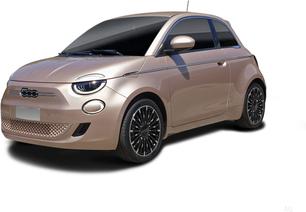
It looks, well, it looks like a Fiat 500.
It’s actually bigger in every dimension than an ICE cinquecento, but it doesn’t really look like it, which is a good thing.
The 17-inch wheels look great, and big against the very small Fiat, and I like the hidden doorhandles, which make the already smooth-looking 500’s flanks look a little smoother still. But I can take or leave the little DRLs up front that are meant to act as little illuminated eyebrows for the headlights, which come over a bit too cutesy.
But I think the highest compliment I can pay it is that it looks like a regular Fiat 500 — one of the most successful reincarnations of a timeless design ever — and not some modern, eco-friendly version that would have killed the look.
In the cabin, however, it’s definitely a more modern affair, with the big screen, the horizontal push-button gear selector, and the nifty push-button door openers.
Still, it’s all pretty familiar Fiat 500, only a little nicer, even if some of the plastics are far too hard and scratchy for a vehicle this expensive.
There are five colours available: Ice white, Onyx black, Rose gold, Ocean green and Celestial blue.
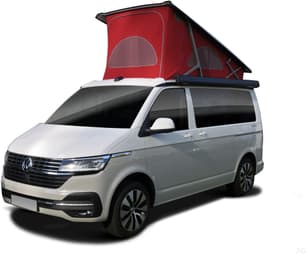
The California Beach does offer an iconic slice of VW’s historic Kombi aesthetic, modernised to its current range. While the two-tone paint is a remarkably expensive option, it does seal the #vanlife deal.
Two-tone paint or not, though, you could do much worse in terms of aesthetics than the Transporter 6.1, which is about as graceful as commercial vehicles come with its now-giant chrome embossed grille, matching painted bodywork, appealing little alloy wheels, and with the LED light package fitted, a contemporary shine profile at night.
The California Beach also hides its status as a camper well, blending in with other people movers and commercial vehicles in traffic with the slight hint given away by its branding and the awning hanging off one side.
The pop-up tent option in our test car is invisible from the outside, and with the seats in their default position, it could be any passenger-oriented van on the road.
More on that later, but the interior, too, brings much of the comfort and aesthetic from the rest of VW’s passenger car range.
Those who want to use this as a multi-role vehicle when they’re not camping will be pleased by its up-to-date interior appointments, with the pragmatic but attractive leather-bound VW wheel shared with other current products, as well as the option of the ever-impressive ‘Digital Cockpit’ dash.
The seats are aesthetically pleasing, with the only giveaway this is a commercial vehicle being the hard plastics with a more rugged pattern across the dash and doors in place of the usual soft materials which adorn Volkswagen passenger cars.
As subtle and sensible as the California may be though, there was no doubt it was instantly recognised at the campground, with owners of other Transporters, Trakkas, and other campervans coming to have a look at a model they clearly knew of.
The 500e is 29mm taller, 61mm longer and 56mm wider than the current ICE Fiat 500 (now 1529mm, 3631mm and 1683mm respectively), and it rides on a longer wheelbase, too .
That means more front-seat room and head room, but there’s still not oodles of space in the four-seat cabin, and especially in the back, where things are pretty tight.
I’m 175cm tall, and my head touches the ceiling in the back, and if I had another full-size human in the back with me, I’d want it to be someone I know well, because we’d be well and truly aquatinted by the time we got to our destination.
The front seats are more accomodating, but there is a strange tightness to the pedal area for the driver. It’s so tight, in fact, that when you rest your left foot, you have to be careful not to accidentally clip the brake pedal when driving.
The boot is a small 185 litres, too. But you’re not buying this for practicality perks, are you?
Interior space in this camper is one of its key highlights. As a van it has a huge and versatile cargo area behind the front seats, with the fold-down rear row on rails to maximise cargo capacity if need be.
A rear shelf at the back can be used for all your storage needs, with a compact space underneath for securing everything from camping equipment to shopping bags on the day-to-day and there are even little draws underneath the sliding seat row for the storage of small items (it was handy to use these for the awning’s winder and pegs, the luggage net which we weren’t using, and other things you don’t want to lose.
VW doesn’t quote a VDA number for the total luggage space given how versatile the load area is, although it does state there is 4.3 square metres of space in the cabin.
As already mentioned, the key advantage of this camper over others is its ease of use. Setting it up and packing it down is a 10 minute affair, allowing you the flexibility to be ready to camp or explore the local area in a pinch.
The California we tested sits five and even has ISOFIX mounts on the outer rear seats, but for larger families, there’s also a seven-seat option, with the extra seats folding down to make for a larger bedding area.
The awning itself is manually operated with a winder and pop-out legs. The front two seats are ‘captain’s chairs’ which can rotate 180-degrees to face back into the cabin.
It’s a neat and sometimes necessary addition to allow for a seating area if the bed is deployed, but they are a little fiddly to operate.
To swivel them, you need to fully fold the steering column away, move the seat all the way forward, rotate it half way, then move it forward again to clear the wheel in the driver’s position.
Practicality for the driver and front passenger while on the move is excellent, with two sets of huge cutaways in the doors for the storage of objects, cupholders seated atop the dash, a big bay for books or laptops which also houses a 12V outlet, and there are adjustable-height armrests attached to the seats.
The seats and wheel are also very adjustable, and the roof is high allowing plenty of space for people of all heights.
A small issue I ran into was the awkward lack of a place to put my phone. The most obvious location seemed to be the cupholder next to the shift lever, especially since this is where the USB-C connections were located, although it was a bit awkward, and my phone and wallet would easily fall out onto the floor, from where they could simply disappear into the rear of the cabin under acceleration.
The 500e is not cheap by modern small EV standards — we’re looking at you, China — but it does arrive in one well-equipped trim level, called La Prima, with paint the only available option.
It's also, quite shockingly for anyone who has driven an ICE Fiat 500 lately, stacked with some truly high-tech kit.
There’s heated seats for the first time ever, for example, and there’s 10.25-inch central screen with Apple CarPlay and Android Auto, and wireless charging.
There’s a digital driver display, too, plus there’s faux-leather on the seats and dash, a panoramic glass sunroof and fancy push-button front doors (though with a mechanical back-up lever hidden in the door pockets should something go pear shaped).
Outside, you’ll find 17-inch alloys, as well as LED lightning all around, including the DRLs, and there’s keyless entry and push-button start, too.
But, and it’s a significant but, the 500e lists at $52,500 before on-roads , which — when you consider its size, battery and range — really edges it into the premium EV space.
A similar-sized EV from China can be had for under $40k, which means you are going to have to really love the 500e to drop that extra $15k or so.
The exact van we’re looking at for this review is the Volkswagen California Beach TDI340 4Motion.
This means it’s the middle of three variants in the California Beach range, which kicks off from $90,990, before on-road costs, for the base front-wheel drive, $94,990 for this all-wheel drive version we’re testing, or $100,990 for the more powerful TDI450 version.
Our mid-spec also had a long list of attached options, including the Kombi-style two-tone paint ($4050), upgraded interior package which includes microfleece seat trim, heated front seats, and the improved digital dash suite ($3690), an electric pop-up roof ($3050), LED headlights ($2050), adaptive chassis control ($2010), the 'Off-Road Pack' (includes a rear diff lock and downhill assist - $1720), power sliding doors (both sides, $1640), fog lights with cornering function ($770), 'Park Assist' ($460), 'Light Assist' ($320), and the no-cost option of a silver-coloured awning.
The list of extras (valued at a total of $19,760) brought the price as-tested (and still before on-roads) to a substantial $114,750.
In concept then we’re left with a van which has pretty much all the creature comforts of a Volkswagen passenger car with two beds (one in the pop-up roof, the other consisting of the fold-out rear seats).
In isolation, this may seem reasonable for such a custom camping solution, but the issue arrives when you consider competitors.
Trakka’s most direct rival, the Trakkadu, can be had from $137,422 and offers such luxuries not even optionally available on the California Beach, like an improved power system (to support 240V outlets), a kitchenette, fridge, plenty of additional storage, and a water supply.
Your $94,990 California Beach in base form then is essentially a Multivan with an awning, interior shades and lighting, a rear fold-out bed and bench, and a set of two chairs and a table.
While it’s very nice to have custom fit blinds on every window and fully adjustable built-in interior lighting, you’ll then need to go and spend more on a power system and possibly plumbing if you want it to be a truly luxurious long-distance tourer. It’s too bad we miss out on higher-spec vehicles available overseas.
A single front-mounted electric motor delivers the power here, with 87kW and 220Nm on offer. Enough, Fiat says, to knock off 100km/h in 9.0 seconds. But it does feel quicker than that in real life, thanks to the way electric vehicles deliver their power.
There’s the usual EV single-speed gearbox, too, with power sent to the front wheels.
The version of the California Beach we tested for this review was the mid-grade TDI340 4Motion.
This means it is powered by a 2.0-litre, four-cylinder, turbo-diesel engine producing 110kW/340Nm. It’s paired with a seven-speed dual-clutch automatic, and in the case of this model, is capable of driving all four wheels.
It’s not much for power, but with the large amount of torque available, pulls strongly even when loaded up.
While it’s nice to have the all-wheel drive for loose surfaces and the like, clearance is limited so I wouldn’t venture into the rough stuff, even with the optional differential lock.
For those looking to fit further enhancements, or tow, the California Beach’s GVM is 3080kg leaving 623kg for payload, and it can tow 750kg unbraked or 2500kg braked.
The Fiat 500e’s 42kWh battery provides a smallish 311km driving range on paper, but when we got in it was more like 290km at 96per cent charged. A city car, then, rather than a long-distance hauler.
When it does come time to charge, you’re set up for 85kW DC fast charging which should take you from zero to 80 percent in 35 minutes.
The California Beach TDI340 4Motion has an official combined fuel consumption figure of 7.5L/100km and a relatively large 80-litre fuel tank, allowing for a healthy cruising range for those more distant camping locations.
Our camping journey (a roughly 600km return trip) meant the California travelled mostly freeway kilometres on our week with the car, and it produced an overall figure of 7.4L/100km. It takes diesel and also has a 13-litre AdBlue tank.
This is the probably the best-driving example of the Fiat 500 I’ve ever climbed into. Sure, it’s not quite as engaging as self-shifting a perky little manual, but it’s smoother, easier and more comfortable, and a whole lot better than ICE vehicles fitted with Fiat's odd dual-logic automatic gearbox.
The EV transition genuinely suits the little Fiat, admittedly sapping a little character, but also thoroughly modernising the drive experience, with smooth, constant acceleration, sharp-enough steering and a ride that’s mostly settled, only really becoming crashy over the bigger road imperfections.
The small dimensions here also help the EV reincarnation. Yes, it’s heavier than you might expect, weighing in at 1290kg (tare), with the batteries adding several hundred kilograms to the equation, but the 500e still doesn’t feel overly heavy, with the little Fiat remaining pretty light on its feet.
There are three drive modes on board, including the catchy Sherpa mode (because it will help get you where you’re going), which, when you’re running low on battery, kills the climate control and anything else it needs to preserve range and get you home.
But you can’t shake the feeling that the 500e is a little expensive for such a specialist tool. It’s unashamedly a city car, but one that will cost you more than $50k, and which doesn’t feel quite premium enough in the cabin to justify that asking price.
One of the California's more appealing features is the way its camping features can be minimised. Unlike some fit-outs which feature built-in fittings, once you pack the rear bed away and fold everything up, it makes for an appealing five-seat van for driving around in day-to-day traffic.
The diesel engine offers a rugged soundscape but plenty of pulling power once you overcome a moment of turbo-lag for cargo, people and equipment, and visibility is great out the front and sides.
The dual clutch transmission behaved well in my time with the van, although like many cars which use this transmission it can occasionally cost you a second at an intersection as it combines with the stop-start system to make for a moment of delay.
The California is a relatively easy van to park and live with when you’re not out on the road, and features a nice organic steering tune to give you plenty of confidence in the corners, bolstered by the addition of all-wheel drive in the van we tested.
The ride when empty is quite rough, like many vans in this segment. With the diesel engine, this can make for a bit of a noisy experience on coarse-chip freeways, and especially gravel roads. Potholes can also be cringe-inducing.
As always one of the biggest advantages of VW commercial products is how closely they can be specified to VW’s passenger vehicles.
With the right option boxes ticked, for example, our car had the very welcome digital dash, and the multimedia suite.
While not the latest fully touch unit you can experience in cars like the Golf 8, it has the welcome addition of tactile shortcut buttons and dials for ease-of-use while driving.
With the fold-away roof, the California also isn’t bigger than a regular Transporter van. At 1990mm high it should fit in most parking lots and garages.
There’s a heap of active safety stuff on board (again, unusual for a 500), with active cruise control, traffic sign recognition, front, rear and side parking sensors, blind-spot monitoring, AEB with pedestrian and cyclist detection, and more.
Still, the 500e only secured a four-star ANCAP safety rating, scoring just below the five-star cut off in Adult Occupant Protection, Child Occupant Protection and Safety Assist, with a lack of a centre airbag not helping.
The California has a decent set of standard safety inclusions, like city-speed auto emergency braking (it’s important to note this is not the usual freeway-speed system which ships on most VW passenger cars), blind spot monitoring with rear cross traffic alert, driver attention alert, and adaptive cruise control.
It doesn’t have lane support systems, but does additionally score tyre pressure monitoring (good for those gravel trails), front and rear parking sensors and a decent rear view camera, hill start assist, and even crosswind assist.
In terms of more passive safety items it scores only driver and passenger front and side airbags, something to keep in mind when transporting passengers in the rear.
For touring it’s hard not to recommend the optional LED headlights for those poorly-lit and far-flung roads, and thankfully the California comes with a full-size steel spare should you end up with a flat in the middle of nowhere.
For a commercial-based vehicle the safety suite is not bad, but when compared to a passenger vehicle, it could do better.
The fly in Fiat’s ointment is its ownership proposition, with a three-year, 150,000km warranty now way below par in Australia these days, even if the battery is covered for the standard eight years.
Servicing is every 12 months or 15,000kms, and will cost $250 a pop for the first eight years, which is commendably cheap.
The California Beach is covered by a five year and unlimited kilometre warranty like the rest of the Volkswagen passenger car range, which includes one year of roadside assistance.
The prime advantage of buying a first-party Volkswagen camper is the entire vehicle is covered by this warranty, as opposed to needing to deal with two warranties if you were to buy from a brand like Trakka.
There is also the option of a five or three year service plan. At the time of writing, the five year service plan was running at the price of a three year plan, valued at $1850 for this 4Motion variant, or just $370 a year for the life of the warranty.
This is a claimed saving of $2302 over the cost of regular scheduled maintenance. Visits to the workshop are required once every 12 months or 15,000km, whichever comes first.