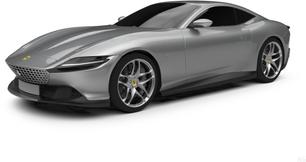
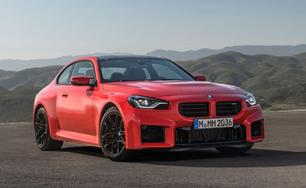
What's the difference?
There aren’t as many Ferraris on the road in Italy as you might think. There’s the purchase price, per-kW taxes and poisonously expensive fuel. So, usually, they’re a rare sight, except around Maranello in the northern province of Modena.
Because that’s Ferrari’s home and in getting to grips with the subject of this review - the twin-turbo V8 Roma - I enjoyed a smile-inducing moment with a local milk truck driver.
On a narrow section, part way into a road test drive through local villages and twisting B-roads to the west of Maranello, the tanker pulled over to let me through.
Gave a thank you double blink of the hazard lights on passing and received a quick headlight flash in return. They almost certainly thought I was putting kays on a test mule in the same way camouflaged prototypes so often do on the same stretch of road.
Maybe I’d inadvertently sipped some Prancing Horse Kool-Aid, but it felt special. Ferrari is so close to Italian hearts and the Roma is such a sleek and engaging example of its current output.
But is this ‘iron fist in a velvet glove’ 2+2 capable of tearing you away from its well-credentialled high-end competitors? Stick with us to find out.
I think auto journalists are supposed to see vehicles a bit like parents see their children. You know, view them all as equals. No favourites. That kind of thing.
But I'm going to let you in on a tiny little secret, just between us. I liked this potent M2 before I even sat in it. And I like it just a little bit more than I love other bite-sized performance cars.
In fact, I like it more than I like bigger, more powerful, and more expensive models in the BMW M family.
The Ferrari Roma is like a trained assassin in a Zegna suit - capable and clinical yet stylish and effortlessly superior. We believe there’s a replacement coming later this year and it will have to be doing well to top this superb machine.
Proving good things still come in small packages, the pint-sized M2 remains my pick of the BMW M range. It's not the perfect daily drive, but I reckon the fun outweighs the foibles.
If you’re looking for a flash Fazza with spoilers and vents at all points of the body, you’ve come to the wrong coupe.
The Roma is a subtle, beautifully balanced and delicately detailed two-door inspired by all-time Ferrari classics like the 250 GT Lusso and 275 GTB.
Its proportions are impeccable with complex curves and sweeping lines combining to produce an exquisitely pure shape.
Slimline LED headlights are divided by horizontal DRL strips, the broad bonnet incorporates a quietly muscular power bulge and the minimalist ’egg crate’ grille sits below a sharply chiseled nose.
I’m a particular fan of the split wedge-shaped tail-lights, seamlessly incorporated into the upper deck of the rounded rear end. The active rear spoiler is also neatly hidden away in the leading edge of the boot lid. No shoutiness here, even the exterior badges are works of art.
Crack open the bonnet and the engine sparkles like a jewel in a display case. Scarlet red crackle finish on the intake plenums and cam covers make it pop like a firecracker.
The interior follows a dual cockpit theme with twin curved sections divided by a flying buttress style console between them housing the gear selection gate and central media screen.
Flashes of carbon-fibre and chromed alloy add a touch of overt raciness, Alcantara on the dash and doors echoes the ‘mouse fur’ of Ferraris past and the contrast stitching around the cabin is flawless.
The sleek front seats feel as good as they look, the typography of the Roma badge on the passenger side of the dash is super cool, and overall the interior is snug and ultra classy.
There have been mixed reviews of the design of the BMW M range, but I reckon this one looks pretty damn good. In fact, I've always thought this kind of hyper-aggressive styling looks better on smaller cars than it does on big ones.
And it certainly is aggressive, right? From the huge bonnet bulges to the meshed out grille and angry rear diffuser, to the staggered alloys and flared wheel arches, to the blocky rear end with its four massive exhaust exits.
But my favourite exterior item has to be the blacked-out carbon roof, which helps shrink the M2 visually, and makes the whole car look more potent.
Inside, it's plenty sporty feeling, with hard-backed sports seats, lashings of carbon-fibre-look trimmings and the bright red M buttons on the steering wheel.
It's nice, but some of the touch points – like the hard plastics on top of the doors, where, if you're like me, you rest your elbow when driving – feel less than premium.
Still, all the tech is present and accounted for, with its digital dash and huge centre screen, and there's no shortage of spaces to connect or charge your phone.
At close to 4.7m long, the Roma isn’t compact but its supercar stance comes courtesy of a close to 2.0m width and low-riding 1.3m height (with a 2670mm wheelbase).
The cabin is cozy, as intended, but at 183cm I still have ample headroom in the front. The rear is a different story with the two ‘+2’ seats serving as occasional emergency spots only or a handy option for smaller kids.
For storage there are slim but long pockets in the doors, a surprisingly generous glove box, a wireless charging pad under the centre console, phone-size slits on either side of that console, a single cupholder between the front seats with a lidded box (containing 12V and USB-A outlets) behind it.
There’s a recess for oddments on the transmission tunnel between the rear seats, and armrests either side in the back.
The boot holds 272 litres, which is enough for several soft bags, rising to 345 litres with the 50/50 split-folding rear seatbacks lowered. There are tie-down anchors, which is handy but be aware there’s no spare, only a repair/inflator kit.
Overall, not exactly SUV-like in terms of day-to-day practicality but at least on par with its key competitors.
The M2 pocket rocket measures just over 4.5m in length, just under 1.9m in width, and just over 1.4m in height, and it rides on a 2747mm wheelbase. That makes it longer, wider and lower than the model it replaces.
Remember that 'lower' bit, as it will come up again in a moment.
Up front, you don't feel cramped, and there's the requisite cupholders, door pockets and hiding holes, as well as wireless device charging and USB connections.
But remember, this is a two-door, four-seat affair, which cuts into the practicality a little, or a lot.
Swing open the wide front doors, and push the front seat-back forwards, and the entire chair will slide forward automatically.
It does help create more room to climb into the back, but it's still a slightly embarrassing challenge to make getting back there look anything like graceful.
Once there, it's tight. I'm 175cm and my head was firmly pressed into the roof.
You do get your own vents and temp controls, but that's about it. Even the pull-down divider only gives you access to the 390-litre boot, rather than extra cupholders.
You do get two sets of ISOFIX attachment points, though, and let's be honest – if you're buying this to make Bunnings runs, you've probably got it wrong.
At $453,000 before on-road costs, the Roma Coupe lines up almost directly with a trio of well-credentialled, well-equipped and ultra-fast 2+2 supercars - the Aston Martin DB12 ($455,000), Maserati GranTurismo Trofeo ($450,000) and Porsche 911 GT3 ($446,700).
If you prefer a roofless experience, the Roma Spider convertible will set you back $520,300 (BOC).
And as you’d expect, the standard features list is impressive; the options list even more so.
Aside from the safety and performance tech covered a little later, highlights include 18-way power front seats, full-grain Frau leather trim, eight-speaker JBL audio (with digital radio), dual zone climate control, an 8.4-inch hi-definition central media display, a 16-inch (highly) configurable instrument cluster, adaptive cruise control and 20-inch forged alloy rims.
There’s also LED exterior lighting (including auto dusk-sensing headlights), Android Auto/Apple CarPlay connectivity, rain-sensing wipers and built-in nav, as well as Alcantara, chromed aluminium and carbon-fibre trim details. There’s more, but you get the idea.
And when it comes to options, the sky’s the limit with the likes of carbon-fibre everything, beefier audio as well as custom colour and trim options available through Ferrari’s ‘Tailor Made’ and ‘Special Equipment’ programs.
One popular addition is an 8.8-inch HD touchscreen for the front passenger (co-pilot?) displaying data on the car’s performance and status as well as allowing selection of music, sat-nav info and climate functions. Super cool and it will set you back $9500.
First, the bad news. The M2 has only been getting more and more expensive over the years, and this new-generation model continues that charge.
Fun fact: When we first tested this model way back in 2016, you could get the Pure grade for less than $90K with a manual transmission.
Or you could spend just under $100K for the full-fruit version. This one, though, lists at $121,700, before on-road costs.
So, a little less bang for buck, but there's still a whole lot of bang on offer here.
You'll find staggered 19- and 20-inch lightweight alloys, while standard performance kit includes an 'Active M Differential', 'Adaptive M Suspension', 'M Compound Brakes' (with blue calipers), 'M Sport Seats' up front and, for the first time, a lightweight 'M Carbon' roof.
Elsewhere, there's adaptive LED headlights, a 12.3-inch instrument display and a 14.9-inch multimedia screen, a head-up display, a Harman Kardon 'Surround Sound' audio system and Android Auto and Apple CarPlay connectivity.
You'll sit on leather seats that adjust electrically and are heated up front. There's three-zone climate control, along with a heated steering wheel, wireless device charging and ambient interior lighting.
Enzo Ferrari famously said “aerodynamics are for people who can’t build engines” and notwithstanding the fact the Roma is slippery in the wind tunnel (Cd .30), its front-mid mounted 3.9-litre turbo-petrol V8 engine would surely meet with il Commendatore’s approval.
Sending drive to the rear wheels via an eight-speed dual-clutch auto transmission, this all-alloy, 90-degree unit features dual twin-scroll turbos, a flat plane crank, dry sump lubrication, direct fuel-injection and a single-piece cast exhaust manifold to produce 456kW from 5750rpm to the 7500rpm rev ceiling, and 760Nm from 3000-5750rpm.
Worth noting its 'front-mid' placement as the entire block is positioned low down and behind the front axle centre line.
Besides, this is what we're really here for, isn't it? The M2 gets the 'M TwinPower' 3.0-litre twin-turbo inline-six engine, producing a sizeable 338kW and 550Nm, sending that power to the rear wheels via an eight-speed auto or six-speed manual.
BMW says this engine is very, very close to the engine that powers the M3 and M4, and says it will rocket the M2 from 0-100km/h in 4.1 seconds, and to 200km/h in either 13.5 seconds in the automatic, or 14.3 seconds in the manual.
The Roma’s official (WLTP) fuel consumption figure on the combined (urban/extra-urban) cycle is 11.2L/100km, the 3.9-litre turbo-petrol V8 emitting 255g/km of CO2 in the process.
Not exactly miserly, but even with that engine begging to be revved we saw an average of 12.9L/100 over a combination of urban shuffling, twisting B-roads and some freeway running.
A start/stop function is standard and with an 80-litre fuel tank on board, the Roma’s theoretical range is around 715km, dropping to approximately 620km using our real-world number.
A small fly in the ointment is fuel use, with the M2 said to use 9.7L/100km on the combined cycle. It also drinks 98 RON premium, and is home to a 52-litre fuel tank. Your theoretical driving range is around 540km.
Now, be warned, you'll be bored stiff if you drive it in the way that's required to get it that low. When we were being gentle, we were somewhere between 10.5 and 11.5 litres per hundred kilometres.
Emissions are pegged a 220g/km of C02.
Press the PS (Partenza Sportiva) button on the console, slip the manettino control on the steering wheel into ‘Race’ mode, left-foot brake (hard) and floor the throttle. Wait for the PS light on the dash, keep the accelerator pinned and lift off the brake.
Ferrari says the Roma will then proceed to accelerate from zero to 100km/h in 3.4 seconds, and in the interests of a thorough assessment I may have found a quiet light commercial area near Maranello, replicated this procedure and validated the claim.
Yes, even at 1570kg, with 760Nm of pulling power available from 3000-5750rpm, the Roma is exceptionally fast in a straight line. And the twin-turbo V8 that’s been so reserved and docile around town lights up to deliver glorious engine noise and a characteristic exhaust howl.
A flat-plane crank arrangement often makes a vee engine lumpier than a more conventional cross-plane design, but it will rev hard and fast, and in this case the compact size of the Roma’s twin turbos enhances throttle response even further.
Speaking of the turbos, variable boost management helps to smooth acceleration while keeping an eye on fuel economy and despite the flat-plane configuration this engine is perfectly civilised.
A tall top (eighth) gear makes for easy cruising but the tight B-roads and lesser highways we spent most time on didn’t allow for any high autostrada speeds.
But how’s this for a flex? Ferrari says the active rear spoiler will stay in its low-drag position until the car hits 100km/h, then pushing through medium and high drag (135-degree) positions as speed rises. But… “over 300 km/h, the spoiler is always in MD mode because in such conditions it is preferable to have a more balanced car”.
Suspension is by double wishbones at the front with a multi-link set-up at the rear and twin solenoid (magnetic) adaptive dampers all around.
Rubber wrapping the 20-inch forged alloys is top-end Michelin Pilot Sport 4 S (245/35 fr / 285/35 rr) and front-to-rear weight distribution is 50/50.
What that all adds up to is a comfortable, responsive and deeply satisfying drive experience. In standard Ferrari fashion the dual-clutch transmission is rapid-fire perfection, the steering is light but accurate and feelsome, while the in-cabin ergonomics are superb.
Push as hard as you dare in tight, flowing corners and the car just continues to grip and bait you to try harder. And if you do give in and start to run out of talent the ‘Active Yaw Control’ and limited-slip ’E-diff’ will step in to imperceptibly save your bacon.
Moving the manettino through its five positions - ‘Wet’, ‘Comfort’, ‘Sport’, ‘Race’ & ‘ESC-Off’ rapidly transforms levels of ride comfort, steering, transmission and engine response. You can also set the ride to Comfort with other attributes dialled up to 11 for a cross-country sweet spot.
And when it comes to slowing rather than going, the Brembo brake set-up is circuit ready with vented carbon ceramic rotors all around (390mm fr / 360mm rr) clamped by six-piston calipers at the front and four-piston units at the rear. They take a while to warm up, but never feel anything other than mega.
Let's be totally up front here: the BMW M2 isn't the most comfortable vehicle to live with. In fact, I recently climbed out of the M3 Touring, and found that to be more comfortable on broken city streets.
The M2 is fitted with adaptive suspension, but even in its most comfortable settings it can feel rough, bumpy and jarring on bad roads (of which Australia has lots), and unless you're gentle with the accelerator, it can feel a little jumpy when first taking off – a by-product of its prodigious power.
Now, let's be totally up front again: I don't care. The M2 is fun, plain and simple, and for mine, the above is a fair price to pay for something that brings so much joy.
The steering is lovely, the power immediate and the soundtrack intoxicating, and it's the kind of car that's fun no matter where, how far or how fast you drive it.
In fact, fun seems to be the very centre of the M2 proposition, which definitely doesn't take itself too seriously.
For evidence, look no further than the 'M Drift Analyser', buried in a hopelessly busy multimedia system that will have you praising the CarPlay and Android Auto gods.
It will rate your best drift out of four stars, measure it for distance, and basically give you a pat on the back for doing your best hooligan impression (not on a public road, of course).
Fun, then, is the order of the day here. And I bloody love it.
No surprise, ANCAP and Euro NCAP have not assessed the Roma, but you could mount a solid case that the car’s high-level dynamic ability is its greatest active (crash avoidance) safety system.
Over and above that there are the usual anti-lock brake, traction and stability control systems (the latter is Ferrari’s adjustable SSC ‘Side Slip Control’) as well as AEB (with vehicle and cyclist detection), adaptive cruise control, lane-keeping assist, lane departure warning, blind-spot monitoring and traffic sign recognition plus front and rear parking sensors.
Also worth calling out ‘FDE’ (Ferrari Dynamic Enhancer) which works in parallel with the SSC to help modulate lateral movement in extreme circumstances.
If a crash is unavoidable there are four airbags - dual front and dual side front (head). That’s an acceptable count in a 2+2 coupe, but it would be nice to see a front centre bag.
The BMW M2 hasn't been assessed by ANCAP, but it arrives with six airbags, as well as all your usual traction and braking aids.
Elsewhere, you'll find lane change and lane departure warning, active cruise control, front and rear parking sensors, tyre pressure monitoring, and AEB with pedestrian detection.
There's also blind-spot monitoring, rear cross-traffic alert and lane centring assist, as well as a tyre-pressure monitoring system.
As the name implies, Ferrari’s ‘7-Year Genuine Maintenance’ program means you won’t have to worry about servicing costs for the first seven years of ownership. Everything from labour and parts to lubricants and brake fluid is included in the free-of-charge package.
For reference, maintenance is recommended every 12 months/20,000km, which is a healthy distance and roadside assistance is complimentary for the first 12 months.
Warranty cover is three years/unlimited kilometres, which trails the mainstream market but matches high-end competitors like Aston Martin, Lamborghini, McLaren and Porsche.
The BMW M2 is covered by a five-year, unlimited kilometre warranty, and servicing is 'condition based', in that the vehicle will tell you what maintenance is required, and when.
You can prepay your service costs at the time of purchase for all BMW vehicles, covering the first five years of ownership, for $3480 (which means $695 per service).