What's the difference?
Yes, this is the car that Ferrari said it would never build. In fact, Ferrari Chief Design Officer, Flavio Manzoni told this very publication (albeit way back in 2015) that "Enzo Ferrari would turn in his grave" should the company ever make something other than a two-door sports car.
But I'd advise you not to get too hung up on all of that. Times change, and the automotive world is a very different place compared to five or 10 years ago.
So, yes, this is the first Ferrari SUV (even if the brand steadfastly refuses to call it one). And it’s the first prancing horse with four doors and four seats.
But it’s also the only SUV on the planet (at least, that I’ve ever heard of) that’s powered by a properly screaming naturally aspirated V12 petrol engine.
So, is this Purosangue the world’s most super SUV, and thus worthy of its iconic badge? Or does it only detract from the brand’s impressive performance legacy?
Let’s go find out, shall we?
Mazda calls the new CX-70 its "flagship" five-seat SUV, which also makes it yet another flag-bearer for the brands relentless push up market as part of its 'Mazda Premium' strategy.
It might have a different badge, but it's really a five-seat version of the brand's biggest and most expensive offering, the seven-seat CX-90.
And, for reasons that will become clear in a moment, it's something of a bargain, at least in the context of Mazda's plush large SUV range.
How so, you ask? Read on.
Write the Purosangue off as nothing more than another SUV-sized cash grab at your peril. It's not just the easiest-to-live-with Ferrari ever made, but also, and indisputably, an actual Ferrari, regardless of its body shape.
Note: CarsGuide attended this event as a guest of the manufacturer, with travel, accommodation and meals provided.
For mine, the CX-70 is the pick of Mazda's premium SUV range, and if you can survive without a third row of seats, it's significantly cheaper than its CX-90 twin, too.
Note: CarsGuide attended this event as a guest of the manufacturer, with travel, accommodation and meals provided.
The word ‘SUV’ is a bit like Voldemort around Maranello — as in, he who shall not be named. And if I’m totally honest, I thought the brand’s refusal to acknowledge what they’ve so obviously made here was just marketing guff to protect its performance heritage.
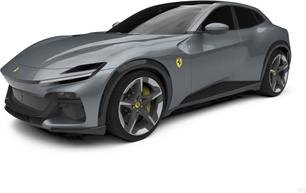
But seeing the Purosangue in the metal has shifted that view a little. Sure, it will compete with models like the Lamborghini Urus, but it doesn’t exactly look like an SUV, does it?
In fact, and this would likely be another dirty word in Ferrari land, it almost looks more like a hot hatch, what with its short rear overhang, swollen body styling and the positioning of each wheel in the furthest possible corners.
But more than that, the Purosangue looks elegant. Aggressive, sure, but still somehow a little understated. And for mine, that’s a huge tick in the positive column.
Unlike some of its competitors, the Purosangue looks like it was designed by adults, for adults, and not by cordial-addled children.
There’s no active aero at work here, with the airflow instead built into the design. Like the openings at either side of the front end, which channel air past the front tyres, or the positioning of the rear spoiler, which pushes air down over the rear windscreen so effectively there's apparently no need for a rear windscreen wiper.
Traditionally, interiors have not been Ferrari’s strongest suit, but the Purosangue is a comfortable and premium space to spend time, and the seats and the steering wheel especially, look fantastic.
The tech, though, isn’t perfect. Some of it (like the haptic Engine Start button) is an awesome addition, but while the twin screens for driver and passenger look good, the technology is a little clunky, and simply not as smooth as using a single, centrally mounted screen.
Yes, the Mazda premium SUV range can look a little same-same, but Mazda insists there are critical differences.
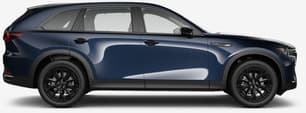
That said, if you can immediately spot the difference between the CX-70 and CX-90 without taking a peek inside, you're doing better than me, given it is the same exact dimensions as Mazda's three-row flagship.
Sure, Mazda talks about things like this design being a “passion pursuer” that serves up "dignified performance” – all of which sounds utterly ridiculous – but the less marketing-speak version is that it looks like a shapely large SUV that ditches the boxy dimensions of a proper 4WD for a more sleek and swooping profile.
Inside, it's a plush and premium-feeling space, with lovely cabin materials, plenty of tech, and plenty of space.
Not the kind of thing you’d normally care about in a Ferrari review, I know, but then this isn’t a normal Ferrari.
So, let’s focus on the back seat for a moment. The Purosangue is a strict four seater. Asked why not just install a bench backseat for more family-friendly practicality, the brand had a quality answer locked and loaded.
The reason, it says, is because a car in this price bracket needs to instil a sense of dignity in every seat, and by installing three across the back row, you don’t just ruin the middle seat, but the two window seats as well, because then everyone is uncomfortable.
It make sense, right? Even if I still harbour suspicions that, by installing just the four seats in the Purosangue, it moves it just a little further from that dreaded SUV tag.
Either way, there is more space in the rear of the Purosangue than you might expect by looking at it. Each rear seat rider can stretch out, with more than enough head and legroom.
And while there, they can access their seat functions and climate control settings through a nifty pop-up rotary dial (front seat riders get one, too).
The rear doors open automatically with a long pull on a lever at the base of the window. Ferrari says the rear-hinged doors serve two purposes, the first being that they allow easier access to the rear seats, and the second being that they look much cooler than regular, boring doors.
The engineers, though, concede making them a reality was a nightmare, with the brand replacing three fastening points with a single massive hinge that emerges from the rear of the body.
There’s more practicality on offer here, too, courtesy of a 473-litre boot space (and more if you flatten the back seats), with a flat load space, and hidden storage beneath it.
The Purosangue measures in at 4973mm in length, 1589mm in height, and 2028mm in width, and it rides on a new spaceframe chassis bespoke to this model.
The CX-70 measures a substantial 5120mm long, 1994mm wide, and 1745mm tall, and it rides on a 3120mm wheelbase.
It will tow 2.5 tonnes no matter which engine you choose, and the expansive boot will swallow between 589 litres and 2015 litres, depending on how you configure the backseat.
All of that space translates to a hugely airy backseat experience, with the second row able to be fixed in a position that either prioritises leg room or boot space.
With the former, you've got tons of space in the second row. I'm 175cm, and my knee and leg room was ample, with only the intrusive tunnel that runs down the middle-centre of the cabin eating into leg room for the middle passenger.
There are also air vents and temp controls, twin USB charge ports, seat heating in the window seats and swathes of very nice materials.
The boot is massive, too. I can't even reach the back of the rear seats when I lean into it, and Mazda says it will swallow smaller surfboard or SUPs without needing to resort to roof racks.
Under-floor storage adds a bit more security for precious items, too.
How much the Purosangue actually costs is something a moot point. Officially, it starts at $728,000, before all your on-road costs.
But Ferrari says every Purosangue will go through its personalisation, 'Atelier' or 'Tailor Made' programs, meaning no two vehicles will be exactly alike, adding significant cost to the sticker price.
But perhaps the biggest issue is that you can’t actually buy one. Ferrari paused orders globally in November last year as it realised its factory capacity had been exhausted by demand.
Right now, all it can say is that, should you want one, you should speak to your dealer, while warning that average global wait times are in excess of 18 months.
Further complicating matters is the fact the brand has issued a production cap on the Purosangue, with the SUV not to exceed 20 percent of Ferrari’s total production volume.
The idea is two-fold. One, Ferrari’s production capacity is limited, and so freeing up space on a factory line isn’t easy. And two, unlike its Italian competition, Ferrari wants to remain Ferrari, not the Purosangue company.
So, this newcomer will produce incremental growth without dominating the entire line-up.
The brand is holding triple-figure orders and expressions of interest in Australia, and though it’s not sure how many cars we’ll actually get, they will begin arriving before the end of the year.
Ferrari in Australia is also yet to confirm exactly what local customers will get, but standard fare internationally includes 22-inch (front) and 23-inch (rear) alloys, leather-and-Alcantara seating (now made from 68 percent recycled materials) in both rows, twin screens (one in the instrument cluster for the driver, and another mounted in the dash directly in front of the passenger), standard Apple CarPlay and Android Auto, a 21-speaker Burmester stereo, automatic-opening rear doors and an automatic boot, seat and steering wheel heating, and an in-seat massage function.
You also get an engine that could power a small city, but let’s circle back to that, shall we?
We'll drill down on this a little more in the practicality section, but it's important to note here that the CX-70 is the same size as the CX-90 – both are 5120mm long, 1994mm wide and 1745mm high — which means the only real difference between the two models is the third row of seats in the CX-90.
And, as it turns out, that's a very expensive pair of chairs. The CX-70 starts with the GT trim at $75,970 before on-road costs for the petrol or $77,970 for the diesel, and then climbs to the Azami trim, which is $82,970 or $84,970.
The CX-90, though, is $82,577 or $85,785 for the GT, or $91,461 or $93,030 for the Azami.
That makes the CX-90's third row at least a $6600 option, but as much as an $8000 upgrade. Mazda has made moves to address this, with a drive-away "plate clearance" that closes that gap, but we suspect those offers will become permanent fixtures to make the jump from 70 to 90 less ferocious.
Anyway, Mazda has thrown just about everything they've got at the CX-70. The GT kicks off with plenty of high-end gear, including 21-inch black alloy wheels, adaptive LED headlights, a panoramic sunroof and a handsfree powered tailgate.
Inside, there are twin 12.3-inch screens with Apple CarPlay and Android Auto, a 12-speaker Bose stereo, leather seats that are heated front and rear, three-zone climate control and a heated steering wheel.
The Azami then adds things like ambient lighting, black Nappa leather seats, which are now ventilated in the front, footwell lighting, body-coloured wheel arches and lower cladding and body-coloured door handles.
Nothing but Ferrari’s best here, with a mid-front mounted V12 engine providing the power, and plenty of rapid forward momentum.
This naturally aspirated 6.5-litre monster produces a total 533kW at 7750rpm and 716Nm at 6250rpm – and climbs to a screaming 8250rpm.
It channels that power to all four wheels via an eight-speed dual-clutch automatic, and a compact and front-mounted power transfer unit that calls the front tyres into action.
It’s a clever solution that allows the Purosangue the grip of all-wheel drive when you’re in fourth gear or below, reverting to rear-wheel-drive at higher speeds.
The reasoning is that you get the lower-speed grip without requiring a heaver permanent AWD solution.
There are more clever things at play here, too. Like a new 'Active Suspension' system that replaces the need for anti-roll bars with motorised adaptive dampers.
Each corner has an electric actuator that can then individually stiffen or soften the suspension as required to keep the Purosangue flat when cornering, or supple on bad road surfaces.
You can also lift or lower the ride height slightly, including for launch control which flatness the Purosangue for maximum aero slipperiness.
You can have one of two engines in the CX-70, with the cheapest being a 3.3-litre, six-cylinder turbo-petrol, producing 254kW and 500Nm. There's also a 3.3-litre, six-cylinder turbo-diesel, making 187kW and 550Nm. Both are equipped with a 48-volt mild hybrid system to marginally reduce fuel use.
All models are AWD, and pair with an eight-speed automatic transmission.
If there’s a fly in this Ferrari’s ointment, we’ve found it. Big V12 engines mean big fuel use, and the Purosangue will require a claimed 17.3L/100km on the combined cycle.
Be warned, though, the Ferrari’s accelerator calls to your right foot like a siren song luring sailors to the rocks, and should you get aggressive with it, I’d suspect your fuel figures to be even higher.
The C02 emissions are pegged at 393g/km.
You might expect a lower score than seven for this section, and I take your point. But for mine, you're buying a vehicle with a huge V12 engine, so you probably know what you're in for, right?
Petrol-powered cars will sip 8.1L/100km on the combined cycle, while the diesel drops that to 5.4 litres.
Both models get a 74-litre tank, meaning a theoretical driving range of around 900kms in the petrol, and almost 1400kms in the diesel.
There’s a reason most supercars aren’t daily drivers, and it’s not always just a financial one.
It’s because they’re the most specialist tools in the automotive toolbox, usually engineered to attack race tracks and alpine roads, but not the school run or bumper-to-bumper traffic.
But you put up with it — the too-firm ride, the questionable ergonomics — because when you do land upon the kind of road your car was built for, any other inconvenience vanishes like traces of smoke from a chimney.
Which is exactly what makes the Purosangue such an interesting proposition, because here is a Ferrari that will likely be driven more, and for longer spells, than any Ferrari to have come before it, but it still needs to excite the senses on the right road.
So has Ferrari pulled it off? In a word, yes.
Honestly, when you’re just tootling around it’s easy to forget you’re driving a supercar.
That V12 engine falls silent, the exhaust is almost non-existent (owing largely to the sound deadening of the cabin – to really hear this beast at full roar you want to crack a window, or find a tunnel), and the suspension (each driving mode has two suspension settings, medium and soft, allowing for some serious fine-tuning of the ride comfort) floats across most road surfaces.
It feels much like any other premium SUV, and not one with a nuclear power plant lurking just ahead of the dashboard.
Because there is a Hyde to this Jekyll, and it arrives when you dial up the sportiness, or get a little too heavy with the accelerator. Then that big V12 roars into life, along with the exhaust, and suddenly you’re very much behind the wheel of Ferrari once again.
Engage launch control and you can feel the Purosangue hunker down, dropping lower onto the wheels and readying for action. Flatten your right foot, and 100km/h arrives in a claimed 3.3 seconds, with 200km/h flashing by in 10.6 seconds.
But there is a quirk here, and that is that the Purosangue doesn’t always feel blisteringly fast. It's powerful, sure, and plenty quick, too, it's just that somehow it doesn't always feel quite as fast as the spec sheet suggests.
Maybe it’s the theatre, or all in my mind, but I reckon the best way to experience the all-out performance is by taking over the gearing yourself, and listening to the machine-gun-popping of the rev limiter before squeezing the paddle shifter, to truly feel like you're unlocking every ounce of performance on offer.
Is it the sharpest Ferrari ever built? Obviously not, and even a carbon-fibre roof can’t compensate for the over 2.0-tonne weight here.
But I promise, should you find yourself on a twisting road, the Purosangue can paint a supercar-sized smile on your face just the same.
The steering isn't quite as sharp as it might be in a true supercar (I suspect its been softened to make the Purosangue more comfortable on freeways and over longer distances), but it still inspires plenty of confidence, while the the rear-wheel-steering helps tuck you nearly into corners before that big engine drags you out the other side, that operatic exhaust bellowing along with you.
A real Ferrari? You bet.
Interestingly, the CX-70 has been tagged as the expected smallest seller of Mazda's premium SUV range, but I reckon it just might be the pick of the bunch.
Every one of the CX-0 models (60, 70, 80 and 90) all get slightly different suspension tunes, and while you can find harsh edges in the other models, the CX-70 feels utterly composed and refined, at least on the smooth-ish roads of our launch test route.
Perhaps most surprising, though, is the CX-70's ability to hold its own on a properly twisting road. We expected lots of weight transfer and the high-pitched sounds of tyres screaming out in pain, but instead found Mazda's massive SUV served up grip, composure, and very little in the way of sea-swell-style body roll.
The two big six-cylinder engines also feel perfectly suited to a vehicle in this space. There's tons of power whenever you need it, and solid levels of refinement in terms of engine noise or diesel rattles.
For mine, the petrol engine is the pick though, feeing just a little smoother than the diesel option. The latter can feel a bit jerky at slower speeds, whether that's the power delivery or the gearbox, and it doesn't seem to happen with the petrol engine.
The biggest caveat, though, is that we haven't driven the CX-70 in its natural environment, the city and suburbs, so while it largely shone on flowing country roads, how it performs on roads like the ones near your place remains a bit of a mystery.
The Ferrari Purosangue has not, and surely will not, be independently crash tested, but does arrive with a pretty stacked suit of safety kit, including AEB, adaptive cruise control, lane keeping assist, blind-spot monitoring, rear cross-traffic alert, traffic sign recognition and hill descent control.
The CX-70 hasn’t been ANCAP tested, but it does arrive with a pretty stacked safety offering, including a 360-degree-view camera, blind-spot monitoring, front and rear cross-traffic alert, and a total of eight airbags, including a knee airbag for the driver.
Every Ferrari arrives with a three-year, unlimited kilometre warranty, with the option of extending coverage for up to seven years at the point of purchase.
Also available is Ferrari's 'Power20' coverage, which covers the engine, gearbox, transmission and all other major mechanical and electronic components for 20 years from the point of purchase.
The recommended service interval is 12 months/20,000km, and there's also a seven-year capped-price servicing program, called '7-Year Genuine Maintenance', which allows you to prepay for all your servicing needs.
Servicing is not particularly cheap in the CX-70, and the service intervals, at least in the diesel, feel a little short, too.
Buy that one, and you’ll be visiting the dealership every 12 months or 10,000kms, and the first five years of ownership will cost you $3298.
Petrol cars require servicing every 12 months or 15,000kms, and five years will set you back $3436.
The CX-70 is also covered by Mazda's five-year, unlimited-kilometre warranty.