What's the difference?
You want a V12 Ferrari, but you have growing responsibilities. A strictly two seat supercar just isn't quite right when kids start to arrive.
Sure, you can add a Ferrari F12 to your collection, and pick up a Merc-AMG family truckster to cover the functional stuff.
But it's not the same. You want to have your Italian torta, and eat it, too. Enter the Ferrari GTC4Lusso, the prancing horse’s latest take on a rapid, luxurious, four seat coupe, able to leap continents in a single bound without so much as a bead of perspiration forming on its forehead.
It's fast, suitably furious, and able to accommodate family or friends on a fast blast to anywhere you choose to go. And as usual with Maranello’s finest, the name says it all.
'GT' stands for Gran Turismo (or Grand Tourer), 'C' is short for Coupe, '4' relates to the number of people it accommodates, 'Lusso' means luxury, and of course, Ferrari is Italian for fast.
I think auto journalists are supposed to see vehicles a bit like parents see their children. You know, view them all as equals. No favourites. That kind of thing.
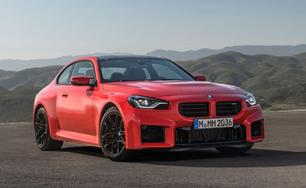
But I'm going to let you in on a tiny little secret, just between us. I liked this potent M2 before I even sat in it. And I like it just a little bit more than I love other bite-sized performance cars.
In fact, I like it more than I like bigger, more powerful, and more expensive models in the BMW M family.
The Ferrari GTC4Lusso is a properly fast, beautifully composed, and supremely luxurious four-seat coupe.
Sadly, evermore stringent emissions regulations have put atmo V12's on the knife edge of extinction, with Ferrari, Lamborghini, Aston Martin and a few others hanging on for grim death.
In fact the twin-turbo V8 Lusso T (powered by the same engine used in the California T and 488) will arrive and be sold alongside this car in Australia later this year.
But we’d like to propose a captive breeding program to keep the big V12s alive because this engine’s soundtrack and the GTC4Lusso’s overall driving experience is magnificent.
Proving good things still come in small packages, the pint-sized M2 remains my pick of the BMW M range. It's not the perfect daily drive, but I reckon the fun outweighs the foibles.
Revealed to the world at last year's Geneva motor show, the GTC4Lusso is a substantial evolution of the out-going FF, and follows classic Ferrari GT form, with a glorious, 6.3-litre, naturally aspirated, V12 sitting majestically in its nose.
The car's proportions echo that configuration with a long snout and rear-biased, gently tapered cabin maintaining essentially the same silhouette as the FF. But Ferrari has remodelled the nose and tail; tweaking the aero detailing at the same time.
There's a host of new vents, ducts and louvers contributing to a claimed six per cent improvement in drag coefficient.
For example, the diffuser is a work of aerodynamic art, following a keel shape, with vertical fences channeling air flow towards the centre to reduce drag and increase downforce.
A wide, single-piece grille dominates a smoother front end that moves from upright to a distinct forward lean, with a neat chin spoiler enhancing the racier look.
Larger, triple-blade vents in the front wings add more aggression, and the treatment of the rear side glass and tailgate have been refined and simplified.
Always a subjective call, but we think the restyling work, done in-house by Ferrari Design, has made an already distinctive car even more appealing.
Ferrari says the interior was developed around a 'dual cockpit' concept, to “enhance the shared driving experience”, and the cabin is beautiful.
There's a new 10.3-inch colour touchscreen, with the interface for the climate control, sat nav and media all refreshed. It's backed up by a more powerful 1.5Ghz CPU with 2GB of RAM, and it’s much, much better.
'Our' car also boasted the optional ($9500) 8.8-inch ‘Passenger Display’ incorporating performance read-outs, and now, the ability to select music and fiddle with the nav.
The attention to design detail and the quality of its execution is breathtaking. Even the slender sunvisors in our test example were hand-stitched leather. And the pedals are drilled alloy. Not alloy covers, or some other faux creation – real aluminium, right down to the passenger footrest pad.
There have been mixed reviews of the design of the BMW M range, but I reckon this one looks pretty damn good. In fact, I've always thought this kind of hyper-aggressive styling looks better on smaller cars than it does on big ones.
And it certainly is aggressive, right? From the huge bonnet bulges to the meshed out grille and angry rear diffuser, to the staggered alloys and flared wheel arches, to the blocky rear end with its four massive exhaust exits.
But my favourite exterior item has to be the blacked-out carbon roof, which helps shrink the M2 visually, and makes the whole car look more potent.
Inside, it's plenty sporty feeling, with hard-backed sports seats, lashings of carbon-fibre-look trimmings and the bright red M buttons on the steering wheel.
It's nice, but some of the touch points – like the hard plastics on top of the doors, where, if you're like me, you rest your elbow when driving – feel less than premium.
Still, all the tech is present and accounted for, with its digital dash and huge centre screen, and there's no shortage of spaces to connect or charge your phone.
For once we can mention Ferrari and practicality in the same breath because the Lusso offers generous accommodation in the front and rear. Forget '2+2', the back seats are for grown-ups.
With all its drive and dynamic tech on board it's hard to think of a more elegant and capable four-seater for your next trip to the chalet for a cheeky weekend skiing off piste.
In fact, Ferrari says the FF attracted a new, younger batch of owners that make greater use of their cars.
Admittedly, Ferraris don't generally rack up huge kays, but clocking mileage 30 per cent higher than average is significant.
Front seat passengers slip easily into generous and intricately sculpted sports seats, with slim map pockets in the doors and space for bottles, a single large cupholder in the substantial centre console, as well as a lidded storage box (which doubles as a centre armrest) housing 12 volt and USB outlets.
There's also a decent-sized glove box, and a second tray sits further towards the dash to store your black credit cards, Vertu phone(s), and assorted jewellery. Its leather trimmed, double-door closure is reminiscent of the finest Milanese cabinet.
The long, leather-wrapped transmission tunnel continues uninterrupted through to the back, dividing the individual rear bucket seats. A pair of jet fighter style vents sit in the centre, slightly ahead of another two cupholders and a small oddments box containing additional USB ports.
But the big surprise is the amount of head, leg and shoulder room on offer back there. The door aperture is enormous and the front seats quickly tilt and slide forward with the flick of a single handle, so entry and egress is relatively easy.
It's an ultra-comfortable and relaxed place to be, and at 183cm I could sit behind the front seat set to my position with heaps of headroom and three to four centimetres of knee clearance. Finding space for your toes under the front chair is more of a challenge, but an extended journey in the back of the Lusso would be fine.
The only caveat there is the test vehicle’s optional 'Panoramic Glass Roof' ($32,500!), which essentially removes the roof lining, and it would be interesting to sit in a car without it.
Cargo space is real-world useful, with a substantial 450 litres on offer with the rear seats upright, and a full 800 litres available with them folded down.
There’s no spare tyre; a 'can of goo' repair kit being your only option.
The M2 pocket rocket measures just over 4.5m in length, just under 1.9m in width, and just over 1.4m in height, and it rides on a 2747mm wheelbase. That makes it longer, wider and lower than the model it replaces.
Remember that 'lower' bit, as it will come up again in a moment.
Up front, you don't feel cramped, and there's the requisite cupholders, door pockets and hiding holes, as well as wireless device charging and USB connections.
But remember, this is a two-door, four-seat affair, which cuts into the practicality a little, or a lot.
Swing open the wide front doors, and push the front seat-back forwards, and the entire chair will slide forward automatically.
It does help create more room to climb into the back, but it's still a slightly embarrassing challenge to make getting back there look anything like graceful.
Once there, it's tight. I'm 175cm and my head was firmly pressed into the roof.
You do get your own vents and temp controls, but that's about it. Even the pull-down divider only gives you access to the 390-litre boot, rather than extra cupholders.
You do get two sets of ISOFIX attachment points, though, and let's be honest – if you're buying this to make Bunnings runs, you've probably got it wrong.
At $578,000, the GTC4Lusso is in serious money territory, and as you’d expect, the standard features list is equally imposing.
Highlights include, bi-xenon headlights with LED indicators and daytime running lights, LED tail-lights, 20-inch alloy rims, electric cargo door, front and rear parking sensors plus rear parking camera, cruise control, dual zone climate control air, integrated peripheral anti-theft system (with anti-lift), keyless entry and start, the 10.3-inch touchscreen interface managing 3D navigation, multimedia and vehicle settings, eight-way adjustable electric seats with heating, pneumatic bolsters and lumbar adjustment, plus three memories, carbon ceramic brakes, electric steering column adjustment with memory and ‘easy entry’ function, a tailored car cover and even battery conditioner.
And that’s before you get to the 'usual' stuff like a herd’s worth of leather lining the interior, cranking nine-speaker audio system, electric windows and mirrors, and all the dynamic and safety tech we’ll get to shortly.
Then, there’s the options list.
There’s a persuasive theory that says once you cross a certain car purchase dollar threshold, let’s say $200k, those options had better be pricey or owners won’t have anything to brag/complain about when introducing their latest acquisition to colleagues in the yacht club car park.
“You know how much that sunroof cost me… just the sunroof? Yep, 32 grand… I know, right!”
By the way, the price of that ‘Low-E’ glass roof will buy you a Subaru XV Premium that Richard tested recently… complete with standard sunroof!
Short story is ‘our’ car featured $109,580-worth of extras, including the roof, forged rims ($10,600), ‘Scuderia Ferrari’ shields on the fenders ($3100), ‘Hi-Fi premium’ audio ($10,450), and a (must have) front and rear suspension lift system ($11,000).
The carbon-rich steering wheel with F1-inspired LED shift lights is a lazy $13k, and the super-cool enamel badge under the lip of the rear spoiler is $1900.
You can point fingers and feign shock at numbers like these, but it all goes to the ultimate personalisation process that is the Ferrari purchase experience; to the point where the factory is now installing a sizeable plaque in each of its cars, listing the options fitted and confirming its original specification for evermore.
First, the bad news. The M2 has only been getting more and more expensive over the years, and this new-generation model continues that charge.
Fun fact: When we first tested this model way back in 2016, you could get the Pure grade for less than $90K with a manual transmission.
Or you could spend just under $100K for the full-fruit version. This one, though, lists at $121,700, before on-road costs.
So, a little less bang for buck, but there's still a whole lot of bang on offer here.
You'll find staggered 19- and 20-inch lightweight alloys, while standard performance kit includes an 'Active M Differential', 'Adaptive M Suspension', 'M Compound Brakes' (with blue calipers), 'M Sport Seats' up front and, for the first time, a lightweight 'M Carbon' roof.
Elsewhere, there's adaptive LED headlights, a 12.3-inch instrument display and a 14.9-inch multimedia screen, a head-up display, a Harman Kardon 'Surround Sound' audio system and Android Auto and Apple CarPlay connectivity.
You'll sit on leather seats that adjust electrically and are heated up front. There's three-zone climate control, along with a heated steering wheel, wireless device charging and ambient interior lighting.
The Lusso is powered by a 6.3-litre, 65-degree, naturally aspirated V12 producing a monumental 507kW (680hp) at 8000rpm and 697Nm at 5750rpm.
It features variable valve timing on the intake and exhaust side, the rev ceiling is a lofty 8250rpm, and revisions from the FF installation include redesigned piston crowns, new anti-knock software, and multi-spark injection, for a four per cent gain in power and two percent rise in maximum torque.
Also new for the Lusso is the adoption of six-into-one exhaust manifold with equal length pipes and a new electronic bypass valve.
The Lusso features an insanely rapid-shift, seven-speed 'F1 DCT' dual-clutch transmission, working in parallel with Ferrari’s new and improved '4RM-S' system, which combines all-wheel drive, and now, four-wheel steering to enhance power down and dynamic response.
The drive and steering tech is integrated with Ferrari's fourth-gen side slip control, as well as the 'E-Diff' electronic differential and 'SCM-E' suspension damping syste.
Besides, this is what we're really here for, isn't it? The M2 gets the 'M TwinPower' 3.0-litre twin-turbo inline-six engine, producing a sizeable 338kW and 550Nm, sending that power to the rear wheels via an eight-speed auto or six-speed manual.
BMW says this engine is very, very close to the engine that powers the M3 and M4, and says it will rocket the M2 from 0-100km/h in 4.1 seconds, and to 200km/h in either 13.5 seconds in the automatic, or 14.3 seconds in the manual.
In case you're interested - and if a Lusso is genuinely on your shopping list, you're almost certainly not - claimed fuel consumption is reassuringly voracious.
Ferrari’s claimed figure for the combined (urban/extra urban) cycle is 15.0L/100km, emitting 350g/km of CO2 in the process. And you'll need 91 litres of premium unleaded to fill the tank.
A small fly in the ointment is fuel use, with the M2 said to use 9.7L/100km on the combined cycle. It also drinks 98 RON premium, and is home to a 52-litre fuel tank. Your theoretical driving range is around 540km.
Now, be warned, you'll be bored stiff if you drive it in the way that's required to get it that low. When we were being gentle, we were somewhere between 10.5 and 11.5 litres per hundred kilometres.
Emissions are pegged a 220g/km of C02.
Although the big V12's maximum torque doesn’t arrive until close to 6000rpm, 80 per cent of it is available from just 1750, and that means the Lusso is flexible enough to dawdle around town or storm towards the horizon with massive acceleration available via a single twist of the right ankle.
We were able to burble up more than gentle inclines (at reasonable speed), in seventh gear, with the engine more or less ticking over at 2000rpm. In fact, in auto mode, the dual clutch is always keen to march towards its highest ratio.
But if the mood is a little more urgent, despite its substantial, 1.9-tonne kerb weight, (with the help of ‘Performance Launch Control’) this family-friendly force of nature can storm from 0-100km/h in just 3.4 seconds, 0-200km/h in 10.5, and on to a staggering maximum velocity of 335km/h.
From a gruff blare on start-up, through a muscular bellow in the mid-range, to a heart-pounding howl at the top end, pushing the Lusso towards its 8250rpm rev ceiling is a special event… every time.
Channelling all that forward thrust into lateral force is the job of the double wishbone front, multi-link rear suspension, with magnetic dampers and other electronic gee-whizzery in support.
Despite the 4WD system, weight balance is an ideal 47 per cent front, 53 per cent rear, with the 'SS4' torque vectoring set-up distributing torque to the front axle when required even faster than the FF.
The 20-inch Pirelli P Zero rubber grips like a Donald Trump handshake (as do the sports front seats), and the monster brakes - ventilated carbon discs front and rear - are mega.
Even in tight, first gear corners the Lusso turns in quickly and progressively thanks to the four-wheel steering and excellent electric assistance set-up, remains neutral mid-corner and slams its power down on exit.
Switch the wheel-mounted Manettino dial from 'Sport' to 'Comfort' and the Lusso settles into an impressively supple mode, deftly soaking up even sharp imperfections.
In short, this is a big beast, but point-to-point, it's a fearsomely rapid, surprisingly agile and hugely entertaining drive.
Let's be totally up front here: the BMW M2 isn't the most comfortable vehicle to live with. In fact, I recently climbed out of the M3 Touring, and found that to be more comfortable on broken city streets.
The M2 is fitted with adaptive suspension, but even in its most comfortable settings it can feel rough, bumpy and jarring on bad roads (of which Australia has lots), and unless you're gentle with the accelerator, it can feel a little jumpy when first taking off – a by-product of its prodigious power.
Now, let's be totally up front again: I don't care. The M2 is fun, plain and simple, and for mine, the above is a fair price to pay for something that brings so much joy.
The steering is lovely, the power immediate and the soundtrack intoxicating, and it's the kind of car that's fun no matter where, how far or how fast you drive it.
In fact, fun seems to be the very centre of the M2 proposition, which definitely doesn't take itself too seriously.
For evidence, look no further than the 'M Drift Analyser', buried in a hopelessly busy multimedia system that will have you praising the CarPlay and Android Auto gods.
It will rate your best drift out of four stars, measure it for distance, and basically give you a pat on the back for doing your best hooligan impression (not on a public road, of course).
Fun, then, is the order of the day here. And I bloody love it.
You could easily characterise the Lusso’s entire drivetrain as one big active safety system with the all-wheel drive, four-wheel steering, side slip control and E-Diff keeping even the most determined attempts to overdrive the car under control.
Add in ABS, EBD, 'F1-Trac' traction control, and tyre pressure monitoring system, and it's safety fast all the way. But a big black mark has to sit next to the lack of AEB.
If you do manage to overcome all of that and engage in a crash, there front and side airbags for the driver and front seat passenger, but no curtains front or rear. Sadly, not good enough for a car in this performance and price bracket. There are ISOFIX child restraint location anchors in each of the rear seat positions though.
The GTC4Lusso has not been tested by ANCAP.
The BMW M2 hasn't been assessed by ANCAP, but it arrives with six airbags, as well as all your usual traction and braking aids.
Elsewhere, you'll find lane change and lane departure warning, active cruise control, front and rear parking sensors, tyre pressure monitoring, and AEB with pedestrian detection.
There's also blind-spot monitoring, rear cross-traffic alert and lane centring assist, as well as a tyre-pressure monitoring system.
Ferrari offers a three year/unlimited km warranty, the latter part of that equation being somewhat hilarious because most Ferraris don't travel very far… ever.
Service is recommended every 12 months or 20,000km, and the seven year 'Genuine Maintenance' program covers scheduled servicing and labour along with genuine parts, oil and brake fluid for the original owner (and subsequent owners) for the first seven years of the car's life. Brilliant.
The BMW M2 is covered by a five-year, unlimited kilometre warranty, and servicing is 'condition based', in that the vehicle will tell you what maintenance is required, and when.
You can prepay your service costs at the time of purchase for all BMW vehicles, covering the first five years of ownership, for $3480 (which means $695 per service).