What's the difference?
If you’ve clicked on this thinking, “What’s a Farizon?” you're probably not alone.
Farizon is yet another sub-brand of Chinese giant Geely which owns brands like Volvo, Polestar, Lotus, Smart and Zeekr, among others.
This new brand is an electric commercial vehicle specialist that arrived in Australia earlier this year thanks to Saudi Arabia-based distributor, Jameel Motors. Sales are currently only offered in Queensland through Farizon’s website, though a dealer network is being developed with a priority of the eastern seaboard.
The Farizon SuperVan is the company’s first offering in Australia, alongside an electric light truck called the H9E. This electric mid-size van is a rival to the likes of the LDV eDeliver 7, Peugeot E-Expert and Volkswagen ID. Buzz, as well as the forthcoming Ford E-Transit Custom.
How does it stack up? Read along to find out.
Mercedes has long been the leader in niche filling, and we’d argue that no other model encapsulates that more than the CLA four-door coupe.
Now in its second-generation form, the CLA is based on Mercedes’ MFA2 small car platform that also underpins the A-Class small car range, B-Class tallboy hatchback and GLA crossover, but is actually dimensionally longer than the one-size up C-Class.
However, while the C-Class might offer more conventional styling, Mercedes says the CLA is targeted towards a younger demographic that puts more weight on design and aesthetics.
The previous generation CLA was topped by a hardcore 45 version, which makes a return here, but new this time around is the less-potent, but still AMG-badged, 35 variant to plug the gap between mainstream grades and the range-topper.
After living with the car for a week, here are our thoughts on the new baby AMG CLA.
You’d think Farizon would be onto a winner given it has created a van with cool looks and the packaging benefits that come with a dedicated EV architecture. However, the SuperVan left a sour taste in my mouth.
There are good bones here, but Farizon has a long way to go with fixing the electric motor whine and safety systems.
It’s great the company is aware of the SuperVan’s shortcomings and is currently working on software updates, but it begs the question, why wasn’t it good in the first place?
Is the Mercedes-AMG CLA 35 the perfect choice in the sleek sedan’s line-up?
Well, if you are after outright performance, then the answer still clearly lies with the CLA 45. But for those that just want a little more pep compared to the standard CLA range, the 35 is undoubtedly the one to get.
It’s not without its flaws, though, commanding a $15,000 price premium over the CLA 250 and a tougher-than-we’d-like ride, but if you value a more engaging drive and a brisk 0-100km/h time, the CLA 35 should definitely be on your shopping list.
This electric van makes a fantastic first impression with its design. It’s futuristic and stands out on the road.
I haven’t driven a car that gets this much attention in a fair while, which is wild given this is a delivery van and traditionally they’re some of the dullest vehicles out there in terms of design.
What makes the SuperVan stand out the most is the variety of colours it comes in. Sure, you can get standard white if you want, but there’s also grey, green and blue. Our tester is finished in the latter which looks cool and modern.
The front continues the futuristic theme with a bright LED lighting signature for the headlights. They’re connected by an LED light strip, as well as an illuminated Farizon badge.
Given this van is electric, it doesn’t need a large, traditional grille to keep an engine cool. Instead there’s a small slotted opening at the bottom of the front bumper to cool the electric motor and high-voltage battery. It’s cool Farizon has made this van obviously look electric with this cue.
Beyond the stylish aero covers for the 16-inch steel wheels, there really isn’t much to talk about in terms of side profile design. It’s very slab-sided which is a classic van look.
It also leans into the trope that vans are essentially boxes on wheels. This is no bad thing because at the end of the day, a van is a work vehicle that’s meant to maximise hauling potential.
At the rear, this version of the SuperVan with the ‘Low Roof’ body style is perfectly square. It looks a little funny, but again this is a work-oriented vehicle that’s the opposite of a mullet - business at the back, party at the front.
Inside, Farizon has made a big attempt to make this electric van look luxurious and contemporary. Having synthetic leather seats is a luxury that many vans don’t have, along with the big digital instrument cluster and touchscreen multimedia system.
I’m a fan of the orange highlights around the cabin as they break up the monotonous black finishes.
Once you sit in the cabin, however, the commercial roots do begin to show. Virtually every surface is rock-hard plastic, which in a way is good because it means it’ll be hard-wearing in the long run.
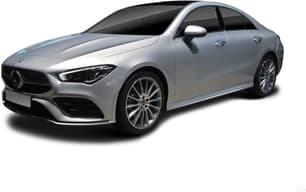
From the front, the CLA 35 exterior oozes style and luxury.
Up front, the sleek and slender headlights emphasise the width of the fascia, while the large Mercedes logo sits proudly front and centre of the CLA’s nose.
There are subtle hints to the CLA 35’s sportiness too, with a slightly bulging bonnet and chiselled lower chin.
The grille is also unique on the 35, with a dual-horizontal slat design instead of the non-AMG CLA’s diamond pattern or the CLA 45’s Panamericana grille.
To my eye, the front of the CLA 35 is actually a bit too tame in styling for an AMG model. I prefer the in-your-face aggression of the CLA 45’s widened track and front grille, while the CLA 35 opts for more subtle styling cues. To each their own, though.
The silver paintwork of our test car probably doesn’t help, and if it was my choice I'd pick 'Sun Yellow' or 'Denim Blue' to stand out a bit more from the sea of black, grey and white German cars out there.
Move to the rear of the car though, and a large rear diffuser, big dual-exhaust outlets and a bootlid spoiler are much more befitting an AMG model.
Step inside the CLA and you will see it adopts the same dashboard design as all new-generation Mercedes vehicles built on the MFA2 platform, with the 'MBUX' dual-screen layout, large air-vents and central touchpad.
Our car was specced out with red-leather interior, which is a bit too loud for my tastes, but a two-tone black leather/titanium grey combo can also be had at no extra cost.
Sitting inside the CLA 35, you can tell it’s a modern car thanks to the clean layout of all the controls, while the screen-heavy dashboard definitely makes it feel tech-focused.
While good looks can get you so far, cabin practicality is where things are a little mixed for the SuperVan.
The driver’s seat is generally comfortable, offering a decent amount of support and a centre armrest, but the driving position is heavily compromised.
The worst offender are the pedals as they’re mounted so high that I need to take my foot off the floor to press them. Then the steering wheel only offers tilt adjustment and not reach.
As a result I need to have the seat pushed further back than I’d like to make sure I can press the pedals without making my right ankle hurt in stop-start traffic. Then even with the backrest virtually upright I still need to have arms extended almost fully to reach the wheel.
It’s not the kind of place I’d like to spend a considerable amount of time, which is disappointing because many people who drive this van will likely spend hours behind the wheel at a time.
Thankfully both seats offer both heating and ventilation, which is rather luxurious.
Ahead of the driver, the steering wheel is wrapped in buttery soft synthetic leather, like the seats, and is nice to hold. I appreciate the amount of physical buttons on it. They’re all clearly marked and easy to click.
The steering wheel is also heated and gets hot super quickly. There’s only one setting – on or off.
The digital instrument cluster looks flashy and has a range of informative pages you can cycle through. One even displays a vehicle weight page which is great if you’re unsure if you’re close to the gross vehicle mass (GVM).
Moving across, the touchscreen infotainment system looks glossy and high-definition, but there’s not much to do on it. This also means it’s hard to get lost and even if you do there are shortcut buttons on the right-hand side of the screen.
As standard there’s wireless Apple CarPlay connectivity which is great if you’ve got an iPhone, but terrible if you have an Android phone. This car has no Android Auto support whatsoever.
It’s great to see a continued use of physical switchgear around the cabin for things like the drive modes, regenerative braking settings and most notably the climate control settings. The latter are big and chunky, meaning they’re hard to miss.
In terms of storage up front, it’s fairly mediocre beyond big door pockets. There’s a slide out drawer with two cupholders and another small storage section, as well as another small storage drawer and a glovebox.
Around the side you'll find one of this van's most unique features. When you open up the passenger side front door and slide open the side cargo door, you’ll see this van doesn’t have a B-pillar. There’s only a plastic partition between the passenger and cargo areas.
As a result, the seatbelt for the passenger is mounted on the door. This feels a bit weird in the passenger seat because the seatbelt cuts across more than usual and doesn’t rest on your shoulder.
The SuperVan only comes with a single sliding door. You can’t opt for one on the driver’s side in Australia which is a little disappointing from an ease-of-use standpoint.
At the back there are rear barn doors that have stops at 90 degrees and 180 degrees, before opening all the way up to 270 degrees. This is great because you’ll be able to put whatever is on a forklift into the cargo area.
Speaking of the cargo area, it’s massive. This SWB Low Roof version measures in at 2690mm long, 1795mm wide and 1440mm tall. This equals 6.95 cubic metres, which is considerably more than any similarly sized van, whether that be diesel or electric.
It’s another major benefit of this van being built on a dedicated electric vehicle architecture, rather than a combustion platform that needs to take drivetrain and exhaust components into account.
Payload is 1300kg which is fairly standard for mid-size electric vans.
I like how low the load lip is at the back. This means you don’t have to lift things too high in order to get them in the cargo area.
In terms of amenities there are some lights, tie-down points, as well as three powerpoints for vehicle-to-load (V2L) support at up to 3.3kW. Disappointingly the latter didn’t work in our tester no matter how hard I tried…
Surprisingly under the cargo area is a full-size spare wheel. This is incredibly rare for an EV, especially one that’s all about maximising cargo capacity. It’s great peace of mind if you do long-distance travelling.
Measuring 4695mm long, 1834mm wide, 1399mm tall and with a 2729mm wheelbase, the CLA 35 is definitely a sizeable sedan in the metal.
This actually makes the CLA 35 slightly longer and wider than a non-AMG C-Class sedan that measures 4686 and 1810mm respectively, but don’t expect the same level of practical interior space.
With a heavily sloped roofline, rear-seat comfort takes a hit. My 183cm (6.0ft) frame could not sit upright behind my driving position without tilting my head, while legroom was also slightly lacking.
With such large C-pillars and a small rear window, the second-row can actually feel a little claustrophobic for full-sized adults, but will seat children quite comfortably.
Second-row amenities include air-vents, two USB-C ports, back-of-seat storage nets, bottle holders in the doors, and two cupholders in the fold-down arm rest.
Just like at a music concert though, the best seats in the CLA 35 are up front, with plenty of room for heads, shoulders and legs.
The cabin is also much more light-filled up front, making for a more pleasant experience.
The front seats are electronically adjustable, as is the steering column, but the headrests are fixed.
Storage options include sizeable door bins, a centre console cubby, glove box, two cupholders and a wireless smartphone charger.
Boot space is 460 litres, but can expand with the rear split-fold 40/20/40 rear seats stowed.
Though the boot looks small and shallow on the outside, the aperture is actually quite large, and can easily accommodate a large suitcase with plenty of room to spare.
The Farizon SuperVan is being offered in Australia in three trim levels. On test here is the entry-level short-wheelbase (SWB) Low Roof option.
Pricing for this variant starts at $71,490 before on-road costs. It’s worth noting that this is for private buyers. If you’re an ABN holder or are buying a fleet of SuperVans, pricing will likely be different.
This is more affordable than the Ford E-Transit Custom, Peugeot E-Expert and Volkswagen ID. Buzz Cargo, but the LDV eDeliver 7 is cheaper again. However, that rival Chinese electric van isn’t built on a dedicated electric platform and doesn’t offer as much range.
As standard the SuperVan comes with a plastic cargo partition, a single sliding side door, as well as rear barn doors that swing up to 270 degrees. You can’t option any other configuration, currently, beyond different wheelbase lengths and heights.
Standard equipment across the line-up includes LED headlights, a 7.0-inch digital instrument cluster, a 12.3-inch touchscreen multimedia system with wireless Apple CarPlay, a heated steering wheel, as well as heated and ventilated synthetic leather seats.
This is generous for a commercial vehicle that’s going to be a workhorse and will need to stand the test of time.
Priced at $85,500 before on-road costs, the CLA 35 sits $15,300 upstream of the CLA 250 but is $25,700 cheaper than the $111,200 CLA 45.
Standard equipment includes leather interior, dual-zone climate control, electronically adjustable front seats with heating and memory function, keyless entry and push-button start, 64-colour ambient lighting, and a wireless smartphone charger.
AMG specific appointments include 19-inch wheels, a flat-bottomed steering wheel, sports exhaust, high-performance brakes with silver-painted calipers, blacked-out exterior highlights, sports suspension, a racy bodykit and speed-sensitive steering.
Instrumentation is displayed on a 10.25-inch screen, which can be customised and features AMG readouts.
The multimedia system, which includes satellite navigation, digital radio and Apple CarPlay/Android Auto connectivity, is also outputted to a 10.25-inch screen, with inputs including touch, voice commands, centre touch pad or steering wheel controls.
Our test car also came with a ‘Mojave Silver Metallic’ paint finish and 'Vision Package', adding $1190 and $990 to the bottom line each.
The Vision Package adds LED headlights with adaptive high beams, a panoramic glass sunroof and surround-view monitor.
Straddling the lines between a small- and mid-size sedan, the CLA 35 doesn’t really have any direct competitors, which is reflected in its pricing that slots it between the Audi S3 and S4 sedans.
Though the CLA 35 features a long list of equipment, it is still a sizeable chunk of coin, costing more than the C300 sedan and Volvo S60 T8 PHEV, the latter boasting higher engine outputs.
All versions of the Farizon SuperVan in Australia are powered by a single, front-mounted electric motor that produces 170kW and 336Nm.
This is fed by an 83kWh lithium iron phosphate (LFP) battery which is sourced from Chinese battery producer CATL.
Farizon doesn’t quote an official 0-100km/h time, though it claims the top speed is 135km/h.
Powered by a 2.0-litre, turbo-petrol four-cylinder engine, the CLA 35 punches out 225kW/400Nm.
Drive is sent through a seven-speed dual-clutch automatic transmissions to the road via Mercedes’ '4Matic' all-wheel-drive system, enabling a 0-100km/h sprint in the 1603kg sedan in just 4.7 seconds. Top speed is electronically limited to 250km/h.
Though I didn’t get a chance to test the latter, the former certainly feels accurate when taking off from a freeway on ramp, however, there is some hesitation from the turbo in getting on boost.
Peak power comes in at 5800rpm, while maximum torque is available from 3000-4000rpm.
Claimed range for the SuperVan depends on the body configuration, but it’s up to 376km according to WLTP testing for the SWB Low Roof body style.
The battery pack can be DC fast-charged at rates up to 140kW, which would see the battery charge from 20 to 80 per cent in 36 minutes.
The battery pack can also be AC charged at rates up to 11kW, which would see the battery charge from 15 to 100 per cent in seven hours.
The SuperVan also offers vehicle-to-load through Australian domestic household plugs at up to 3.3kW of continuous power. This allows you to use the van’s battery pack to power appliances, tools, or other emergency backup systems.
Farizon doesn’t quote an official energy consumption figure for the SuperVan, but during my unladen testing I saw an average of 23.5kWh/100km, which would give a theoretical range of 350km. This would likely drop with a heavier load onboard.
Officially, the CLA 35 sips 7.5 litres per 100km on the combined cycle, but we managed a 9.9L/100km figure in our week with the car.
The majority of our driving was done in inner-city environments, with the two trips down the freeway to seek out twisty country rounds.
Minimum fuel grade in the CLA 35 is 98 RON.
Driving this van is punishing. It’s quite unlike any other modern van I’ve experienced as they can be fun to drive. This SuperVan, however, leaves me feeling like a lot of the elements need finessing.
First up there’s the electric motor. It makes a decent amount of power and easily gets this big box on wheels moving. In Sport mode the front wheels can get overwhelmed if you’re not careful.
However, this van has an incredibly loud electric motor whine. It builds as you gain speed, then once you reach your desired speed it hovers at an annoying high pitch. Some extra sound deadening would likely help.
Additionally, there’s a pedestrian warning sound that plays under 25km/h, as well as a beeping tone when reversing. While this is common for EVs, this one feels like it’s louder on the inside rather than the outside. This somewhat defeats the purpose.
There are three levels of regenerative braking as standard and all of them require you to use the brake pedal to come to a complete stop. This means there’s no one-pedal driving mode.
With all the settings the regen braking is either completely on or off. There’s no in between which creates a thrashy feeling in the cabin, especially when travelling down a hill and you’re trying to coast along without activating regen braking too much. As a result, I like the weakest regen setting the most.
Surprisingly the interaction between the regenerative braking and the traditional friction brakes is rather seamless. Even the brake pedal feels relatively normal, compared to a regular combustion vehicle, which is sometimes uncommon for EVs.
As standard there’s an electric power steering system which, unlike some other new Chinese vehicles, feels like it’s actually connected to the wheels. While you can tell the steering is electrically assisted, you can still feel what the wheels are doing.
Thanks to the dedicated electric architecture, the turning circle is surprisingly good for such a large vehicle. It measures in at 12.2 metres kerb-to-kerb.
Like many commercial vans, the SuperVan has a double wishbone independent front and a rear leaf spring suspension setup. This typically prioritises cargo-carrying ability rather than on-road comfort.
When unladen the SuperVan’s suspension is incredibly jittery and harsh. You can feel every single bump in the road and crossing a speed bump makes me grit my teeth. It doesn’t help that the tyres need to be pumped up high. As standard the rear tyres need to be pumped up to 61psi.
With some added weight onboard the SuperVan’s suspension does settle, but it’s still quite choppy. We didn’t get a chance to test this vehicle at the full GVM, but it would be interesting to see whether the rear springs get a little more compliant then. Range would likely plummet though.
In terms of visibility, you sit up high in the cabin and there’s a large windscreen. These are both big ticks. It also helps there are large side windows and side mirrors that make seeing kerbs easier.
Like many vans however, over-the-shoulder checks aren’t possible in the SuperVan as there are no rear windows, plus seeing out the back through the tiny envelope is virtually impossible.
Thankfully there are front and rear parking sensors as standard, as well as a surround-view camera that has good quality but a choppy camera feed. Having the standard sensors and camera system is great while doing tricky parking manoeuvres.
Lastly, let’s talk about the chimes… They are some of the loudest and most incessant I have ever experienced in a new car. They’re so loud that they honestly scared me at first.
There are a variety of different tones for all the different safety systems. One that grates the most are the intelligent speed limit assist which bongs each time it detects a new speed limit, then again if the system thinks you’re travelling over that limit. It’s particularly annoying because it picks up 40km/h school zones even when it’s not school zone times.
Another chime plays for the driver monitoring system when it can’t detect your eyes. This is annoying if you want to wear sunglasses while driving.
You can turn off these settings in a menu on the touchscreen, but they all default back to on when you restart the car.
Other loud bongs play when you change the drive mode, the regenerative braking setting, even when you turn on the adaptive cruise control. You just can’t escape it.
The CLA 35 might not offer the outright thrills or breadth of capability of the CLA 45, but don’t think the cut-price AMG offers up a cut-rate driving experience.
From the driver’s seat, one of the cool things about the CLA 35 is that it doesn’t actually look any different from its more expensive sibling.
The drive-mode selector that is now embedded on the steering wheel is fantastic, a feature first seen on the Mercedes-AMG GT 4-door, and makes changing the driving dynamics on the fly an absolute breeze.
In fact, we think all cars where you can select drive modes should have a selector on the steering wheel like this, which lets you quickly and easily dial it up or down while keeping your hands on the wheel.
'Comfort', 'Sport', 'Sport+' and 'Individual' modes are available, while the transmission can also be put into manual mode independently for those that prefer to use the flappy paddles.
Suspension settings can also be tweaked regardless of which drive mode you are in, and it’s this level of customisability that we appreciate.
You want loud exhaust pops and the engine in full attack with manual shifting and the softest suspension? Sure, that’s doable here in the CLA 35. And toning it down to its most comfortable settings is just a flick of the wrist away.
The steering feels a little numb on centre and at slower speeds, though feedback picks right up with speed and is communicative enough when the road starts to get twisty.
Fitted with wide and sticky Michelin rubber, as well as the aforementioned all-wheel drive system, the CLA 35 is certainly not lacking in grip.
The suspension does an okay job of absorbing bumps, but uneven surfaces, like Melbourne’s tram tracks, can send uncomfortable jolts into the cabin if travelling quickly.
In fact, we think the ride comfort of the CLA 35 is probably its weakest aspect, offering not enough variability in its Comfort and Sport settings, and instead settling somewhere in between, regardless of drive mode.
The CLA 35 is ultimately still a fun and engaging sports sedan, though there are some sacrifices made to get it there.
The Farizon SuperVan hasn’t been crash tested by ANCAP just yet, however it was awarded a five-star rating by Euro NCAP earlier this year.
As standard there’s autonomous emergency braking (AEB), blind-spot monitoring, rear cross-traffic alert, lane-keep assist, adaptive cruise control, traffic sign recognition, intelligent speed limit assist, a driver monitoring system, front and rear parking sensors, as well as a surround-view camera.
This is a lot of safety kit, especially for a commercial van, but as mentioned above a lot of safety systems are rather intrusive and have obnoxiously loud chimes.
Thankfully Farizon is currently working on a software fix that’ll see all the chimes reduced by 20 decibels. It’s also planning some tweaks to the lane-keep assist and reverse camera which may form as part of the same update.
The CLA 35 has not been tested by ANCAP or Euro NCAP, but the standard CLA range was awarded a five-star rating in September 2019.
Standard safety equipment in the CLA 35 includes autonomous emergency braking, automatic high beams, nine airbags, drive attention alert, blind-spot monitoring with exit warning, lane-keep assist, traffic sign recognition and tyre pressure monitoring.
The standard CLA also comes with these features, and was awarded 96 and 92 per cent respectively in ANCAP adult occupant and child occupant protection tests.
For the vulnerable road user and safety assist examinations, the standard CLA scored 91 and 76 per cent respectively.
ANCAP says the AEB system works from seven-200km/h.
Of note, adaptive cruise control is not standard in the CLA 35 like it is in the CLA 45. Instead, buyers will have to tick the 'Driving Assistance Package' box for the feature, which also comes bundled with cross-traffic alert and lane change assist.
The Farizon SuperVan is covered by a five-year, 200,000km warranty, while the high-voltage battery pack is covered for eight years or 200,000km.
There’s also five years of complimentary roadside assistance.
Logbook servicing is required every 12 months or 30,000km, which is relatively standard for commercial vehicles.
The first five services are capped and all up cost $2730. This averages out to around $550 per service, which is a little on the expensive side for an EV. However, diesel vans can be much more expensive to maintain in the long-term.
Farizon currently doesn’t have a dealer network in Australia and only sells vehicles in Queensland through its website. The company is working on setting up a dealer network in the coming months and is prioritising the eastern seaboard.
As with all new Mercedes-Benz models, the CLA 35 comes with a five-year/unlimited kilometre warranty, which is one of the best assurance periods offered by a premium carmaker.
It also comes with five years of roadside assist.
Scheduled service intervals are every 25,000km or 12 months, whichever comes first.
A three-year service plan is available for $2150 for new CLA 35 buyers, saving $500 when priced individually.
Four- and five-year plans are also available, and are priced at $4200 and $4950 respectively.