












Retro is all the rage at the moment with manufacturers across the car world trying to replicate the success of smash-hits like the Suzuki Jimny.
Who says, though, this has to be exclusively the realm of off-road SUVs? Certainly not Volkswagen, whose ID. Buzz we’re looking at for this international pre-launch review heavily leans into the lineage, look, and feel of the iconic Kombi (or T1 as it’s officially known).
Endearing styling or not, electrifying a van-shaped object this big has proved a challenge for other manufacturers. So, does the ID. Buzz succeed in areas where its rivals have failed?

-
 New go-fast family-hauler confirmed for Oz: 2025 Volkswagen ID.Buzz GTX is locked in to Australia bringing all-wheel drive grip to tackle the Kia Carnival and Hyundai Staria
-
Every new Volkswagen electric car, SUV and passenger car: VW kicks off new model offensive with ID.4, ID.5, ID.Buzz, Golf facelift, next-gen Tiguan and Multivan
-
Best hatchback, sedans and people movers arriving in 2024
Come along with us to the heart of Germany to find out.
Volkswagen ID. Buzz 2025: Cargo Swb
| Engine Type | Not Applicable, 0.0L |
|---|---|
| Fuel Type | Electric |
| Fuel Efficiency | 0.0L/100km (combined) |
| Seating | 3 |
| Price From | $54,120 - $62,150 |
Price and features – Does it represent good value for the price? What features does it come with?
8 / 10
Pricing was only recently announced for the ID. Buzz range in Australia, and with it comes the good news we’ll only be getting an updated version with a more powerful motor.
The range will kick off with a base Cargo version (that’s right, even tradies will be able to rock this classic look), which starts at $79,990, before on-road costs.
From there, the range is people-mover only, moving to the Pro SWB ($87,990) and Pro LWB ($87,990). It’s important to note only the Cargo and Pro SWB slot under the luxury car tax (LCT) threshold for low-emissions vehicles.

Finally, topping off the range is the GTX 4Motion ($109,990). This is a performance-oriented people mover, with additional power outputs, only available as a long-wheelbase model.
Standard equipment also looks good, with even Cargo versions scoring such luxuries as a 12.9-inch multimedia touchscreen with wireless Apple CarPlay and Android Auto, a leather steering wheel, 10-inch digital dash cluster, LED headlights and an array of recycled materials on the inside.
Wheels are sized from 18-inches up, with the cargo scoring steel wheels and the passenger versions picking up 19-inch alloys.

There's no shortage of options, from two-tone paints ($4090), to 21-inch wheels ($1900), a panoramic sunroof ($3290 - with electrochromatic dimming), and a head-up display as well as Harman Kardon audio ($2200).
From there you can also tick the box for an interior style package ($6470) which adds sustainable fabrics, a luggage area loading platform, tinted rear windows, as well as heated front and second-row outboard seats. A premium version of this pack ($6970) swaps the sustainable seat trim out for sporty velour.
You can also customise the Cargo version quite heavily, with the option of wing doors instead of a tailgate ($390), add the otherwise missing powered doors ($1610) and tailgate ($890), add improved seat fabrics ($390) and universal flooring with lashing rails ($1490).

Also available are 19-inch alloys ($3500), as well as packages which add back the matrix LED headlights, paired with the electric tailgate ($3480) or wing doors ($2980).
What’s missing? While it’s nice the ID Buzz gets 45W USB-C charging in the cabin, there’s no full-size power outlet inside to make use of the big battery, nor is there any V2L system allowing you to power devices from its charging port. Seems like a big miss for a vehicle which lends itself to camping trips or the like.
Safe to say when the ID.Buzz arrives it will have the most comprehensive range of variants available compared to any other electric van on sale in Australia.

Speaking of which, what will it rival? You may be surprised to learn there are a few options out there, providing important context to the Buzz’s price-tag.
Cargo versions will go into battle against the likes of the more affordable but decidedly less endearing LDV eDeliver 7, while passenger versions will need to face rivals like the LDV Mifa9 and Mercedes-Benz eVito Tourer.
In the future, we expect to see new entrants into this space, like the Zeekr 009 and Xpeng X9, both of which also look to be high-end offerings geared toward VIP transport rather than a mainstream people mover role.
As you can see, even though it’s hard to call the ID. Buzz ‘affordable’, considering its battery size, performance, and standard equipment, along with its relative badge cred compared to what’s out there right now, it's relatively well priced.
Design – Is there anything interesting about its design?
8 / 10
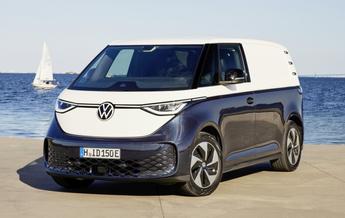
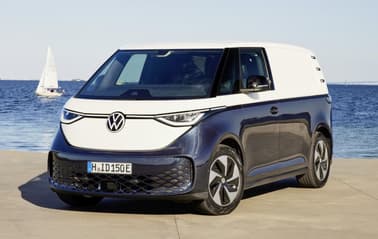
While it’s easy to think the design of the ID. Buzz is an over-the-top exercise in self-congratulatory nostalgia, there’s quite a bit more to its form than meets the eye.
For example, the ID. Buzz has a very low drag coefficient while maintaining a shape which maximises its interior space.


VW drew on the shape of the original T1 which is similar thanks to its rear engine mountings, leaning into benefits derived from small overhangs and an ultra-long wheelbase.
Relating the Buzz to the rest of the ID range is the matrix-style LED headlights rather than a set of sappy round ones which adorn most retro-look vehicles.

It also feels anything but retro on the inside once you look past the pale colour scheme which came on our test LWB example. VW has placed all the high-tech elements from the rest of its passenger car range inside, including the large screens with sharp, fast software and modern-feeling seat and wheel designs.

Eco credentials are helped along here as the brand says a solid portion of items like the roof lining, seat covers and the suede-style surfaces on the GTX are made from recycled materials.
The over-the-top retro look and feel might not be for everyone, though. Ultimately the ID. Buzz is a quite shouty proposition, which is a stand-out in the normally conservative VW line-up.
Practicality – How practical is its space and tech inside?
8 / 10
Expect plenty of height and width for even the tallest adults in the cabin of the Buzz, even considering its extra-tall seating position, which for some might take a little getting used to.
The array of materials in the seats and armrests is nice, although there is an abundance of hard plastics everywhere else. To be fair to VW here, there is an extra amount of door and dash space to cover, but for some it may be a hard sell for a car which can cost upward of $100,000.
Practicality, for the most part, is stellar. Not only is there an expansive, flat floor offering extra space for your legs and feet compared to most vans, but there’s multi-tiered storage in the doors.


There are also cut-outs across the dash for loose objects, and a centre console table with variable storage areas, which itself can be entirely removed if you need extra space between the front seats.
The tall dash features a fold-out set of bottle holders, as well as a cut-away for a wireless charger, and there's a set of buttons for remotely opening the powered side doors. Always a handy function.
The rear seat might be one of the most spacious I’ve been in, even in the people mover segment, with almost enough room for another adult in front of me behind my own driving position (at 182cm tall).

The second row is, of course, on rails, so you can reduce this room a little to grant third-row passengers additional space if need be.
Amenity-wise there are power sliding side windows (which maintain the Kombi-style square frames, nice touch), a completely flat floor (making the centre position useful for adults) and an array of storage pockets on the backs of the front seats ready to accept everything from phones to larger objects.
There’s also a set of airline-style fold-down dining trays with bottle holders, grab handles for getting in, as well as roof-mounted adjustable air vents, an LED light and a touch-panel for the rear climate zone.

The third row offers a plush set of seats with almost as much padding as the first two rows (rare for any three-row vehicle), soft-touch armrests over the wheel arches, bottle holders, an LED light, USB-C outlets and an adjustable air vent in the roof.
I fit with plenty of room for my knees behind the second row, with it rolled forward only slightly, and the flat floor continues to offer plenty of space for my feet, too.
You wouldn’t want to be too much taller than me when it comes to headroom, but the feeling of spaciousness is amplified by the size of the third-row windows.

In terms of luggage capacity, there’s a massive 1121 litres with just five seats deployed, or double that with the second row folded down.
With all seven seats in place, the second and third row can be folded flush, opening up the possibility of placing a mattress back there for a proper camping weekend. Our test car even had a set of cargo drawers under the third row for additional storage.
Let’s not forget the Cargo version, which has a payload of 650kg and can accommodate two Euro-sized palettes in its 3.9 cubic metre storage area.
Under the bonnet – What are the key stats for its motor?
8 / 10
An advantage of the delayed launch of the ID. Buzz in Australia compared to elsewhere in the world means we’ll only be getting examples with upgraded motors.
Rear-wheel drive SWB and LWBs will score 210kW/560Nm, while the go-fast GTX produces a combined 250kW with no official torque figure stated.
While the two combine to produce 675Nm on paper, the brand explains because they don't produce peak torque at the same time, it’s not an official torque number.
Regardless, both versions are a fair bit punchier than their electric rivals, at least for the time being.
Efficiency – What is its driving range? What is its charging time?
7 / 10
We don’t have official range or efficiency figures for the Australian market yet. No matter which ID. Buzz variant you’re looking at though, you can expect in excess of 450km of range.
For example, the short-wheelbase Cargo version is rated to 474km of driving range in the UK market. Expect slightly less for the heavier LWB version, and less again for the all-wheel drive GTX which also gets performance-oriented tyres.
Despite low drag and more efficient motors, the ID. Buzz is still a heavy blocky object and unfortunately this means it won’t be one of Australia’s most energy efficient electric vehicles when it arrives.
Overseas numbers have even the most efficient versions consuming over 20kWh/100km, with the example SWB Cargo using 21.7kWh/100km (for reference, less than 18kWh/100km would be considered good). Expect Australian versions not to stray too far from this.
Charging specs impress, on the other hand, with 11kW AC charging granting a slow charge time of around six hours (from 10 per cent), and 170kW on DC for a 10-80 per cent fast charge time in around 30 minutes.
Driving – What's it like to drive?
8 / 10
There’s nothing retro about the drive experience of the ID. Buzz, which is immediately characterised by silent, smooth electric acceleration, powerful motors in the LWB and GTX we drove and surprisingly sharp steering.
A commanding view of the road and short overhangs do make the ID. Buzz feel more van-like than car-like however, and there’s no getting around the sheer length and weight of the thing when it comes to cornering.
Still, despite the disconcerting feeling of being so far off the ground, the Buzz handles itself with, at times, an alarming amount of poise.
This makes the LWB version feel controlled, but the GTX offers occasionally laugh-out-loud thrills as it does things a van traditionally shouldn’t be capable of.

Neither version is particularly overwhelming in a straight line, despite their impressive power outputs. Rather than the face-melting acceleration which some EVs are known for, Volkswagen has sensibly opted for an acceleration response and traction system which prevents rear-wheel loss of traction when you stomp on it.
In a way this made the GTX feel a little disappointing in a straight line, but this isn’t where its best traits lie.
Instead, the GTX has absurd handling in the corners, which combines with the great tyres and additional front motor traction to make for ridiculous cornering prowess.
The ride quality is mostly good despite the sheer weight of the imposing bodywork and 84kWh battery under the floor. It handles most bumps well, although it becomes a tad unsettled on corrugations.

Having the wheels all the way out to the edges pays dividends for handling, but can occasionally come with a stilted feel when either axle takes a bigger hit. But that's common to a lot of vans.
One of the Buzz’s most annoying traits is the user experience when it comes to multimedia and climate systems while on-the-go. The big screens with easy shortcut buttons are welcome, but the touch sliders which reside below it and the touch-based buttons on the steering wheel can be a bit fiddly.
They look cool (and reduce the amount of parts in the cabin) but having to negotiate with them or a climate sub-menu when trying to concentrate on the road can be frustrating.
Regardless, I can’t think of a van which is better to drive than this. The Kia Carnival might give it a run for its money in feeling so SUV-like, but you’re out of luck if you’re keen to make the switch to electric.
Safety – What safety equipment is fitted? What is its safety rating?
8 / 10
The standard list of active safety equipment is exhaustive. Expect the usual refinements like freeway-speed auto emergency braking, lane keeping assist, blind-spot monitoring with rear cross-traffic alert.
Most impressively, though, these systems didn’t interfere much with the driving experience, and only intervened when they really should have, which can’t be said for every active safety suite on the market right now, particularly when it comes to lane keep and traffic sign systems.
The ID. Buzz has seven airbags (driver, front passenger, front centre, front side and curtain) and was awarded a maximum five-star Euro NCAP rating in 2022. You’ll have to tune back in later to see if its score transfers across to ANCAP when the Buzz finally arrives in Australia.
Ownership – What warranty is offered? What are its service intervals? What are its running costs?
7 / 10
Expect the usual five-year and unlimited kilometre warranty VW offers in the Australian market. The battery unit should also continue to be covered by an industry-standard eight-year and 160,000km warranty.
But finer details, like service intervals, service pricing, roadside assist and any charging incentives are yet to be confirmed.
Again, tune back in at the local launch of the ID. Buzz in Australia before the end of 2024 for these details.


Related cars for sale on CarsGuide
See more Volkswagen ID. Buzzs for sale View cars for saleVerdict
It’s fun, slick, pragmatic and offers a solid driving range but it’s also not afraid to be a bit goofy. I think that’s a great combo, and one which is much more than just oozing nostalgia for the sake of it.
I can’t think of a commercial vehicle or people mover which will be as nice to drive or as well equipped on the inside as this, so for those hanging out for its Australian arrival, I don’t think you’ll be disappointed.
For an even deeper dive into all things ID. Buzz, tune back in before the end of 2024 to see what we make of locally-specified versions.
Note: CarsGuide attended this event as a guest of the manufacturer, with travel, accommodation and meals provided.
Pricing Guides
Range and Specs
| Vehicle | Specs | Price* |
|---|---|---|
| Cargo Swb | Electric, 1 SPEED AUTOMATIC | $74,250 - $85,360 |
.jpg)
.jpg)
.jpg)
.jpg)
.jpg)
.jpg)
.png)
.jpg)
.png)
.jpg)
.jpg)


.png)


.png)


