









.jpg)
Despite appearing quite different, the Volvo EX30 and Smart #1 (yes, it's pronounced Hashtag One) are actually cousins - or at least distant relatives by marriage.
You see, their manufacturers share a parent company, Geely, and they share a platform. But of course, they’re by no means the same.
On top of their identical components are two diverging approaches to creating an engaging small electric SUV when it comes to the way they drive and operate.

-
 Another Geely brand backflips on electric-only? 2025 Smart #5 spotted in China with petrol engine, suggesting it could add a plug-in hybrid option and compete with the BYD Sealion 6 PHEV SUV
-
More driving range and simpler name for electric family SUV: 2025 Volvo EX40 name locked in for BMW iX1, Mercedes-Benz EQA and Renault Megane E-Tech rivalling XC40 Recharge Pure Electric
-
Europe versus China: How one carmaker plans to take on Chinese-made rivals like the Volvo EX30, MG4 and Mini Aceman with its new European-made electric car
They both wanna be the choice for you, and these two variants in particular want to be real quick about it, because both can hit 100km/h in less than four seconds.
Now do I have your attention?
In the sort of Swedish corner we have the Volvo EX30 Twin Motor Performance Ultra, and in the sort of German corner is the Smart #1 Brabus.
Neither are entirely of those nations, however, because despite Volvo’s Scandinavian roots and Smart’s ongoing connection to Mercedes-Benz, they’re both built in China under each brand’s parent company, Geely.
While Volvo is entirely owned by Geely, Smart is a joint venture between Mercedes and Geely, and the input from their ‘badge’ brands and parent company differ between them.
Both are built on the same Geely platform that also underpins the Zeekr X, and they have the same powerful dual-motor set-up. Same outputs and all.
Oh, and both their names could be better for differing reasons.
But where do they start to diverge?
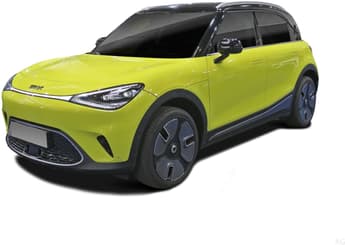
Smart 1 2025: Brabus
| Seating | 5 |
|---|---|
| Electric motor type | Permanent Magnet |
| Number of motors | 2 |
| Battery capacity | 66.00 kWh |
| Energy consumption | — |
| Electric range | 400 km |
| 0-100 km/h | 3.9 sec |
| Battery warranty | 8 years / 150,000 km |
| Price From | $52,800 - $60,720 |
| Safety Rating |
|
Price and features – Does it represent good value for the price? What features does it come with?
| Model | Score |
| Volvo EX30 | 8/10 |
| Smart #1 | 9/10 |
These cars land (just) either side of $70,000 and are pretty handsomely packed with features.
Both come with some of the premium kit you’d expect for something of this size at this price: heated front seats, sunroof, wireless phone charging, premium sound systems, big multimedia touchscreens, keyless entry and start and electric tailgates.


But when it comes to the specifics of each, one puts its nose in front in terms of the goodies. And it’s not the more expensive one.
Yep, the Volvo misses out on a couple of little things that make the Smart work better as an everyday car.
The Smart has a sunroof blind to stop the sun turning it into an oven, but Volvo charges extra for a clip-in unit.


The Smart also has a head-up display for the driver, but the Volvo has the Harman Kardon sound bar in the way.
Another little thoughtful addition for the #1 is the central storage bin in the Smart is cooled, though the EX30 does have retractable cupholders.
Related cars for sale on CarsGuide
See more Smart 1s for sale View cars for saleDesign – Is there anything interesting about its design?
| Model | Score |
| Volvo EX30 | 8/10 |
| Smart #1 | 6/10 |
Of course, the biggest difference between these cars is visual.
While they’re both looking to convey a vibe to their intended buyer, each one's aim is different and it’s up for debate whether either works.
I’ll start with the EX30, which I reckon looks pretty good for the most part.
It’s perhaps a little conservative in some ways, or to be kinder, it sticks to the brand’s established aesthetic steadfastly.
Elements like the Volvo logo centred in the diagonal bar and the 'Thor’s hammer' headlights were already or have become staples in the brand’s design language.


I also enjoy the way it doesn’t look like it was designed purely in a wind tunnel. It's still got a bit of boxiness to it, as a Volvo should, I feel.
Volvo’s also not historically been one for bright colours (most of the time) but 'Moss Yellow' in the EX30’s list of paint options is a bit more intense than the 'Cloud Blue' our test car wears.
Inside, our test car has the 'Indigo' interior treatment. Of the four options available it’s a darker theme with denim trim, though all the fabric and material options for the EX30 strike me as pretty premium.
It’s minimalistic and feels quite spacious. It’s almost a little jarring, even for an EV. I can imagine if you’ve gone from a relatively standard petrol-powered car to this, you’d be somewhat confused.
The EX30’s rival in this comparison, however, keeps things more traditional inside, but we’ll start with the exterior which is decidedly less conservative.


When I was a kid we always thought the Smart ForTwo looked a little silly. Now, here I am with some familiar feelings about the #1.
It’s a little longer and taller than the EX30, but looks out of proportion to me.
It might not help that our black and red test car makes it seem like someone acquired a Mini JCW from a dodgy website. Even the key fob is circular, another modern Mini thing.
But there are elements that work in isolation. Take the tail-light arrangement for example. Mercedes designed the #1 and there’s some EQ model DNA in there.
The red roof sort of ‘melts’ down over the back of the car, though, and the back looks frumpy.
Inside, it gets even more Merc, the rounded vents and the screen mounted above closable storage compartments is very Stuttgart.
Like the exterior there’s also a bunch of red inside the Brabus variant, including the seatbelts, though the plastic bit in the headrest might be a bit much.
Practicality – How practical is its space and tech inside?
| Model | Score |
| Volvo EX30 | 7/10 |
| Smart #1 | 8/10 |
From ‘a bit much’ and back to perhaps not enough, the EX30’s Scandi minimalism might start to become worrying when you realise anything that could be called a button has been given the Scandi flick.
Sure, it feels spacious in the front row and most of the surfaces you’ll touch are quite nice, but the trend of having to do everything through a single, central screen can get in the bin.
Also, to get the most out of its native multimedia, you need to log into your Google account, which I’m sure will turn some off right away.
It’s a particular shame the EX30 doesn’t have a head-up display, instead the Harman Kardon sounds bar is in the way - which itself looks futuristic but ultimately doesn’t deliver sound in a natural enough way to warrant its existence.
So you find yourself turning your head to check your speed or adjust settings.
And that includes adjusting the mirrors or steering wheel position. This has to be done by finding the setting in the menu then using the steering wheel buttons to adjust.


The thinking is apparently that it’s not something that needs to be done often, but my thinking is that it smells like cost-cutting. And if it’s genuinely a decision made for the purpose of a cleaner looking design, then I’d argue concept cars should be the only place where buttonless interiors exist.
Speaking of which, look up and there’s no cover for the sunroof, which I can promise you means the interior gets hot on a sunny summer day. You have to buy a sunshade as an accessory.
However, there are some clever things going on in the Swede.
The cupholder can be used as a single or a double by popping out, and the rings can be slid separately.
A low down storage space is nicely out of the way and has a little cubby door, plus the charger slots your phone in nicely and is visible but out of reach.
The door storage is wide enough for a standard drink bottle, too, but it won’t stay upright.
The back seat could be better. There’s not much reason to be back there aside from necessity, but at 180cm I reckon I’d be comfy on a short enough trip.
The 318L boot isn’t huge for a small SUV, but there is an EV battery underneath eating into some of that.
There’s a drop-down section in the boot with storage under the floor for cables or anything you don’t want on the boot carpet, too.
Oh, and as you might unfortunately expect, there’s no spare tyre, just a repair kit. It’s the same with the other car in this test, in fact.
But practicality is where the #1 beats the EX30 inside.


For a start, buttons! On the steering wheel, and some little quick-access options under the multimedia screen.
And there’s another screen in front of the driver with some clear information, as well as a really well thought-out head-up display.
It’s minimal, but gives you the right information like a blind-spot warning without being overbearing.
The touchscreen menu itself is unfortunately not super intuitive but it does get easier when you’re used to it, and there’s a quick way to access most menus, even if you’re in Android Auto.
Strangely, though, the graphics are a little bit goofy which is odd given the tone of the interior. There’s even a little fox character supposed to be an AI helper. No thanks.
Physically, the space and placement of things feels a little less ‘airy’ in the Smart, but it’s still quite ergonomically sound.
Then there are small things working in the #1’s favour; vents that direct air better or, surprisingly, a vent in the storage bin!
The back seat also feels decent in the Smart, perhaps thanks to the extra wheelbase and height.
Claimed boot space is also just a little more than the EX30, its 323 litres has the Volvo beat by 5.0L.
Under the bonnet – What are the key stats for their motors?
| Model | Score |
| Volvo EX30 | 9/10 |
| Smart #1 | 9/10 |
Both of these cars have the same powertrains, a dual-motor set-up pushing a maximum of 315kW and 543Nm through an all-wheel drive system.
The difference is how they deliver that power, and this means the Volvo has a claimed 0-100km/h time of 3.6sec, while the Smart sits at 3.9.
The Volvo’s drivetrain can be set to prioritise performance or range via two settings, but the #1 has four drive modes - 'Eco', 'Comfort', 'Sport' and 'Brabus'.
Efficiency – What are their driving ranges? What are their charging times?
| Model | Score |
| Volvo EX30 | 8/10 |
| Smart #1 | 8/10 |
Both cars should theoretically be able to achieve similar efficiency given the shared mechanicals and similar batteries and weights.
The Volvo’s fitted with a 69kWh battery and boasts a 445km range according to the brand, while the Smart has a 66kWh battery and 400km range.

Given the shared platform, it’s possible they are physically the same, just measured differently.
Putting these to the test over a long test loop involving highways, winding fast roads and some suburbia, both cars started the trip at about 70 per cent and finished at around 20 per cent.
So under hard driving, both burn through about the same amount of energy.
They also charge at about the same rate, over the course of charging, just under half an hour to go from 10 to 80 per cent each, though we saw the EX30 peak at a rate of 134kW and the #1 at 157kW.

The trip computers for each were slightly more telling, the longest stretch of measurement under our watch in the Smart was a few days, and the car told us it was averaging 19.4kWh per 100km.
The EX30 however has been under the custodianship of CarsGuide’s head of editorial Justin Hilliard for a few months, and during the month it went up against the Smart it returned a 18.3kWh figure.
I’d say both are, day-to-day, about as efficient as each other, but the real-world range you’re likely to get out of them is more like 340-370km, depending on use.
Driving – What's it like to drive?
| Model | Score |
| Volvo EX30 | 8/10 |
| Smart #1 | 8/10 |
Despite the powertrains and platforms for each of these cars being essentially the same, there’s more difference in their characteristics on the road than you might expect.
That’s not to say one is significantly better than the other, though, as both seem to be pretty well sorted out for slightly different applications.
Let’s start with the Smart #1 Brabus, which is a more customisable but perhaps less mature car from behind the wheel. Again, not a complaint.
While it’s got Eco and Comfort modes for its day-to-day driving, and both let you have enough power under foot that they don’t feel sluggish, the suspension is a little firmer than the Volvo's and feels more like it’s urging you into Sport mode.
Or better yet, the unnecessary-but-rather-fun Brabus mode, which will get an ‘oh my god’ rise out of anyone unfamiliar with the instant high-torque delivery of an EV.

But unlike Silverchair in the late 2000s it’s not all straight lines, and the Smart is well-equipped for cornering for something that, let’s be honest, is heavy. About 1900kg, in fact.
The biggest surprise isn’t the acceleration out of corners or the brakes, it’s what I ended up deeming the ‘chuckability’ of the little EV during the back-to-back test drive.
All the rest of its attributes stack up at least on par with expectations from a car like this. The brakes are decent, the steering is okay if left in Normal and not moved to its heavier setting, and despite its firm-ish suspension it soaks up bumps better than some heavier EVs.
But the Smart #1 Brabus almost encourages some naughty behaviour around sharp corners - behaviour you shouldn’t engage in on public roads.
It’s a contrast to the ‘tsk-tsk’ vibe the EX30 gives off in the same circumstances.

Firstly, the way the EX30 operates doesn’t encourage dynamic driving, as you need to go through a few sub-menus to get to the switch between the drivetrain prioritising range or acceleration and performance.
Its acceleration, despite being quicker on paper, also doesn’t feel as urgent, and even its brake pedal is softer.
Its suspension is a little more compliant, but not to the point of being wafty, and it doesn’t pitch or roll much mid-corner, only perhaps a little more than the Smart.
With all this said, the EX30 will certainly keep up with the #1, it just doesn’t feel as much like it’s meant to be.
There’s another small downside to the Volvo, and that’s the setting for one-pedal driving being somewhat misleading. If you expected the car to pull up in a short distance in a traffic situation, you might end up relying on its AEB, something we didn’t deem appropriate for testing in Melbourne’s CBD.
While it’s likely the better pick for day-to-day driving, its lack of adjustability is a downfall when it comes to matching the Smart as an engaging car to drive.
Warranty & Safety Rating

Safety – What safety equipment is fitted? What is its safety rating?
| Model | Score |
| Volvo EX30 | 9/10 |
| Smart #1 | 8/10 |
Both cars have a maximum five-star safety rating under ANCAP’s testing, though it’s the Smart that has better occupant protection for adults and children.
In fact, its adult protection score is an excellent 96 per cent!
They’re also both chockers with safety kit, things like semi-autonomous cruise control, parking assist, driver alerts and AEB, and both have seven airbags.
But the biggest difference is in how the active safety systems operate in each.
While the Smart seems to be a little more obviously active when it’s in assisted driving mode, the Volvo tends to be more natural.
It’s on the highways where it feels most pronounced, the Smart doesn’t regulate the distance to the leading car as well as the EX30, and its lane-centering could be smoother.
The Volvo on the other hand is a lot more comforting in that most of the decisions it makes roughly mirror what you’d expect, and it’s quite gradual in going about it when it’s safe to.
Ownership – What warranty is offered? What are its service intervals? What are its running costs?
| Model | Score |
| Volvo EX30 | 8/10 |
| Smart #1 | 6/10 |
Picking up an EX30 means a five-year/unlimited kilometre warranty with roadside assist and the battery covered for eight years/160,000km.
That’s about average for a Euro brand, but five years or 150,000km of free servicing, whichever comes first, is excellent. Intervals are every 24 months or 30,000km.
Smart #1 falls behind here, a five-year or 150,000km warranty is okay only, plus the eight-year coverage for the battery is limited by the same 150,000km.
Smart’s servicing intervals are also a little short at every 12 months or every 20,000km, and even though the brand doesn’t publish servicing costs online, they told us a five-year plan for the Brabus is $2231.
This is broken down into the five services costing $242, $380, $666, $701 and $242 respectively, which is quite high for an EV given the mechanical simplicity compared to an ICE car.


Verdict
What each brand has built on top of this Geely platform is impressive when you put it all into the perspective that you can get a supercar-chasing electric SUV for about $70,000.
Both of these cars are great and there’s not a wrong decision here, but when it comes down to their strengths and weaknesses… the Volvo has more long-term benefits.
It has a steeper initial learning curve, but to look at and maybe even potentially own long-term, the EX30 starts to become more appealing.
But for a car to jump into and take out purely for a drive? It’s got to be the #1 Brabus.
Hopefully, after having gone over the details of each with me, you’ve made up your mind about which would suit you better.
Smart #1 Brabus 7.8/10
Volvo EX30 Twin Motor Performance Ultra 8.1/10


.jpg)
.jpg)
.jpg)
.png)
.jpg)
.png)
.jpg)
.jpg)


.png)


.png)
.png)


.png)



.jpg)
.jpg)

