What's the difference?
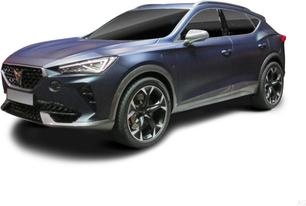
The Cupra Formentor is the most popular model in the Cupra stable and now the VZe Tribe Edition has joined the ranks.
Sitting one rung below the top petrol grade, the Tribe Edition combines the VZe plug-in hybrid powertrain with some great design upgrades, as well as features usually reserved for the top model.
Is this the most appealing Formentor model yet? We've spent a week with it to find out.
The Denza B5 Leopard PHEV is the latest in China’s plug-in hybrid invasion of Australia.
Denza is a premium sub-brand of BYD and the B5 is a luxury body-on-frame 4WD wagon with five seats, 16 drive modes, a low-range gear-set on the rear axle, and front and rear diff locks.
It has a packed standard features list, a premium-style interior, about 100km electric-only driving range, and real off-road adventure potential.
But how does this plush plug-in perform off-road?
Read on.
The Cupra Formentor VZe Tribe Edition offers some great luxury features and is coupled with a plug-in hybrid powertrain that should entice those wanting something more efficient than the standard petrol grade. It's peak efficiency is only available with a fair amount of charging commitment, though, and the driving comfort isn’t always the best but its fun and looks hot. The price point also makes it appealing compared to its rivals.
The Denza B5 Leopard PHEV is an impressive five-seat premium-style 4WD wagon: it’s reasonably nice to drive, it’s comfortable and it’s a capable 4WD and word on the tracks is that a new software update is set to make it even more of an effective off-roader.
It doesn’t offer the level of fuel economy you’d hope for, and there are issues with elements of its driver-assist tech suite – some of which are jarring and over-reactive – but the B5 looks and feels like a premium 4WD and represents decent value for money, especially when cross-shopped against something like a new-generation Prado.
The Cupra Formentor sounds like a Transformers name and if it were one, it’d be a Decepticon, for sure. It’s way too sharply styled and sexy to be a good guy.
The special-edition model sees it paired with black and copper 19-inch alloy wheels and every design aspect doubles down on its sports-car presence from the crisp pleating across the body, to the twin exhausts and shapely grille. And this sporty presence is what its rivals lack.
Head inside and you'll notice the biggest change from the standard VZe model are the sport bucket seats in the front and the blue leather upholstery that has been liberally applied across the cabin.
The dashboard features gorgeous copper accents and contrasting stitching while being headlined with large tech screens that immediately catch your eye.
The interior has a killer design but it's not one you'd call plush as the edges and surfaces are as sharp as they look.
It’s easy to immediately pick up on the B5’s plethora of design cues: it wears with pride its old-school 4WD influences – not the least of which is its blocky, straight-up-and-down profile – mixed in new-gen looks.
All-round this 4WD wagon might be considered an affectionate homage to the likes of the Toyota Prado (aka 250 Series).
The B5 sports roof rails, a sunroof and 20-inch alloy wheels.
Whatever you see when you look at the B5, at least it’s not generic or boring.
And that non-boring impression continues inside…
The B5’s interior is premium-looking and -feeling and it also features quirky touches, such as the crystal-look buttons including a ruby-red start-stop button, and enough leather-accented surfaces and brushed-metal-type sections to keep you intrigued.
Though the dash may be a confusion of buttons and controls, on- and off-screen, the whole she-bang is superficially impressive.
Case in point: the auto shifter lowers and self-stows away in the centre console when the car is switched off and rises for use when the car is switched on. Neat.
It’s on a par in design terms with rivals, such as the Prado.
For something that leans more towards a sports car than SUV in its styling, the cabin is still fairly practical when it comes to space and access.
Front occupants enjoy the best of each, though, and it's easy enough for a taller driver to get into a comfortable position.
The rear row offers excellent headroom but the legroom may be cramped for a tall passenger. It's best to think of the car as a four-seater as the middle armrest won't go down when there is a car seat installed.
In terms of seat comfort, fatigue will set in early on a long trip for front rowers as they are decidedly hard under the butt but the padding is a lot better in the rear row.
Overall, storage options and amenities are great throughout the car with the tri-zone climate control, heated front seats and steering wheel functions giving a premium cabin experience.
The glove box is extra large and can easily fit a small handbag and a manual while the middle console is on the small side. There are four cupholders and drink bottle holders (4/4) but the front cupholders need to be spaced out more to accommodate two cups properly. A few loose coffee lids were had!
In the rear you also get two map pockets and the boot has 345L of capacity available which is on the tiny side for a medium SUV! However, the wide boot aperture tricks you into thinking it’s bigger and the powered tailgate is always a handy feature.
Technology looks great but the multimedia system is finicky to use and one that takes a while to get used to. At first it's difficult to recognise what you have to touch to access the different menus available but the screen is responsive and the graphics are clear.
The built-in satellite navigation is easy to use, and the Tribe Edition also has wired/wireless Apple CarPlay and Android Auto, four USB-C ports, a wireless charging pad and a 12-volt socket.
The B5’s cabin is plush, spacious, and comfortable.
The driver’s seat is eight-way power adjustable (plus four-way adjustable lumbar support), while the front passenger seat is six-way power adjustable.
As mentioned earlier, all seats are Nappa leather-accented.
The B5’s luxury-style interior, also as mentioned, includes nifty touches, such as crystal-look buttons being the most obvious, and an auto shifter auto that stows away in the centre console when the car is switched off and rises, ready for use, when the car is switched on.
Elsewhere the dash and centre console is, at first, a confusion of buttons and controls, on-screen and off. But you soon get sort of used to all of it.
The second row is a 60:40 split-fold split and it has a flip-down control console rather than a basic centre armrest with cupholders.
The rear cargo area has four tie-down points and volume is listed as 470L (with the second row up and in use) and 1064 litres with the second row stowed away.
There are usually three variants available for the Formentor; the base V petrol model, the mid-spec VZe plug-in hybrid and the range-topping VZx petrol.
The Tribe Edition pairs the plug-in hybrid powertrain with some of the features you get in the VZx, making it technically sit right below the top model, despite being $2200 more expensive at $67,990 MSRP.
Yet still it offers great value compared to its luxury rivals, the Lexus NX350h Luxury Hybrid which sits at $71,600 MSRP and the Peugeot 3008 GT Sport Plug-in hybrid which starts at $82,915 MSRP, without feeling like the poor cousin.
For a $3K price hike over the standard VZe model, you enjoy heated front seats, sport bucket front seats, 'Petrol Blue' leather upholstery throughout the cabin, black and copper 19-inch alloy wheels, a black headliner, a 360-degree view camera and a powered drivers seat with memory and lumbar function.
Other standard equipment includes keyless entry and start, powered tailgate, heated steering wheel, dusk-sensing LED headlights, rain-sensing wipers, auto-start/stop function and a tyre repair kit and inflator.
Technology looks top-tier with the 12-inch touchscreen multimedia system with built-in satellite navigation, 10.25-inch digital instrument cluster, tri-zone climate control, wired and wireless Apple CarPlay/Android Auto, four USB-C ports, Bluetooth, AM/FM radio, digital radio and a nine-speaker Harman Kardon sound system.
The Denza B5 Leopard PHEV is available in two specs: entry-level B5 and top-spec B5 Leopard, which is the subject of this test. The Leopard has a recommended retail price of $79,990 (excluding on-road costs), while the regular B5 is $74,990.
Standard features in the Leopard include a 15.6-inch touchscreen multimedia system (with wireless Apple CarPlay and Android Auto), a 12.3-inch driver instrument cluster, surround-view cameras, hydraulic adaptive suspension, 16 driving modes, and front and rear diff locks.
The Leopard has Nappa leather-accented seats.
The B5 and its bigger stablemate, the B8, mark the debut of Denza’s Dual Mode Off-road (DMO) hybrid 4x4 architecture, consisting of the plug-in hybrid powertrain, which umbrellas a Blade battery, twin electric motors, and turbocharged four-cylinder engine – but more on that later.
Also of note is the fact that this B5’s 31.8kWh battery supports Vehicle-to-Load (V2L) functionality/capability, which means you can power your camping gear (lights, fridge, karaoke juke box etc.).
Eclipse Black paint is standard. Optional paint choices – including Alpine White, Juniper Green, Glacier Blue, Granite Grey and Leopard Gold – each costs an extra $1500 (including an interior colour-scheme and materials to match).
It’s more impressive in the value-for-money stakes than something like the new-generation Toyota Prado, which will set you back upwards of $100,000 for an Altitude or Kakadu spec.
The VZe Tribe Edition is a plug-in hybrid that has an electric motor that produces up to 85kW/330Nm. This is paired with a 1.4L four-cylinder turbo-petrol engine. Together, they produce outputs of up to 180kW and 400Nm.
However, once the lithium-ion battery is depleted, those figures drop to 110kW/250Nm and you notice the difference on the open road.
The Tribe has a smooth six-speed automatic transmission and can do a 0-100km/h sprint in 7.0-seconds. Not crazy fast but still fun.
The B5 has a 1.5-litre turbocharged four-cylinder petrol engine, a 31.8kWh battery and an electric motor on each axle (front: 200kW/360Nm, rear: 285kW/400Nm) – and that combination all-up produces total outputs of 400kW and 760Nm.
The Leopard has a CVT, low-range 4WD gearing, as well as a front and rear diff lock.
The Denza B5 has 16 selectable drive modes: daily drive modes (Comfort, Eco and Sport), as well as terrain modes (Snow, Sand, Mud, Mountain, Rock, Intelligent, Creep, Wading, Sport+, Custom, Burst, Climbing, Tug-of-War (towing), L Function (low-range 4WD), and Leopard Turn, which is the B5’s equivalent of the Tank Turn, where it brakes the inside rear wheel during tight, low-speed off-road turns, reducing the turning radius, and so enabling the B5 to navigate a particularly tight turn.
Like all plug-in hybrids, you get the best efficiency if you recharge the Tribe often. If you want to get close to the official combined (urban/extra-urban) fuel cycle figure of 1.9L/100km you need to charge it every single time you use it.
Following this procedure over 347km of a mix of open and city driving, saw the real-world usage pop out at 2.3L/100km, which is outstanding.
However, the second half of the week saw 336km travelled and no recharge and the real-world usage stepped up considerably to 6.0L.
With its 40L fuel tank, you have a theoretical driving range of up to 2105km but expect less in real-world conditions. Worth noting Cupra recommends a minimum 95 RON unleaded petrol for this model.
The Tribe has a lithium-ion battery with a usable 10.9kWh capacity and the claimed pure EV range is up to 58km, as well as, a claimed 14.1kWh energy consumption figure.
Over my week with it, the consumption hovered around 22.8kWh/100km when cruising on the highway going 100km/h.
The 31.8kWh battery provides up to 100km of electric-only driving and supports 100kW DC fast-charging.
Official combined fuel consumption is 3.9L/100km and the B5 runs on regular unleaded fuel (91).
Official fuel consumption is 10.9L/100km when state of charge is lower than 25 per cent.
On this test, I recorded 10.2L/100km.
The B5 has a 83-litre fuel tank so, going by my fuel figures, you could expect a total driving range of about 900km out of a full tank and a full charge.
The VZe Tribe Edition is happiest in the city and when you have a full battery. This is when it feels the most responsive with its power delivery. In the city, it’s quick and sure-footed.
However, once that battery hits empty and you’re on the open road, the power is there but it stops feeling as fun.
The firm steering keeps it nimble and the driver's cockpit makes you feel well connected with what the car is doing but the ride comfort is like the design, not what you'd call plush.
The suspension is firm and you feel every bump in the road. Road and wind noise are also pretty high and in general, you feel a bit weary at the end of longer trips.
The visibility is good despite having narrow windows but a car seat or passenger in the back seat compromises the rear view vision.
The Formentor shines in a tight car park with its 10.7m turning circle and compact proportions. The 360-degree view camera system is also most welcome but the quality of the feed is reflective of the grade level.
The B5 Leopard is 4921mm long (with a 2800mm wheelbase), 1970mm wide, 1930mm high. It has a listed kerb weight of 3007kg and a 11.8m turning circle.
Yep, so it’s not insubstantial. But it doesn’t feel unwieldy to drive.
On road, there’s a lot to like about the B5: it's comfortable, refined and composed and it has such a premium feel about it that it really is a top spot in which to spend a lot of time, on road trips, day-to-day driving or long road trips – it's very impressive.
Denza reckons the B5 is capable of doing the 0-100km/h sprint in 4.8 seconds but, while I did admittedly check out the B5’s impressive acceleration in short bursts, I didn’t try to prove or disprove that 0-100km/h claim.
On dirt tracks the B5’s suspension – double wishbone independent and coil springs – yields a firm and jittery ride over minor irregularities in the track but otherwise it’s mostly controlled
Off-road, the separate body-on-ladder chassis B5 has up its metal sleeve an effective combination of mechanical low-range 4WD on the rear axle, electronic torque vectoring at front, diff locks front and rear, and well-calibrated off-road traction control.
This plug-in hybrid optimises a combination of driver-assist technology – including 16 drive modes with the bulk of those designed for off-road scenarios – and with nicely dialled-in off-road traction control and mechanical diff locks on-board it is formidable in most off-road situations.
In action, all of those modes adjust vehicle systems, throttle, and engine output to give the driver the best chance possible of getting safely through every off-road challenge.
And it does a bloody good job of it.
The B5 tackled our steep rock-step test with ease there's plenty of torque available and again that off-road traction control system is well calibrated, sharp and precise in its application.
Off-road angles on this vehicle are also on the right side of good and the fact that the Leopard has hydraulic-adjustable suspension to suit each driving mode is also a handy feature because you can maximise those off-road angles – approach, departure and ramp-over – as well as ground clearance.
In fact, you can set ground clearance anywhere between 220mm and 310mm and that means you have greater flexibility in terms of what you can drive, how you can drive, how severe an obstacle you can tackle and how safe you are while doing that.
This plug-in hybrid works through a continuously variable transmission (CVT) and it works well in this vehicle, in this package. It's clever, smooth and seamless in its operation
Another bonus is the B5’s off-road/360-degree cameras, which actually offer a decent image rather than the muddy, fish-eye view of some other on-board camera systems.
Now for the flaws.
There’s little to no wheel travel; there’s not a lot of stretch to those wheels when the height-adjustable suspension is maxed out at its top point – in Crawl mode – so you are sacrificing that.
The B5’s tyres (Pirelli Scorpion Elect SUV tyres – 275/55R20) are marketed as “all weather” tyres but they're not suited to four-wheel driving of any great difficulty.
If you’re thinking about using your B5 as an off-road tourer, get rid of the showroom-standard tyres and replace them with more aggressive all-terrains.
Payload in the Leopard is 490kg (600kg in the standard B5).
In terms of towing capacity: the B5 Leopard is rated to tow 750kg unbraked, and 3000kg braked. GVM is 3497kg, while GCM is 6232kg.
The B5 is a very effective 4WD wagon: smooth and comfortably capable.
There are some issues with the driver-assist tech, but that's mostly limited to its on-road behaviour – it can be intrusive and preemptive in its application – but the driver-assist tech, which relates to off-road performance, is impressive.
We eagerly await a full-blown software update that will further improve the B5’s off-road efficacy.
The Formentor has a maximum five-star ANCAP safety rating from testing done in 2021 and now features 10 airbags including side chest bags for the rear row and a front centre airbag as standard.
Other standard equipment includes blind-spot monitoring, driver monitoring, tyre-pressure monitoring, LED DRLs, front and rear fog lights, forward collision warning, rear cross-traffic alert, lane departure alert, lane keeping aid, side exit assist, adaptive cruise control, park assist, front and rear parking sensors and a 360-degree view camera system.
The Formentor has AEB with car, pedestrian and cyclist detection and is operational from 5.0-250km/h. The Formentor also has two ISOFIX child seat mounts and three top tethers but the rear seat is only wide enough for two child seats.
The Denza B5 Leopard PHEV has the maximum five-star ANCAP rating from testing in 2025.
As standard, it has 11 airbags (curtain, front, side, knee and centre airbags) and a comprehensive suite of driver-assist tech including AEB, adaptive cruise control, tyre pressure monitoring, a 360-degree around-view camera, as well as front and rear collision warning, and front cross traffic alert.
On a par with more expensive rivals, then.
The Formentor has a five-year/unlimited km warranty but it’s becoming more common to see longer warranty periods being offered now.
You can pre-purchase a three- or five-year servicing program. The three-year program costs a flat $990, averaging $330 per service. The five-year option averages costs $1990, averaging $398 per service which is reasonable for the class.
Servicing intervals are good at every 12-months or 15,000km, whichever occurs first.
The Denza B5 Leopard PHEV is covered by a six-year/150,000km warranty.
The B5’s 31.8kWh battery has an eight year/160,000km warranty.
The first service is scheduled at six months/3500km; the rest of the servicing appointments are set for every 12 months/20,000km.
Total cost is $3220 (plus GST) via five-year capped-price servicing.
That puts it on a par with more expensive rivals.