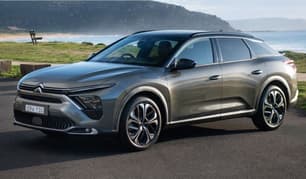
What's the difference?
The all-new Citroen C5 X is different. It takes just one look at the car to realise that.
It’s partly an SUV, has more than a hint of wagon to it, and it’s nothing like the old Citroen C5s of years gone by. That’s no bad thing - because this is the sort of Citroen that people who have never even heard of the brand will likely pay attention to
The brand has shaken off its ‘quirky and French’ vibes for a more ‘modern European’ look, and let me tell you - this is a very interesting car. Read on to find out all the stuff you want to know, plus the things you need to know.
Commercial vans are not an exciting segment of the car industry - but they are big business.
Not only do businesses, especially fleets, need a quality van, if you can crack the market there are meaningful sales for some of the biggest name brands in the country.
Unsurprisingly, Toyota dominates the mid-size van market with its HiAce, which notched up more than 12,000 sales in 2024 to make it one of the market leader's most popular models. For Ford the Transit Custom is even more important as the brand’s third best-selling vehicle behind the Ranger and Everest.
Which is why the decline of Volkswagen’s Transporter has been a big deal for the brand, and it’s why the arrival of the all-new, seventh-generation model is such a big deal. The German maker only sold 875 Transporters last year, as the transition between the out-going model and this new one hit hard.
But that’s the past, Volkswagen is focused on the future, with high hopes this new Transporter can rise back up the sales charts. It also completes VW’s commercial van line-up, sitting alongside the smaller Caddy and ID.Buzz Cargo as well as the larger Crafter.
This new Transporter is slightly less Volkswagen than the previous six generations, though, as it is now platform sharing with Ford as part of the two automotive giants’ commercial partnership (which sees the Amarok also based on the Ranger).
By working together it has allowed the two companies to develop not only a new diesel-powered van but also an all-electric offering and a plug-in hybrid. The latter won’t be available until sometime in 2026, but we’ve just driven the new diesel and electric Transporter.
This is a new take on the Citroen station wagon, and it’s an impressive one at that. It may not tick all the boxes, but it is a comfortable and practical car, with stunning design, decent equipment and a pretty agreeable price tag.
Now, just get that plug-in hybrid version in at a reasonable price please, Citroen.
Note: CarsGuide attended this event as a guest of the manufacturer, with meals provided.
So has Volkswagen done enough with this new Transporter to win back buyers in what has become a highly-competitive van market?
Based on our initial test drive of the Transporter, it’s safe to say Volkswagen has a good chance of regaining some lost ground. But it won’t be easy because there isn’t any particular area where the Transporter really sets itself apart from the competition.
It’s a pleasant van to drive, with a roomy, modern cabin and a competitive cargo area, at least with the diesel engine. The electric Transporter provides an alternative choice for a small audience, but the huge price premium and limited range will mean it won’t suit the vast majority of buyers.
The real opportunity for VW will come when the PHEV arrives in 2026. That has the potential to help create some difference between itself and the likes of Toyota and Hyundai.
It’s noticeable that the brands dominating the commercial van market are the big name ones, rather than the cheaper Chinese competition, which suggests buyers are looking for a trusted name rather than the lowest price.
So from that perspective, Volkswagen has a decent chance of regaining lost ground given its heritage in the van segment.
Note: CarsGuide attended this event as a guest of the manufacturer with meals provided.
Citroen reckons the C5 X combines SUV, wagon and sedan design cues to make it a true crossover model. I reckon they’ve got a point, and while it’s certainly not as butch as some other crossover wagons out there, it’s not bashful, either.
I’m a massive fan of the assertive front end lighting design, the bold body lines that punctuate the bonnet and swoop backwards down the sides of the car, and the swooping roofline that dips away, almost like the iconic Citroen DS.
It’s quite a large car, too - at 4805mm long on a 2785mm wheelbase, it has a commanding presence, and it’s 1865mm wide (not including the side mirrors) and a rather sleek 1490mm tall.
Of course it has some body cladding and black plastics to give that ‘rough and tumble’ appearance - and the rear features a couple of spoilers on the boot that help it cut through the air cleanly, and they look interesting as well.
Inside, there’s an almost-square steering wheel, which is interesting, and a pair of screens - a 12.0-inch touchscreen for your multimedia duties, and a 7.0-inch driver info screen. It looks and feels upmarket and pretty conventional in the cabin, so let’s see what the practicality is like.
Commercial vans are typically not instruments of design, but rather a study in functionality. But credit to the Volkswagen designers because it clearly looks like a Volkswagen from the outside, despite its Ford lineage. While there are obviously some similarities between the Transporter and Transit Custom inside, the front-end design definitely has a visual connection to the previous generation models.
But, of course, functionality is important and by using the Transit Custom underpinnings, Volkswagen has been able to grow the Transporter. It is 150mm longer and the standard wheelbase has been stretched by 100mm, compared to the six-generation, which allows for even more cargo space.
The cabin is well laid out, with a new 12-inch digital instrument display and a 13-inch multimedia touchscreen taking prominence on the dashboard. The multimedia system includes built-in navigation plus wireless Apple CarPlay and Android Auto, as well as digital radio.
The Citroen C5 X is almost as big as a Subaru Outback, and similar in size to a Kia Stinger. So it ought to have a bit of family-friendliness packed in.
Starting at the back, there’s a 545-litre boot capacity, with the kick-action, electronically controlled tailgate that you can also use the keyfob to open. It is a low, wide, quite squared-off aperture, meaning loading bulky items in should be a breeze. Just note that the roofline does taper down towards the rear, so bigger things will need to be pushed towards the seat backrests.
Or, if you’re really acting like a delivery van, you can drop the rear seats down to allow 1640 litres of cargo capacity. There are boot-mounted releases to drop the seats down, and there’s a floor mat in the boot, under which is a space saver spare wheel.
Back seat occupants are decently catered for. I’m 182cm/6’0” tall and I managed to sit behind my own driving position with plenty of leg and foot room - however, the sunroof does create a bit of a hump in the ceiling that you might bump your head on, and those with big feet or small children might want to take note that the sills in the door openings are very tall. A child could easily trip over them if they were clambering in the back in a rush.
Children will be covered with a pair of ISOFIX child-seat anchor points in the window seats and three top-tether restraints, too. There are map pockets, door pockets with bottle holders, a pair of USB-C charge points and directional air vents, too.
However, it wouldn’t be a French car without some kind of quirky cup holder situation, and the back seat has none - there’s no flip-down armrest to speak of. But the seat is exceptionally cushy.
Front seat impressions are good - and cup holders are present. They’re big ones, too - large enough for a big cuppa or a bottle of water, even, And there are door pockets with bottle holsters as well.
There’s an opening centre armrest box with a USB-C charge point, and in front of the interestingly designed recessed gear selector and parking brake, there’s another storage spot with a wireless phone charger, too. Nice.
Seat comfort up front is very good, with lots of adjustability (eight-way electric for the driver, six-way electric for front passenger) and heated front seats as well.
Scoring a big tick from me is the fact there are physical dials and buttons for the air conditioning and ventilation controls. But they’re in that glossy black finish, which shows fingerprints so much that it makes you feel self-conscious of being a walking germ farm.
The big touchscreen multimedia system has a few buttons and knobs, too - though the menus on screen do take some getting used to. It is highly customisable, so if you bought one you’d set it and forget it, but on first impression I struggled to get to grips with some of the nuances of the menus.
It does, however, have wireless or wired Apple CarPlay and Android Auto (with the media-feed USB-C port under the controls) and it goes full screen, too, while leaving enough space for other crucial elements. The graphics are nice and high-definition, and the 360-degree camera display puts the “surround” view units in Peugeot models to shame.
There’s also a configurable driver info screen, and a crisp and lovely head-up display as well.
This is the really important element for any good commercial van, both the practicality of the cabin (as drivers spend long hours behind the wheel) and the cargo capacity in the back (for the obvious reasons).
Up front there’s a wireless charging pad and seven USB ports spread around the cabin. There are plenty of small item storage spots, and some not so small items, with a large shelf on top of the dashboard and multiple in-door shelves.
Of course, it’s out the back that’s really important and, as mentioned earlier, there is more space thanks to the larger overall dimensions.
Both SWB and LWB vans come with a plastic floor cover as standard, plus there are load rated tied tie down points, a 12V charging port in the D-pillar and LED lights in the roof.
Thanks to the extra length, the SWB has a 2.6m load length and 5.8 cubic metres of cargo space, while the LWB has 3.0m in length and 6.8 cubic metres. There’s also a steel fixed partition with window, window grille and load through hatch to stretch the usable space even more.
The total payload for the Transporter varies depending on the powertrain. The TDI 2WD can take up to 1062kg (SWB) and 1016kg (LWB), while TDI AWD can manage 963kg (SWB) and 917kg (LWB). The electric Transporter has a significantly lower payload, rated at 806kg (SWB) and 760kg (LWB).
Towing capacity also changes depending on the powertrain, the TDI 2WD can manage 2000kg, TDI AWD up to 2800kg and the electric 2300kg.
Citroen has made it simple for customers. There’s only one spec available for the C5 X at the time of launch, and it comes pretty much fully loaded for the list price of $57,670 (that’s before on-road costs).
The so-called C5 X Shine is the version we get at that price point, though there may be a higher-priced model with a plug-in hybrid powertrain sometime in the near future.
As it stands, this crossover wagon could be something you consider as an alternative to high-spec Subaru Outback (which maxes out at $55,990 for the new top-spec turbo XT version), or maybe you could think of it as a bit of a cut-price Euro alternative to an Audi A4 Allroad (from $75,200). The Citroen also looks like good value alongside the Peugeot 508 Sportswagon (from $65,657), which it shares a platform and technology with, and a value alternative to a VW Arteon Shooting Brake 140TSI at $65,640.
Standard are 19-inch wheels, LED headlights and daytime running lights, LED tail-lights, LED fog-lights, roof bars, two-tone paint finish with a black roof, leather interior trim, electric front seat adjustment, heated front seats, a sunroof, keyless entry and start, and sat nav with a standard three-year online subscription so your maps will stay up to date. You can extend up to six years, or you can use the integrated Apple CarPlay or Android Auto.
The screens are a 12.0-inch touchscreen for multimedia, and there’s a 7.0-inch driver information screen and a head-up display as well. There are four USB-C ports (two front, two rear), an auto-dimming rearview mirror, front and rear floor mats, and a space saver spare wheel.
The colour palette includes the following colours: Magnetic Blue metallic is the only no-cost paint option, while Steel Grey, Platinum Grey, Amazonite Grey and Nera Black are all priced at $690. Believe it or not, Pearl White paint is the most expensive option at $1050.
It certainly has plenty of gear for the money, and the design is something you’d pay money for, too. Let’s take a closer look at it.
In addition to the multiple powertrains, there’s also a variety of body styles to choose from - van in both standard and long wheelbase, Crewvan in both lengths and the long wheelbase Dual Cab.
The Transporter TDI (diesel) SWB van begins the range at $58,590 (all prices exclude on-road costs), while the same size with electric power is priced from $83,590; so the cost of going electric is a big one.
The diesel van LWB is priced from $60,590, and the electric van LWB $85,590, so the extra room is a much cheaper upgrade.
Standard equipment on the Transporter van includes 16-inch steel wheels, LED headlights and tail-lights, keyless ignition, climate control, cloth-trimmed seats, heated front seats and a four-speaker sound system.
Customisation is a key part of the commercial vehicle market, so Volkswagen has done its best to ensure aftermarket suppliers can use the Transporter as a platform to shape it into whatever customers need - delivery van, camper, etc.
For business operators Volkswagen Australia has done a deal with a company called Sortimo. The so-called Sortimo ‘1-Click’ is a new system, exclusive to Volkswagen, that allows owners to add interval shelving options to any VW commercial van direct from the dealer. This can be added at the time of purchase so it can be included in the financing for the car.
Yes it’s almost 2023, but the Citroen C5 X model launching right now isn’t bringing anything new or exciting to the table in terms of what’s powering it.
Instead, it runs a 1.6-litre turbo-petrol four-cylinder engine that is also used in other Citroen and Peugeot models. No hybrid tech, no electric version yet…. But Citroen has stated it is keen to bring a plug-in hybrid model to the market. Hopefully, it comes soon.
The petrol motor used here is the brand’s PureTech 180 with Stop & Start, and it’s good for 133kW of power at 5500rpm and 250Nm of torque at 1650rpm. This isn’t a small car, but it is relatively light, weighing in at 1439kg (tare mass).
However, it has a pretty small engine with low outputs for this type of vehicle. For context, the 508 from Peugeot has 165kW and 300Nm.
The C5 X has a standard fit eight-speed automatic transmission, and despite some SUV pretences, it’s a two-wheel drive, with power sent to the ground via the front wheels only.
That much-anticipated plug-in hybrid (or PHEV) uses the same petrol engine but adds an 81kW electric motor to the mix, for a combined output of 168kW of power and 360Nm of torque. Grunty.
As mentioned earlier, Volkswagen has been able to diversify the Transporter for now and into the future, which means the choice of diesel, electric and plug-in hybrid.
Despite the electrified additions, the most popular choice for buyers is overwhelmingly going to be the turbo diesel. The 2.0-litre four-cylinder unit makes 125kW of power and 390Nm of torque and is paired to an eight-speed automatic. It’s available either with front-wheel drive or Volkswagen’s '4Motion' all-wheel drive set-up.
The eTransporter is rear-wheel drive only, and has a single-speed gearbox attached to its 210kW/415Nm electric motor.
The PHEV isn’t here yet, but when it does arrive, Volkswagen has confirmed it will be producing 171kW/205Nm.
If you see a brand-new Citroen C5 X in the showroom or on the street you’ll note that the sticker on the windscreen shows an official combined cycle figure of 6.0 litres per 100 kilometres. For a petrol engine, that’s impressive.
Now, whether you get near that will be determined by how you drive. Lots of city and urban driving could result in a higher figure - but it does have start-stop tech for the true traffic grind.
On the launch drive, which included a mix of different driving situations, I saw an on-display return of 8.5 litres per 100 on the trip computer.
Fuel tank capacity is 52 litres, meaning a driving range of 866km if you can achieve the official figure, or 611km if you average what I did on the launch drive.
Can’t wait for the plug-in hybrid version of this car; it has claimed efficiency one-fifth of the petrol version launching initially - yep, it sips a claimed 1.2L/100km… but of course that relies on you making sure you actually charge it up and use the 50km of EV driving range it is said to offer. We’ll cover it off in more detail when the vehicle launches locally, likely sometime in 2023.
Fuel economy for the diesel is rated at 7.9L/100km for the two-wheel drive variant and rises to 8.4L/100km for the 4Motion AWD.
Our test drive was limited, so we couldn’t get a fair real-world fuel figure, but if you can hit those claims, with its 70-litre fuel tank it has a theoretical driving range of 886km for the 2WD and 833km for the 4Motion - which should be enough to get even the more active delivery drivers through a few days.
As for the eTransporter, VW claims a driving range of 330km, with 125kW DC charging able to replenish the battery from 10-80 per cent in just 38 minutes. Volkswagen is confident that this should be enough to appeal to back-to-base-style operators looking to cut fuel costs and emissions.
If comfort is your main priority when it comes to your new car, then the Citroen C5 X (or any Citroen, really) should suffice.
The brand says that comfort is one of its defining features - a pillar of why Citroen exists, if you will - and as the flagship model in the brand’s lineup, this should represent the ultimate in comfort.
And it does.
The seats - with triple-layer foam - play a big part. They’re wider than most seats and, while they don’t hold you in place like the buckets in a sports car, this isn’t a sports car.
It also has acoustic glass front and rear to help make it feel more serene and ‘cocoon-like’ inside. There’s barely any wind noise, and just a touch of road roar over coarse-chip roads, but it’s far from noisy in the cabin.
Further, it glides along with relative comfort over bumpy sections of road, with the so-called Suspension with Progressive Hydraulic Cushioning all-but eliminating road surface intrusion into the cabin.
The suspension has hydraulic cushions at the ends of the springs and dampers (but before the bump stops) that are designed to delete the little bumps in the road surface, while also helping lessen the impact of larger imperfections like potholes. And, with the launch being held in Sydney on yet another wet day, the suspension did a spectacular job.
You can still feel the 19-inch wheels moving around a bit when you sink into a pockmark, but the way it feels from the driver’s seat is very good. I didn’t get to play passenger on this launch drive, but the seat of the pants vibe I got was that all occupants will be cosseted nicely.
That tendency towards relaxed movement is reflected in the handling of the car, too. It’s not a corner carver. You can engage Sport mode - which adapts the powertrain (engine and transmission calibration and sensitivity) and also the steering weight, if you really want to.
On the engine - it is perky enough in Sport mode and can do the 0-100km/h sprint in 8.1 seconds, according to Citroen.
This powertrain should really be categorised in the ‘comforting’ rather than ‘compelling’ category. It’s not a bad engine - but you can feel the weight of the car is holding it back, and it particularly feels a bit sluggish from a standing start. I also noticed a bit of vibration through the car under full-throttle acceleration, too.
But honestly, unless you were trying to duck through a gap in traffic, you’re not likely to spend much time with your foot pinned to the boards in this car.
I love and admire that this isn’t a car designed to be sporty. It isn’t trying to be that. The PHEV version will be more of a driver’s tool, with an adaptive suspension system and more power and torque. But honestly, I’d be happy with the C5 X as it is, because it’s just a lovely car.
Volkswagen is a company that prides itself on its driving dynamics, even when it comes to vans. Even with the Ford influence, the new Transporter unmistakably feels like a Volkswagen in the way it drives.
It's worth noting we drove the Transporter unladen, so it may respond differently when filled with cargo, but the fundamental behaviour should remain the same.
There’s no mistaking you’re behind the wheel of a big van, but the Transporter reacts well to your inputs, so it feels responsive and surprisingly agile for such a sizable vehicle.
The same is true for the turbo-diesel engine, which feels strong enough to pull the big van along with a minimum of fuss (although, again, that was without a full cargo load in the back). What the engine does well is perform quietly. The cabin is well-insulated from the outside world, so it makes for a more relaxed environment, which will be a welcome factor for anyone looking to spend their working day inside the Transporter.
We sampled the electric Transporter and it also performed well. Dynamically it felt very similar, despite being rear-wheel drive, but obviously the bigger difference is under the bonnet. The electric motor does a fine job, but it feels solid rather than being particularly punchy. The TDI feels like it does the work easier, even under acceleration which should be the electric motor’s strength.
There’s nothing groundbreaking on offer in terms of safety tech in the C5 X - but it does debut a few things for the Citroen brand, like rear cross-traffic alert. Yep, it took this long to get that in a Citroen.
There’s also active lane positioning assistance, “extended range” blind-spot monitoring and adaptive cruise control with speed sign adjustment, and the expected items like auto emergency braking (AEB) with pedestrian and cyclist detection.
It has parking sensors front and rear, and a 360 degree view camera. The camera is a big, big step up on the Peugeot 508 that the Citroen shares plenty with.
However, the C5 X doesn’t have a front centre airbag like some new rivals, though it does have dual front, side and curtain airbags fitted.
There is no ANCAP rating or Euro NCAP score for this car. But based on the current expectations and criteria, it wouldn’t likely score the maximum five-star rating due to some safety technology items being absent (junction assist for AEB, child presence detection, motorcycle AEB).
This is an area previously overlooked, not just by carmakers but even the safety authorities. Given vans like the Transporter are on the road more than your average family car, it’s important to keep everyone safe.
There is no ANCAP score for the new Transporter yet, and the safety authority hasn’t crash tested the latest Ford Transit Custom, either. So there is clearly still some work to do before commercial vans get the same level of attention as passenger cars.
In terms of equipment, the Transporter comes with a range of active safety items including 'Front Assist' (with cross traffic alert and adaptive cruise control) and a rear view camera. There are also front and curtain airbags to protect the occupants.
Buy a Citroen and you get a five-year/unlimited-kilometre warranty, as well as five years roadside assist and a five-year capped price servicing plan.
The C5 X isn’t cheap to maintain, with the average service cost sitting at more than $560 - that’s based on service intervals of 12 months/15,000 kilometres.
Volkswagen says the Transporter and eTransporter require servicing annually or every 30,000km - whichever comes first.
The diesel is significantly more expensive to service, with even the cheapest visit costing $670 and the most expensive $892. Over the first five years the Transporter will cost $3880 to maintain.
By contrast, the eTransporter costs $410 for every visit, except the 90,000km major check-up which is $496. So over five years it will cost $2136 to service.
While VW has an expansive national network of dealers for servicing, and a history with commercial vehicles, that’s not a big advantage over its key rivals in this market - Toyota, Ford and Hyundai - which all boast the same.