What's the difference?
You may be sensing an increasing level of hype around hybrid and full battery-electric vehicles. In fact, it feels like the automotive world has gone full-fat bananas over ‘electro-mobility’.
At least car manufacturers have, with Tesla’s entertaining antics disrupting the status quo, and causing virtually every mainstream brand to get on board the zero-emissions express.
But of course, the other side of that equation is demand. The rush to meet ever tightening emissions regulations (and save the planet in the process) fails to recognise the fact that not everybody wants a ZEV… yet.
The days of big-bore, more is good, internal combustion propulsion aren’t over yet, and Chrysler, like the rest of the ‘Murican Big Three’ is keeping traditional muscle car enthusiasts happy.
In fact, we’re in the midst of a US horsepower arms race not seen since the late 1960s and early ‘70s, and Chrysler’s SRT (Street & Racing Technology) performance subsidiary is leading from the front with a variety of over-the-top Hellcats, Demons and Red Eyes.
Australia has recently picked up a whiff of that action with the utterly mad 522kW Jeep Grand Cherokee Trackhawk, but the only slightly unhinged SRT version, and this car, the Chrysler 300 SRT, have been around for some time.
Launched here in 2012, the second-generation version of the 6.4-litre naturally aspirated sedan was discontinued in the USA in 2014. But sensing a large sedan-sized opportunity as local manufacturing from Ford, Holden and Toyota went the way of the Dodo, the local FCA team negotiated a continuation deal.
Think of the 300 SRT as America’s M5 or E63. A full-size performance sedan with a thick layer of luxury laid over the top, but at around one third the price.
What’s the closest thing we have to a modern-day Holden Statesman/Caprice?
If, like General Motors, you obliterate Australia’s Own from existence altogether, you’re left with time-honoured rivals also made in this country, like the Ford Fairlane, Chrysler by Chrysler and Toyota’s Crown and Avalon.
But they’re also all in history’s dustbin (well, the American ones, anyway), leaving the humble Camry as the sole living nameplate with any connection to Australian manufacturing.
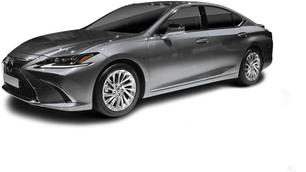
And since the Lexus ES is a close relative, we’re going to take a fresh look at the latest version, with a view of it as a bit of a survivor of a bygone era – where aspirational vehicles were created from normal family sedans.
Just like the Fairlane, Crown and of course, the Caprice.
Launched in mid 2018 but facelifted in 2021, we test the ultimate version of the seventh-generation ES, the 300h Sports Luxury – or SL, if we’re to make yet another tenuous connection to long-gone Holdens.
Let’s go!
The Chrysler 300 SRT is a big, fast, well-equipped and super-comfortable point-to-point tourer that’s also able to soak up the stresses of a city commute with ease. It’s also showing its age in terms of design, obscenely thirsty, dynamically flawed, and offered with a bottom-of-the-class ownership package. A fun place to visit but make sure you’re ready for permanent residency.
There’s no denying the Sport Luxury is imposing, spacious, plush, chock-full of kit, efficient, speedy and pleasingly relaxing up to a point.
But its interior is also dated and true ride comfort can be elusive beyond smooth roads for this top-of-the-line version to make the grade as a proper luxury sedan.
The ES 300h feels more like an aspirational Toyota than a Lexus for the (wealthier) masses, especially after recent triumphs like the latest NX and RX SUVs. The Camry DNA is difficult to disguise, as the amused strangers who sat in our test car uninvited thinking it was their Camry highlights.
Sure, the hybrid is no Chevy V8, but in many other ways, the Sport Luxury seems like the modern successor to the Holden Caprice experience.