What's the difference?
Following the money comes pretty naturally to carmakers. It’s what happens when the product planning department smells a new direction on the breeze and then handballs that to the design and engineering folks who turn a perceived market trend into a showroom reality. And when everybody gets it right, you have a new default product. And everybody else has to keep up. Some even have to catch up.
We’ve seen it plenty of times before, too. Think about those early 1980s days when the default small car went from a sedan to the five-door hatchback. Didn’t that catch on? You might also remember more recently when a family car had to be a four-wheel drive. And what about the dual-cab ute revolution of the last 15 years?
The other strident market segment right now is the SUV, of course. And within that, most recently has been the march to electrification, starting with conventional hybrid technology and now progressing to the new must-have, a plug-in hybrid platform.
The fact is, if you’re a Chinese carmaker intending to sell on a world stage, you can’t ignore the plug-in SUV in any of its various sizes and marketing segments. There’s a good basis for this, too. Plug-in hybrids just make good sense. They offer the urban running-cost advantages of any hybrid, the option of zero tailpipe emissions, all-electric running over a normal commuting distance and – crucial for a big country like this one – they’ll keep motoring along for as long as the owner puts petrol in them.
Okay, so they can be heavy with all that tech on board, and there’s no denying that two power sources (petrol and electric) make for a more complex machine, but the advantages outweigh the downsides for many buyers.
The other graph you can plot with great certainty is that new tech will get cheaper as the industry moves forward. Which is exactly where BYD finds itself right now by being able to offer a plug-in hybrid variant of its Sealion 5 mid-sized SUV at a price that will have much of the opposition running scared. But how scared should the others be?
Up until 2024 when its title was nabbed by the Tesla Model Y, the humble Toyota Corolla has been the world’s best-selling car for quite some time.
A reputation for reliability, affordability, efficiency and in its current guise, being fun to drive, the Corolla has seen off all comers to retain the title of the most popular small car on Earth.
The current twelfth-generation Corolla is now seven years into its life cycle having landed in mid-2018. In that time scores of buyers have moved across into small SUVs, and the Corolla’s competitor set has shrunk dramatically as car brands pull out of the small passenger car segment.
But as we gear up for the next-gen Corolla, is the existing one still worth considering against some newer rivals? And should you look at this instead of a small SUV?
I lived with the mid-range Corolla SX hatchback for a week to find out.
Cars that don’t always appeal to enthusiast buyers are often seen by manufacturers as a way of not bothering with the dynamics. Good enough is, apparently, good enough. Thankfully, BYD hasn’t taken that path here and the local suspension tweaks have turned what could have been a me-too product into a bit of a dynamic class leader. And even if buyers can’t verbalise the benefits of that, they will still be subliminally enjoying them with every kilometre.
The other stand-out feature is the price-tag which represents an awful lot of car for the money. And, in such a price-sensitive market as this one, that will get the BYD over the line for a lot of families. That it also offers a vastly better driving experience simply makes the value equation – and the purchasing proposition – even stronger.
The final score for this review makes it look as though the Corolla is a middling effort. The scores for each individual section of the review are well considered and fair. The Corolla does lack the practicality of some of its rivals. A lack of an ANCAP rating isn’t great and the powertrain is just okay. But it remains one of the most fun-to-drive hatchbacks on the market today, even seven years into its life, and I would wholeheartedly recommend the Corolla to anyone looking for a small car. If you can forgive some of the quirks, it is a reliable, adorable, fun and efficient small car favourite.
The interior of the Sealion 5 feels pretty well-made and there are soft-touch surfaces on most of the touch-points. The steering wheel, too, is thick and chunky and nice to hang on to. But there’s a lot going on in terms of different colours, textures and surfaces, and it can all look a bit busy, despite the high-tech boardroom overall flavour. It’s also worth mentioning the trim material is synthetic but does a great job of looking and feeling like real leather.
Externally, there’s not a lot to grab the eye. Sure, it’s not an unpleasant looking vehicle, but neither does it stand out from the mid-size SUV pack. At least BYD decided against those cheap-looking plastic tack-ons on each wheel-arch.
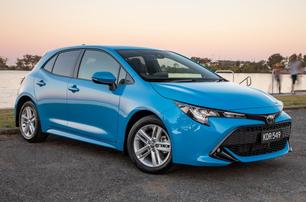
It’s been around for a good seven years, but the current-gen Corolla hatch is still a smart design. It has a squat stance and looks as though it has sporty intentions (it doesn’t), and the head and tail-light treatment doesn’t look like anything else in the segment.
The Corolla has adorable proportions and a pert little behind in a sea of increasingly boring small SUVs.
However, in SX trim and in the ‘Sunstone Orange’ body colour of my test car, the Corolla gives off rental car vibes. Which is hardly surprising given lower grade Corollas are a favourite of rental companies.
Inside that vibe continues. This is where the Corolla is really showing its age.
There are various shades of grey throughout the cabin, with a mix of hard and soft plastics. The cloth seat trim is drab, which is a shame because some other brands have managed to make cloth cool again. Not Toyota.
The touchscreen sticks up out the top of the dash like an old iPad and the dash design is old but functional.
There is nothing inspiring about this interior design. In saying that, of those aforementioned rivals, only the Mazda3 and the new Kia K4 have modern cabins.
Here’s the other big shock relative to the price-tag of the Sealion 5: This is not a small car. Based on the price, you might have been thinking the vehicle would be a compact SUV. And you’d have been wrong. This is a proper mid-sized SUV with room for five and luggage and an overall length of 4.7 metres and change. And to put that into some kind of perspective, that’s just 30mm shorter than the Sealion 6 which costs about $9000 more at its starting point.
The wheelbase is long, too, and the 2712mm between the axles helps make the interior even more spacious. That means there’s lots of stretching room in the front, but also that a grown adult can comfortably sit in the back seat behind another grown adult at the wheel and still have enough room in every direction. The window sills are commendably low in the rear seat, too, ensuring even littlies can see out.
The biggest problem in the back is that the seat cushion is a bit flat, but, like the front chairs, it’s still pretty plush.
With all five seats in place, the Sealion 5 boasts 463 litres of luggage space and the cargo area is well done with storage pockets at each side, a light and an under-floor tray designed to transport charging cables and a tyre repair kit. Yep, that’s right, there’s no spare tyre of any sort here. No surprise, really.
Fold the rear seat down and you’re suddenly looking at 1410 litres of cargo space and your SUV is now a panel van.
As well as the dual-zone climate control, the Sealion 5 also offers a single USB -C and a USB-A charging port in the front and rear compartments.
The Sealion 5 also offers a V2L (Vehicle to Load) function, meaning it can power camping or on-site work equipment and even act as your home’s battery.
The Corolla is a small car and that is evident inside. You might bump elbows with your front passenger, but I have no problem with the front leg or headroom.
Those cloth seats might be drab but boy they are comfy, and the fronts have loads of side bolstering.
The steering wheel has typically clear controls and looks and feels nice.
As a more, shall we say seasoned model in the segment, the Corolla still has buttons on the dash for things like air con, but not too many. That bulbous centre stack and the centre console, however, could be better designed for the space.
As it is, the wireless charging pad is hidden under it at the far end of the console. It’s a bit fiddly to get your phone in and out. This is also where one of the USB-C ports lives.
The other one is in the central storage bin which is quite small, but also houses a 12-volt outlet. There are no other places to store things because of the rounded shape of the console, which also features a couple of narrow cupholders.
OurCarsGuide bottle had to be squeezed into the door storage cavity - only narrow, short vessels will fit properly.
That 8.0-inch multimedia screen is very easy to navigate, with logical menus and icons. However, it’s almost too basic, which is not helped by the all-white background. It could be a more engaging set-up but it’s also very hard to fault the functionality. Our Apple CarPlay maintained its connection the whole time with the car, too.
Space is quite tight in the rear, although I have enough headroom for my 184cm frame. Legroom is just okay behind my driving position. There’s more space in the back of a Hyundai i30. It’s also dark because of smallish rear windows and thick C-pillars.
The rear seat backrest is quite upright, but, like the front seats, well cushioned.
Amenities are just average back there - there’s a weird cupholder high on the door, only a passenger side map pocket, no rear air vents and no USB ports, although you could easily use the one housed in the front central bin. There’s a rear fold-down armrest with two cupholders.
The rear seats split and fold 60/40 and they fold flat making for a better loading space.
The good news is the SX (and the base Ascent Sport) come standard with a temporary spare wheel, which is great news for a hybrid model. The bad news is, that reduces boot space to a paltry 217 litres.
That’s off the pace of all of its key hatchback rivals, including the Mazda3 which has its own cargo concerns at 295L, and the Hyundai i30 with 395L.
The Corolla ZR hatch has more space at 333L but you only get a tyre repair kit instead of a temporary spare.
If you’re dead set on a Corolla but need more cargo space, consider the smart looking sedan that has 470 litres.
The plug-in hybrid in question is the BYD Sealion 5. It has a claimed EV-only range of better than 100km, relatively quick charging, a decent sized battery, adequate performance, enough interior space for a family, good safety and lots of equipment. Oh, and it costs just $33,990, before on-road costs, in its entry-level Essential form. Incoming!
Equipment-wise, that sub-34K sticker gets you a 10.1-inch central info-screen, an 8.8-inch driver display, digital radio, a six-speaker stereo, wireless connectivity for Android Auto and Apple CarPlay and dual-zone climate control.
Throw another four grand on the table and you move up to the Premium version which adds plenty of kit for the $37,990 ask. That includes a panoramic sunroof, automatic tailgate, roof rails, heated and electrically folding mirrors, one-touch power windows, a six-way powered drivers seat and four-way powered co-pilot’s chair, a heated and ventilated driver’s seat and wireless charging.
The step up from Essential to Premium also includes a battery upgrade, and we’ll cover that off in the Under the Bonnet section below.
Toyota dropped all exclusively internal combustion engine versions of passenger car models and car-based SUVs last year so the Corolla is now hybrid-only.
The grade we tested is the SX five-door hatchback which is priced from $35,260, before on-road costs. Interestingly, the sedan version, which has a much bigger boot, is $340 cheaper.
The SX sits in the middle of the Corolla range with the Ascent Sport the most affordable (from $32,110) and the ZR the priciest before you get to the fire-breathing GR Corolla hot hatch.
Direct rivals at this approximate price point include the Hyundai i30 N Line ($36,000 BOC), Mazda3 G20 Touring ($37,110), Subaru Impreza 2.0R ($35,490) and the Kia K4 Sport ($35,190), although that is sedan only for now.
You get 16-inch alloy wheels, cloth bucket seats, a synthetic leather steering wheel, auto-dimming rear view mirror, rain-sensing wipers, rear privacy glass, keyless entry and start, dual-zone climate control, USB-C ports, a wireless device charging pad, six-speaker audio, an 8.0-inch colour multimedia display with sat-nav, digital radio, Bluetooth, voice assistant and wireless Apple CarPlay and Android Auto.
The standard features list could be described as adequate without being overly generous for the price. A head-up display (standard in the ZR) would be nice.
Both variants of the Sealion 5 have the same driveline – mostly. They each use a 1.5-litre petrol engine teamed with a single electric motor, both driving the front wheels. Unlike the bigger Sealions, there’s no all-wheel drive version. Power peaks at 156kW and torque at 300Nm.
Why a non-turbocharged engine? BYD tells us the non-turbo engine helps keep cost out of the vehicle and, since the engine really only runs to power the electric motor and charge the batteries, it does so at a relatively constant engine speed, negating the need for a wide spread of petrol power.
The only major difference is that the Essential version has a 12.9kWh battery-pack, while the Premium gets a bigger, 18.3kWh pack for longer range, but precisely the same output and, therefore, performance.
A single-speed transmission is part of the BYD driveline package, also made possible by the fact that the vast majority of the driving of wheels is done by the electric motor.
Since Toyota dropped the petrol engine from the Corolla range, it’s a hybrid-only affair.
The powerplant is a 1.8-litre naturally aspirated petrol engine paired with Toyota’s fifth-generation hybrid system that incorporates a lithium-ion battery, which is lighter yet more powerful since the 2022 update.
The Corolla drives the front wheels exclusively via a continuously variable transmission (CVT).
It’s not the punchiest engine and could do with more poke, but Toyota does do hybrids well.
The Premium’s bigger battery claims to up the official NEDC range from the Essential’s 71km to 100km. BYD reckons with the 52-litre fuel tank brimmed and the car operating at its claimed 1.2 litres per 100km efficiency, the range of either version is just on 1000km. In the real world, that’s likely to be closer to 800km (especially with some highway running thrown in) but it’s still one heck of a solution to range anxiety.
There’s no DC charging function for the Sealion 5, so forget about commercial fast chargers. But on a 3.3kW AC power outlet, the maker claims the Essential can reach full charge in under four hours, while the Premium’s bigger battery will take under six hours to fully charge. A Type 1 charge cable is included.
According to Toyota the official fuel-use figure for the Corolla hybrid hatch is 4.0-litres per 100 kilometres and CO2 emissions sit at 90g/km.
While the trip computer said 4.8L/100km at the end of our week, my own fuel consumption calculation came to 5.8L.
You will only need 91 RON 'standard' petrol to fill up the Corolla.
You don’t have to drive very far to realise that the local input into the Sealion 5’s suspension and steering have been worth the effort. BYD Australia has a local engineering team on call these days, and it shows here.
Actually, the steering is not the highlight; it has some weight but not a whole lot of feel, or, indeed, feedback for the driver. The ride and handling combination is what stars. Obviously well-damped, the suspension allows for a ride that is both complaint and quiet, without causing the car to wallow around like some jacked-up designs can with their higher centre of gravity.
In fact, the BYD is athletic to the point where keener drivers will find it an entertaining drive; hardly something that can be said for the majority of medium SUVs.
Performance is strong without being overwhelming and even though the Sealion 5 has that signature electric-drive feeling of effortlessness, the accelerator pedal has been calibrated to avoid the neck-snapping surge of grunt off the line. As such, it emerges with a fairly flat acceleration curve, and no hint that the petrol motor is cutting in or out.
Until, that is, you bury the throttle all the way at which point the petrol engine takes a few second to join in. And when it does, it’s pretty vocal – shrill, almost – as it catches up with the rest of the car and starts directly driving the wheels. To be fair, though, this is not going to be a common occurrence in everyday life thanks to the flexibility of the petrol-electric system for 99 per cent of circumstances.
On the move, the cabin is perhaps most notable for its soft, plush seats that are a nice change from the church pews of some manufacturers. And although the driving position is about right, taller drivers might prefer a steering column that extends out another few millimetres.
The driver display screen is another source of annoyance. It’s pretty small and contains lots and lots of information, to the point where the typeface is too small to be read on the run by anybody who relies on reading glasses.
Most generations of Corollas have been solid, dependable and occasionally, even fun to drive.
My first car was a Holden Nova GS hatchback, which was a rebadged version of the seventh-generation Corolla. I loved that car. It was zippy, fun and super economical.
The same principles generally apply to the current-gen Corolla. Thankfully, Toyota’s former CEO, Akio Toyoda, insisted all models from the Camry to the Kluger needed to be injected with more fun. And he succeeded with the Corolla. So much so that they've spun off a wild GR performance hot hatch version.
The Corolla sits low to the ground and it just feels much more connected to the road than a small SUV can. Even in mid-range SX guise, the Corolla can hug a corner and there is ample grip to ensure a fun drive on your favourite winding road.
Sure, the hybrid powertrain might not set your heart racing, but it is quick enough from a standing start and it lacks the lag of some of its turbocharged contemporaries. There’s also plenty of poke on tap for a small car when overtaking.
Even though it has a sporting edge to how it handles, the Corolla SX has been tuned for comfort first and foremost and this is another area it excels. The damper set-up ensures the Corolla soaks up speed bumps, nasty potholes and whatever else our shoddy roads can throw at it. At no point in my seven days with the Corolla did I complain about a harsh bump or thud.
Steering has a mechanical feel but it is still sharp, adding to the ‘chuckable’ vibe of this hatchback.
The powertrain can be noisy when pushed and combined with a CVT auto it’s the nicest sounding engine out there. Also, the transition from electric to petrol power isn’t particularly smooth. Other carmaker’s hybrid offerings - like Honda for example - are close to seamless.
Some road noise gets into the cabin but it’s no deal breaker.
Passive safety in the Sealion 5 starts with no fewer than seven airbags including full-length side-curtain bags.
There’s also a front-centre airbag, something we’d like to see in more cars, particularly at this price-point. Child restraint points in the rear seat are the ISOFIX type.
The BYD gets pretty much the full suite of driver aids, including autonomous emergency braking, blind-spot monitoring, rear-cross traffic alert with active assistance, stability control, active cruise-control, traffic-sign recognition, front and rear collision warning and tyre pressure monitoring.
The Sealion 5 also incorporates a driver-attention monitor which seems better calibrated than some earlier efforts from some of the Chinese carmakers. Also improved in calibration terms is the lane-keeping assistance which is still too violent for our tastes, but more subtle than some of the competition’s systems. But while the savagery of this system has been toned down, it appears to have been at the expense of sensitivity and, time and time again, the cameras missed road markings that were faded or dirty.
The major safety benefit in paying more for the Premium variant is the addition of front parking sensors and a 360-degree camera instead of the Essential’s simple reversing camera.
The Sealion 5 has not been ANCAP tested as yet, although BYD says this is largely down to ANCAP’s scheduling rather than any hesitance on BYD’s part.
The Corolla is currently unrated by crash safety watchdog ANCAP. It did achieve a maximum five-star rating back in 2018 but that expired at the end of last year.
Safety features are largely standard across all grades and the SX comes with auto emergency braking (AEB) with pedestrian and daytime cyclist detection, lane departure alert with steering assist, speed sign recognition, 'Lane Trace Assist', adaptive cruise control, a blind spot monitor with safe exit assist, a rear cross-traffic alert, reversing camera and front and rear parking sensors and a rear occupant alert.
It doesn’t have a driver attention alert, and it’s all the better for it.
The lane keeping aid is well calibrated and subtle in its interventions, but the adaptive cruise let the speed creep several kilometres over the set speed on several occasions.
Like other BYDs, the Sealion 5 comes with a six-year/150,000km warranty. Some of the competition have unlimited kilometre warranties, but to be honest, 150,000km in six years is going to be beyond the need and aspirations of most owners.
The EV battery is covered by an eight-year/160,000km warranty, and let’s not forget, BYD was a battery manufacturer before it started making whole cars. Certainly, the company is very bullish about the quality and safety of its 'Blade' battery technology, claiming it easily passes the technically-daunting 'nail-puncture' test.
BYD plans to have capped-price servicing for the Sealion 5, but no pricing announcements have been made yet.
Servicing also falls into line with other BYD models, so that means 12 months or 20,000km intervals.
The Corolla is covered by Toyota’s five-year/unlimited kilometre warranty, which, given Kia, MG, GWM, Jaecoo and more have longer terms (not to mention Nissan and Mitsubishi’s conditional 10-year terms) is now officially trailing its competitors.
However, the capped-price servicing plan of up to five years costs just $250 for each service, which is incredibly competitive. The service schedule is every 12 months or 15,000km, whichever occurs first.