What's the difference?
I remember the first Bond film I ever watched.
I was about eight or nine years old, and it was GoldenEye on VHS. In that film, Pierce Brosnan drove a BMW Z3 convertible, which obviously oozed cool.
I didn’t know at the time that it was just a little bit weird that he wasn’t driving an Aston Martin for the entire duration of the movie, but it didn’t matter, that drop-top Beamer with its radar and missiles imprinted itself on my mind.
As such, I’ve always had a soft spot for BMW’s 'zed' range, so I was quite keen to helm this new one as it came through the CarsGuide office, especially since it shares its underpinnings with the new Toyota Supra.
So, is the new Z4 a case of never meet your heroes? Or did it make me feel a little bit like a secret agent? Read on to find out.
Subaru struck gold when it first launched the BRZ in 2011.
It, alongside the related Toyota 86 (now GR86), has been the standard for budget two-door sports cars for 15 years now. Nothing besides the MX-5 convertible is in the same class.
However, buyer’s preferences have changed dramatically over the years and sports cars are at risk of becoming more mundane and vanilla to please the general public. It’s great that Subaru continues to offer the BRZ, importantly with the availability of a manual gearbox. Hallelujah.
Last year Subaru made some slight tweaks to the BRZ, including adding active safety tech and a ‘Sport’ mode to the manual trims, plus a full-size spare wheel on the top-spec tS grade.
Speaking of, we’ve got the BRZ tS manual on test here, so let’s see how it fares in 2026.
The Z4 didn’t make me feel like Peirce Brosnan’s 007. It’s way too serious – a proper gritty reboot. Maybe it’s meant for Daniel Craig. Either way, its brave design makes it one of the best-looking BMWs of recent memory, and it’s a tech- and comfort-fest that the Bavarian automaker should be proud of. I just wish it was a smidge more fun behind the wheel.
The Subaru BRZ is a classic modern-day sports car that is a driver’s car through and through. This top-spec tS tester with the litany of accessories is a great example of what’s possible straight from the dealer, but it’s definitely not the best bang for your buck.
Thankfully you still get virtually every benefit the BRZ offers in the entry-level model. You’ll save thousands of dollars which you can use to pay for fuel on a road trip or modify your car exactly how you’d like.
The Z4 is a sight to behold. It’s brave, especially for a BMW, it even betrays the brand’s strongest styling pillars, making its own way with its more horizontal grille design, flat body and curved out rear.
It’s more than that, though. In black, this car looks sinister, brooding. The more you look at it, the more you notice tiny details - the scooped-out sides, or the way the entire rear seems to flick up into the integrated spoiler. I couldn’t get enough of staring at it – it manages to look even better with the roof down.
That’s probably when it hit me. To my eyes, at least, this is the most stunning BMW in years. Sure, the X7 is a sight to behold due to its sheer dimensions and borderline offensive grille, but the Z4 is the opposite. It’s subtle, it hides its details away in its silhouette.
It’s designer, Calvin Luk (an Australian no less), was inspired at least in part by the Z8 – another Brosnan bond car – and you can see the Fisker design reflected in the Z4’s low, flat grille and almost bulbous rear.
Inside, sadly, the Z4’s strong design doesn’t quite play out. There’s no wily Fisker touches here, just a standard set of BMW switchgear. While it all works well, it just dumbs down the Z4’s character.
The big, chunky steering wheel in particular is a let-down. It’s the same wheel that sits in the brand’s X5 SUV, and it feels right there, but not here in a convertible where you’re so close to the ground. A smaller wheel would not only suit this car better, it would make it feel just a smidge more alive. I miss the three-spoke M sport wheel from previous-generation BMW cars.
I do like the dash, which is seemly carved from rhomboid shapes - a theme that rolls into the doors, screens, and vents elegantly. I’m normally not a fan of gloss plastics and chrome touches, but in the Z4 they’re all tastefully applied.
The seats, too, are lovely. I’m not sure about the contrast bright-red leather our car came with, but they’re nice and close to the ground and have excellent trim that you seem to sink into just enough to be comfortable and sporty all at once.
It’s a slick place to be, I just wish it felt less like you were at the helm of an SUV and more like you were driving something that looks this damn good.
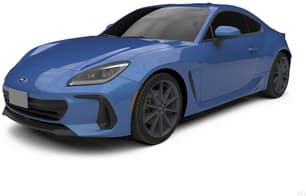
The Subaru BRZ has a timeless exterior design that screams dynamic sports car from every angle.
Even though the second-generation BRZ is around halfway through its lifecycle now, the design is aging like fine wine. It’s also a lovely evolution of the original which dates back to 2011.
The BRZ is low slung, has an aggressive front fascia plus the rear has prominent exhaust pipes. All of this stacks up to make a tough-looking car.
Thankfully this test example is also finished in 'WR Blue' exterior paint, which in my books is still the best colour for a Subaru performance car.
Adding all the genuine accessory goodies onto this car not only amplifies its street appeal, but also harnesses its racing intent. The carbon rear wing in particular has a swan neck design much like the Porsche 911 GT3. Many interested car-spotters craned their necks to get a good look.
Despite this, all the accessories are too flashy for my taste, especially for a car likely to be driven daily. I’d go for the stock look to retain resale, or something subtle like a small rear lip spoiler.
Inside the BRZ has all of the hallmarks of a sports car, as well. These include a steering wheel with minimal buttons, a prominent rev counter and contoured seats.
The manual gear shifter in this car is prominent and nice to hold. It’s great to still see manual options as they’re slowly but surely falling out of favour with buyers.
The manual handbrake is also a nice touch from a design perspective, but it limits overall interior practicality. More on that in a bit.
You can tell the interior is getting a little dated due to the older central multimedia system. But at the end of the day sports cars are more about the driving experience than the flashy tech.
The Z4 is a convertible, so it’s naturally compromised on space. As far as convertibles go though, you’ll be hard pressed to find one you can fit more stuff into.
The Z4 is wide - the same width, in fact, as a 5 Series - and this carries into the cabin. There are only two seats, but those seats are wide, and occupants will find themselves with luxurious amounts of airspace for their arms, as well as excellent leather-trimmed and padded surfaces for landing elbows on.
Legroom is also great, as the seats have a surprising amount of rail-travel on them, so that even taller folk won’t struggle to fit their limbs in.
A genuinely impressive characteristic of the Z4 is much head room there it is. Despite its low-slung looks from the outside, the roof towers over my 182cm tall head when I’m inside, so this isn’t one of those convertibles that feels like braking too hard might simply decapitate those above six-foot tall.
In terms of storage areas you get some long but shallow trenches in the doors, a bay with connection ports and a Qi wireless charging pad under the air-conditioning controls, a glovebox (hey, not all convertibles have them) and a trick centre console that houses two deep cupholders inside.
There’s also a netted shelf behind the seats that could fit small bags, and given the length of the cabin, you could even fit laptops and the like behind the seats provided you haven’t used the full extent of the seat’s rearward movement.
The boot is deep, wide and long for a drop-top, and offers a total of 281-litres which is more than some popular hatchbacks. It even offers tie-down points and netting either side. To top it off, the fabric roof folds away into its own compartment, so the boot space is unaffected if you choose to drop the lid.
For a convertible – the Z4 is a practicality wizard.
Hopping into the BRZ you’re immediately aware you’re getting into a sports car. It’s low-slung and the driving position feels like you’re almost sitting on the road. Perfect for this kind of machine.
The front seats are beautifully contoured and lock you in for when you’re driving through the twisties. Thankfully, the bolstering isn’t too aggressive and it’s still comfortable for everyday driving.
Ahead of the driver, the leather-wrapped steering wheel has a thin rim and is lovely to hold and turn. There aren’t many buttons but the few that remain are purposeful and have a lovely tactile click.
Behind this there is a 7.0-inch digital instrument cluster that permanently displays the rev counter in the middle. It’s a cool set-up that almost has a retro look to it, plus you’re able to configure the content that is displayed on the left-hand side.
Moving across, the central touchscreen multimedia system is classic Subaru. Nothing revolutionary, but I appreciate the physical shortcut buttons and dials on both sides of the screen.
It’s very easy to navigate around the screen, though as the photos show it is prone to glare, especially in bright scenarios.
Disappointingly there is only wired Apple CarPlay and Android Auto, with no wireless versions offered. You need to plug your phone in with a USB-A cable in a slot under the split-fold centre armrest.
While this means your phone will reliably charge, rather than having your phone overheat on a wireless charger, there’s no nice spot to put your phone given the physical handbrake takes up so much valuable centre armrest space.
You can put your phone in one of the cupholder spots, but when you do you don’t get a centre armrest. It’s too compromised for my liking.
While I’m on the topic of storage, there isn’t a great deal of it. There’s a small glove box and if you want, you can technically use the backseat area as they’re way too compromised for adults to fit into.
The rear seats are so small I didn’t even bother trying to fit as in my default driving position there is zero legroom. Even kids would struggle.
In terms of boot space, there is 201L available with the rear seats upright. It’s a fine space, though it’s impeded by the full-size spare wheel poking above the load floor. As a result you need to pack around the wheel.
Folding the rear seats makes the boot space more usable, though the envelope to slot things into the boot is narrow.
While the full-size spare wheel impedes the boot area, I’m glad it’s there because it’s much more usable than a dinky space-saver spare wheel or nothing at all. It gives you peace of mind in the event you have a puncture in the middle of nowhere.
The Z4 isn’t cheap, but it plays in a field of expensive Deutsche drop-tops. Our car was the mid-spec 30i which comes in at an MSRP of $104,900 (before on-road costs).
For that you’ll get a more highly tuned version of the base 20i’s four-cylinder turbocharged engine, producing 190kW/400Nm, 19-inch alloy wheels, M Sport brakes, Adaptive M suspension, and adaptive LED headlights.
That’s on top of the already impressively-specified 20i’s kit which includes dual 10.25-inch screens – one for the multimedia functions, the other as a digital dashboard, a head-up display, full Vernasca leather interior trim, auto-dimming rearview mirror, power adjustable and heated front seats with memory function, dual-zone climate control, 10-speaker 205W stereo, a Qi wireless charging pad, and adaptive cruise control as part of a marginally upgraded safety package (more on that in the safety section).
It’s a pretty plush set of equipment, although a challenging value proposition as the almost-as-well-equipped 20i starts from $84,900, a full $20k cheaper.
Rivals for this 30i model? You’ve got the soon-to-be-discontinued Mercedes-Benz SLC300 ($102,500), all-wheel drive Audi TT S quattro ($105,661), and, at a stretch, the entry-level Porsche Boxster ($122,960).
Of course, being a premium European car, there is an extensive options list. Our car was fitted with the excellent and probably-worth-the-money M Sport differential ($2400), as well as the rudely priced M seat belts (literally just the M pattern embroidered in - $560!) and interior ambient lighting package (lovely, perhaps not worth $550).
The Z4 is only offered in five colours, three of which – including our car’s Black Sapphire – come at a cost of $2000. The red interior, surprisingly, is a no-cost option.
If you’re keeping track that brings the car you’re looking at here to $110,410. Not cheap, and it doesn’t have six-cylinders - but given its other attributes explored later in this review, the fact that it still manages to undercut an entry-level Boxster is actually reasonable.
The 2026 Subaru BRZ line-up starts at $47,890, before on-road costs, for the entry-level model regardless of whether you opt for the manual or automatic.
On test here, however, is the flagship tS trim which starts from $52,790, before on-roads. That's $4100 more expensive than it was when it first launched in 2024.
It’s worth noting this is overlooking the limited-edition tS Kiiro ($53,590, before on-roads) with its bright yellow paint.
As a base, the BRZ comes with a solid amount of kit. This includes 18-inch alloy wheels, LED headlights, power-folding side mirrors, an 8.0-inch touchscreen multimedia system with wired Apple CarPlay and Android Auto plus dual-zone climate control.
One of the few things missing is wireless Apple CarPlay and Android Auto. This is becoming commonplace in many cars and while it can be a hassle to plug into a USB port, it also means your phone will reliably charge.
You need to step up to the S trim if you want features like leather-accented upholstery and heated front seats. The top-spec tS in particular gains STI-tuned suspension, Brembo front and rear brakes, black door mirror covers and tS badging.
Adding to this, our particular tester comes equipped with a wealth of optional accessories. These include an STI body kit, STI alloy wheels and an STI carbon boot spoiler, totalling just over $14,500 fitted… Goodness me. For reference, the carbon rear wing is almost half of that.
Altogether, this kitted-up BRZ tS tester costs around $67,300, before on-road costs. While this is much more than the top-spec Toyota GR86 and Mazda MX-5, it’s still less than an entry-level Ford Mustang Ecoboost or BMW 2 Series.
Welcome to the age of ridiculously powered four-cylinder turbo engines. Despite a capacity of just 2.0-litres, the engine in the Z4 30i produces a whopping 190kW/400Nm.
That’s probably enough for a car this size. I’m keen to drive the six-cylinder, but surprisingly it seems to offer diminishing returns for extra cylinders offering a 60kW/100Nm power boost for an extra $20,000. Perhaps a six-cylinder is the way to go in a BMW, and given this car’s other seriously sporty attributes, it might be the only way to make it a bit more… fun. More on that in the driving section.
All Z4s are rear-wheel drive, using an eight-speed torque converter automatic. Sorry, no option for a manual this time around.
It’s claimed that the Z4 will drink just 6.5 litres per 100 kilometres on the official combined cycle test, but I found that sticking my foot in occasionally resulted in a slightly more realistic sounding figure of 8.4L/100km.
That’s still a great fuel consumption number for a car like this, and perhaps one of the strongest benefits of having just four cylinders.
A discerning vehicle, the Z4 will drink nothing less than the best-quality 98RON unleaded to fill its 52-litre tank.
Subaru claims the BRZ manual consumes an average of 9.5L/100km on the (ADR 81/02) combined (urban/extra-urban) cycle.
We almost matched this during our largely urban-based testing, achieving an average of 9.7L/100km. There’s a 50L fuel tank which means there’s a total theoretical range of 515km using our as-tested fuel consumption.
A minimum of 98 RON premium unleaded petrol is required which isn’t uncommon for sports cars, but it still hurts your hip pocket nerve.
A car that looks this good better live up to the promise behind the wheel, right?
For the most part, the 30i does, but it’s a victim of its own performance credentials and luxuriousness.
See, a drop-top should be fun-packed, you should feel close to the road, connected. Sadly, a combination Z4’s excellent suspension and not-so-excellent SUV-like interior separates you too much from the surface below.
An advantage, of course, is the refinement on offer. The Z4 is easily one of the quietest, most refined convertibles I’ve ever driven, but it’s a little too insulated.
I can’t help but feel like it’s all business and no pleasure. It feels a little more like I should be cruising to work on the autobahn and a little less like I should be flinging it around corners on a tight B-road.
It feels almost wrong to drive it in a T-shirt. It’s serious and doesn’t want you to mess around, it wants you to wear a suit and tie.
This grand-tourer style feel is one that will keep a lot of buyers in the premium space happy, but I’m of the opinion that BMW will have that segment well and truly covered by the new 8 Series. If the budget allows.
Regardless, the 30i’s four-cyl engine feels like any six-cylinder would have a few years ago. It’s got a surge to it in the straights that’s quite satisfying, and it responds via the exhaust with an angry tone that makes it feel a little more alive, especially with the roof down.
This feeling was all helped along by our car’s M active differential which simply won’t let the fat tyres at the rear slide unless you’ve got high-speeds and loads of tarmac to play with – for better or worse.
The Z4 also has ‘variable sport steering’ which reacts to the car’s speed and position of the wheels to adjust the input ratio. It’s good when you’re at speed, but the weight and response of the steering can make the Z4 feel bigger than it actually is at lower speeds.
The suspension is firm, and can be a little bouncy over rough surfaces, but seems well suited to the Z4’s chassis.
Other than those notable characteristics you’ll find that the Z4 is wonderfully tuned in terms of its inputs, everything is slick and smooth, suited perfectly for long meandering drives.
This is where the BRZ has always excelled and this kitted-out tS manual is no exception.
Firing up with a cold engine, you’re immediately aware this is powered by a horizontally-opposed 'boxer' engine. It has that classic high idle that eventually simmers down once the engine has warmed up a bit.
Setting off you need to acquaint yourself with how this manual gearbox works. Every manual is a little different, however this BRZ is easy to pick up and understand quickly.
I particularly like the notchy and direct gear throw. It makes changing gears easy, fun and engaging.
If I am to be critical, the clutch bite point is a little high and there is a touch too much rev hang when changing gears, especially in the ‘Sport’ drive mode, but you get used to it eventually.
In everyday driving scenarios there is enough power available. Some more wouldn’t go astray due to the lack of a turbocharger, but this constraint makes the car more fun to drive as you have to work harder with the gears.
Speaking of, the gearing is short, which means you will be shifting gears quickly. At 60km/h, for example, the car can be driven around in sixth gear, which is clearly focused on maximising efficiency.
Once you’ve reached your set speed there’s enough torque to maintain it without having to dive back through the gears. This is nice because you don’t have to shuffle through the gears to keep up with traffic.
Out on the open road is where the BRZ comes into its own. The steering in particular highlights how balanced and poised the car feels. It’s so fun to chuck around on twisty bends and feel the weight transfer.
The STI-tuned suspension in this particular trim also highlights how sporty and dialled-in this car is. It can feel a little rough and taut on pimpled urban roads, though you need to remind yourself this is a sports car, not a comfort-oriented SUV.
In a similar vein, at higher speeds there is a lot of road and tyre noise that transfers into the cabin. This is made worse when the rear seats are folded. While more sound insulation would likely fix this, I like it being left out in the name of lighter weight (kerb weight is only 1.3 tonnes).
Convertibles and safety don’t often fall in the same sentence, unless its one where a concerned relative is trying to convince you not to buy one.
In any case, the Z4 benefits from four airbags (dual front and dual side), as well as the expected electronic stability controls. That optional M Sport differential will have the added bonus of preventing any unexpected slip and slide at the rear.
On the active side the Z4 gets ‘Driving Assistant’ which includes forward collision warning (FCW), lane departure warning (LDW), rear cross traffic alert (RCTA), and rear collision warning. The 30i grade also gets 'active cruise control with stop & go' which allows for full auto emergency braking (AEB) with pedestrian and cyclist detection. Not on the spec sheet, but apparently present in the car I drove was some form of traffic sign recognition (TSR) and lane keep assist (LKAS).
A nice high-res reversing camera displayed on the massive touchscreen is a welcome standard addition.
Considering the meagre safety specification of most convertible cars, the Z4 30i shines with a half-way decent active safety suite. But you can forget ISOFIX child-seat anchor points. There aren't any.
The current-generation Subaru BRZ hasn’t been crash-tested by ANCAP and is therefore unrated.
In 2025, the manual BRZ joined the auto version when it gained Subaru’s 'EyeSight' camera system, which brings autonomous emergency braking (AEB), lane departure warning and even adaptive cruise control. It’s rare for manual-equipped vehicles to feature the latter.
This is above and beyond the seven airbags, blind-spot monitoring, rear cross-traffic alert, lane change assist, reverse camera and tyre pressure monitoring.
It’s worth noting manual versions of the BRZ do not have any parking sensors, front or rear, as standard. Automatic versions gain rear parking sensors and a rear AEB system.
There are two ISOFIX anchors and two top-tether points for child seats in the second row, though space is rather limited.
If recent quotes are anything to go by BMW is set to stick by its lacklustre three-year unlimited kilometre warranty, as it says its customers simply aren’t interested in five years (or longer) when it comes to warranty coverage.
It’s a shame, as even Volkswagen has upped its warranty to five years, and Mercedes has considered a 10-year coverage plan in the past.
In terms of servicing, there are two fixed-price plans available – the suspiciously cheap ‘Basic’ plan which comes at a cost of $1373 for five years (or $274.60 per year) and the more realistic-sounding ‘Plus’ which costs $3934 over five years (or $786.80 per year).
Like every other BMW, the Z4’s computer tells you when its service time: how often it needs maintenance will depend on how often – and how hard – you drive it.
Subaru BRZ owners are covered by a five-year, 100,000km warranty which is now commonplace in the mainstream segment. Many carmakers are now extending their coverage out to seven years and beyond.
Logbook servicing is required every 12 months or 15,000km, whichever comes first. The first five services cost a total of $2595.51, which averages out to around $519 per service. For the performance car space this isn’t cheap but not as exorbitant as more premium offerings.
Subaru has a total of 128 dealers around Australia, with a spread across metro, rural and regional areas.