What's the difference?
I think auto journalists are supposed to see vehicles a bit like parents see their children. You know, view them all as equals. No favourites. That kind of thing.
But I'm going to let you in on a tiny little secret, just between us. I liked this potent M2 before I even sat in it. And I like it just a little bit more than I love other bite-sized performance cars.
In fact, I like it more than I like bigger, more powerful, and more expensive models in the BMW M family.
A big welcome to one of the first turbo-petrol four-cylinder versions of the new-generation Hyundai Santa Fe, a model that launched locally with only its hybrid variants available to our market.
While it might not satisfy the fans of the previous-gen's V6 petrol engine, it might be enough for those who have been on the fence about going the hybrid route.
This is my third time in the new Santa Fe, and each tested variant has managed to offer something different and the base petrol grade, in FWD, is no different – but does it offer enough?
Proving good things still come in small packages, the pint-sized M2 remains my pick of the BMW M range. It's not the perfect daily drive, but I reckon the fun outweighs the foibles.
So I asked at the beginning if the Hyundai Santa Fe FWD petrol offered enough for families looking for a large seven-seat SUV and the answer is: YES!
It's practical, has people-mover space and storage and is downright comfortable to drive. There's so much to like here.
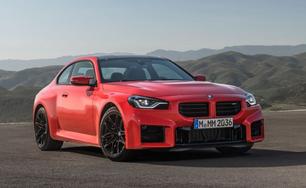
There have been mixed reviews of the design of the BMW M range, but I reckon this one looks pretty damn good. In fact, I've always thought this kind of hyper-aggressive styling looks better on smaller cars than it does on big ones.
And it certainly is aggressive, right? From the huge bonnet bulges to the meshed out grille and angry rear diffuser, to the staggered alloys and flared wheel arches, to the blocky rear end with its four massive exhaust exits.
But my favourite exterior item has to be the blacked-out carbon roof, which helps shrink the M2 visually, and makes the whole car look more potent.
Inside, it's plenty sporty feeling, with hard-backed sports seats, lashings of carbon-fibre-look trimmings and the bright red M buttons on the steering wheel.
It's nice, but some of the touch points – like the hard plastics on top of the doors, where, if you're like me, you rest your elbow when driving – feel less than premium.
Still, all the tech is present and accounted for, with its digital dash and huge centre screen, and there's no shortage of spaces to connect or charge your phone.
It's boxy and bold and you certainly won't mistake it for anything else on the road. That's both good and bad.
The front works beautifully; pairing a chunky and square aesthetic with cool H-shaped LED headlights (a running motif throughout the car). The front and sides look like the chiseled face of a Greek hero or the latest Romantasy crush, but the rear is just awkward. It's essentially just a big blank body panel and the only interesting thing about the back are the H-shaped tail lights.
Head inside and the interior is exactly the same as the base FWD hybrid variant - you get an interesting black and grey tartan fabric upholstery across the seats, and enough soft touchpoints scattered throughout to stop you looking too hard at the heavy use of plastics.
The dashboard shares similar chunky proportions with the exterior and you can see lots of H shapes in the air vents and panelling, so it flows pretty well inside.
The highlight is 100 per cent the large curved panel on the dash that houses the dual 12.3-inch displays. They look high-end and instantly lift the cabin from feeling 'basic'.
Joinery is flush, nothing rattles and there's an overwhelming sense of high-build quality inside. It's a cabin you'll be able to spend a lot of time in.
The M2 pocket rocket measures just over 4.5m in length, just under 1.9m in width, and just over 1.4m in height, and it rides on a 2747mm wheelbase. That makes it longer, wider and lower than the model it replaces.
Remember that 'lower' bit, as it will come up again in a moment.
Up front, you don't feel cramped, and there's the requisite cupholders, door pockets and hiding holes, as well as wireless device charging and USB connections.
But remember, this is a two-door, four-seat affair, which cuts into the practicality a little, or a lot.
Swing open the wide front doors, and push the front seat-back forwards, and the entire chair will slide forward automatically.
It does help create more room to climb into the back, but it's still a slightly embarrassing challenge to make getting back there look anything like graceful.
Once there, it's tight. I'm 175cm and my head was firmly pressed into the roof.
You do get your own vents and temp controls, but that's about it. Even the pull-down divider only gives you access to the 390-litre boot, rather than extra cupholders.
You do get two sets of ISOFIX attachment points, though, and let's be honest – if you're buying this to make Bunnings runs, you've probably got it wrong.
I've said it before but I'll say it again. The cabin offers similar, if not the same, level of practicality of a people mover with passenger space and storage solutions.
In fact, Hyundai may have shot their other three-row SUV, the Palisade, in the foot here because I'm not sure why you'd now bother forking out an extra $13,800 on the base Elite grade over out test model. Not when each row will be comfortable for an adult and feature decent amenities.
With seats that don't sit too high and a 177mm ground clearance, the Santa Fe is an easy SUV to get in and out of, even for kids.
The front- and middle-row seats are the most comfortable when it comes to padding and under-thigh support. The powered drivers seat also offers adjustable lumbar support on top of the heat functions that both front seats get.
Storage is top-notch with lots of cubbies to choose from up front with dual gloveboxes, one that can fit a manual and one that will hold smaller items like a wallet, wet wipes etc.
The middle console is huge and has a removable shelf but is also shared with the middle row as the bottom pulls out into a storage drawer for them. This means you can cut out the middle man (AKA the parent) and have a handy place to put any roadie snacks.
The centre console features two phone cradles and a large shelf underneath that easily holds a handbag or Saturday night's takeaway.
There are a total of 12 cupholders (2/6/4) and four drink holders (one in each door storage bin) plus a sunglasses holder and map pockets on the back of the front seats. So, definitely spoiled for choice when it comes to individual storage.
The technology is easy to use and high-quality with display screens that feature crisp graphics and a responsive multimedia touchscreen. The system features wireless phone mirroring for Apple CarPlay and Android Auto, as well as Bluetooth connectivity.
Charging options are good throughout the car with six USB-C ports (2/2/2), and a 12-volt socket and wireless charging pad up front.
Rounding out the cabin is the large boot which offers 642L when the third row is stowed, and up to 1963L when just the front seats are in use.
The loading space is level but you still get a handy under-floor compartment for small items. And the full-size spare tyre and powered tailgate are always practical to have!
First, the bad news. The M2 has only been getting more and more expensive over the years, and this new-generation model continues that charge.
Fun fact: When we first tested this model way back in 2016, you could get the Pure grade for less than $90K with a manual transmission.
Or you could spend just under $100K for the full-fruit version. This one, though, lists at $121,700, before on-road costs.
So, a little less bang for buck, but there's still a whole lot of bang on offer here.
You'll find staggered 19- and 20-inch lightweight alloys, while standard performance kit includes an 'Active M Differential', 'Adaptive M Suspension', 'M Compound Brakes' (with blue calipers), 'M Sport Seats' up front and, for the first time, a lightweight 'M Carbon' roof.
Elsewhere, there's adaptive LED headlights, a 12.3-inch instrument display and a 14.9-inch multimedia screen, a head-up display, a Harman Kardon 'Surround Sound' audio system and Android Auto and Apple CarPlay connectivity.
You'll sit on leather seats that adjust electrically and are heated up front. There's three-zone climate control, along with a heated steering wheel, wireless device charging and ambient interior lighting.
The Hyundai Santa Fe is offered in three grades, with the base- and mid-spec options now having the option of having a turbo-petrol engine or a self-charging hybrid powertrain.
Our test model is the front-wheel-drive base-petrol grade, which is priced from $53,000 before on-road costs. That makes it the most affordable variant in the Santa Fe line-up, being $2500 more affordable than the base FWD hybrid model.
This positions it in between its three-row large SUV rivals, the Kia Sorento S ($50,680) and even larger Nissan Pathfinder ST-L ($60,220). But the Sorento is still offered with a choice between V6 petrol engine and a four-cylinder turbo-diesel engine, which will entice some.
Our test model is incredibly well-equipped for a base variant and includes features like heated front seats, a powered driver's seat (with adjustable lumbar support), rear privacy glass and LED external lights.
There are great practical items like a full-size spare wheel, a powered tailgate, keyless entry/start, a 360-degree camera system, dual-zone climate control and tyre pressure monitoring.
Technology is also a standout with dual 12.3-inch displays taking centre stage, FM/AM and digital radio, wireless Apple CarPlay/ Android Auto, Hyundai 'Bluelink' app, over-the-air updates, Bluetooth connectivity, a wireless charging pad, six USB-C ports and two 12-volt sockets.
Bluelink connected car services brings features like ‘Automatic Collision Notification’ an emergency call (SOS) function, geo-fencing, valet, speed and time alerts and more.
Besides, this is what we're really here for, isn't it? The M2 gets the 'M TwinPower' 3.0-litre twin-turbo inline-six engine, producing a sizeable 338kW and 550Nm, sending that power to the rear wheels via an eight-speed auto or six-speed manual.
BMW says this engine is very, very close to the engine that powers the M3 and M4, and says it will rocket the M2 from 0-100km/h in 4.1 seconds, and to 200km/h in either 13.5 seconds in the automatic, or 14.3 seconds in the manual.
Our Santa Fe is the front-wheel-drive base variant, which features an eight-speed dual-clutch auto transmission and a 2.5-litre four-cylinder turbo-petrol engine that produces up to 206kW of power and 422Nm of torque.
Our model has a braked towing capacity of 2000kg, which is up from its hybrid siblings which can only tow up to 1650kg.
A small fly in the ointment is fuel use, with the M2 said to use 9.7L/100km on the combined cycle. It also drinks 98 RON premium, and is home to a 52-litre fuel tank. Your theoretical driving range is around 540km.
Now, be warned, you'll be bored stiff if you drive it in the way that's required to get it that low. When we were being gentle, we were somewhere between 10.5 and 11.5 litres per hundred kilometres.
Emissions are pegged a 220g/km of C02.
The base petrol Santa Fe has an official combined fuel cycle usage of 9.3L/100km and 67L fuel tank, giving it a theoretical driving range of 740km, which isn’t as good as its hybrid siblings but still sufficient for the odd road trip.
After doing lots of open-roading this week and a good three days of city dwelling, my real-world usage has popped out at 8.7L/100km, which is a solid result for such a large SUV.
Let's be totally up front here: the BMW M2 isn't the most comfortable vehicle to live with. In fact, I recently climbed out of the M3 Touring, and found that to be more comfortable on broken city streets.
The M2 is fitted with adaptive suspension, but even in its most comfortable settings it can feel rough, bumpy and jarring on bad roads (of which Australia has lots), and unless you're gentle with the accelerator, it can feel a little jumpy when first taking off – a by-product of its prodigious power.
Now, let's be totally up front again: I don't care. The M2 is fun, plain and simple, and for mine, the above is a fair price to pay for something that brings so much joy.
The steering is lovely, the power immediate and the soundtrack intoxicating, and it's the kind of car that's fun no matter where, how far or how fast you drive it.
In fact, fun seems to be the very centre of the M2 proposition, which definitely doesn't take itself too seriously.
For evidence, look no further than the 'M Drift Analyser', buried in a hopelessly busy multimedia system that will have you praising the CarPlay and Android Auto gods.
It will rate your best drift out of four stars, measure it for distance, and basically give you a pat on the back for doing your best hooligan impression (not on a public road, of course).
Fun, then, is the order of the day here. And I bloody love it.
The petrol engine definitely has more pep to it than the hybrid variants I've sampled. The power is responsive and you still feel like there’s heaps leftover when you have to overtake or get up a hill without any annoying engine whines.
The steering isn’t too heavy, despite the size of this car but turning off the lane-keeping aid will keep the on-road experience feeling smooth. Otherwise, you sort of ping-pong in your lane as the aid readjusts strongly.
All Santa Fes feel way more nimble than they have any right to in corners. You do get some roll, but our test model is sure-footed, even in heavy wet weather.
The eight-speed dual-clutch auto transmission is smooth enough and you don’t get any annoying lags when you accelerate from a full stop, which is unusual for such a unit.
Ride comfort is pretty high as well, with suspension that feels forgiving over the worst of the bumps and a cabin that remains quiet, even at higher speeds.
You have really great visibility in this model because of how big the windows are and the taller driving position helps as well. None of the pillars hindered my vision either from my driving position.
The Santa Fe well and truly fills out a car space and it was easy to see it in a car park because the butt hangs out a bit, but it’s still easy to park with its very clear 360-degree camera system and parking sensors at the front, side and rear. So while it is big, it doesn't feel big to park.
Overall, the petrol Santa Fe is an simple SUV to drive and will be a forgiving choice for lots of different driving styles.
The BMW M2 hasn't been assessed by ANCAP, but it arrives with six airbags, as well as all your usual traction and braking aids.
Elsewhere, you'll find lane change and lane departure warning, active cruise control, front and rear parking sensors, tyre pressure monitoring, and AEB with pedestrian detection.
There's also blind-spot monitoring, rear cross-traffic alert and lane centring assist, as well as a tyre-pressure monitoring system.
All hybrid Hyundai Santa Fe variants are covered by a maximum five-star ANCAP safety rating from testing done in 2024, but the petrol variants are not, so our test model is currently unrated. It does feature 10 airbags, though, which is excellent for a family SUV and the curtain airbags extend to the third row.
The standard safety equipment includes blind-spot monitoring, LED daytime running lights, driver attention alert, leading vehicle departure alert, safe exit assist, rear occupant alert (first two rows only), rear collision warning, forward collision warning, rear cross-traffic alert, lane departure alert and a lane-keeping aid.
There's also lane following assist, traffic sign recognition, an intelligent seatbelt warning (first two rows only), adaptive cruise control (with start/stop), the 360-degree camera system and front, side, and rear parking sensors.
It's also nice to see the blind-spot monitor on the base model, which is a system that pops a video feed of your blind spot onto your dashboard.
However, some of the safety features, like the driver attention monitor and traffic sign recognition, can be intrusive to daily driving. If you could permanently disable the sound alert, it would be a lot more enjoyable to drive long term.
The BMW M2 is covered by a five-year, unlimited kilometre warranty, and servicing is 'condition based', in that the vehicle will tell you what maintenance is required, and when.
You can prepay your service costs at the time of purchase for all BMW vehicles, covering the first five years of ownership, for $3480 (which means $695 per service).
The Santa Fe comes with a five-year/unlimited-kilometre warranty, which isn’t as good as some of its rivals, especially with Nissan now offering a 10-year warranty on its models, albeit conditional.
The pre-paid servicing plans are competitive, though, and the five-year plan averages just $481 per service.
Servicing intervals could get a bit annoying if you do a lot of kays every year as they're at every 12 months or 10,000km, whichever occurs first.
The Santa Fe petrol is a simple gal and enjoys 91RON unleaded petrol and is even E10 suitable.