What's the difference?
We’re in the new BMW iX3, the first production model to arrive on BMW’s Neue Klasse (new class) EV architecture. We’re testing the flagship 50 xDrive, and it begs the question: has BMW actually managed to make its next generation of EVs feel like a proper Bimmer? Buyers expect a lot from that badge when it comes to ride and handling, so does this electric SUV actually deliver?
Sharing the same Volkswagen Group PPE platform as its main rival, the Porsche Macan 4S, the newly launched Audi SQ6 e-tron has promised both efficiency and performance.
Is it a combination that can be achieved in real life? My family of three have been testing it out this week to find out for you.
The BMW iX3 50 xDrive is a seriously quick electric SUV that earns points for its family practicality, while its impressive range could go a long way towards easing range anxiety. The ride isn’t always as settled as I’d like, but for the most part, this is a well-executed premium EV.
When it comes to a performance electric SUV, the Audi SQ6 e-tron is a fine example and showcases a masterclass in design. It drives and handles beautifully, even if it’s not as fun as I expected.
The technology looks amazing and I'm sure the little bumps we experienced will be ironed out with a software update.
The SQ6 will suit a smaller family best but the decent driving range and fast charging capabilities means regional families might like it too.
BMW has done a really good job with the iX3's styling. It’s distinctly futuristic without falling into that pillowy, blob-like look that some EVs have. The LED light signatures are gorgeous, although the illuminated kidney grille, from some angles, gives off bucktooth vibes. The rear indicators are also far too small.
The optioned 22-inch alloys are enormous and look fantastic, but are they worth the extra coin? Because in the EV world, size does matter and the larger the tyre, the bigger the hit to the driving range (in this case, roughly between 8-10 per cent).
Inside, BMW has avoided the same-same, slightly sterile feel of some EV cabins. There’s plenty of personality here, with the burgundy two-tone synthetic leather, stepped dashboard and seriously flashy displays bringing plenty of wow factor. The knitted accent panels across the dashboard add some welcomed warmth and texture to what could otherwise be a very tech-heavy cabin.
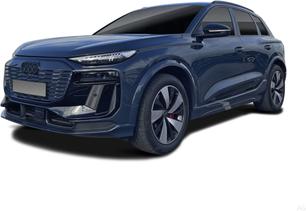
The SQ6 has a distinct look compared to the other mid-size SUVs in Audi’s stable with panelling that lacks some of the severe pleating of its cousins, instead incorporating swoopy lines and a more pronounced moulding around the base of the car.
The sporty S styling is seen in the large 21-inch alloy wheels and red calipers but the customisable light designs inside and out really make this stand out.
The interior is sumptuously styled with Nappa leather and suede upholstery and trims, and sports front seats, while the use of displays in the dashboard makes the SQ6 feel like a spaceship.
However, the main panel curves towards the driver and it still feels accessible and intimate for a cockpit. The cabin looks as expensive as what you’d want it to look like at this price point.
The front row is spacious, and the sport seats offer plenty of adjustment to get comfortable. The massage function is particularly good when you’re sitting in a school pick-up line or waiting for the car to charge. Access is also easy, thanks to the comfortable step-in and step-out height.
There are a few storage options up front, including a shelf underneath the centre console, a couple of cupholders and drink bottle holders in the doors. Both the centre console and glovebox are on the shallow side, but I love the dual phone holders and the way they’re angled so you can still see your phone screen when you need to.
Charging options are good, with a 12-volt socket, two USB-C ports and a ventilated wireless charging pad. A second charging pad for your co-pilot would have been nice, though.
The displays look a little overwhelming at first, but the panoramic display is surprisingly intuitive to use while driving. In fact, I found it made the 3D head-up display feel somewhat redundant. The multimedia system is highly customisable and easy to navigate once you’ve spent some time getting familiar with it. Wireless Apple CarPlay was also easy to connect, and Android Auto is available too.
The rear row is just as spacious as the front, with a flat floor that will make middle-seat passengers happy. There’s also enough width for three kids to sit comfortably. The seats are firm but supportive, and I like the height of the centre armrest.
Storage back here isn’t quite as generous, with two cupholders and door-bin storage essentially covering the options. The hard seat backs are easy to clean, though, and my son was a fan of the rear climate controls, directional air vents and two USB-C ports.
There are three top-tether anchor points and two ISOFIX child-seat mounts, while the 40/20/40-split rear seat adds some useful flexibility when you need to carry a mix of passengers and cargo.
The boot offers up to 520 litres of capacity with all seats in use, which is plenty for a big grocery haul or a road trip’s worth of luggage. There’s a handy netted pocket on the side and a hard cargo cover, although, unsurprisingly for an EV, you only get a tyre repair kit rather than a spare wheel. The powered tailgate is also a welcome convenience.
Rounding everything off is a 58L frunk which houses all the charging cables.
The cabin's primary objective seems to be one of passenger comfort. Everything you touch feels soft under hand and while seat padding is on the firmer side, all but the rear middle seat is comfy on a longer journey because of their extra functions.
The rear-row back rest has two recline positions and the seat beds offer long under-thigh support. The middle seat bulges up, and coupled with the compromised legroom, it won't be a nice seat for an adult.
The front row offers the best legroom and there is enough space in the rear for my six foot three brother to squeeze into (somehow) but I wouldn't want to be in the rear for a longer journey if you're super tall.
Access is good for each row with wide door apertures and seats that aren't positioned too high. There will be no groans getting in and out of the SQ6.
Up front the glovebox and middle console shoulder most of the storage burden but there is a handy flip-down drawer at the driver's knee for a wallet and a centre console with the charging stuff but it is an awkward space that could have been better utilised. Things tend to move around in there if not secured.
In the rear there are a couple of net map pockets, storage bins and a total of four drink holders but that's about it. The other amenities back there soften the lack of storage options as you get directional air vents, climate control, heated outboard seats and a couple of USB-C ports.
The technology on a whole looks amazing and the touchscreen multimedia display is responsive and logically laid out. You'll be able to figure it out quickly and I like that important functions, like climate control, and shortcuts are pinned to the screen as it makes it easier to access them when on the go. The Audi voice assistant can be activated by 'Hey Audi' if you don't want to fiddle with screens on the road.
The wireless Apple CarPlay was simple to set up but at the beginning of the week it did tend to get booted whenever the climate or massage functions were activated. This was annoying as you'd have to reselect CarPlay and jump back into whatever app you were in and when you're using the Map app, it feels disjointed. However, this sorted itself out by the end of my week.
On the whole, all the screens and their functions are user friendly but there were a couple of gremlins that needed a car restart to fix. Randomly, my volume became useless and the touchpad/buttons on the steering wheel stopped working.
I do like a normal button over touchpad controls as I find them more responsive but the touchpad controls on the driver's door were really easy to use and I like the family-friendly option of being able to individually apply the child-lock to the rear doors.
Rounding out the cabin is the large 526L boot which offers a level loading space and the ability to adjust the height via the adaptive S air-suspension from buttons in the rear.
The rear row has a 40/20/40 split, which opens up storage options again and there is a deep under-floor storage pocket that houses the tyre repair kit. A handsfree-powered tailgate comes standard, which I always appreciate and the massive frunk (64L) takes care of all of the cable storage.
There are two variants available for the iX3, and we’re in the flagship 50 xDrive for this review. It starts from $109,900 before on-road costs, putting it in the same general territory as rivals like the Mercedes-Benz GLC400, from $112,200, and the Volvo EX60 Ultra P10, from $101,990.
Of course, like most European cars, that’s before you start adding options and our test car has quite a few.
There's $7700 22-inch M light alloy wheels and Frozen Space Silver metallic paint for another $6000. Topping it off is the M Sport Package Pro for $3500, which adds the BMW Iconic Glow Exterior Package — essentially some very swishy ambient lighting — red M Sport brake calipers, M seat belts, sport front seats and steering wheel, a 3D head-up display and a Harman Kardon sound system.
Standard equipment includes:
All up, our iX3 comes in at around $140,000 drive-away. With that in mind, it is a little surprising, then, that the rear seats miss out on heating and the front seats aren’t ventilated. Those feel like notable omissions in a car that otherwise leans heavily into premium comfort and technology.
The launch of the flagship SQ6 e-tron brings the Q6 line up to three before a high-performance RS hits our shores sometime in the future. However, this new variant is priced at $151,400 before on-road costs and that's a hike of $28,900 over the mid-spec Q6 e-tron quattro.
Is it worth the jump? Mostly because this model has almost every feature that is found as an at-cost extra or pack for the other variants but it does miss out on a ventilation function for the front seats and at this stage Audi is saying it's not available to add, which is odd for a top model grade.
With the motor outputs and performance tweaks, the SQ6 competes in the world of the Porsche Macan 4S as they are mechanically related but you can pick up the 4S for $149,300 MSRP and the SQ6 can't match it's torque output of 820Nm.
The most exciting thing about the Q6 range in general is the technology and the SQ6 is no different. The dashboard is a visual feast for the eyes with a 14.5-inch multimedia display, an 11.9-inch digital instrument cluster, and a 10.9-inch touchscreen for the front passenger.
There is wired/wireless Apple CarPlay and Android Auto, built-in satellite navigation and because the system is run by Android Automotive there are a whole bunch of downloadable apps like Spotify, YouTube and Amazon Alexa voice assistant on top of the connected Audi App. These apps are accessible from the passenger display, which means they can scroll the news or watch a video on a longer trip.
There is also the upgraded 3D Bang & Olufsen surround sound system, a colour augmented reality head-up display (the screen is basically a dynamic 3D setup) and three-zone climate control.
Charging is taken care of with four USB-C ports (2/2), a 12-volt socket that moonlights as an actual cigarette lighter (complete with an nearby ashtray) and a wireless charging pad with its own 'arm' that secures your phone.
The LED lights at the rear can be customised with different light signatures which are downright cool and the front LED lights also have animated individual pixels that do a little light show when you turn on the car (to the delight of my child).
Other highlights include front sports seats with heat and massage functions, wine-red Nappa leather upholstery and black suede trims, a heated steering wheel, panoramic sunroof, heated rear outboard seats, and a handsfree powered tailgate.
Audi also includes three charging cables and a one-year subscription for Chargefox public charging stations for free, as well as installing an at-home 7kW charger, which is a nice way of making a new owner feel valued.
The new BMW iX3 is built on an 800-volt platform and features a dual-motor all-wheel-drive set-up producing up to 345kW of power and 645Nm of torque. It can sprint from 0-100km/h in just 4.9 seconds, so in a nutshell, it’s pretty darn powerful and fast.
It might not be segment-leading when it comes to outright performance, but there’s certainly no shortage of grunt for a family SUV.
The SQ6 is a fully electric all-wheel drive and has two motors, one located on each axle. Together they produce up to 380kW of power and 580Nm of torque, which means this can do a 0-100km/h sprint in just 4.3 seconds when the launch control is activated.
There are three regenerative braking levels and a one-pedal mode which can be selected by sliding the gear-selector into 'B' otherwise the other two modes can be selected via the paddles on the steering wheel. You'll get the best efficiency when B is selected but it does take a beat to get used to and if you time your stops right, it can function as a proper one-pedal action.
The iX3 has a massive 108.7kWh lithium-ion NCM battery and a WLTP driving range of up to 805km. With the optional 22-inch alloys, that range does take a hit in our test vehicle, dropping to around 740km, which is still very good.
With my average consumption sitting at 15.5kWh/100km, I’ve actually beaten the claimed energy consumption of 18.8kWh/100km. That’s after a mix of highway and urban driving throughout the week, which is seriously impressive for a large, powerful electric SUV.
The iX3 has a Type 2/CCS charging port and can accept up to 22kW on an AC charger and a hefty 400kW on a fast DC charger. Finding a charger capable of delivering that much power will be the real challenge, but if you do, BMW claims a 10-80 per cent charge in just 21 minutes. That’s excellent charging performance and makes longer road trips considerably easier.
However, it does lose marks for missing out on vehicle-to-load (V2L) functionality. BMW Australia says the iX3 is equipped with the hardware for V2L, but the company is waiting on approvals for the required accessories before it can be rolled out to Australian versions. In other words, it's coming soon.
The SQ6 has a lithium-ion battery with a large 100kW capacity and can accept up to 270kW on DC power, which is excellent. There are two Type 2 charging ports (on either side of the car) and one has a CCS enhancement which means you can charge this from 10 to 80 per cent capacity in as little as 21 minutes on a 270kW ultra-rapid DC charger.
It is more common to see a 50kW DC charger though and that charge time sits closer to an hour and 20 minutes.
On a home 7.4kW charger, you'll get the same percentage after 15 hours, perfect for an overnight recharge.
With a claimed WLTP driving range of up to 568km and energy consumption between 17.5 and 18.6kWh/100km, the daily commute and odd family road trip is more than covered with this model.
My average consumption popped out at 18.1kWh based on the trip computer and that’s a good result for how hard I’ve pushed it over country roads, in the city and on the highway.
The iX3 50 has plenty of power and torque to satisfy when you need to plant it on a hill or overtake. Power is delivered smoothly in Efficient mode, but it definitely feels more dynamic when you switch to Sport.
The suspension is nicely balanced around town and through corners, but occasionally the car feels a little unsettled on an uneven open road. This is where you start to wonder whether those big tyres are doing the car any favours.
The steering is lighter than expected, although you do get used to it after a couple of days. The car can also feel heavy when you need to stop quickly, to the point where the brakes can feel a smidge spongey. Otherwise, they’re responsive enough.
The cabin is impressively quiet around town, although road noise, again, likely helped along by those big tyres, creeps in a little more on the open road. To be clear, it’s only more noticeable by EV standards; this is still a quiet car compared with a combustion-powered SUV.
Visibility is quite good from my driving position, and I like the commanding view overall. SUVs do rule the roost in this regard. There are four regenerative braking levels, including B mode for one-pedal driving, and I’ve kept it on either level three or B throughout the week.
I also like that you can still creep at lower speeds in B mode, and the 360-degree camera is exceptionally clear. The way the camera view moves with the steering wheel takes a beat to get used to, though. If you're a little unsure, you can activate the parking assist function, and the car will park itself.
Outside of the initial acceleration thrill, I have to say that the SQ6 sort of drives like a lot of the other Audi SUVs I’ve sampled. Which is fine because it’s dynamic and handles beautifully on the highway or city but it’s just not as fun as what I was hoping it would be. The power will satisfy everyone though.
The different driving profiles and adaptive S air suspension really personalises the on-road experience when you want it and my favourite profile is Dynamic as the suspension and steering feels more performance focused, which I prefer.
Ride comfort is up there with the best and you won’t really be bothered by the bumps in the road, even with the stiffer suspension, but road noise does creep in at higher speeds.
The visibility all round is good despite thicker pillars but the rear visibility is narrow even before a car seat or passengers are back there. A digital rearview mirror would have been handy here.
Just something interesting to note is that when you accelerate from a full stop, there can be a small lurch as if it’s rolled backwards or the brakes have held a tad too long. It’s so quick when it happens that it’s not annoying but it is noticeable in stop/start traffic.
The SQ6 is really simple to park and navigating small car parks feels like a dream. The dimensions are forgiving and the 360-degree camera system is top notch.
The BMW iX3 has a maximum five-star ANCAP safety rating, based on testing conducted under the new 2026 protocols. It scored 71 per cent for Safe Driving, 83 per cent for Crash Avoidance, 86 per cent for Crash Protection and 95 per cent for Post-Crash Response.
Importantly, I found the safety systems unobtrusive in everyday driving, while the adaptive cruise control is nicely calibrated and doesn’t constantly feel like it’s fighting you for control.
Standard features include:
The SQ6 is covered by a maximum five-star ANCAP safety rating from testing done in 2024, and features nine airbags which includes side chest airbags for the second row but it’s more common to see those just on the first row so it's nice to see on a family car.
There’s a host of safety equipment included but standouts are the emergency call capability, and safe exit assist which will delay your door from opening if it detects a car or cyclist which is a handy feature if you have a kid that throws open their door like mine.
Other equipment includes driver attention warning and alert, blind-spot monitoring, tyre-pressure monitoring, intelligent seatbelt warning, adaptive cruise control with stop/go function, lane departure warning, lane keeping assist, emergency lane keeping, park assist, front/rear parking sensors, 360-degree camera system, rear cross-traffic alert, and traffic sign recognition.
There is auto emergency braking (AEB) with forward collision warning, car, pedestrian, cyclist and junction turning assist which is operational from to five to 250km/h.
There are ISOFIX child seat mounts on the rear outboard seats and three top-tether anchor points but two seats will fit best. Front passenger space might get cosy when a rearward facing child seat is installed but I had no issue fitting my big booster seat this week.
The iX3 is covered by a five-year/200,000km warranty, which is a fairly typical term at this end of the market. You can also pre-purchase a six-year servicing plan for $2420, which is a reasonable cost for a vehicle in this price bracket.
Maintenance is governed by BMW’s Condition Based Servicing system, so the car will tell you when it’s time to head in for a service. Depending on how you drive it, expect servicing to be required somewhere between 12 and 24 months.
The SQ6 is covered by Audi’s five-year/unlimited kilometre warranty and the battery is covered by an eight-year or up to 160,000km warranty, which are all standard terms for the class.
Audi also offers six years of complimentary roadside assistance and a servicing program for six years that costs $2080, which is competitive, and servicing intervals are at every two years or 30,000km.
Audi includes the installation of a 7.4kW AC home charger, three charging cables and a one-year Chargefox public charging subscription with this model.