What's the difference?
When the BMW iX first showed up a few years ago, it was a promising look at what BMW seemed capable of when it comes to electric cars.
While mildly flawed, the iX was fast, comfortable and felt properly premium. Now it’s had a decent update, with the iX xDrive45 M Sport here to replace the former entry-level xDrive 40.
BMW claims among other mechanical and tech updates a power increase of 25 per cent, a 30 per cent greater energy content for the battery, a 38 per cent increase in driving range and a 17 per cent faster charging rate.
But in the time since the iX launched, there have been big strides in the premium electric SUV space, including new arrivals from European opposition like the Polestar 3; even a new American in the form of the Cadillac Lyriq.
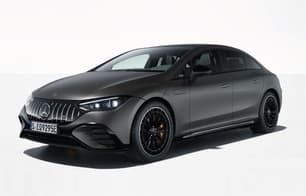
Mercedes-Benz has released an all-electric sedan which is the equivalent of its iconic E-Class.
It has the looks and technology to rival any EV on the market but what about the practicality for a family? Will this be the luxury electric sedan families have been hoping for?
I've been driving it for a week with my little family of three to find out.
If anyone was worried that it would be too late to get a decent bit of value out of an entry-level iX, there's reassuring news.
With more power, range and features added to the model and the cost remaining close to its former sticker price, the iX has held up well despite now existing in a more competitive environment.
The Mercedes-Benz EQE350 4Matic is an electric sedan that will comfortably house your family. My son really liked this one, the ambient lighting in particular!
It has enough power to satisfy the drivers out there and a driving range that will make you feel at ease. But the boot is small and this car will suit families whose kids are out of the pram stage best. I really like the safety and standard features on the EQE but the ongoing costs are a bit expensive for an EV.
The iX was a bit divisive upon its original launch, because it was one of the early adopters of BMW’s current ‘big grille’ era.
The good news for the iX is that many have adjusted their expectations on that front and it now feels pretty well at home in the brand’s line-up.
The addition of the 'Iconic Glow' grille surround might be a step too far for some, but overall the iX has aged well and its exterior design hasn’t changed much because of that.
The adaptive LED headlights have new DRL elements, and the M Sport pack is now standard, but if you were only casually familiar with the iX you’d have to be looking closely to spot the update.
The new colour palette for the iX also includes the pictured 'Arctic Race Blue metallic', though I’m personally a fan of the iX in all black, giving it a more monolithic look.
Inside, it’s a similar story - what was once perhaps ahead of its time is now the expectation in an electric SUV. Minimalism in terms of physical controls, but plenty of space.
Helping the feeling of spaciousness is the now-standard panoramic sunroof, though a lack of physical shade is one of the iX’s few interior let-downs. Instead, it can electrochromatically ‘shade’, which still lets in plenty of light.
At night, ambient lighting joins the glow of the iX’s rather large 14.9-inch multimedia touchscreen and 12.3-inch driver display.
Love it or leave it, the swoopy design of the EQE sedan is decidedly modern with a shiny black grille that features a repeated Mercedes-Benz star motif and the aerodynamic covers on the 20-inch alloy wheels.
The nose is snubby and dips down too low for it to look sexy but the rear earns some design points with its elegant proportions, 3D ‘helix’ LED lights and cute spoiler.
The chrome accents around the windows and the illuminated flush door handles add some pizzazz, too.
I’m not a massive fan of its exterior looks but the interior is gorgeous! The dashboard features an 12.8-inch touchscreen multimedia system and a 12.3-inch digital instrument panel that pull your focus with their crystal-clear graphics but they need to, because the dashboard has a whole lotta empty space which looks a tad boring.
The side air vents are styled like jet turbines but are a little finicky to manoeuvre.
The black suede-like headliner creates a plush aesthetic but when you open the panoramic sunroof, the cabin is downright airy.
The door panels, which double as a grab handle, house the window and side mirror controls and its super handy to have the seat-configurator and memory functions on the door itself, rather than the side of the seat. This positioning makes them much easier to see!
Mercedes has added LED ambient-strip lighting around a lot of the interior, including the front seats, which has a massive wow factor at night time.
The ambient lighting can be adjusted up to 64-ways and also features a dynamic element where the lights pulse (under certain selections) when you accelerate.
The space on offer in both rows of the iX is a huge plus, and it might even be enough to make you look past some of the small downsides to the electric Bimmer’s interior.
The iX’s clever two-level central console has the phone charger pad and drinks holders down out of the way and means you can put distractions (phone) and your tall bottles out of the way. There's a slot above for your phone to sit upright with a gap under for charging, too.
The storage bin under the armrest also has plenty of space as well as a little shelf for smaller items you don't want to go hunting for, but the iX’s control panel and dial are still reflective and, at certain times of the day, this means distracting light getting in your eyes.
Speaking of distracting, I have found BMW’s multimedia software to be less intuitive and more complicated with each major update, and ‘OS 8.5’ is no different. At this point, using the brand’s touchscreen feels like operating an iPad on the move, with dozens of menu tiles to sort through.
But back to the physical space that is the iX’s interior - the big EV makes a lot of sense as a family car, especially if your kids are old enough to appreciate (and keep clean) the fit and finish.
Not only does the drive have a nicely adjustable and comfortable sports seat thanks to the M Sport pack, there's also heating and a massage function.
The front passenger gets the same, and the second row is borderline palatial. There's heaps of kneeroom, headroom, and even space under the front seats at their lowest setting to slot your feet.
The four-zone climate controls mean arguments are avoided, there is of course a central armrest, though even with it folded up and a person in the centre there's enough room in the back to be comfortable.
Behind that, the iX’s 500 litres of boot space could probably be expanded but at the expense of rear legroom, so it's acceptable. There is space under the floor for cables, but no space saver spare, just a repair kit.
There's a switch that allows you to fold the seats down from the tailgate, but you can also manually fold the middle seat for a 40/20/40 split rather than the more expected 60/40.
Mercedes uses the term ‘saloon’ for its sedans and this term highlights the space each passenger will enjoy in the EQE sedan! There is plenty of head and legroom up front and you don’t feel like you’re on top of your co-pilot, either.
The electric front seats are comfortable with their adjustable lumbar control and extendable under-thigh support. The kinetic function on both also make longer journeys an absolute pleasure.
The rear seats are well-padded and you get limo-like legroom but the swoopy roofline does cut into the headspace. I’m comfortable enough with my 168cm (5'6") height but someone with a few inches over six-foot may not be.
You’re spoiled for choice when it comes to individual storage options with large middle and centre consoles, the latter can be made even larger because the two cupholders are retractable.
There is a massive shelf underneath them that has a handy elastic strap for larger items, like a handbag. The glove box is on the shallow side but both doors have a drink bottle holder and storage bin.
In the rear, individual storage is also decent with two map pockets, two retractable cupholders in the fold-down armrest, as well as a drink bottle holder and storage bin in each door.
The other amenities in the rear are good with a couple of reading lights and directional air vents. I would have preferred to have seen climate control, too, but there’s enough here to satisfy.
The technology looks high-end but is relatively simple to operate once you get used to the Mercedes-Benz operating system.
The touchscreen multimedia screen has haptic feedback, which just means it vibrates when you touch it, and built-in satellite navigation with an augmented reality feature.
The digital instrument panel is customisable and the coloured head-up display is easy to see.
It is simple to connect to the wireless Apple CarPlay and there is also wired Android Auto.
Charging options are fantastic throughout the car with four USB-C ports and a wireless charging pad to choose from up front.
However, it’s annoying to use the charging pad if you’re also using the cupholders as its awkward to try and get a phone in and out of the housing. In the rear there are another two USB-C ports.
For the class, the boot isn’t massive at 430L and the wheels do cut into the width but it’s been big enough for my shopping errands.
You get a tyre puncture repair kit in the EQE sedan and I like the way you can electrically fold the rear seats if you need extra storage space. Having the hands-free powered boot lid is very convenient.
The sole entry-grade iX is the xDrive45 M Sport, which brings with it more than the original base xDrive40, but also a price a few thousand dollars higher.
It starts from $142,900 but can quickly become much more expensive when you start ticking options boxes. But in this market segment, it's not that unusual, especially considering recent arrivals like the Polestar 3.
Given it’s only a little more expensive than before, the extra kit and higher grade that now forms the iX entry-point is impressive.
The 'M Sport' pack is now standard as the name suggests, plus there’s M trim inside like the steering wheel, the M seats and silver design highlights.
The LED lights are now adaptive and the glowing grille surround has also been added.
There’s also now a panoramic glass roof as standard, rather than an option, plus the steering wheel is heated and there’s now a tyre pressure monitor.
Aside from that, there’s plenty that carries over, like the wireless phone charging, wireless Android Auto and Apple CarPlay, 18-speaker surround sound by Harman Kardon, four-zone climate control and heated front seats.
There’s also an 'Executive Pack' which adds some comfort features like soft-close doors, privacy glass and front seat ventilation with rear seat heating. That one’s $6500.
Then there’s active steering, which brings the rear wheels into play for more manoeuvrability and stability for $3000.
Adaptive air suspension is $4000, while the most expensive option is a 30-speaker Bowers & Wilkins ‘Diamond’ surround sound system for $9500.
There are three models for the EQE sedan and our test model is the mid-spec 350 4Matic grade, which will cost you $144,900, before on-road costs. It manages to slide into being the most affordable compared to its rivals and it has a tonne of features.
Front occupants enjoy creature comforts like heated and electrically-adjustable front seats that feature four-way lumbar support, extendable under-thigh support, as well as, three-position memory function. They also have a ‘kinetic’ function which I liken to gentle stretching.
Premium items include a panoramic sunroof, black headliner, dual-zone climate control, AMG floor mats, 360-degree view camera system, Burmester 3D sound system, hands-free powered boot lid and electrically folding rear seats (access to the controls are via the boot lid).
The built-in satellite navigation also features an augmented reality feature, which shows dynamic directions overlaid on a video feed. Some might call this gimmicky but it does help navigating a city with all of the little laneways!
On the exterior you get 20-inch alloy wheels with aerodynamic covers and a glossy black grille that features a repeated Mercedes-Benz star motif.
There are a few cool lighting features on the EQE like the Mercedes-Benz logo projected from the side mirrors, a 64-way coloured ambient lighting system and something that Mercedes calls ‘Digital Light’ – which are LED HD adaptive projector-like headlights.
The iX has, as the xDrive part of its name would suggest, a dual-motor electric set-up with all-wheel drive.
Power and torque now total 300kW and 700Nm for the system in the xDrive45 M Sport, up from the 240kW and 630Nm on offer in the outgoing xDrive40.
BMW says the iX is now good to hit 100km/h from a standstill in 5.1 seconds, with its claimed top speed a nice, rounded 200km/h.
The 350 4Matic is an all-wheel drive with two electric motors that have a combined power output of 215kW and a massive 765Nm of torque. The lithium-ion battery has a large 90.5kWh capacity.
The 350 4Matic has a 0-100km/h sprint time of only 6.3-seconds but it feels gusty and you get a tummy-sucking sensation when you have to put your foot down.
The iX’s 94.8kWh battery allows a range up to 522km, but relatively low efficiency because of the size and weight.
Its 20kWh/100km is on the higher side of power use for cars around this size and this is part of the reason its huge battery capacity results in a fairly average driving range.
Maximum power input for DC fast charging is, however, up from 150kW to 175kW with the update, which is good news for those long drives.
The 350 4Matic has an official energy consumption figure of 17.6kWh. My average sat round 16.9kWh and that is after a lot of open road driving. Happy with that.
With a driving range of up to 590km, I didn’t feet any range anxiety!
The charging port is a Type 2 CCS which will accept up to 170kW on DC, which means you can charge it from 10 - 80 per cent in 33 minutes. On an 11kW system, you can see that time jump to just under 10hrs.
The BMW iX was a relatively early entry into the catalogue of electric cars I’ve driven and because of that it had a couple of (in hindsight) unfair criticisms levelled at it.
For a start, it felt heavier than expected and its ride quality didn’t feel up to BMW’s standards - both things that plenty of electric SUVs have struggled with since.
But its drivetrain, design, and interior all impressed, aside from perhaps some of the aforementioned interior reflections.
Now years on, and the iX has aged well.
Some of the mechanicals and suspension also copped a tweak along with the entry iX now being a more powerful ‘45’. The result is a big electric SUV that holds up better than I remember.
‘Smooth’ is the key word that comes to mind in regards to a lot of the iX’s characteristics. While it’s still not perfect and feels heavy, the iX rides well in comparison to many SUVs on the market, including some of its close rivals.
Perhaps key to this is the fact its standard 21-inch wheels leave plenty of tyre to help the suspension soak up sharp edges on bumps, while we’re sure BMW’s handling engineers have learned more about getting the best out of a big, heavy electric vehicle in the last couple of years.
Road noise is well-muted as a result, and the shape of the iX doesn’t seem to lend itself to excessive wind noise. Even when you’re getting rather quick.
Despite being a 2525kg beast, its 5.1-second sprint to 100km/h is in the muscle car realm - the last of Holden’s V8 Commodores would do about that, for reference.
Its acceleration is also nicely progressive, rather than giving you an almighty but unnecessary jolt of torque right as you put your foot down. But once there’s traction and you’re rolling, the xDrive45 is impressive.
Meanwhile, its cornering and braking still reveal the heft behind the iX, it’s not something you can chuck around like a go-kart, but that’s also not really its area.
Anyone familiar with BMW’s steering characteristics will find the slightly higher force required for its weight (and thickness of the steering wheel rim) standard, though it’s still unnecessarily on the heavier side.
With the amount of power the 350 4Matic model has, it’s no wonder I enjoy driving it! The motor is responsive and the car doesn’t shift around when you have to put your foot down, either.
The EQE handles beautifully on the road where it feels stable and sure of itself. It tackles corners without breaking a sweat and the steering is crisp.
The ride comfort is high quality with suspension that smooths out bumps without feeling floaty. The cabin space is quiet even at higher speeds.
There are three levels of regenerative braking – none, normal or strong – ‘strong’ enables a one-pedal driving experience.
It’s responsive enough that you’re confident using it in stop/start city traffic but it wigs me out how the brake pedal moves by itself when activated!
I have kept the level at the default ‘normal’ setting but do tend to turn it off whenever I need to reverse because it can cause a ‘bunny hop’ effect at lower speeds.
The EQE is super easy to park with a clear 360-degree camera system, as well as, front and rear parking sensors.
The BMW iX holds a five-star ANCAP rating, which it earned under slightly more lenient testing back in 2021.
Seven airbags, auto emergency braking with cyclist and pedestrian detection up to 80km/h, lane-assist, rear-cross traffic alert and intersection assist, plus a surround view parking camera all help immensely.
The EQE comes jammed pack with safety features and I think the 'Pre-Safe' systems are cool.
For example, a pre-crash audio tone will transmit through the speaker system when an imminent collision is detected. It elicits a reaction from your inner ear that dampens sound when the accident occurs.
Other features that come standard, are LED daytime running lights, forward collision warning, rear cross-traffic alert, lane keeping aids, lane departure warning, intelligent seat belt reminders, front and rear parking sensors, 360-degree view reversing camera, traffic sign recognition, driver fatigue monitor, and adaptive cruise control with stop and go functionality.
The EQE also has rear collision emergency stop and stolen vehicle tracking. The autonomous emergency braking with car, pedestrian, and rear detection is operational from 7.0-80km/h (up to 250km/h for car detection).
The EQE achieved a maximum five-star ANCAP safety rating from testing done in 2022. There are a whopping 10 airbags, including a front centre airbag and drivers knee bag.
Back seat passengers also get side chest airbags, whereas its usual to only see these on the front row.
Families will be happy to see ISOFIX child seat mounts on the rear outboard seats and three top tethers, but two seats will fit best. There’s plenty of room for front passengers when you install a 0-4 rearward facing child seat.
BMW offers a five-year/unlimited kilometre warranty with an eight-year/160,000km warranty on the battery.
BMW servicing takes place as needed rather than on a schedule, meaning you’ll be alerted via the car or app when a service is required in the near future.
For the iX a six-year all-inclusive service pack costs $3475, regardless of how many km you drive.
BMW has 54 servicing dealers listed in Australia, with each capital city covered and many more locations in the eastern states.
On the EQE you’ll enjoy a five-year/unlimited km warranty and the battery is covered by a 10-year or up to 250,000km warranty (whichever occurs first) – which is better than most.
You can pre-purchase either a three-, four-, or five-year servicing plan and the five-year plan costs a flat $3555, or an average of $711 per service.
That’s quite expensive for an EV and the servicing intervals are more in line with a fuel-based car than an EV at every 12-months or 15,000km, whichever occurs first.