What's the difference?
It’s easy to forget BMW was paddling into the growing electric vehicle wave when it was only a gentle swell. It took off early with the i3 city car, which believe it or not has been in the Aussie new car market for six years.
While the German maker has long been developing the concept of electrified powertrains in existing models, the i3 was the result of a dramatically different approach, showcasing the use of exotic materials and innovative packaging.
Like its i8 supercar sibling, the i3 won’t be replaced with a new-generation version, but BMW says it will continue to develop this high-tech hatch before it departs, and we spent a week in the sporty i3s to see how it stands up in 2020.
Richard Berry road tests and reviews the new Alfa Romeo Giulietta Veloce hatch with specs, fuel consumption and verdict.
Nobody just buys an Alfa Romeo, in the same way that nobody goes out and just buys a top hat. Yes it's functional and yes you'll looking amazing in it whether you're male or female, and people will pay you compliments - possibly question your judgement, too, but it's not the obvious choice and buying one is a conscious decision. See, you don't even know if I'm talking about the top hat or the Alfa any more.
At backyard barbecues and dinner parties throughout Australia you'll overhear people saying: "My heart says yes but my head says no." They're not discussing robbing the convenience store on the corner after dessert, but they're more likely to be talking about buying an Alfa Romeo. See Alfas are famous for their stunning beauty, their racing pedigree and their performance, but in the past they've been infamous for their reliability issues. You knew that, right?
The top-of-the-range Giulietta Veloce with the dual-clutch auto is the best reference to the brand's performance pedigree. This version has only just arrived on the market, and follows a major styling and technology update to the Giulietta in 2015.
Like most test cars, we lived with it for a week. Is it too small to be a family car? What's wrong with the glovebox? Is it as racy as it looks? What's with all the water? And is it just me or are my hands too small to drive this car? We'll even be able to point you in the right direction for a guide to Giulietta's reliability.
Yes, it’s pricey for a small hatch, but this little BMW is a city car like no other. The i3s is tailor made for the urban environment, and six years on retains the quirkiness and charisma that stood it apart at launch, and it can still hold its head high among the current EV crop.
So much right and some things not quite right – the Giulietta has the Alfa Romeo mix of highs and lows which the brand is famous for. There’s no mistaking that this is a unique and sexy looking car, with the practicality of a five-door hatch plus impressive handling and performance. More heart than head decision here though it seems, but romantic Alfa enthusiasts should adore it.
Built around a carbon-fibre reinforced plastic (CFRP) tub, the i3s is ultra-light (for a battery-electric vehicle), super strong, and unlike anything else on the road.
At just over 4.0m long, close to 1.8m wide, and a fraction under 1.6m tall, the i3s is compact, upright, and boxy. A classically polarising design, with some crossing the street to avoid it, and others (like me) loving its unique proportions and stand-out styling.
The nose is tall, short and upright, with the distance from the base of the front windscreen to the front axle (car designers call it the ‘dash-to-axle ratio’) unusually short.
That’s because the electric motor sits in the back of the car driving the rear wheels, with only a small front boot compartment required to house charging cables and other bits and pieces.
Despite the lack of anything of substance behind it, BMW’s signature ‘kidney grille’ is present and accounted for, with swoopy LED headlights (and DRLs) either side. Our test car’s ‘Fluid Black’ finish with ‘i Blue’ highlights dialed up the little car’s charismatic personality.
One of the i3’s most impressive party tricks is its counter-opening ‘clamshell’ doors, and the engineering trickery used to create a B-pillar free side opening (including the strength of the carbon body structure) means the high window line follows a jagged path from front to back, the rearmost hatch windows shrinking the rear glass area appreciably.
The i3s’s standard 20-inch (dual) five-spoke alloy rims, although slightly wider in this performance model, are alarmingly skinny. But taking the car’s relatively light weight (1245kg) and urban-centric purpose into consideration, the narrow, low-rolling resistance rubber makes sense.
With the roofline and sides of the car tapering distinctly towards the back, the rear view is suitably idiosyncratic, highlighted by flush-fit, vaguely U-shaped LED tail-lights.
The hatch window is small, and the bumper sits high to marry with the load space floor sitting on top of the motor and transmission.
And when it comes to moving inside, BMW offers a choice of three ‘interior worlds - ‘Loft’, ‘Lodge’, and ‘Suite’ - featuring renewable natural fibres, recycled plastics, naturally tanned leather, and open-pore wood (sourced from 100 per cent Forest Stewardship Council-certified forestry).
But irrespective of where everything comes from, the end result is inviting, comfortable and sub-zero cool. Our car’s ‘Suite’ interior was combined with ‘Oak dark matt’ wood, and ‘Vernasca’ brown leather to stunning effect.
A tunnel-free floor, gently curved dash and digital screens for instruments and media let you know you’re in something different and special. It might be six years old, but the i3 still feels contemporary and distinctive.
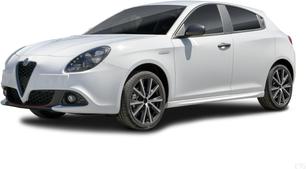
Alfa Romeo couldn't design a boring car even if it was handed a picture of a Toyota Camry and told to copy it or else. The Giulietta is no exception.
There's the deep 'V' grille shared with the new Giulia sedan and 4C sports cars that make up the current Alfa model line-up. There's the bug-eye headlights with pretty inset LEDs and the chiselled bonnet, a side profile which looks like that of a mini Porsche Cayenne and a cute-but-tough bottom with its elegant taillights and twin exhausts.
The latest update brought a honeycomb mesh grille and a slightly different design to the headlight and LED foglight surrounds. The tail pipes were also given a styling tweak, so too were the alloy wheels.
Despite its coupe looks it's actually a five-door hatch with ‘hidden' handles for the rear doors.
The cabin saw new materials and finishes added. The Veloce had the Alfa Romeo logo stitched into the integrated headrests, shiny sports pedals, and lashings of faux carbon fibre trim on the doors and dash.
You can tell a Veloce from the outside by the red Brembo brake calipers behind the front wheels, 18-inch alloys, its chunkier exhaust tips poking out of the diffuser, red pin-striping to the front and rear bumpers, and the black window surrounds.
Okay, how big or small is it? Here's some dimensions for you. The Guilietta is 4351mm long, 1798mm wide, 1465mm tall and the Veloce with its sports suspension is 9mm lower than the others with 102mm of ground clearance.
Compared to say a Mazda3 hatch the Giulietta is 109mm shorter end-to-end and only 3mm wider. But if you're considering an Giulietta why are you looking at the Mazda3 anyway? That would be sensible - Like comparing Cancer Council hats to top hats.
Wide-opening clamshell doors make getting in and out of the i3s a breeze. But bear in mind you have to open the front door to get to the latch for the back one, which can be a pain.
The driver and front passenger enjoy heaps of room, in an open environment, but there’s only a single cupholder in the centre console, so let the coffee cup wars begin.
Aside from that there are seriously big bins in the front doors, a modest glove box, and a handy elasticised pocket near the floor at the base of the bulkhead.
Outlets for 12-volt and USB are provided, and there’s a small oddments tray at the rear of the centre console.
Slip around to the rear and you’re in anything but limousine territory. Sitting behind the driver’s seat set for my 183cm height, head and legroom are modest but do-able. And remember it’s two seats only back there.
In terms of storage, there are two cupholders between the seats but no storage pockets or bottle holders in the doors. You won’t find adjustable ventilation outlets either, but that’s not a huge factor in car of this stature.
The boot’s volume is quoted at 260 litres with the 50/50 split-fold rear seatback upright, which is enough to easily swallow the largest 124-litre suitcase in the CarsGuide three-piece set. The smaller 95- and 36-litre cases will sit side-by-side without a problem.
Fold the rear seat down and you have 1100 litres of space at your disposal, with tie-down anchors, an elasticised pocket and 12-volt power provided.
Don’t bother looking for a spare of any description, a repair/inflator kit is your only option. And not surprisingly, the i3 is a no-tow zone.
Beautiful things tend to favour form over function. The Giuletta tries to do both and succeeds…but also fails in places.
Successes first: despite its coupe looks it's actually a five-door hatch with ‘hidden' handles for the rear doors placed up at window level near the C-pillar. So good is the two-door disguise that our photographer climbed into the back seat through the front door.
Rear legroom is a bit tight back there and at 191cm I can sit behind my driving position but I'd hate for me to be sitting behind me because my knees are digging hard into the seat back.
Headroom isn't much chop either and I literally can't sit in the back seat and hold my head high – a combination of that sloping roofline and the optional double sunroof reduces the head space.
A major practicality fail is the lack of storage throughout the cabin.
Ordering drive-thru is possibly out of the question.
My wife's phone kept mysteriously appearing in the footwell every time we left it in the glove box, like there was a tear in the time-space fabric, but then we realised it was slipping through a gap.
There's no centre armrest storage bin in the front – actually there's no centre armrest. There is a pop-up hidey-hole on the dash but with only enough room for a pair of sunglasses.
The two cup holders in the front are small. It's safe to say that unless you have somebody with hands at the ready, ordering drive-thru is possibly out of the question.
Or if you have long arms and can reach the fold down armrest in the back there are two decent sized cup holders along with a small storage space. There are no bottle holders any of the doors, but there is fortunately room for a phone and wallet because there isn't space for them anywhere else.
But wait, the Giulietta is saved from a total storage fail by a large-for-the-class 350-litre boot. That's 70 litres bigger than a Toyota Corolla's and only 14 litres less than the Mazda3. We could fit the pram, the shopping and the rest of the gear which goes with a military operation such as a trip to the park with a toddler in there.
For a compact, four-seat hatch the BMW i3s is all the money at $70,900, before on-road costs. Close to $20K more than even the top-spec ‘Premium’ version of Hyundai’s Ioniq electric hatch ($52,490), and even further away from Renault’s cute little Zoe ($49,490).
But a carbon monocoque body and high-tech powertrain don’t come cheap, and that’s where BMW’s ‘i’ model program has seemingly run out of juice.
Getting into the EV market early, BMW took a punt on niche vehicles using exotic materials, appealing to a relatively small group of premium buyers. And in glorious hindsight, that path has proved something of a dead end.
But putting all that to one side, it’s fair to expect a generous standard equipment list in a $70K-plus BMW, and the i3s comes to the party with a solid, if not spectacular batch of features.
Aside from the safety tech detailed later, Included is a 10.25-inch media touchscreen, managing audio, built-in nav (with real time traffic alerts), phone connectivity and more.
Other features include, wireless phone charging (for compatible devices), a rear-view camera, automated parking assist, active cruise control (with stop-go function), climate control air, driver’s digital display, ambient interior lighting, 20-inch alloy wheels, auto LED headlights, LED DRLs, indicators and tail-lights, keyless start, rain-sensing wipers, plus heated and folding power mirrors.
But there are a few surprises. It might be an electric car, but forget power adjustment of either front seat. And despite inclusion of Apple CarPlay (BMW says Android Auto will be available later in 2020) and digital radio, the audio system only has four speakers, all in the front doors (because of the clamshell arrangement detailed later).
Our test car featured the ‘Suite’ interior package ($2308) which brings ‘Vernasca Dark Truffle’ leather on the seats, instrument panel, doors and side trim, as well as ‘Oak dark matt’ wood trim, the steering wheel in black with a ‘Satin Silver’ contrast ring, floor mats (and general interior fabrics) in ‘Anthracite’, the roofliner in ‘Carum Spice Grey’, plus orange/white LED lighting for the door pull handles and front map pocket. A dual porthole-style glass sunroof adds another $2246, for an as-tested price of $74,454.
The 2016 update saw the Giulietta variants renamed. There's the entry grade $29,990 Super Manual which has a six-speed manual gearbox, then buyers can step up to the Super TCT with a six-speed dual clutch automatic transmission for $34,900 and then there's our test car – the Veloce for $41,990. There's 10 paint colours at your disposal from the colour of our car (Alfa Red) to Perla Moonlight. Only Alfa White comes at no extra cost, the rest are a $500 option.
The Veloce collects the same features as the Super TCT such as a 6.5-inch touch screen, with sat nav, front and rear parking sensors, three drive modes and then adds bi-xenon headlights, 18-inch alloys, leather and Alcantara seats, a flat-bottomed steering wheel, the big exhaust tips and the sports diffuser, tinted rear glass and then less cosmetic features such as sports suspension and launch control.
There's no reversing camera which is disappointing, considering they come standard on some cars half the price.
At this price you'd shop the Veloce against a BMW 120i hatch for $41,900, a Volkswagen Golf GTI for $43,490 or possibly a high-end Mazda3 SP 25 Astina for $37,040.
The i3s is powered by BMW’s ‘eDrive’ hybrid synchronous electric motor, producing 135kW at 7000rpm, and 270Nm from 0-4500rpm. Yep, that’s right, maximum torque is delivered the instant you depress the right-hand pedal, and we’ll get to what that brings to the driving experience a little later.
The unit incorporates a charging and generator function for braking energy recuperation, the latter delivering up to 50kW.
Drive goes to the rear wheels via a single-speed (fixed-ratio) automatic transmission.
The battery powering the whole show is a 352-volt/120 amp-hour (Ah) Lithium-ion unit with a (gross) energy rating of 42.2kWh.
The Giulietta Veloce has a 1.75-litre four-cylinder turbo-petrol engine which produce 177kW of power and 340Nm of torque. It's a great engine that lets loose a wonderful scream when pushed hard and the little grunts it makes when it changes gear when driving around normally sound like a giant enjoying his food.
The transmission is a dual-clutch auto which Alfa calls a TCT or twin-clutch transmission. I'm not a fan of them regardless of the brand of car they're in but the Alfa version is better than most of the others in its smoothness at lower speeds and decisiveness.
There's so much potential here for a great driving experience.
What about the Giulietta's reliability over time? This version of the car is less than two months old so we can only comment on what it offers as a brand-new vehicle, but you'll find good context in our used review of the earlier 2011-2014 Giulietta.
When it comes to an electric car’s energy use and projected range, there are two main things to consider - the motor’s power consumption and the battery’s capacity.
And according to BMW, the i3s’s power consumption for the combined (urban/extra-urban) cycle is 14.6–14.0kWh/100km.
Over a week, and roughly 250km of urban driving (with some brief freeway runs thrown in) we saw 19.3kWh/100km staring back at us from the on-board computer.
When BMW launched the i3 in Australia in 2014, the pure EV version came with a 60Ah battery pack delivering a claimed 130 kilometre range (a range extender model featuring the addition of a two-cylinder petrol motorcycle engine was also offered).
In 2016 a 94Ah version arrived to boost range up to 183km, and the i3s launched in 2018, with its 120Ah battery pushing range out to BMW’s current, real-world estimate of 260km.
Then, there’s charging time, which is like asking how long is an electric piece of string.
According to BMW, for a 0–80 per cent charge from a (50 kW DC) fast-charging station, you’re looking at 45min.
From a (11kW/16A/380V) high-output home/office wall unit, that pushes out to 3.10h, and using a (3.7kW/16A/240V) low-output home/office unit stretches the wait time to 9.40h.
BMW offers the ‘WallBox plus’ charging suite as a dealer accessory priced from $1990 (not including GST or install costs).
Plug into a domestic (2.4kW/10A/240V) socket, and you’re staring down the barrel of 15.00h. But at least you can use low-cost, off-peak energy overnight, right? Nah, I don’t buy that line either.
Alfa Romeo says you should see your Veloce drink at a rate of 6.8L/100km during combined driving, but the dash showed more than double that during mainly urban driving while channelling Enzo Ferrari.
It might not look like a conventional sports car, but the BMW i3s certainly accelerates like one, with a claimed 0-100km/h time of 6.9sec. The i3s is a smile-inducing hoot to drive.
Every one of this little hatch’s 270 newton metres of torque is available from the minute you hit the accelerator pedal, and remain in service until 4500rpm, at which point torque delivery drops off a cliff.
But peak power steps in at exactly 7000rpm, so if you’re determined to make that overtaking move you won’t be left in the lurch. In fact, BMW says it only takes the i3s 4.3 seconds to surge from 80km/h to 120km/h.
However, the i3’s forte is 100 per cent the city, rather than the open road. Its ‘point and squirt’ ability making it the perfect partner for the cut and thrust of the urban jungle.
The i3s features an upgraded ‘Sports Suspension’ incorporating firmer dampers, re-tuned springs and revised anti-roll bars. It’s also lowered 10mm, the track is widened (+21mm front / +2.0mm rear) and the wheels go plus one inch to 20-inch alloys.
The standard i3 (no longer offered in Australia) rolls on 19-inch rims shod with 155/70 rubber all around. And while the i3s’s 175/55 front and 190/50 rear tyres are still exceptionally narrow, from the side the low-profile Bridgestone Ecopias look like fan belts wrapped around pulleys rather than tyres around wheels..
No surprise then that ride comfort isn’t exactly cushy, and in signing on for the i3s experience you’ll need to be ready for more than occasional bumps and thumps.
But the pay-off is super-sharp dynamics, Suspension is by alloy struts at the front, and a five-link alloy set-up at the rear..The steering responds to inputs quickly yet smoothly, and with 48/52 front to rear weight distribution, the car always feels balanced, eager, and taut.
And if you really want to dial things up the ‘driving experience control’ allows a switch to Sport mode for a further tweak of the suspension, steering, and traction control set-ups.
A tight 10.3m turning circle makes for easy parking and stress-free U-turns. But if things get too tight, rapid three-point turns are assisted by the gear shift controller bring mounted on a chunky stalk on the right-hand side of the steering column. Too easy.
Braking is by vented discs front and rear, but they’re tiny. That’s because the ‘Brake Energy Regeneration’ system does most of the work.
Effectively turning the motor into a generator, the system not only slows the car dramatically but feeds energy to the battery in the process. It takes a while to get used to the sensation, but soon becomes a fun, and surprisingly easy game to use the brake pedal as little as possible… often not at all, for long periods.
There's so much potential here for a great driving experience such as the accurate and direct steering and great suspension which provides a comfortable ride and great handling, only for all to be let down by turbo lag which kills the responsiveness in the car.
Of the three steering modes: Dynamic, Natural and All Weather, the Dynamic setting was kept on almost always with the other two just feeling too lethargic.
The Giulietta is front-wheel drive and there's a lot of torque being sent to those wheels, but unlike a stack of Alfas in the past there's next to no torque steer. That said, our hill start test on a wet night saw those front wheels scrambling for traction as it accelerated up the slope. Cornering grip from the tyres is excellent, however.
There's some Alfa Romeo ergonomic issues in the cabin we've gotten used to over the years, but just because you're accustomed to something doesn't mean it's okay. For example, the cramped driver's footwell with the brake and accelerator pedals so close that it's easy to hit both at the same time.
Such is the intensity of the spray from both the window washer and the headlight washers it's like you're captaining a fishing trawler that's hit a massive wave at sea.
The indicator and wiper stalks are also so far from the steering wheel rim that they're almost out of reach – I don't think I have small hands, nobody's ever pointed them out or laughed at them.
And speaking of wipers, the Giulietta is obsessed with keeping itself clean. Pull the wiper stalk towards you to clean the windows and such is the intensity of the spray from both the window washer and the headlight washers it's like you're captaining a fishing trawler that's hit a massive wave at sea. Put the car into reverse and the rear wiper starts squirting and washing.
For Christmas I want Alfa to upgrade their media unit or bin it – the UConnect system disconnected my phone without prompting and isn't intuitive to use.
The i3 scored a maximum five ANCAP stars when it was assessed at the time of its local launch in 2014, and the standard safety spec has been boosted since then.
Active tech includes ‘the usual suspects’ such as ABS, EBD, and ESC, as well as city-speed AEB (with 'Forward Collision Warning', and 'Traffic Sign Recognition'). reversing collision avoidance, a reversing camera, and tyre pressure monitoring.
If all that doesn’t prevent an impact, passive safety tech includes, dual front, side chest and side curtain airbags.
There are also top-thether points and ISOFIX anchors to secure child seats/baby capsules in both rear seating positions, as well as a first aid kit and warning triangle..
The Alfa Romeo Giulietta has been given the maximum five-star ANCAP rating. It doesn't have the advanced safety technology such as AEB and lane keeping assistance which is now standard on any small hatches for a lot less money.
For child and baby seats there's two top tether and two ISIOFIX points in the back seat.
BMW offers a three year/unlimited km warranty, which is off the pace given the majority of mainstream brands have stepped up to five-year cover, with some at seven. And the pressure is on with Mercedes-Benz recently announcing its shift to five years/unlimited km.
That said, the BMW's body is warranted against rust (perforation) for 12 years/unlimited km, and roadside assistance is provided free-of-charge for three years/unlimited km.
Maintenance is 'condition based' with sensors and on-board algorithms (mileage, time since last service, driving style) determining whether an annual vehicle inspection is required.
The 'BMW Service Inclusive' package, offering a single, one-off advance payment to cover selected service and maintenance costs, is available in two levels - 'Basic' ($850) or 'Plus' (dealer quote)
The Giulietta is covered by Alfa Romeo's three year/150,000km warranty. Servicing is recommended at 12month/15,000km intervals with a major service every two years. Alfa Romeo doesn't have capped price servicing but there is Mopar Vehicle Protection which customers can purchase with the vehicle for $1995.