What's the difference?
The right lane on Aussie freeways is occasionally referred to as the ‘fast lane’, which is laughable because the highest legal speed in the entire country is 130km/h (81mph). And that’s only on a few stretches in the Top End. Other than that, 110km/h (68mph) is all you’re getting.
Sure, a 'buck thirty' isn’t hanging around, but the subject of this review is a 460kW (625hp) four-door missile, capable of accelerating from 0-100 km/h in 3.2 seconds, and on to a maximum velocity somewhat in excess of our legal limit.
Fact is, the BMW M8 Competition Gran Coupe is born and bred in Germany, where the autobahn’s left lane is serious territory, with open speed sections, and the car itself the only thing holding you back. In this case, to no less than 305km/h (190mph)!
Which begs the question, isn’t steering this machine onto an Aussie highway like cracking a walnut with a twin-turbo, V8-powered sledgehammer?
Well, yes, But by that logic a whole bunch of high-end, ultra high-performance cars would instantly become surplus to requirements here. Yet they continue to sell, in healthy numbers.
So, there’s got to be more to it. Time to investigate.
If it wasn’t for this review appearing on your screen right now, would you have even remembered the Lexus RC was a thing?
At the time of writing, the RC is actually the fifth most popular model in its sports car segment. Yep, only the two-door versions of the Mercedes-Benz C-Class and E-Class, and BMW 4 Series and Z4 sell better.
So, why is the RC seemingly invisible? But more importantly, does it deserve to be? Let’s test the RC 350 F Sport to find out.
With dramatic looks, a luxurious spec, and impeccable quality, the BMW M8 Competition Gran Coupe remains supremely well controlled as it delivers eye-widening performance and amazing dynamics. But there’s an ‘edge’ to the experience you need to be ready for. If I was determined to head for the Aussie ‘fast lane’ in a BMW 8 Series Gran Coupe I’d opt for the M850i and pocket a lazy $71K (enough for a cheeky M235i Gran Coupe to add to your collection).
If you’re a buyer that thinks with their head, the RC 350 F Sport is the obvious choice when compared to its direct rivals.
After all, it looks great (at least to these eyes), feels luxurious in more ways than one, and is unrivalled when considering value-for-money.
But, if you think with your heart instead, it’s clear it is isn’t on the same level dynamically and therefore doesn’t feel as sporty to drive as its name suggests.
So, don’t let its sports car classification fool you, the RC 350 F Sport is more of a grand tourer, or a comfortable cruiser, to be precise, and an underrated one at that.
Want to start a vigorous car enthusiast discussion (more a verbal punch-up)? Simply ask whether a four-door car can be a coupe.
Traditionally, the answer is no, but over time numerous automotive brands have applied that description to cars with more than two doors, including SUVs!
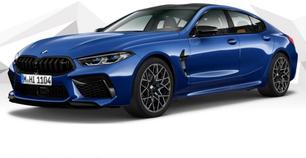
So, here we are. A four-door ‘Gran Coupe’, and the M8 Competition version retains the smoothly tapering turret and frameless side glass that help give selected BMW four-door models the same swoopy, coupe look.
At close to 4.9m long, a fraction over 1.9m wide, and under 1.4m high, the BMW 8 Series Gran Coupe has a firmly planted, low-slung, wide-track stance. Always a subjective call, but I for one, think it looks stunning, especially in our test car’s ‘Frozen Brilliant White’ matt paint finish.
In an era of comically oversized BMW grilles, things are relatively under control here, with a bright black finish applied to that ‘kidney grille’, as well as the huge front bumper air intakes, front splitter, front fender vents, exterior mirrors, window surrounds, 20-inch rims, lip spoiler on the boot, rear valance panel (incorporating a functional diffuser), and quad exhaust tips. The roof’s black, too, but that’s because it’s made of carbon-fibre.
Overall the M8 Competition Gran Coupe is a compelling combination of strong, confident character lines along the bonnet and lower flanks, with tightly wrapped curves following the high hip line, and more organically irregular, yet distinctly BMW shapes in the head- and tail-lights.
The interior is a beautifully balanced design with a broad centre console sweeping up to the middle of the dash and wrapping around to focus on the driver, in typical BMW fashion.
The multi-adjustable sports front seats are immaculate, with high-end quilting in the centre section matching a similar treatment in the doors. The dark grey (full) leather trim is offset by carbon and brushed metal trim elements for a cool, calm and focused feel.
Crack the bonnet open and a spectacular ‘BMW M Power’ carbon cover dressing the top of the engine is guaranteed to impress friends and family.
Looking at the RC 350 F Sport, it’s hard to imagine how it became so anonymous on the road, whether you love it or hate it.
Up front, its striking design simply cannot be ignored, with its unique mesh 'Spindle' grille insert demanding attention.
Either side of it are the LED headlights and boomerang-style daytime running lights, which, again, cannot be missed.
Around the side, the RC 350 F Sport has all the hallmarks of a classic coupe, including a swoopy roofline, and looks all the better for it.
The 19-inch alloy wheels wrapped in a mixed set of Bridgestone Potenza tyres are particularly arresting thanks to their sporty 10-spoke design.
That said, the rear end is arguably the RC 350 F Sport’s best angle, at least universally, thanks to its crisp LED tail-lights and chunky bootlid.
The bumper below is also a looker, even with its fake side air intakes, while its diffuser insert is flanked by a pair of chrome exhaust tailpipes.
Inside, the RC 350 F Sport isn’t quite as good, with most of our criticism directed at the 10.3-inch central display, which is powered by an average multimedia system made worse by an incredibly fiddly touchpad controller. The physical shortcut buttons on hand are but small mercies.
Thankfully, Apple CarPlay and Android Auto support is now standard, so a better user interface is literally in your pocket… but you still don’t have a touchscreen to work with.
The RC 350 F Sport’s button-controlled 8.0-inch digital instrument cluster is much better, even if it’s more like a multi-function display due to its limited functionality.
While the centre stack and console designs are undoubtedly showing their age, there’s no doubting this is a premium model thanks to the selection of high-quality materials used throughout the cabin.
In our test vehicle, black leather-accented upholstery with (very cool) 'Tuscan Sun' yellow accents, piping and stitching covers the sports steering wheel, gear selector, sports seats, armrests, door inserts, knee rests and the instrument cluster. So, almost every touch-point.
Pleasingly, soft-touch plastics are used for the upper and middle dashboard as well as the door shoulders, with hard plastics only found on the lower dashboard, door bins and rear seat divider.
As per other Lexus models, the RC 350 F Sport has nice rose-gold accents on its steering wheel, gear selector, front air vents and centre console, while specific Naguri aluminium trim adorns its dashboard and door inserts. And there are also steel pedals.
Of the M8 Competition Gran Coupe’s 4867mm overall length, 2827 of it sits between the front and rear axles, which is a pretty healthy wheelbase for a car this size (and 200mm more than the 8 Series two-door coupe).
Space up front is generous, and one upside of a four-door, rather than two-door coupe, is you’re not struggling quite so much for space to get in and out when parked next to other cars.
Once inside, there’s plenty of storage up front, with a large lidded box/armrest between the front seats, twin cupholders in the centre console, as well as another covered area for wireless phone charging and extra bits and pieces in front of that. Long door pockets provide space for bottles, and the glove box is a decent size. There’s 12V power as well as USB sockets for media connection, with charging outlets in support.
At first glance you’d swear the rear seat was designed as a two-seater only, but when push (literally) comes to shove a centre passenger can squeeze in, legs straddling the rear console.
In terms of legroom, at 183cm (6’0”) I could sit behind the driver’s seat set for my position with knee room to spare, but headroom is another matter, with my noggin making solid contact with the soft Alcantara headlining. It’s the price you pay for this car’s racy profile.
There’s a neatly trimmed storage box and two cupholders in the fold-down centre armrest, plus door pockets with enough room for small bottles. The rear console houses dual climate controls, twin USB power sockets, and a small oddments tray, as well as buttons for the optional rear seat heating fitted to our test car ($900).
The 440-litre boot is a bit like the car itself - long and wide, but not very high. The rear seat split-folds 40/20/40 if you need more space, and the boot lid is automatic with a hands free function. But don’t bother looking for a spare of any description, a tyre repair kit is your only option.
Hope you’re not expecting the RC350 F Sport to be the first word in practicality, because it’s not.
Measuring 4700mm long (with a 2730mm wheelbase), 1840mm wide and 1395mm tall, the RC350 F Sport is a decently sized coupe, but that doesn’t mean it’s spacious. Hell, it’s hard to get into it the first place, let alone out.
We are of course referencing the token second row, which is cramped at best. In fact, behind my 184cm (6.0ft) driving position, there is no toe-room nor headroom. Yep, if you’re around my height or taller, get used to burying your chin into your chest.
Thankfully, legroom is better but still limited to less than two centimetres, while foot space is compromised by the unusually tall transmission tunnel. And in case you were wondering, even the first row is on the tighter side.
Beyond the central air vents, you’d think rear occupants would be cheered up with cupholders, a fold-down armrest and USB ports at the very least. Well, they don’t get any of that, with a couple of coat hooks the only amenities on offer.
And don’t forget that being a four-seater, there are only two seats in the second row, so this is definitely not a ‘family car.' That said, there are two ISOFIX and two top-tether anchorage points for child seats, so you can theoretically take a couple of younglings with you on a trip.
In-cabin storage options are very limited, with the glove box small in size and mostly taken up by the manual, while the central bin is useable but somewhat occupied by two USB-A ports, a 12V power outlet, and an auxiliary input.
And whatever you do, only bring up to two drinks with you, as beside the pair of cupholders next to the gear selector, there is no other place to officially store extras. Yep, the front door bins are only good for storing very short and narrow items.
The boot is a different story, with a decent 374L of cargo capacity, and it can be expanded by stowing the 60/40 split-fold rear bench, an action that can annoyingly only be performed in-cabin via the manual release latches.
That said, the boot’s tall load lip makes unloading bulkier items a little trickier, while getting them onboard in the first place is complicated by its wide but short aperture. At least there are four tie-down points on hand to secure loose loads?
At $349,900, before on-road costs, the BMW M8 Competition Gran Coupe sits in an interesting part of the upper-luxury, high-performance market, the unifying theme being a forced induction V8 engine under the bonnet.
On price, it lines up almost exactly with Bentley’s twin-turbo Continental GT V8 ($346,268), but that’s a more conventional, two-door coupe.
If it’s four doors you’re after, some compelling options, within shouting distance of the M8’s price, include the supercharged V8 Jaguar XJR 575 ($309,380), twin-turbo V8 Maserati Quattroporte GTS GranSport ($299,990), and the presidentially powerful and imposing twin-turbo V8 Mercedes-AMG S 63 L ($392,835).
But, arguably, the competitor that lines up best in terms of intent, performance, and personality is Porsche’s Panamera GTS ($366,700). You guessed it, a twin-turbo V8, also designed to prowl the autobahn’s left lane.
So, in this exalted company you need to bring your quality and features A-game, and the M8 Competition Gran Coupe doesn’t disappoint.
Running through all the car’s standard equipment would be a tedious exercise, if only for the sheer volume of features, and hopefully, the following highlights package will give you a feel for the level we’re talking about here.
Aside from copious amounts of active and passive safety tech (covered in the Safety section) this brutal Beamer features, four-zone climate control, configurable ambient (interior) lighting, keyless entry and start, ‘Merino’ leather trim covering the seats, doors, dash, M steering wheel, and gearshift, ‘Anthracite’ Alcantara headlining, 20-inch alloy rims, active cruise control, a digital instrument panel, head-up display, and laser headlights.
The electrically-adjustable sports front seats are ventilated and heated, while the leather-trimmed steering wheel, front centre armrest, and even the front door armrests can also be dialled up to a toasty setting.
You can also add a 10.25-inch multimedia display featuring navigation (with real-time traffic updates), Apple CarPlay and Bluetooth connectivity, as well as gesture control and voice recognition. The exterior mirrors are heated, folding, and auto-dimming. The Bang & Olufsen surround sound audio system boasts 16 speakers and digital radio.
There’s also a digital dash display, panoramic sunroof, rain-sensing wipers, soft-close doors, power sunblinds on the rear, and rear side windows, and a l-o-t more. Even in this price range, that standard fit-out is impressive.
Priced from $78,636 plus on-road costs, the RC 350 F Sport commands $3000 and $8000 premiums over its lower-output RC300 and lower-spec Luxury siblings.
In terms of rivals, the RC 350 F Sport significantly undercuts the best-selling Mercedes-Benz C 300 Coupe ($89,000) but is about on par with the Audi A5 40 TFSI Sport Coupe ($78,900).
Standard equipment not already mentioned in the RC 350 F Sport includes rain-sensing wipers, power-folding side mirrors, satellite navigation with live traffic, digital radio, an 835W Mark Levinson sound system (with 17 speakers), keyless entry and start, dual-zone climate control, power-adjustable front seats with heating and cooling, a power-adjustable steering column and an auto-dimming rearview mirror.
Yep, it’s loaded, which is very good news. What isn’t, though, is its foot-operated park brake. Sure, the RC is six years old, but electric park brakes were well and truly a thing in 2014, so it’s quite an annoying quirk.
The RC 350 F Sport only has two options: a $2500 power-operated sunroof and $1500 premium paintwork, both of which were fitted to our test vehicle, with the latter taking the form of 'Graphite Black.'
The M8 Competition is powered by an all-alloy, 4.4-litre twin-turbo V8 engine, featuring direct-injection, as well as the latest version of BMW’s ‘Valvetronic’ variable valve timing and ‘Double-VANOS’ variable camshaft control, to produce 460kW (625hp) at 6000rpm, and 750Nm from 1800-5800rpm.
Designated ‘S63’, the engine’s two twin-scroll turbos are located, along with a cross-bank exhaust manifold, in the engine’s (90-degree) ‘hot vee.’
The idea is consistent transmission of exhaust energy to the turbos for improved response, with the reversal of usual practice completed by inlet manifolds positioned on the engine’s outer edges.
Drive goes to all four wheels via an eight-speed ‘M Steptronic’ (torque converter) auto transmission with ‘Drivelogic’, and dedicated oil cooling, as well as BMW’s ‘xDrive’ all-wheel drive system.
The xDrive set-up is built around a central transfer case housing an electronically-controlled, variable multi-plate clutch, with front to rear drive distribution set to a default 40:60 split.
The system monitors multiple inputs including, wheel speed (and slip), acceleration and steering angle, and is able to vary the ratio up to 100 per cent rear thanks to the ‘Active M Differential.’
The RC 350 is motivated by a lusty 3.5-litre naturally aspirated V6 petrol engine that produces 232kW of power at 6600rpm and 380Nm of torque from 4800-4900rpm.
For reference, the RC 300 uses a 2.0-litre turbo-petrol four-cylinder unit that develops 180kW at 5800rpm and 350Nm from 1650-4400rpm.
Either way, these outputs are exclusively sent to the rear wheels via a well-sorted eight-speed torque converter automatic transmission with paddle-shifters.
This combination helps the RC350 sprint from a standstill to 100km/h in about 6.1 seconds while on the way to its electronically limited top speed of 230km/h.
Claimed fuel economy for the combined (ADR 81/02 - urban, extra-urban) cycle is 10.4L/100km, the M8 Competition emitting 239g/km of CO2 in the process.
Despite the standard auto stop/start function, over a week-long combination of city, suburban, and freeway running we recorded a (dash-indicated) average of 15.6L/100km.
Pretty thirsty, but not outrageous when you consider this car’s performance potential, and the fact that (purely for research purposes) we exploited it regularly.
Recommended fuel is 98 RON premium unleaded, and you’ll need 68 litres of it to fill the tank. That equates to a range of 654km in line with the factory claim, and 436km using our real-world number as a guide.
The RC350’s fuel consumption on the combined-cycle test (ADR 81/02) is 9.1 litres per 100 kilometres, while its carbon-dioxide emissions are 212 grams per kilometre, but both claims are a little keen.
In our real-world testing, we averaged 12.2L/100km, which is far cry from the above, given our result came from 180km of driving that was heavily skewed towards highway stints over city traffic.
For reference, the RC 350’s 66L fuel tank takes 95 RON premium petrol at minimum.
There’s something teutonically symmetrical about the way the M8 Competition Gran Coupe delivers its prodigious thrust.
Peak torque of no less than 750Nm is available from just 1800rpm, remaining on full song across a broad plateau all the way to 5800rpm. Just 200revs later (6000rpm) peak power of 460kW (625hp!) takes over to finish the job, with the rev ceiling sitting just over 7000rpm.
That’s enough to slingshot this 1885kg bruiser from 0-100km/h in 3.2 seconds, which is supercar fast. And the engine and exhaust noise produced by the 4.4-litre twin-turbo V8 during such rapid acceleration is suitably brutal, courtesy of electronically-controlled flaps in the system opening up.
On a more civilised drive you can reduce the exhaust noise via an ‘M Sound Control’ button on the centre console.
The eight-speed auto is fast and positive, especially in manual mode, which dials up the fun via wheel-mounted paddles. And when it’s time to direct this car’s forward momentum into lateral movement BMW has brought in the engineering heavy artillery.
Despite its frameless door body structure the M8 Competition Gran Coupe feels solid as a rock thanks in no small part to its ‘Carbon Core’ construction, using four primary components - carbon-fibre-reinforced plastic (CFRP), aluminum, high-strength steel, and magnesium.
Then the ‘Adaptive M Suspension Professional’ (with active anti-roll stabilisation), the tricky xDrive continuously variable AWD system, and active M Sport diff combine to keep everything under control.
Suspension is a double wishbone front, five-link rear arrangement, with all key components in alloy to minimise unsprung weight. In concert with the electronic wizardry on-board, it helps keep the M8 buttoned down with only modest body roll in enthusiastic cornering, as the rear-biased AWD system seamlessly distributes drive to the axle and wheels that can make best use of it.
The price you’ll pay for the track-ready tune is in compromised ride comfort. Even in the ‘Comfort’ setting, the M8 Competition is firm, and feels corrugations and imperfections to a surprising degree.
An alignment of the BMW 8 Series planets left me with the keys to this car and the M850i Gran Coupe (also using the Carbon Core body) at the same time, and the difference between their softest settings is appreciable.
Also be aware that at 12.2m the M8 Gran Coupe’s turning circle is substantial, and it’s just as well all that camera, sensor and self-parking tech is available to help you guide this ship into port.
The M8’s electrically-assisted, variable-ratio steering features an ‘M’ specific calibration to deliver satisfying precision and good road feel. But in similar fashion to the ride a noticeable amount of unwelcome feedback comes through to the wheel.
The fat Pirelli P Zero rubber (275/35 fr / 285/35 rr) grips hard, and the monster brakes (ventilated all around, with 395mm rotors and six-piston calipers up front) wash off speed without fuss or fade.
But overall, you’ll have to live with a less refined drive when you sign on for the M8 Competition. Straight away it feels faster but lacks the M850i’s lighter touch. No matter which drive or suspension mode you select, responses are more aggressive and physical.
To fully explore and enjoy the M8 Competition’s abilities it feels like the race circuit is its most appropriate habitat. On the open road, the M850i is all the Gran Coupe you’re going to need.
The RC350 F Sport is actually pretty good to drive – so long as you understand what it’s about.
Think of it more as a comfortable cruiser than a sports car and you’ll forgive it for some of its shortcomings. Yep, it is that relaxing to drive.
While the F Sport’s suspension (independent double-wishbone front and multi-link rear axles with adaptive dampers) does have a sports tune, it still serves up a comfortable ride on most surfaces.
Naturally you can play with the five drive modes (Eco, Normal, S, S+ and Custom) on hand to increase its stiffness and therefore improve handling, but the difference between soft and ‘hard’ is negligible, so don’t bother.
Either way, the F Sport does have a noticeable habit of picking up sharper road edges, such as nasty potholes, and it's particularly prevalent at the rear. That said, it doesn’t detract from its luxuriousness all that much.
Where the sportiness really comes to the fore, though, is via the F Sport’s electric power steering system, which has a variable ratio.
As well-weighted as this set-up is as standard, you’ll find it hard to forget how sharp it is on turn-in. Among several factors at play, the obvious one is the F Sport’s rear-wheel steering system, which is better executed than most.
This technology turns the front wheels in the opposite direction to the rears at lower speeds but in the same orientation at higher velocities.
The result of the former? A mid-size coupe that feels like it has a short wheelbase, with the improved manoeuvrability especially noticeable in car parks. Conversely, the latter lends itself to greater stability when you need it.
And it’s a good thing it is the way it is, because the RC 350 F Sport has a kerb weight of 1740kg, which is not exactly sports-car light. This heft is a felt when cornering hard, even though body control is pretty strong overall.
Handling performance is also enhanced by the rear Torsen limited-slip differential, which helps improve grip upon corner exit, at which point the RC 350 gets to show off its straight-line abilities.
The V6 engine is buttery-smooth, but you really need to stick the boot in to fully enjoy it, with it only really starting to come alive when engine speeds are above 3000rpm.
That said, it’s easy to appreciate this character trait around town, where the RC 350 is truly unfazed. Take it onto the open road, though, and acceleration is more than pleasing.
The automatic transmission is a great dancing partner here, serving up delightfully smooth gear changes. It’s also surprisingly responsive, perhaps too responsive, as it can be quite fussy in city traffic, shuffling up and down ratios in quick succession.
Biggest gripe, however, is the digitally enhanced sound the RC 350 produces. Sitting inside, the noise being pumped in is satisfying, but you can’t help but acknowledge the aural deception at play.
The BMW M8 Competition Gran Coupe hasn’t been assessed by ANCAP or Euro NCAP, but that doesn’t mean it’s lacking in terms of active and passive safety tech.
As well as expected crash avoidance features like stability and traction controls, this M8 features the ‘Driving Assistant Professional’ suite which incorporates active cruise control (with ‘Stop & Go’ function) and ‘Night Vision’ (with pedestrian recognition).
Also included are AEB (with pedestrian and cyclist detection), ‘Steering and Lane Control Assistant’, ‘Lane Keeping Assistant’ (with active side collision protection”, an ‘Evasion Assistant’, a ‘Crossroads warning’, ‘Wrong-way warning’, as well as front and rear cross traffic alert.
The headlights are ‘Laserlight’ units incorporating ‘BMW Selective Beam’ (with active high-beam control), there’s a tyre pressure indicator, and ‘Dynamic Brake Lights’ to warn those behind of an extreme braking event.
Plus, M8 Competition owners score complimentary enrollment in the BMW Driving Experience Advance 1 and 2 courses.
To help guide your parking efforts there’s a hi-def reversing camera (with panoramic view monitor), rear parking distance control, and ‘Reverse Assist’. But if all else fails the car can park itself anyway (parallel and perpendicular).
If all of that isn’t enough to avoid an impact, you’re protected by 10 airbags (dual front and front side, knee bags for the driver and front seat passenger, as well as side airbags for the second row, and curtain airbags covering both rows).
An automatic emergency call function contacts the BMW call centre for connection to relevant services in the event of a crash. And as has been the case with BMW since the dawn of time, a first-aid kit and warning triangle are on-board.
Neither ANCAP nor Euro NCAP have issued a safety rating for the RC range, although the mechanically related IS line-up received the maximum five stars in 2016.
Advanced driver-assist systems in the RC 350 include autonomous emergency braking (with pedestrian detection), lane-keep assist, blind-spot monitoring, rear cross-traffic alert, adaptive cruise control, a (low-resolution) reversing camera and front and rear parking sensors. Yep, the only major thing missing here is steering assist.
Other standard safety equipment includes eight airbags (dual front, side, curtain and knee), anti-lock brakes (ABS), electronic brakeforce distribution (EBD), brake assist (BA) and the usual electronic stability and traction control systems.
BMW offers a three year/unlimited km warranty, which is at least a couple of years off the mainstream market pace, and lagging other premium players like Mercedes-Benz and Genesis, both sitting at five years/unlimited km.
Roadside assistance is included for the duration of the warranty period, and the standard ‘Concierge Service’ provides everything from flight information, to global weather updates, and restaurant recommendations, from a real human.
Technically, service is ‘condition based’ with the car telling you when it’s time to hit the workshop, but you can use every 12 months/15,000km as a guide.
BMW Australia offers ‘Service Inclusive’ packages that require customers to pre-pay for servicing, allowing the cost to be covered off in finance or leasing packages and reducing the need for concern about paying for maintenance further down the track.
BMW says there are different packages available, from three to 10 years, or between 40,000 and 200,000km.
As with all Lexus models in Australia, the RC 350 comes with a four-year/100,000km warranty and four years of roadside assistance. Both offers are a year behind that of fellow premium brands Mercedes-Benz and Genesis.
The RC 350’s service intervals are every 12 months or 15,000km, whichever comes first. A three-year/45,000km capped-price servicing plan is available, costing $495 per visit, which is not too bad at all.