What's the difference?
Andrew Chesterton road tests and reviews the new BMW 5 Series 520d, 530i, 530d and 540i sedans with specs, fuel consumption and verdict at its Australian launch in Victoria.
When we're all living under the cruel rule of our robot overlords, the few remaining human historians will track the genesis of our downfall to the technology explosion that occurred in 2017's new-car market.
Never before have car companies focused so hard on producing cars that can't just be driven, but that can drive themselves, negotiating corners, unexpected obstacles and changing traffic conditions without ever needing to consult the human actually sitting behind the steering wheel.
And BMW's all-new 5 Series sedan takes yet another a step forward, eliminating the need for said human to even be sitting in the car. Owners can instead move their 5 Series in and out of tight parking spaces simply by pressing a button on their key.
The Active Key function is admittedly a $1,600 cost option, but it proves the techno-focus applied to the seventh-generation of BMW's executive express, which will land in Australian dealerships this month. Every car is also fitted with what the German brand calls its personal co-pilot; a series of nifty cameras and radars that allow the car to be driven completely autonomously for spells of 30 seconds.
But the question is, has all this new technology come at the cost of regular, old-school driver enjoyment?
KGM – formerly SsangYong – has revised its seven-seat Rexton range for 2026, with some minor changes throughout the Australian line-up and a name-change for the Adventure, which has now become the Advance.
The Advance is a seven-seat large SUV with high and low-range gearing, an auto-locking rear differential and 3.5 tonne towing capacity.
Is this a value-for-money rival for the likes of GWM Tank 500, Mahindra Scorpio and LDV D90, or could it be a viable (cheaper) alternative to the Isuzu MU-X, Toyota Fortuner, Mitsubishi Pajero Sport or even Ford Everest?
Sleek and attractive in the city, engaging on a country back road and with plenty of clever technology, the 5 Series sedan ticks all the right boxes as an executive express. If you can stomach the price hike, the six-cylinder 540i is our pick of the bunch.
The KGM Rexton Advance is a large 4WD wagon packing an adequate amount of appeal.
It’s nice to drive on the open road, it’s comfortable and it signals continued incremental progress for KGM in terms of quality and functionality.
It’s fine for light off-roading but its 4WD efficacy is lacking. While it's not in the same class as something like the Ford Everest in terms of refinement, comfort, and general quality, ultimately, a lot of its rivals represent greater value for money and all-round driveability as family vehicles.
And even though it does offer owners a chance to take their urban-focussed SUV into the bush, its price is climbing, and other rival vehicles offer a more refined overall driving experience.
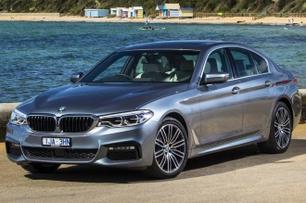
Hardly a revolution, the 5 Series has instead undergone a few nips and tucks. But if it ain't broke and all that. It might not be the most head-turning offering, but the 5 Series sedan remains sleek, powerful and understated, and it is undeniably handsome on the road.
Its 8mm wider, 28mm longer and 2mm taller than the car it replaces, but it's also around 95kg lighter, thanks to its aluminium doors and boot and a clever magnesium frame for the instrument panel that saved another two kilograms. There's some other clever design elements, too. The kidney grille has active air flaps that open when extra cooling is required, closing when it isn't, reducing drag and helping accleration.
Inside, the 5 Series offers a beautifully crafted yet joyously understated cabin, with quality materials joining modern technology in a seamless way.
The Rexton remains essentially unchanged from the previous generation and so it stays pleasant enough but generically inoffensive as are most other SUVs on the market.
Even for a city-focussed SUV, the body-on-frame Rexton looks low and while its 203mm of ground clearance is okay for daily driving it’s less than ideal for off-roading.
The only change to this Rexton over the previous generation? Pull-up sun blinds on the rear doors. Not a design change per se, but worth mentioning.
Does it set itself apart enough from other similar SUVs? Not really, but does that even matter to you?
This is a full-size sedan, and every seat feels spacious and airy. The sloping, slightly coupe-style roofline does cut into headroom in the back, but human-sized people will have little trouble, even sitting behind a tall driver.
Each trim offers two cupholders in the front, with another two housed in a pull-down divider that seperates the rear seat. And there's two ISOFIX attachment points, one in each window seat in the back.
The 5 Series' boot opens to rival a surprisingly sizeable storage space, offering 530 litres with the 40:20:40 rear seats in place.
This Korean SUV has a nice but unspectacular interior, although it does have a low-key premium look and feel about it and the cabin is comfortable.
It has a familiar ease of functionality and there’s a family-friendly mix of durable plastic and soft-touch surfaces throughout the cabin.
The 2026 KGM Rexton range is a seven-seat 4WD wagon in a two-, three- (second row) and two-seat (third row) 50/50 configuration.
The leather-look seats are comfortable enough and the front seats are heated, ventilated and power-adjustable; the second-row outer seats are also heated.
The multimedia system with its 12.3-inch screen is okay to use, but I had no luck getting Apple CarPlay paired to my not-so-smart phone. And, believe it or not, that hasn’t happened to me for a long time. Note: other people were able to pair their phones to this Rexton with no problems during my week of testing.
Otherwise, functionality, storage and charge points around the cabin are satisfactory, including two USB-C ports up front (centre console) and a 12V power outlet.
The second-row seats – a 60/40 configuration, which folds, reclines and tumbles – are supportive without being overly so.
In the second row, as mentioned earlier, the only changes evident to this Rexton over the previous generation are the pull-up sun blinds on the rear doors.
There’s actually a decent amount of space for passengers in the third row here, but an adult still wouldn’t love to spend too much time back there.
The rear cargo area space of the 2026 KGM Rexton range is listed as 236 litres (with all three rows of seats in use), 641 litres (with third row stowed away), and 1806 litres (with second and third row stowed away).
There’s a 12V power outlet in the cargo area.
This new Rexton offers reasonable practicality but rivals such as the Mahindra Scorpio and LDV D90 offer just as much, sometimes more, all-round family suitability but for $5000-$10,000 less, depending on the variant.
BMW's venerable 5 Series is now 45 years old, and this all-new model arrives in four distinct flavours, with a fifth - an incoming M5 performance sedan - still some way off.
For now, though, the range kicks off with the 520d, before stepping up what BMW hopes to be the big seller of the range, the 530i (replacing the outgoing 528i). Next up is biggest diesel, the 530d (replacing the the 535d), before the current range tops out with the petrol-powered 540i (replacing the old 535i).
Be warned though, there's been some pretty serious price increases right across the line up, ranging from $9,145 to a whopping $19,245. In fact, only the 530d has seen its price come down, now $3,755 cheaper than the outgoing 535d. BMW justifies the hikes by pointing to an increase in standard inclusions across the range.
It might not be the most head-turning offering, but the 5 Series sedan remains sleek, powerful and understated.
The 520d kicks off from $93,900, and arrives predictably well equipped for your money. Expect 18-inch alloys, leather trim, dual-zone climate control and a 12-speaker stereo. You'll also get a technology overhaul, with a bigger and upgraded Head Up display (it can now read street signs and beam that info onto the screen), a 10.25-inch touchscreen and a wireless (insert link to chi charger story) charging pad.
Step up to the 530i ($108,900) or 530d ($119,900) and you'll add 19-inch alloys, adaptive dampers with dynamic mode (that reads both driver input and navigation data and tweak suspension, gear and steering settings automatically) a 16-speaker Harman Kardon stereo and a crystal-clear 12.3 high-resolution digital display in the driver's binnacle. You'll also find heated front seats, a powered boot and sports seats in the front.
Finally, spring for the 540i ($136,900) and you'll get 20-inch alloys, a sunroof and electric blinds for the rear windows. You'll also find better Nappa leather on the seats, which now also offer a cooling function. Under the skin, you'll get an active anti-roll bar at each axle designed to keep the car from rolling side-to-side on the twisty stuff.
One quirk, however, is the fact that BMW's very cool wireless Apple CarPlay is a cost option on every trim level, and one that will set you back $479.
The KGM Rexton is available in four variants: ELX, Advance, Ultimate – and the Ultimate with the optional Rexton Sport Pack.
The Advance as standard has recommended drive-away pricing of $58,200 (correct at the time of writing and includes $700 Marble Grey metallic paint). But our test vehicle also has a $1842 tow bar fitted, and a $665 electronic brake controller fitted, pushing its as-tested price to $60,707.
Standard features in the Advance include C-type design LED daytime running lights, a 12.3-inch touchscreen multimedia system (with Apple CarPlay and Android Auto), a 12.3-inch digital LCD instrument cluster, leather-accented heated and ventilated, power-adjustable front seats, ambient interior mood lighting, walk-away automatic door locking, a power tailgate, 18-inch 'diamond cut' alloy wheels and a suite of driver-assist tech including a tyre pressure monitoring system, but it misses out on the higher grades’ 360-degree surround view monitor.
The only change to this Rexton over the previous version? Pull-up sun blinds on the rear doors.
This new Rexton has plenty going for it, in terms of standard features, but rivals such as the GWM Tank 300, Mahindra Scorpio and LDV D90 offer just as much onboard but for $5000-$10,000 less, depending on the variant.
Exterior paint choices include Grand White, Marble Grey (metallic paint), Pearl White (metallic paint), and Space Black (metallic paint). Metallic paint is available for $700 on all grades, but is included in the price of the Sport Pack.
The hunt for efficiency sees all but the most expensive 5 Series models equipped with four-cylinder engines, including the entry-level 520d, which is fitted with a 2.0-litre diesel unit that will produce 140kW at 4,000rpm and 400Nm from 1,750rpm. That's enough to push the cheapest 5 Series to 100km/h in a not particularly inspiring 7.5 seconds, topping out at 235km/h.
The cheapest petrol, the 530i, arrives with a turbocharged 2.0-litre engine good for 185kW at 5,200rpm and 350Nm from 1,450rpm. That will see you clip 100km/h in 6.2 seconds and push on to a limited top speed of 250km/h.
The turbocharged six-cylinder feels right at home in a car this size, with acceleration effortless and freeway overtaking manoeuvres an absolute breeze.
The 530d introduces the first six-cylinder engine, a 3.0-litre unit that will produce 195kW at 4,000rpm and an impressive 620Nm from 2,000rpm. That's enough to knock off the sprint in in 5.7 seconds and offers a top speed limited to 250km/h.
Finally, the top-spec petrol, the 540i, will produce 250kW at 5,500rpm and 450Nm from 1,380rpm from its 3.0-litre turbocharged straight-six engine. Those are healthy numbers, and enough to welcome 100km/h in a sprightly 5.1 seconds before topping out a limited 250km/h.
Every model is paired with an eight-speed torque converter automatic transmission.
The entire KGM Rexton line-up has a 2.2-litre four-cylinder turbo-diesel engine producing 148kW of power and 441Nm of torque.
It has an eight-speed automatic transmission, part-time 4x4 with high and low range, and an auto-locking rear differential.
This is a sluggish combination and not a particularly efficient powertrain, but it does the job, albeit in a lacklustre fashion.
Drive modes include Normal, Sport and Winter modes.
BMW quotes a combined 4.3 litres per hundred kilometres from the 520d, which will also spit out 114g per kilometre of C02. The 530d lifts that number to 4.7 litres per hundred kilometres (which seems a small price to pay for all that extra torque), with C02 pegged at 124g per kilometre. Both diesels get a slightly smaller tank, at 66 litres.
The 530i will sip a claimed/combined 5.8 litres per hundred kilometres, with C02 emissions a claimed 132g per kilometre, while the big 540i requires 6.7 litres per hundred kilometres, with C02 pegged at 154g per kilometre. Both petrol models get a 68-litre tank and require 95RON fuel.
Official fuel consumption for the Rexton is listed as 8.7L/100km.
On this test, I recorded 10.6L/100km, but I have done a chunk of high and low-range, four-wheel driving.
The Rexton has a 70-litre fuel tank. So going by that on-test fuel figure from a full tank, you could reasonably expect a driving range of about 660km.
But remember, I'm travelling with just me and some vehicle recovery gear. You'll be traveling with your kids, your mates, your pets, your camping gear, your sporting gear, all that sort of stuff. And that extra weight will have an impact on the vehicle's fuel consumption, so just keep that in mind.
BMW's pre-drive briefing was so technology focused we half expected the black turtle neck and dad jean-wearing ghost of Steve Jobs to emerge from behind a curtain clutching an iPad. Only a minuscule portion was dedicated to the cars' drivetrains, with BMW instead hammering home autonomy functions, technology upgrades and the fact that its car was a preview to "the future".
But once we'd slipped behind the wheel of the all-new 5 Series, it all started to make more sense. Having briefly sampled three models (the 530i, 530d and 540i), we can safely report there's nothing particularly revolutionary about their on-road behaviour. That's not necessarily a bad thing - they do everything you could ask of a car in this bracket. They're mostly smooth and always quiet, the new chassis has done nothing to dampen engagement when you start to ask a little more of it, and it's generally a luxurious experience. But then so was the old car.
But what's new is the technology poured into the 5 Series. Every car gets what BMW is calling its personal co-pilot, for example, which is a set of tricky systems (there's six cameras, five radar sensors and 12 ultrasonic sensors scattered around the car) that work with the active cruise control and allow the car to be driven completely autonomous for 30-second intervals. Now, it's not quite as advanced as some of its competitor's systems - it can't change lanes for example - but if you're out on a country road or on a highway, it will stay within its lane, turn around corners and keep up with the traffic, even if they stop in front of you.
This is a full-size sedan, and every seat feels spacious and airy.
While the cheapest diesel model has historically been the best seller, BMW is hoping the new 530i will prove the most popular this time around. And while you couldn't describe it as fast, the power from its four-cylinder engine is ample for all that will likely be asked of it, and it feels sorted and composed on more challenging roads. It's a smooth and comfortable ride, too, even with the optional 20-inch alloys fitted, though that's undoubtedly thanks to the adaptive dampers and ever-changing dynamic ride function, both of which are fitted as standard. In fact, we're yet to drive a car without those options fitted, so we're forced to reserve judgement on the as-standard ride quality of the cheaper models.
Be warned though, none in the 5 Series range offer the disconnected and perfectly smooth conveyance you might find in some true luxury offerings, and you'll still know when you're diving into deep pockmarks in the road. But the trade off is a an engaging ride and steering set up that always feels planted, with enough feedback to ensure you feel connected to what's happening beneath the tyres. And that's a trade we're more than willing to make.
Step up to the 540i and things take a much sportier turn. The turbocharged six-cylinder feels right at home in a car this size, with acceleration effortless and freeway overtaking manoeuvres an absolute breeze. And while we didn't find roads quite brutal enough to really test the active anti-roll bars housed at each axle, there's a wonderful and stable flatness to the way the biggest petrol handles corners.
It's not cheap, but thanks to the bigger engine and sorted dynamics, the 540i feels most like a 5 Series probably should.
The Rexton is 4850mm long (with a 2865mm wheelbase), 1960mm wide and 1825mm high with a listed kerb weight of 2136kg.
With a turning circle of 11m, the Rexton is quite nimble around town.
On road, it’s okay. It's reasonably quiet and comfortable, and though it’s not particularly dynamic – the engine and auto make for a sluggish pairing – the Rexton is sufficiently driveable all round.
Its suspension – double wishbones and coil springs at the front, independent multi-link and coil springs at the rear – is firm, mostly controlled, but ride becomes jittery on irregular sealed surfaces and that characteristic is only amplified on even mildly corrugated dirt tracks.
And it’s in the dirt where the Rexton’s limitations are quickly exposed.
The Rexton is best considered a light-duty four-wheel drive: it is quite low; its stock tyres – Nexen NPriz RH7 (255/60R18 108H) – though marketed as “all season” aren't well suited for four-wheel driving. And the Rexton’s 4WD mechanicals and off-road traction control feel dated in operation, they just don't feel as effective as they should in a very competitive SUV market.
It doesn't have a lot of ground clearance or wheel travel and its shallow off-road angles – approach (20.5 degrees), departure (20.5) and ramp over (20) – are best suited to light-duty off-roading (i.e. well-maintained tracks in national parks in dry weather).
There's a decent spread of revs here, but there's not a lot to work with in terms of how effective the Rexton is as an off-road package so if you are here for a hardcore 4WD review with tyres-ripping-the-dirt action you're in the wrong place, because the Rexton just isn't up to that. And that's perfectly fine because people won't be using it for that purpose.
Having said that, the Rexton does reasonably well with what it has on board: there’s a decent amount of torque across a spread of revs; steering has a direct feel and nice liveliness to it; throttle response is quite sharp; and there is plenty of visibility forward over the bonnet.
Its auto rear diff lock is clunky in operation, disengaging abruptly, sometimes when you’re not even up, over or through the particular off-road challenge you’re tackling. I’ve noted similar issues with the Mahindra Scorpio in the past.
But driven with careful consideration the Rexton may do – at a stretch – the type of terrain you might not think it would be capable of.
And a decent set of all-terrain tyres would also help the Rexton, but it is what it is: a light-duty, four-wheel drive.
If you're thinking of using your family go-mobile as a touring vehicle, it’s worth noting the payload is 824kg, gross vehicle mass is 2960kg and gross combined mass is 6460kg.
Towing capacity is 750kg (unbraked) and 3500kg (braked).
The GWM Tank 300, Mahindra Scorpio and LDV D90 have similarly old-school type powertrains and 4WD set-ups, but the Tank is more comfortably capable off-road and yields a better general driveability than the Rexton and those others.
Expect plenty of clever safety gear, with every 5 Series sedan arriving with six airbags (dual front and full-length side airbags, along with head protection bags for front passengers). You'll also find a surround-view reversing camera and parking sensors.
But the high-tech stuff arrives courtesy of active cruise control, cross-traffic alert, lane keep assist and cross-road alerts.
The Rexton does not have an ANCAP rating because it has not been officially tested.
As standard, it has nine airbags, auto emergency braking (AEB), adaptive cruise control, forward collision warning, lane keeping assist, blind spot warning, lane change-collision warning, rear cross-traffic warning, trailer sway control, driver attention alert, front vehicle start alert and more.
Though it doesn’t have an ANCAP rating, the Rexton holds its own in terms of driver-assist tech against rivals such as GWM Tank 300, Mahindra Scorpio and LDV D90.
The BMW 5 Series is covered by a three year, unlimited-kilometre warranty, and requires condition-based servicing (rather than a pre-defined service interval).
You can also prepay your maintenance costs for five years/80,000kms, with prices ranging from $1,640 for the basic package, and climbing to $4,600 for the all-inclusive option.
The MY26 Rexton range is covered by a seven-year/unlimited kilometre new-vehicle warranty, and five years of roadside assistance.
A service is required every 12 months or 15,000km, whichever occurs soonest with cost per service either $418 or $522.
KGM Australia has more than 50 dealerships across the country with a decent spread across metro and regional areas. Rextons can be serviced at those dealers or at approved workshops.
The Rexton offers a competitive warranty when pitched against the likes of the GWM Tank 300 (seven-year/unlimited kilometre), Mahindra Scorpio (seven-year/150,000 km) and LDV D90 (seven-year/200,000km warranty).