What's the difference?
Back in the day, the 3 Series sedan was often the entry to the brand for first time BMW owners, and for good reason. They offered practical interior space without compromising on engine performance.
And they simply looked good, no boring nanny design elements. Then the 1 Series came along and price points bumped up, so how does the ‘entry’ BMW 320i M Sport live up to its long-standing reputation?
With an updated dashboard that brings the interior and tech up to market and a sharper exterior design, it more than holds its own at the table of luxury sedans, despite hard competition from the likes of the Audi A4, Mercedes-Benz C200 and Jaguar XE.
However, if the Merc is a placid and well-behaved mare… the BMW is the barely-broken-in bronco and it takes a certain kind of ‘rider’ to enjoy what the 320i has to offer.
I’ve been discovering just that this week with my family of three. What did we find out? Read below!
You like performance, love a bit of luxury and fancy a traditional sedan. The budget is healthy and there’s a surprising amount of choice. But Mercedes-AMG believes it’s created the car that perfectly answers your new-car brief.
The Mercedes-AMG E53 Hybrid 4Matic+ is a fresh expression of an established high-performance sedan formula mixing internal-combustion power with electric punch and all-wheel drive.
We were invited to its local launch, so stay with us to see if this newcomer is ready to fill that primo European performance car shaped space in your garage.
I thoroughly enjoyed my time in the BMW 320i M Sport. It’s fun to drive and I felt connected to what the car was doing on the road. The harder ride may not appeal to some but I didn’t mind it. The cosy back seat and boot mean it will probably suit a smaller family best and one which doesn’t have to worry about carrying a lot of gear around regularly, but it suited my needs just fine.
I reckon this is a car for those drivers who don’t want to compromise on performance but still have a kid or two. If you’re after the cushioned comfort of a Merc, this won’t appeal but I didn't want to give this one back and happily give it a firm 8/10.
My son liked the sports car looks and enjoyed the amenities in his row. He gives it a 10/10.
The Mercedes-AMG E53 Hybrid 4Matic+ is a superb blend of high-tech hybrid muscle and cossetting top-end luxury. Value is competitive, it looks (and feels) the business, despite the conventional sedan configuration it’s surprisingly practical (except for the modest boot), fuel-efficiency is a key benefit and safety is stellar. The ownership proposition is okay for the category but that’s not top of mind when an enticing series of corners ranges into view. It’s an impressive package.
Note: CarsGuide attended this event as a guest of the manufacturer, with travel, accommodation and meals provided.
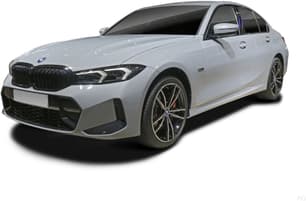
Sharper than its predecessor, the new 320i has LED everything with the rear lights being longer and curving around to the sides of the car.
The classic 'kidney' grille is darkened and more pronounced, with the black panelling extending to the rear to create an unapologetically sporty presence. A presence that’s accentuated by the twin exhausts.
The batcave interior with its black headliner, black seats… black everything, looks smart and stylish.
You do have a fair bit of harder touchpoints throughout but the customisable ambient lighting helps to soften the overall effect.
With its 2068mm width, 4709mm length and 1435mm height, the sedan makes its presence known without feeling cumbersome to manoeuvre. Urban dwellers need not fear their local car park!
At first glance the E53 passes as a flash-looking Mercedes-Benz E-Class running 20-inch rims, especially in the launch car’s rich ‘Patagonia Red’ finish.
But then, there’s something about the AMG sedan’s stance that sets it apart. Which makes sense because the front fenders are wider by 11mm on both sides (compared to the E-Class) to make room for a wider front track (increased by just over 30mm over the previous-generation E53).
Wheelbase has also increased by just over 20mm to almost 3.0m and the car’s more aggressive nose treatment enhances the distinctive look.
There’s the AMG-specific radiator trim with ‘Panamericana’-style vertical slats, the sleek dual-section headlights and a large lower inlet that directs air to an additional front intercooler as well as an external opening for a wheel-arch cooler.
In profile there’s barely a hard edge to be seen, although character lines in the bonnet and along the car’s flanks contribute to a taut surface treatment.
At the rear, horizontally-connected LED tail-lights feature a stylised Mercedes three-pointed star signature, then a rear apron housing a diffuser and twin double tailpipe ‘trims’ and a bootlid spoiler on the left and right round off a beautifully proportioned design.
Climbing inside means a trip to screen city with an upright digital display in front of the driver flanked by a large central screen to the left and an additional panel for the front passenger beyond that. It’s a lot.
But once you’re on top of all the glass surfaces, details like open pore grey ashwood trim on the lower console come into focus, as do the brushed metal accents, beautifully sculpted ‘Performance’ front sports seats (optionally fitted to our launch drive example), racy stainless steel pedal covers and the five spoke AMG performance steering wheel with configurable rotary buttons.
It’s a supremely luxurious and comfortable interior.
For such a sleek looking sedan, it’s generous up front with plenty of head and legroom.
You can adjust the seat to sit quite low and both front seats have extendable under-thigh supports, which should excite taller drivers.
My 189cm (6’2”) brother has the 328i and is very comfortable but taller front passengers will encroach on back seat passenger comfort.
The front seats are quite firm on the backside, they also lack adjustable lumbar support, so expect to stretch the kinks out on a longer trip.
The amenities and tech feel well thought out and easy enough to use. The 12.3-inch touchscreen multimedia system looks great and has the best-looking graphics I’ve sampled.
The BMW system is intuitive to use once you get used to it. If you’re not interested in using the touchscreen, you can also utilise the rotary-wheel for menu selections.
There’s also Bluetooth connectivity, wireless Apple CarPlay and Android Auto plus built-in satellite navigation.
The 12.3-inch digital instrument panel is customisable and the information displayed simply but you won’t really look at it because of the head-up display.
Front occupants enjoy a wireless charging pad for their smart phone, a USB-A and USB-C port plus a 12-volt socket. Rear passengers get a couple of USB-C ports, too.
The storage is good for this size sedan but overall passenger room takes priority, but the glove box and middle console will suffice for everyday use.
While it may not excite others, I love the big bottle holders in the doors. They’re large enough for my big 1.5L bottle and angled for easy access. These are found in the rear doors as well.
Back seat passengers enjoy climate control, directional air vents, two cupholders, netted map pockets and reading lights.
My six-year old was happy with the amenities and lower ground clearance because he felt comfortable and had his independence.
The boot offers a good capacity of 480L and the aperture isn’t too narrow, so you can comfortably access items if they roll to the back.
I had plenty of room for my little family’s needs but if you’re a larger family, you may need to get strategic with gear storage.
Being a base model, you do miss out on a powered tailgate, which is a shame but not too much of an issue given this is a sedan and the lid isn’t heavy.
There’s also no spare tyre or even a puncture repair kit but you have run-flats, so you should be able to limp to a service centre if need be.
At over 4.9m long, close to 2.1m wide and a little under 1.5m tall, with a 2961mm wheelbase, the new E53 is a substantial car and feels it on the inside.
Plenty of breathing space for the driver and front passenger thanks in part to the away slope of the screen-dominated dash.
Generous storage, too, with large door bins including enough space for big bottles, a deep lidded box between the seats (which doubles as a centre armrest), a generous glove box and two cupholders under a sliding top at the front of the centre console.
Hit the second row, and sitting behind the driver’s seat, set for my 183cm position, I have plenty of head and legroom, with enough shoulder space for three adults on short journeys. A trio of up to mid-teenage kids will be fine for a road trip.
Storage is pretty handy as well with hefty door bins and two pop-out cupholders in the fold-down centre armrest. No map pockets on the back of the (optional) Performance front seats, though.
Four-zone climate control means there’s individual temperature control for each side of the back seat, with adjustable vents at the back of the front centre console and trailing edge of the B-pillars. Very civilised.
Power and connectivity runs to three USB-C outlets and a wireless device charging pad in the front.
Thanks to the traction battery under its floor, boot volume is restricted to 370 litres (compared to 540L in the conventional E-Class sedan), although there are bag hooks, tie-down anchors and the 60/40 split-folding rear seat is able to liberate more space.
No spare tyre of any description, just a repair/inflator kit, which might make sense for automotive designers and engineers trying to maximise space and reduce weight, but doesn’t make sense for an owner stranded on the side of the road with an unrepairable puncture.
There are seven variants for the BMW 3 Series sedan and our model is the base model for the petrol variants.
There is a plug-in hybrid version, the 330e, if you’re after a more fuel-efficient option but it will up the price by about $20K.
As it stands the 320i M Sport is $78,900, before on-road costs. Our model has been finished in 'M Brooklyn Grey', which adds $1539 to the price.
That puts it at a similar price point as its rivals. You get a well-specified package with the M Sport but it doesn’t have the same sense of cushioned comfort as the Merc does, but more on that later.
Still, the sporty and streamlined interior is headlined by BMW’s dual 12.3-inch screens that sit propped on the dash like a futuristic cockpit.
The mix of synthetic leather and cloth seats are electric and have adjustable side bolsters for when you want to go hard in a turn.
The interior also boasts a sunroof and wireless Apple CarPlay and wired Android Auto. There are some other highlights like the 18-inch alloy wheels, leather steering wheel and the crystal-clear head-up display, to name a few.
Priced at $199,900, before on-road costs, the Mercedes-AMG E53 Hybrid 4Matic+ lines up against an interesting mix of internal combustion, hybrid and pure-EV contenders, the most closely aligned on spec and price being the BMW M4 M Competition xDrive ($201,300), Lexus LS500h F Sport ($199,250) and Porsche Taycan 4 Cross Turismo ($197,400).
And as you’d expect for a performance sedan on the cusp of $200K the standard equipment list is long. Aside from the performance and safety tech we’ll get to shortly, the E53 features four-zone automatic climate control, 17-speaker Burmester surround sound audio (including digital radio), Nappa leather trim (including the steering wheel) and the ‘MBUX Superscreen’ display consisting of three screens - 14.4-inch central media, 12.3-inch instrument/info for the driver and 12.3-inch for the front passenger.
You can also tick off the box on Android Auto, Apple CarPlay and Bluetooth connectivity, plus the power front seats (with memory) are heated.
There’s also a head-up display, panoramic sliding sunroof, ambient lighting, keyless entry and start, built-in nav, a 360-degree virtual top-down camera view, LED exterior lighting and 20-inch alloy rims.
There’s more, but you get the idea. This car is loaded with included features that help it match or better its diverse competitive set.
There are four optional AMG packages available - The ‘Night Package’ ($3000) which includes aero-influenced body elements, special rims and more. The ‘Carbon Fibre Package’ ($6000), featuring a range of carbon bits including the exterior mirror caps, bootlid spoiler and interior pieces like the centre console and steering wheel. A ‘Performance Seat Package’ ($5000), which unsurprisingly focuses on racier front seats with integrated headrests. And the ‘Energizing Package Plus’ ($5300) adds ‘multicontour’ front seats that are heated (as are the centre console lid and door armrests) and individual fragrance for the interior, as well as ionisation of the cabin air.
The 320i M Sport has the ‘baby’ engine in the 3 Series line-up but the 2.0-litre, four-cylinder turbo-petrol powertrain still delivers on power with a maximum output of 135kW/300Nm.
This is a rear-wheel drive and has an eight-speed auto-transmission which delivers very smooth gear changes.
Despite having the smaller engine, it can still go from 0-100km/h in just 7.4 seconds.
The E53 is powered by a 3.0-litre, turbo-petrol, in-line six-cylinder engine working in concert with an electric motor housed within the car’s nine-speed (torque-converter) automatic transmission.
Drive goes to all four wheels via an electro-mechanically controlled clutch distributing power between the front and rear axles.
Engine performance is up by around 10kW compared to the previous E53 thanks to software upgrades, a new twin-scroll turbo with higher boost pressure (1.5 bar vs 1.1 bar) as well as additional front and wheel-arch intercoolers.
The engine alone produces 330kW/560Nm while the permanently excited synchronous motor chips in with a solid 120kW/480Nm for overall outputs of 450kW/750Nm.
In a world with rising fuel prices, the efficiency of this decently powered sedan should excite you.
The official combined fuel cycle is 6.5L/100km. Real world testing saw my figure at 7.4L/100km after a mix of open-road and urban driving this week.
I thought that was great for how hard I drove it and for the power, you won’t be wincing when you put your foot down. I would expect it to be higher in an urban setting.
The 320i has a 59L fuel tank and based on the official combined cycle figure, you should get just over 900km of driving range, which is great, especially if you do 'roadies' like me!
The E53’s official combined cycle (urban/extra-urban) fuel figure is 1.7L/100km, a spectacularly frugal number for such a high-performance machine. But it’s worth noting it’s predicated on the drive battery being constantly and completely recharged.
Speaking of which, the 28.6kWh, 400-volt traction battery is housed at the rear of the car under the boot floor. It delivers a claimed EV-only range of up to 100km, although that will diminish dramatically if you decide to push up towards the car’s pure-electric top speed of 140km/h.
Important to note the battery’s 21kWh ‘day-to-day’ capacity, designed to keep charge in reserve for any required ‘high-performance boosts’.
An 11kW AC charger is onboard with regenerative braking also harvesting energy, the car automatically selecting the level of recuperation power in line with traffic conditions.
In pure EV mode you can also manually adjust regen through four levels via the steering wheel-mounted transmission shift paddles.
Auto stop/start for the engine is standard and 98 RON premium unleaded is recommended, although 95 RON is okay at a pinch.
The E53’s official fuel consumption figure and 50-litre tank capacity translate to a range approaching 3000km! But to bring that down to earth somewhat, on the launch drive program, covering urban and mostly highway running, we saw a (dash indicated) average of 6.4L/100km, which equates to a more realistic, but still lengthy, 780km between fills.
There's a lot that I like about how this performs but a highlight is how eagerly the car responds when you accelerate.
However, it’s not unbridled power. There’s no bucking at the front or shuddering through the steering wheel. It’s controlled but still very fun.
The lower centre of gravity and coupe-like height of this does mean it handles corners well and the bolstered seats hold you firmly into place, meaning you can be free to drive this a little harder than you might normally. Which I did and can confirm it handles itself well.
This has the M Sport suspension, which means it’s stiff, but you feel very connected to the road.
You do get a lot of talk-back from bumps in the road but unless you hit a big pothole, you never feel rattled by them.
But it is a harder ride than other luxury models, which doesn’t bother me as I like the handling, but if you want limo-like comfort, look elsewhere.
The cabin is very nice to spend a lot of time in and relatively quiet, even at higher speeds.
The 11.4m turning circle and sleek dimensions makes it very handy to park, even in tight car parks. The nose is long but the front and rear parking sensors take out any ‘will I make it’ moments and the super clear reversing camera is great.
If you’re lining up for a Mercedes-AMG you want an optimal blend of luxury and performance and the E53 Hybrid 4Matic+ nails that delicate balance.
With 450kW (that’s 612hp!) and 750Nm under your right foot, engaging ‘Race Start’, pushing the accelerator to the floor and letting the car do its thing will result in 0-100km/h acceleration in 3.8 seconds. The fat band of mid-range torque is so satisfying to lean into.
Induction, engine and exhaust sounds combine to produce a suitably gruff soundtrack with the hybrid powertrain operating seamlessly. Hit your preferred track day or tempt legal fate and you can explore the car’s claimed (governed) maximum velocity of 280km/h.
The nine-speed auto is slick and manual changes using the wheel mounted paddles are rapid. In normal conditions the AWD system is biased to the rear and an electric rear locking diff helps keep things under control if you decide to get the bit between your teeth on a twisting drive.
A chunky brace links the front suspension strut mounts and the car feels predictable and stable in enthusiastic cornering. Rubber is Michelin Pilot Sport 4S (245/35 fr / 275/30 rr) which grips with satisfying determination but does make its rumbling presence felt on anything approaching a coarse chip surface (despite the car’s standard acoustic glass).
Speed-sensitive power-steering delivers accuracy and good road feel without any jitters, the standard active rear-axle steering playing its part. The ‘turning point’ is 100km/h with the rear wheels subtly turning in the opposite direction to the fronts up to that speed and in the same direction beyond it.
‘AMG Ride Control’ combines steel spring suspension (strut front, multi-link rear) with adaptive adjustable damping for the choice of ‘Comfort’, ‘Sport’ and ‘Sport+’ settings. Comfort is the pick for B-road running on typically uneven surfaces. The optional ‘Performance’ sports front seats are comfortable and grippy in equal measure.
Braking is by ventilated composite rotors all around, with beefy four-piston fixed calipers up front. An electro-mechanical brake booster is designed to combine electrical recuperation with the hydraulic brake for more frequent and efficient energy harvesting over a longer period of time. The pedal feels firm and progressive with smooth initial bite.
All around vision is good for a conventional sedan with a quality reversing camera, 360-degree overhead view and front and rear parking sensors helping massively with parking duties. That said, a 12.5m turning circle isn’t tiny.
The safety list includes a suite of features and the following come as standard: adaptive cruise control, auto emergency braking (operational from 5.0-210km/h), blind-spot monitoring, speed sign recognition, forward collision warning, SOS emergency call button, daytime running lights and rear cross-traffic alert.
I like the intelligent seatbelt reminder and that the bonnet is considered 'active', meaning it will lift up and away from the engine if the sensors detect that a pedestrian has been hit.
However, I have to call out the lane departure and keeping aids. It’s a hit or miss system and I tested it extensively this week once I noticed it.
You can customise the sensitivity levels and even on the highest sensitivity, it works too sporadically for my liking. BMW should improve this system for future instalments.
The 3 Series has been awarded a maximum five-star ANCAP safety rating but it was done a while ago in 2019. It only has seven airbags and is missing the newer front centre airbag.
There are ISOFIX child seat mounts on the outboard seats and three top tether anchor points but the back seat is a bit too narrow to comfortably fit three child seats side by side.
You'll be able to fit a 0-4 rearward facing child seat but may struggle if you're a tall family.
The Mercedes-AMG E53 Hybrid 4Matic+ hasn’t been assessed by ANCAP or Euro NCAP, but that doesn’t mean it comes up short in terms of crash-avoidance and passive safety tech.
It features a comprehensive suite of ‘Advanced Driver Assistance Systems’ (ADAS) features including ‘Active Brake Assist’ (Merc-speak for AEB), adaptive cruise control, blind-spot monitoring, lane-change and lane-keeping assist, front and rear cross-traffic alert, traffic sign recognition, driver attention monitoring, adaptive high-beam, ‘Park Assist’ (including front and rear parking sensors) and tyre pressure monitoring.
And if an impact is unavoidable the airbag count runs to 11 - dual front, front and rear side, full-length side curtains, driver and front passenger knee and a front centre bag.
As the name implies, ‘Auto Emergency Call’ will contact emergency services after a collision and there’s even the obligatory Mercedes first aid kit and high-vis vests.
There are three top tethers for child seats or baby capsules across the rear seat with ISOFIX anchors on the two outer rear positions.
The 320i comes with a five-year/unlimited km warranty, which is standard for this class.
You can choose between a three- or five-year capped-priced servicing plan. The five-year plan costs just $2150, or $430 a year, which is competitive for this class.
Like other BMWs, servicing intervals are condition-based, with the car letting you know when it needs to be serviced.
The Mercedes-AMG E53 Hybrid 4Matic+ is covered by a five-year/unlimited km warranty with the high-voltage battery covered for eight years/160,000km. Those terms match the key players in the premium and luxury parts of the market.
Mercedes-Benz ‘Road Care’ assistance is included for the duration of the main vehicle warranty.
Maintenance is recommended every 12 months/25,000km, with service plans offered across three- ($4110), four- ($5410) and five-year ($7570) periods. That’s an average of around $1350 for the first two and $1500 for the last one. That added powertrain complexity obviously has an impact in the workshop.